Version 0.9.3 puts several kinds of local inference in one process
mistral.rs v0.9.3 can run text, vision, video, audio, image-generation, speech, and embedding models. The command line handles interactive chat, one-shot prompts, a server, and its own benchmark command. The server exposes a web interface on port 1234, OpenAI-compatible routes below /v1, and Anthropic-compatible Messages routes. Rust and Python applications can call the engine without keeping a separate HTTP service alive.
That range is the reason to consider it. A team experimenting with a vision model today and tool-using text models tomorrow can keep one runtime and similar request shapes. Quantized GGUF files, Hugging Face checkpoints, and the project's UQFF format share the same front door. The cost is a large codebase with many model-specific and hardware-specific branches, which showed up clearly when we tried to verify the source.
A 900-second compile cap makes the prebuilt installer the practical entry
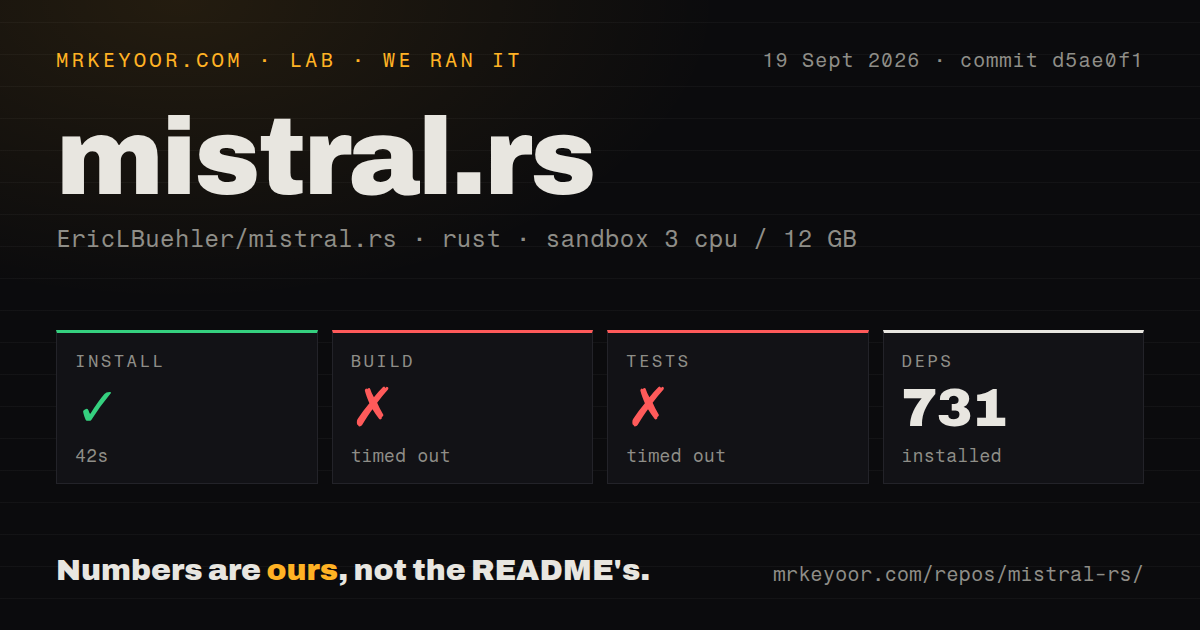
Our clean Debian sandbox installed 731 Rust packages in 42 seconds, but the build did not finish within 900 seconds. The checkout contained 1,885 files and about 565,909 source lines before dependencies, so a long compile is believable without turning the timeout into a speed claim. The supplied log ended while Rust was still compiling workspace crates and dependencies. It did not show a compiler error.
The README's installer avoids that wait by downloading a self-contained binary when one exists, then falling back to a source build. Linux users can choose CPU or a CUDA build for their GPU; Apple Silicon gets Metal; the standard Windows route is CPU-only. Standard acceleration needs neither Rust nor a CUDA toolkit. Optional cuTile acceleration is different and requires NVIDIA's separately installed tileiras tool.
What happened when we ran it
Our run installed 731 packages in 42 seconds. The build timed out after 900 seconds, and the test command reached the same 900-second cap. Its final lines showed mistralrs, mistralrs-server-core, mimalloc, crossterm, and other crates still compiling. No test result appeared, so the honest result is a timeout, not a passing suite and not a failed assertion.
The repository itself was 59.6 MB at commit d5ae0f1, with 7 CI workflow files and a Dockerfile. Our scan found no top-level tests directory, though Cargo can keep tests beside source or elsewhere in a workspace. We did not download model weights or measure inference. Nothing in this run supports a claim about token speed, output quality, memory use during serving, or which accelerator performs best.
The supported list covers 45+ architectures, not every model on Hugging Face
The README points to 45+ supported model architectures and says the generated reference is the source of truth. Automatic loading detects architecture, weight format, and chat template for models the engine knows. That last condition matters. Issue 156 remains a model wishlist with unchecked families, so a repository name on Hugging Face does not guarantee that mistral.rs can load its configuration.
Model files also bring operational choices that a one-line quick start cannot settle. mistralrs tune recommends quantization and device mapping, while the runtime supports GGUF, UQFF, GPTQ, AWQ, HQQ, FP8, and other formats. Those are useful controls for fitting a model to real hardware. They also mean that a successful small-model demo says little about the larger model, precision, context length, or multi-GPU layout you plan to serve.
OpenAI and Anthropic compatibility still needs application-level checks
Version 0.9.3 serves both API styles and added more Anthropic Messages and Claude Code work. Compatibility is broad enough to reuse common clients, but open issue 2432 shows a concrete chat-template difference: pad_token is parsed yet missing from the rendering context. Issue 2431 reports ignored tojson options. Both had proposed fixes in active pull requests when we checked, which shows response rather than finished resolution.
Tool users have another sharp edge. Issue 2427 on reasoning-mode tool calls reports that a Qwen-style tool call can appear twice: once in the structured tool_calls field and again as raw tagged JSON in visible content. If an application executes tools or stores assistant messages, test streaming and non-streaming responses with the exact model and chat template. An API-compatible route cannot promise identical edge behavior by itself.
Seven CI workflows and a September release show active maintenance
GitHub recorded 7,704 stars and 384 open issues and pull requests when fetched on September 19, 2026. The combined count is not a bug total. Release v0.9.3 arrived on September 7, and the reviewed commit was pushed on September 8. Recent issues had matching fix pull requests for chat-template values and CPU quantization, while other reports covered projector discovery and reasoning-mode output.
This is active software with a wide surface, not a neglected experiment. That activity should make you more willing to trial it, but less willing to skip a release-specific acceptance test. Start with the binary, one model, and the same request shape your application will use. If that path passes, mistral.rs can replace several separate local runtimes. If you only need a text model behind one endpoint, llama.cpp, vLLM, or Ollama asks you to reason about fewer moving parts.