mrkeyoor.com_
Thu 01 Oct 21:37 UTC
Webevaluationupdated 01 Oct 2026

ming-official-atlas review

Ming Official Atlas is a Chinese-language interactive site for exploring Ming dynasty offices, officials, careers, era names, and administrative geography from 1368 to 1644. The README and deployment guide are in Simplified Chinese, and the README does not link an English guide.

Verdict

Our Ming Official Atlas run installed 572 packages and built in 22 seconds, but it had no test target and npm audit found 14 vulnerabilities. Use it as a Chinese-language reference experience or a digital-humanities case study after checking the historical provenance. Do not adopt it as a reusable production base until licensing is explicit, the dependency findings are resolved, and the private PHP/MySQL deployment can be reproduced.

We ran it

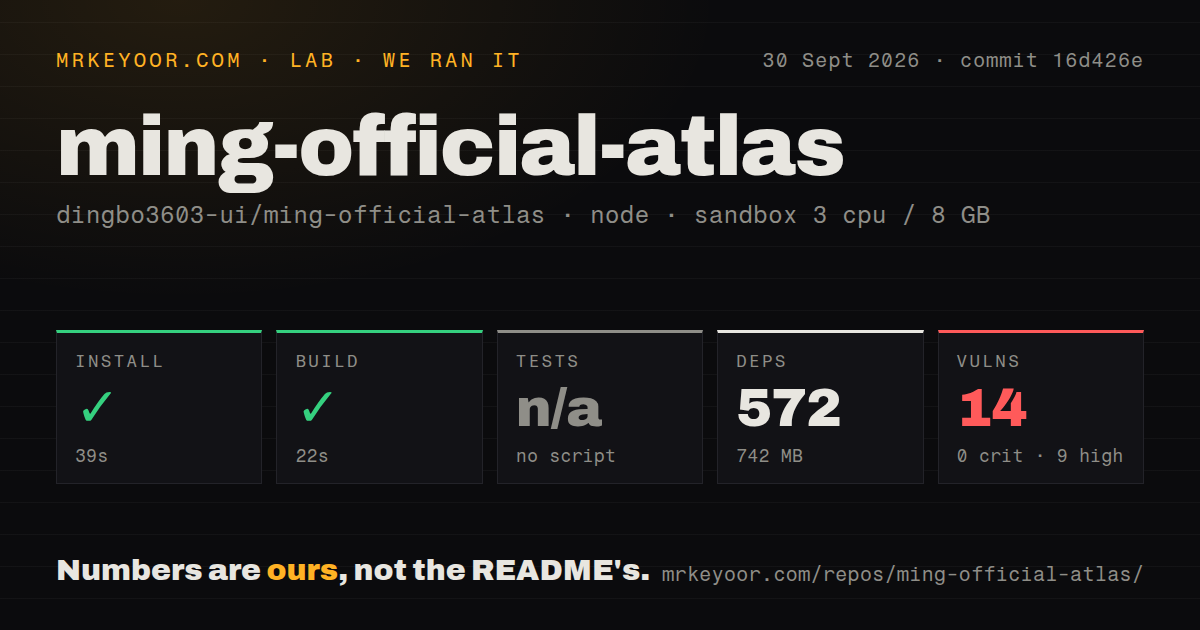
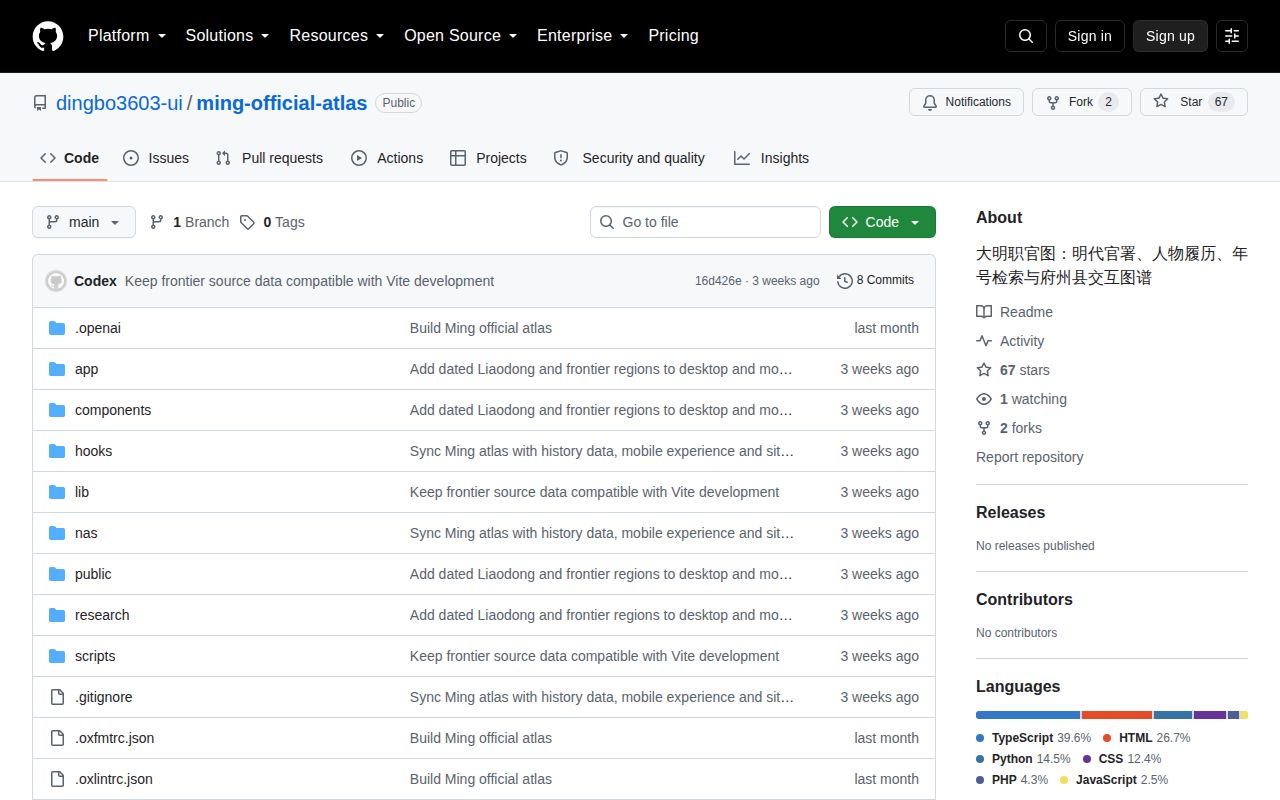
Lab card: what happened when we ran ming-official-atlasScreenshot of ming-official-atlas (github.com/dingbo3603-ui/ming-official-atlas)
Install✓ · 39s572 packages · 742 MB
Build✓ · 22s
Testsn/ano test script
Known vulns140 critical · 9 high · 4 moderate · 1 low (npm audit)
Repo786 files~15,476 lines of source · 321.6 MB · 0 CI workflows

Answers from our run

Does ming-official-atlas build from source?

Dependencies installed in 39 seconds (572 packages), and the build succeeded in 22 seconds. We cloned commit 16d426e into a clean Debian container with 3 CPUs and no project-specific setup.

Does ming-official-atlas have tests you can run?

Not through a standard command: the project exposes no test script or target that our harness could run.

Does ming-official-atlas have known vulnerabilities in its dependencies?

npm audit flagged 14 known advisories in the dependency tree at the time of our run.

Who should not use ming-official-atlas?

English-only users: the product and repository documentation are Chinese, with no English guide linked from the README.

What are the alternatives to ming-official-atlas?

OpenHistoricalMap, Wikidata Query Service, China Historical GIS. Our Ming Official Atlas run installed 572 packages and built in 22 seconds, but it had no test target and npm audit found 14 vulnerabilities.

Setup3/5Build passed, but 572 packages and a separate PHP/MySQL stack
Docs3/5Detailed Chinese operations notes with no English guide
Community2/567 stars with no public issue history
Maturity2/5No release, license, CI, or automated test target

Who it’s for

Chinese-reading students and history enthusiasts exploring Ming institutions by place and year.
Digital-humanities developers studying a React atlas backed by curated historical snapshots.
Museums or educators willing to audit the source data and build their own deployment boundary.
Maintainers comfortable operating a static front end alongside private PHP and MySQL services.

Who it’s NOT for

English-only users: the product and repository documentation are Chinese, with no English guide linked from the README.
Teams that need a turnkey container deployment: the repository has no Dockerfile, while production features depend on PHP 8.2, MySQL 8.0, and private host configuration.
Reusers who need clear redistribution terms: GitHub detects no license and the root has no license file.
Researchers seeking a complete yearly roster of Ming officials: the README says the historical material remains under correction and is not a full record.
Security teams that reject high-severity dependency findings: npm audit reported 14 known vulnerabilities, including 9 high severity.

Setup reality

Our sandbox installed commit 16d426e in 39 seconds, adding 572 packages and using 742 MB on disk. The build succeeded in 22 seconds. There was no test script or target, so tests were skipped. Npm audit reported 14 known vulnerabilities: 9 high, 4 moderate, and 1 low.

Local front-end work needs Node.js 22.13 or newer. The live history API, visit analytics, phone-number feedback, and admin area also need PHP 8.2, PDO MySQL, MySQL 8.0, private configuration, and valid HTTPS.

The deployment build writes dist-nas/ for a website root and is not arranged for a subdirectory. Our scan found no Dockerfile, no tests directory, and no CI workflow files. Several historical reconstruction tasks also depend on local source directories and database exports that are not in the repository.

The 1368 to 1644 scope turns institutions into a browsable map

Ming Official Atlas connects administrative geography, central offices, official titles, reign eras, and individual careers across the Ming dynasty. The default year is 1566, but readers can move through the 1368 to 1644 range and see names change with the selected year. Provinces lead to prefectures and counties, while court and local-office scenes offer another route into the same material.

The interface has separate desktop and mobile compositions. Search covers people and offices, biography panels show appointments and sources, and the phone layout uses its own navigation and full-screen reading panels. That care makes this more than a map with pins. It is an editorial model of how a reader might enter a dense institutional history by year, place, person, or office.

The README also states a firm limit: the collected people, careers, and offices are still being corrected and do not form a complete annual roster of Ming officials. Source uncertainty is retained, and fiction is not substituted for historical evidence. Researchers should therefore treat the atlas as a navigational aid whose records still need source-level checking.

Our 572-package install built, with no test target to run

Our sandbox installed commit 16d426e in 39 seconds, pulling 572 packages and occupying 742 MB. The production build completed in 22 seconds. The package had no test script or target, so we skipped tests rather than inventing a substitute command. Npm audit found 14 known vulnerabilities: 9 high, 4 moderate, and 1 low. Those findings need review before the code handles visitor or feedback data.

The repository itself was large for a focused atlas: 786 files, about 15,476 source lines, and a 321.6 MB checkout. Our scan found 0 CI workflow files, no Dockerfile, and no tests directory. A successful build shows that the front-end path is coherent at the measured commit. It does not provide regression coverage for year changes, geographic navigation, historical matching, or administrative access.

What happened when we ran it

Our run used an unprivileged Debian container with 3 CPUs, 8 GB of RAM, Node 22, and no secrets. Installation succeeded in 39 seconds and the build succeeded in 22 seconds. We did not run tests because the repository exposed no test target. We also did not connect MySQL, start PHP, submit a phone number, inspect the admin area, or deploy the generated files to a web host.

Npm audit reported 14 vulnerabilities across the 572 installed packages. The supplied result gives severity counts, not package names or exploit paths, so it would be wrong to call them reachable defects in the public site. It would also be wrong to ignore 9 high-severity findings. A maintainer should reproduce the audit, map each advisory to the built output or tooling path, and update without changing the historical interface.

Node 22.13 builds only the public half of the system

Local front-end work requires Node.js 22.13 or newer and starts a Vite server on port 5174. The versioned public snapshots let much of the history experience work from the repository. Visit tracking, feedback, the admin area, and live history services add PHP 8.2, PDO MySQL, MySQL 8.0, and configuration stored outside the web root. Development proxies those APIs through port 8088.

The deployment target is a website root populated from dist-nas/; the documented assets are not prepared for a nested path. Valid HTTPS is required for admin access and phone-number feedback. Private database settings, sessions, backups, visitor IP data, and feedback records stay outside the repository. That separation is sensible, but it means a Git clone cannot recreate the complete production system. Some historical rebuild scripts also rely on local raw sources and database exports.

The 67-star project has no license or release

GitHub showed 67 stars, no open issues or pull requests, and no releases when checked on October 1, 2026. The last push was September 9. That is recent activity from a project created two days earlier, but it leaves almost no public maintenance history. More importantly, GitHub detected no license and the repository root contains no license file. Public source does not automatically grant reuse rights.

The missing license changes the recommendation more than the visual polish does. You can study the architecture and browse the published material, but copying the code or redistributing a derivative needs permission or an explicit license. Combined with 14 audit findings, no automated test target, and production data that lives elsewhere, this is best approached as a reference atlas first. A reusable software platform would need clearer legal and operational foundations.

Alternatives

ProjectWhat it isPick it when
OpenHistoricalMapA collaborative map for placing historical features and boundaries on a shared timeline.pick this instead when broad geographic contribution matters more than a curated Ming-officials experience.
Wikidata Query ServiceA query service for exploring structured people, places, dates, and relationships in Wikidata.pick this instead when you need programmable cross-period data rather than a purpose-built atlas interface.
China Historical GISA research dataset and platform for historical Chinese administrative geography.pick this instead when scholarly GIS data matters more than offices, biographies, and scene-based browsing.

What people are saying

  1. [velocity-scout] dingbo3603-ui/ming-official-atlas

Sources

  1. Ming Official Atlas README
  2. Ming Official Atlas repository
  3. Ming Official Atlas deployment guide
  4. Historical data provenance

More web reviews

truanayangi · hit-and-run-web · RhineLabUI · clay-safari · javranking-extension · heroui · the whole board →