mrkeyoor.com_
Fri 18 Sept 19:11 UTC
Self-Hostedevaluationupdated 18 Sept 2026

Memoh review

Memoh is a self-hosted platform for AI agents that stay online after your laptop closes. Each bot can get a filesystem, desktop, browser, network, and saved memory, while users talk to it through the web or chat services. It can run its built-in agent or host Claude Code and Codex inside managed workspaces.

Verdict

Our Memoh run installed 1,050 packages and used 1,144 MB, then 1,959 of 1,968 tests passed, so the platform is active and substantial but not clean at commit 8603825. Try it when an agent genuinely needs a persistent computer, messaging access, and memory under one self-hosted control plane. Skip it for a simple chatbot or coding assistant, and do not put it on a sensitive host until you accept the privileged workspace model and reproduce the open browser and storage paths you need.

We ran it

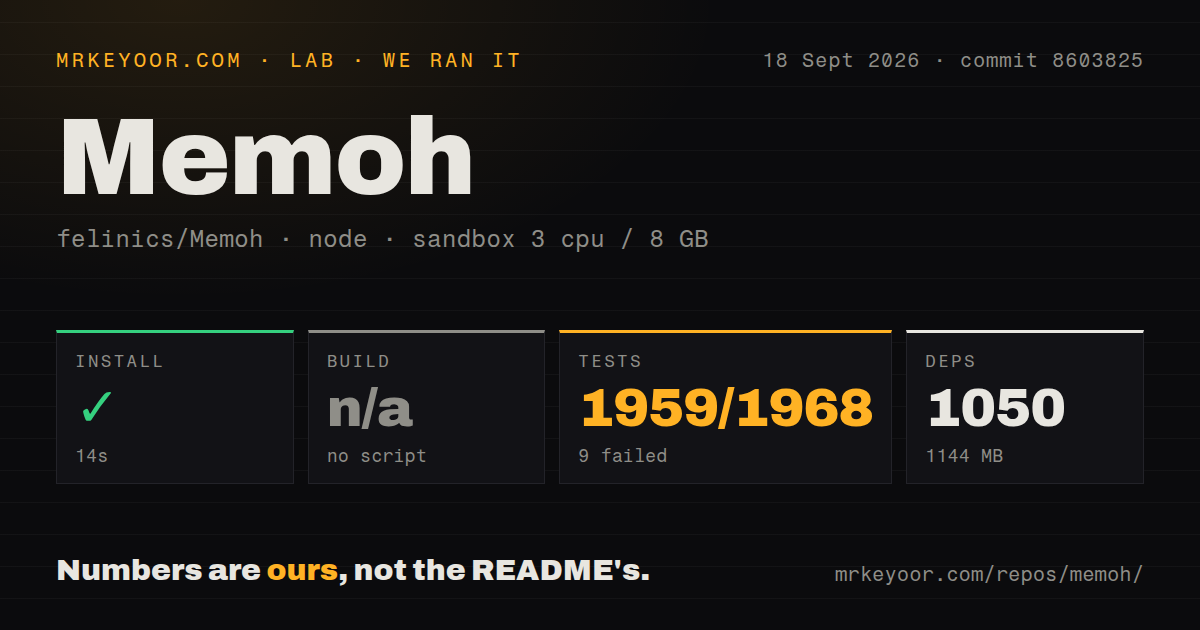
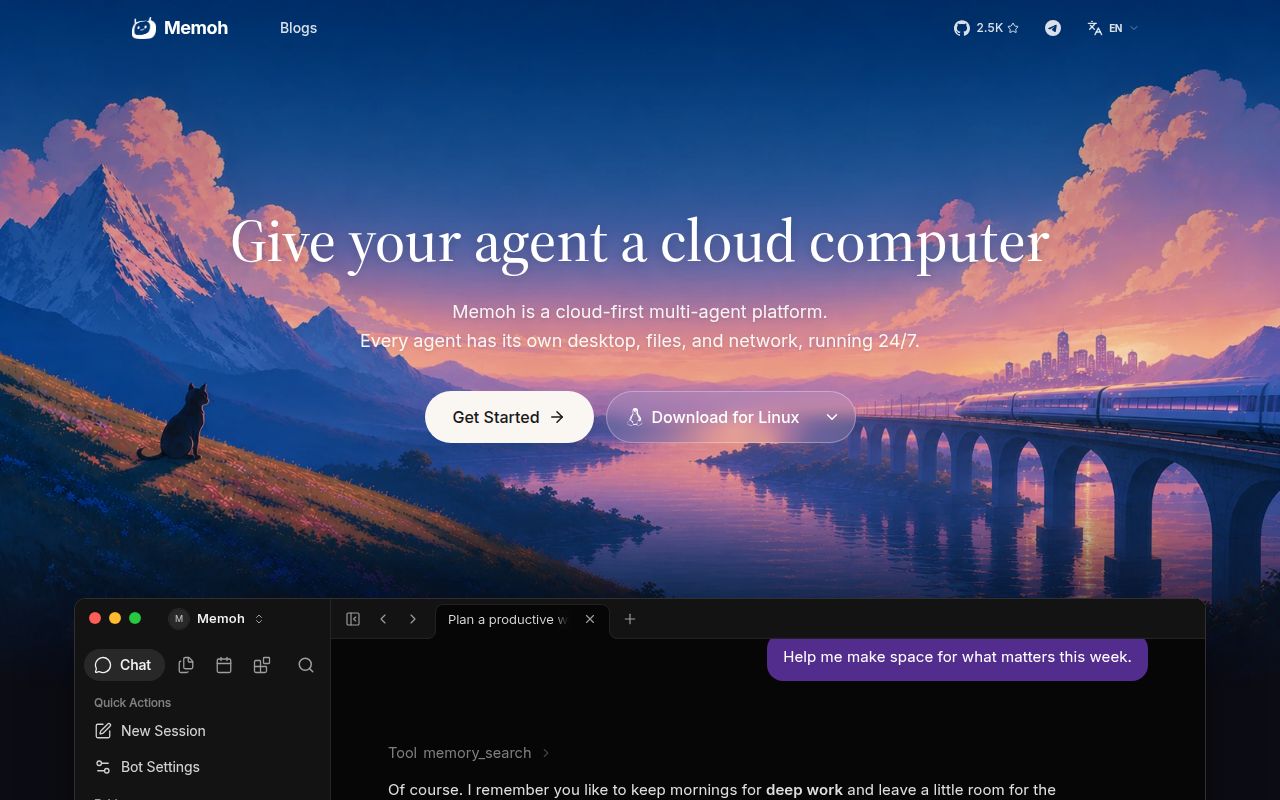
Lab card: what happened when we ran MemohScreenshot of Memoh (memoh.ai)
Install✓ · 14s1050 packages · 1144 MB
Buildn/ano build script
Tests✗ · 103s1959 passed · 9 failed of 1968 (vitest)
Repo4312 files~809,113 lines of source · 43.9 MB · 17 CI workflows · tests dir

Answers from our run

Does Memoh build from source?

Dependencies installed in 14 seconds (1050 packages), and the project has no separate build step. We cloned commit 8603825 into a clean Debian container with 3 CPUs and no project-specific setup.

Do Memoh's tests pass?

Not all of them: 1959 of 1968 passed and 9 failed when we ran the project's own test command (vitest). Some failures need services or credentials a bare container does not have.

Who should not use Memoh?

Hosts that prohibit privileged containers or host PID access: the standard Compose server requests both to manage bot workspaces.

What are the alternatives to Memoh?

OpenHands, Suna, Cua. Our Memoh run installed 1,050 packages and used 1,144 MB, then 1,959 of 1,968 tests passed, so the platform is active and substantial but not clean at commit 8603825.

Setup2/51,144 MB install plus a privileged six-service deployment
Docs4/5Deployment, secrets, backends, and update paths are documented
Community5/52,498 stars with same-day pushes and 26 open pull requests
Maturity3/5v0.20.0 moves fast; 9 tests and several workspace paths failed

Who it’s for

Teams that want an always-on agent with its own isolated computer rather than a chat window alone.
Self-hosters prepared to operate Docker Compose, databases, workspace images, secrets, and HTTPS.
Developers who want Claude Code or Codex reachable through a web UI and messaging channels.
Organizations that need several users or bots on one managed agent platform and accept AGPL-3.0 licensing.

Who it’s NOT for

Hosts that prohibit privileged containers or host PID access: the standard Compose server requests both to manage bot workspaces.
Teams requiring a clean repository test run before adoption: our Vitest run ended with 9 failures across desktop, Docker, and web projects.
Organizations that will not deploy AGPL-3.0 software or have not reviewed that license for their use.
Operators who depend on headed browser use on the reported Apple Silicon stack: open issue 1307 describes Chromium crashing after a workspace restart in v0.20.0.
Installations with strict workspace quotas and no tolerance for manual cleanup: issue 1303 reports deleted bots failing to release storage, preventing another bot from being created.

Setup reality

Our sandbox installed 1,050 pnpm packages in 14 seconds and used 1,144 MB. The repository had no generic build script or target, so build was skipped. Tests failed after 103 seconds: Vitest reported 1,959 passed and 9 failed out of 1,968, across 206 files.

Self-hosting needs Docker with Compose v2, Git, a generated config.toml, changed admin and database passwords, a JWT secret, and a shared internal RPC secret. Useful agents also need model credentials. Telegram, Discord, Lark, WeChat, email, webhooks, connectors, and external memory providers add their own keys or public endpoints.

The standard stack runs PostgreSQL, pgvector, migrations, server, channel, and web services. Its server is privileged and joins the host PID namespace to manage nested workspaces. The 43.9 MB checkout contained 4,312 files and about 809,113 source lines, 17 CI workflows, a Compose file, monorepo workspaces, and a tests directory, but no Dockerfile at the repository root.

Each bot gets its own computer and stays online

Memoh assigns a bot an isolated workspace with files, a desktop, browser access, networking, and saved memory. The server keeps that workspace available while your laptop is closed. You can use Memoh's built-in agent or put Claude Code and Codex inside the managed environment, then reach the bot from the web or a supported chat service. That is a larger promise than a self-hosted chat page.

The repository matches that scope. commit 8603825 contained 4,312 files, about 809,113 source lines, and a 43.9 MB checkout before dependencies. It mixes Go services with pnpm workspaces for web, desktop, SDK, configuration, and runtime packages. Our scan found 17 CI workflow files, a tests directory, and Compose configuration. There was no Dockerfile at the repository root, though Dockerfiles live under the project's deployment directories.

The one-line installer starts six core services and a privileged server

The README offers curl -fsSL https://memoh.sh | sh, and the script generates configuration before starting Docker Compose. Under that short command sits a current base file with PostgreSQL, pgvector, a migration job, server, channel, and web services. The server runs privileged and joins the host PID namespace so it can operate nested workspaces. Memoh's own deployment guide says to use it only in a trusted environment.

Production setup needs more than accepting installer defaults. The guide tells operators to replace the admin password, JWT secret, PostgreSQL password, and shared internal RPC secret, then add HTTPS, firewall rules, resource limits, and backups. The server's default memory ceiling is 8 GB. Model providers and chat channels bring more credentials. The 1,144 MB installed pnpm tree from our run covers repository development, not container images, databases, or bot workspace images.

What happened when we ran it

Our sandbox installed 1,050 pnpm packages in 14 seconds and occupied 1,144 MB. The root package had no generic build script or target, so the lab skipped that step rather than substituting a different command. The checkout had monorepo workspaces and a tests directory. These measurements describe commit 8603825 in an unprivileged Debian container with 3 CPUs and 8 GB of RAM.

Vitest ran for 103 seconds and exited 1. It reported 1,959 passing tests and 9 failures out of 1,968, with 200 passing files and 6 failed files out of 206. The summary attributes 5 failures to desktop/src/shared/server-connection.test.ts, 3 to docker/server-entrypoint.test.ts, and 1 to web/src/lib/ui-icon-contract.test.ts. The supplied tail has no assertion details, so it does not establish a shared cause.

Workspace isolation requires broad host authority

Giving each bot a computer explains the privileged server, nested containerd data, CNI state, host PID visibility, workspace images, and exposed WebRTC port. It also changes the threat model. An ordinary web application can often run with a narrow container profile. Memoh's main service manages the environments where agents execute commands and browse, so host placement, image trust, network egress, secret scope, and deletion behavior all need review before outside users can create bots.

Two open v0.20.0 reports show where that machinery can hurt. Issue 1301 reproduces a first workspace-image pull exceeding 5 minutes and leaving a bot stuck in creating, without a workspace or an enabled retry control. Issue 1307 reports headed Chromium crashing after restart on an Apple Silicon setup, which leaves the browser CDP endpoint unreachable. Across a 4,312-file system, those paths deserve live acceptance tests rather than a successful login page.

Memory and chat channels turn a bot into an ongoing service

Memoh can keep context across sessions and route conversations through Telegram, Discord, Lark, WeChat, the web, email, and webhooks. Its pgvector service supports semantic memory search, while external Mem0 and OpenViking providers are also documented. MCP tools and a connector gateway expand what an agent can reach. Version 0.20.0 adds direct Codex runtime work, Claude Code session controls, encrypted agent credential storage, and app authorization changes.

Every connection adds state that outlives one chat. The Compose deployment splits the server and channel runtime with a shared secret, and provider or channel tokens must be rotated on their own schedules. Remote computers use a Node runtime enrollment key saved under the user's home directory. With 1,050 packages in the development install and separate container images in production, upgrades should include database backups, credential checks, workspace creation, channel delivery, and a real agent turn.

September activity is fast, and 39 issues remain open

GitHub recorded 2,498 stars and a September 18, 2026 push when checked. Release v0.20.0 arrived on September 15. The tracker contained 39 open issues and 26 open pull requests, rather than the combined count GitHub shows on the repository header. Several fixes for ACP startup, Claude Code MCP results, desktop reconnection, and model persistence closed on September 18, which shows active maintenance around reported failures.

Fast maintenance also means operators are adopting a moving system. Open reports cover quota release after bot deletion, workspace creation timeouts, browser startup, and image routing. Our run's 9 failed tests add another reason to trial a pinned release before putting durable work inside it. Create one expendable bot, reboot the stack, reconnect its channels, exercise browser use, delete it, and confirm storage is reclaimed. Those checks test the parts that make Memoh different.

Alternatives

ProjectWhat it isPick it when
OpenHands gh↗A platform focused on software-development agents working in isolated environments.pick this instead when coding tasks are the main job and messaging-channel bots or general personal assistants are secondary.
Suna gh↗A self-hosted AI management system with browser, research, files, and automation tools.pick this instead when you want a general web-based assistant and prefer its task model over per-bot computers.
Cua gh↗Infrastructure and drivers for computer-use agents across desktop environments.pick this instead when desktop control, evaluation, or computer-use fleets matter more than chat channels and long-term memory.
Dify gh↗A self-hosted builder for agent workflows, retrieval pipelines, model routing, and applications.pick this instead when teams need governed workflows and knowledge apps rather than a persistent computer for each bot.

What people are saying

  1. [github-trending] felinics/Memoh

Sources

  1. Memoh repository
  2. Memoh v0.20.0 release
  3. Memoh deployment guide
  4. Memoh configuration reference
  5. Workspace image timeout report
  6. Workspace storage release report
  7. Workspace Chromium crash report
  8. Memoh remote runtime documentation

More self-hosted reviews

fleet · audiobookshelf · jitsi-meet · celld · EchoMuse · versitygw · the whole board →