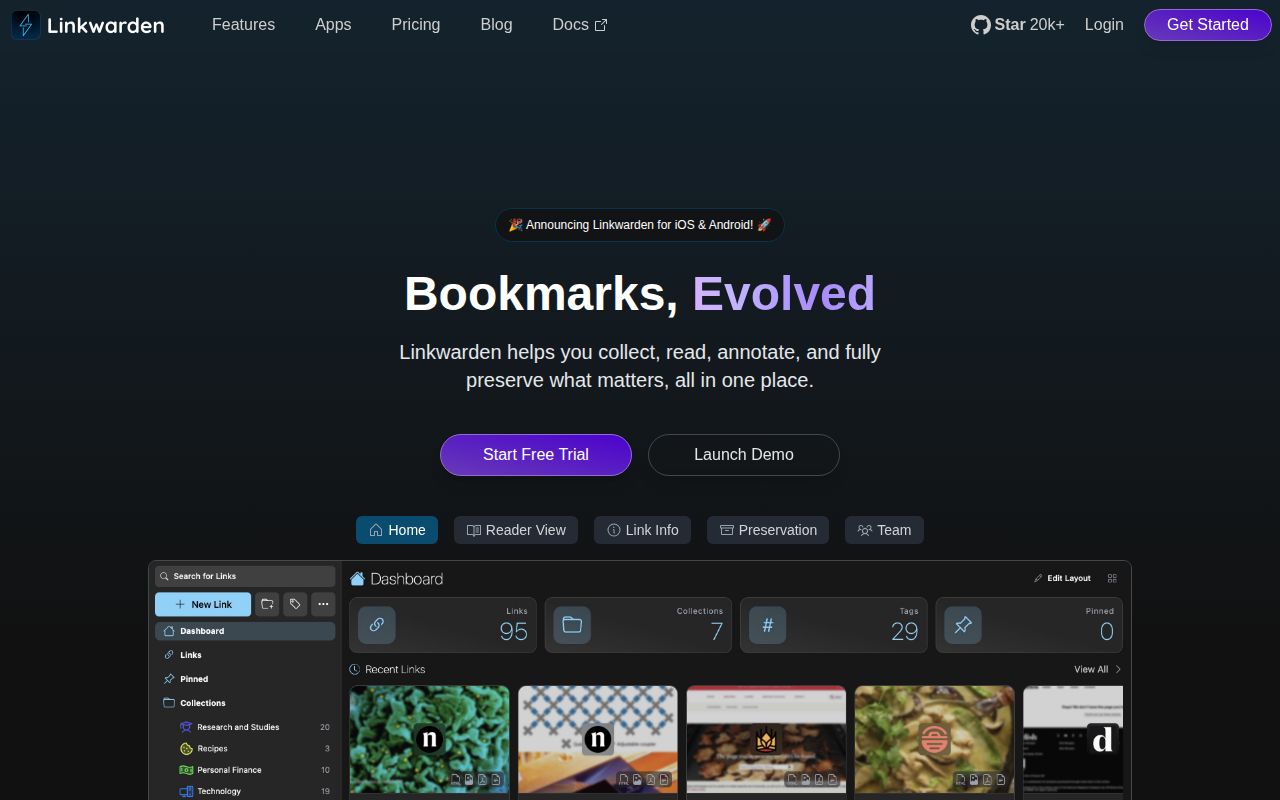
Saving a URL doesn't save the page behind it. Linkwarden's README documents screenshot, PDF and single-file HTML capture to keep a copy alongside the bookmark. That is a useful reason to consider it if you return to old references. Our installation stopped before we could check whether those copies were created.
Saved page copies are the reason to run this server
Linkwarden combines a reader with highlights and annotations, collections and configurable member permissions. For a small team gathering references, a collection can be both a reading list and a place to retain the material. The capture formats are documented capabilities, without a measured capture-success rate in this review.
Choose the pages for an evaluation before you import a whole library. Include the kinds of references you depend on, then open their saved formats and check that the content you need is present. A bookmark appearing in a collection proves less than a preserved page you can actually read. We didn't perform that check in this run.
The README lists local AI tagging as optional. You don't need to make an AI integration the reason to adopt Linkwarden. If preserving and sharing references is the job, settle whether those ordinary operations work for your collection before adding another service to manage.
What happened when we ran it
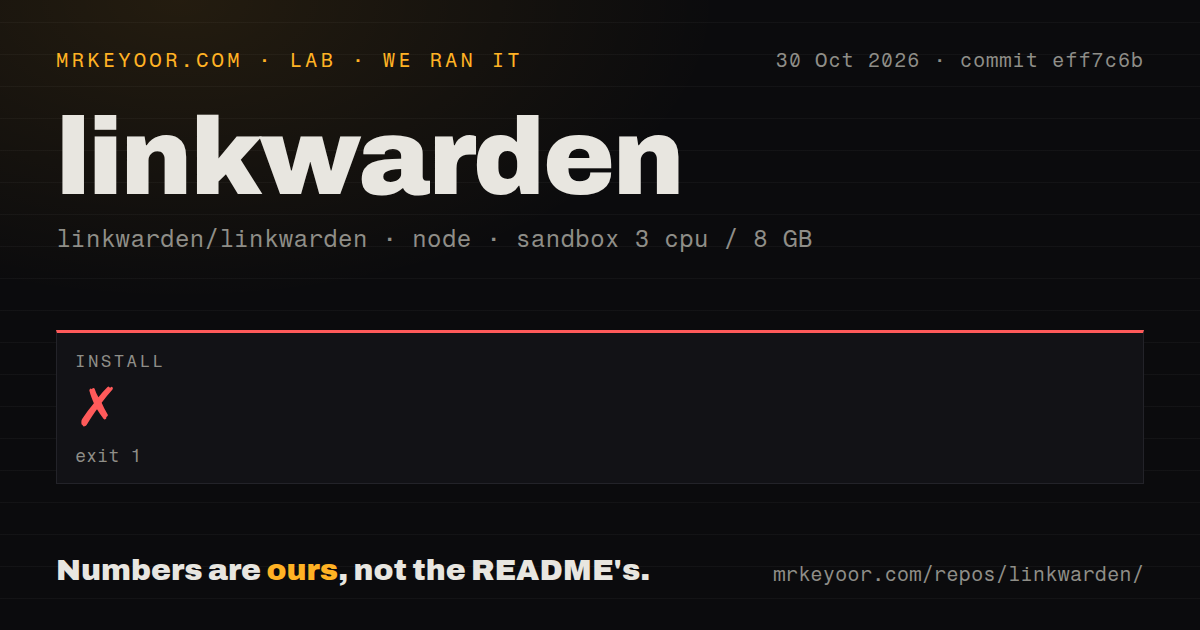
Our sandbox's Yarn install failed with exit 1 after 121 seconds at Linkwarden commit eff7c6b on October 30, 2026. Its tail reports failed browser installation for the root workspace and the web workspace. During the latter, the process announced that it was switching to root to install dependencies, then printed su: Authentication failure.
That is a specific installation obstacle. The tail doesn't explain why authentication failed, identify a missing system package or demonstrate that the browser could run afterward. It also doesn't show that the documented container route has the same problem. We can't infer a broken bookmarking product from this failed setup attempt.
No subsequent build, test or vulnerability-audit result is supplied. The checkout scan recorded 798 files, approximately 62,450 source lines and 10 MB, with 7 CI workflow files, a Dockerfile, a Compose file and workspaces. It detected no tests directory. That observation doesn't establish the absence of all project checks.
The recorded sandbox configuration was 3 CPUs, 8 GB RAM and image label lab-node:22. We don't have raw toolchain logs establishing the actual Node or operating-system version. Neither storage use after installation nor page-capture performance was measured, since installation didn't complete.
The documented deployment includes database and secret configuration
The project's public setup source offers Docker Compose and manual deployment. The manual route names PostgreSQL and Monolith alongside Node and Yarn with Corepack. That is enough to rule out treating this as a static bookmark page you can drop onto any web host.
The guide requires an authentication secret and database configuration, and tells you to change the authentication URL for a remote hostname. Its Compose instructions also require a search-service secret. Keep those deployment values under your control and plan recovery before importing a collection you can't replace. Those are proposed operating steps, not a backup procedure validated here.
Container deployment is a reasonable next evaluation route because the project documents it separately. It remains unmeasured in this review. Don't reuse our failed Yarn duration as an estimate of how long a container deployment takes or assume that a different route removes every browser requirement.
The mobile app still needs a Linkwarden account
The official mobile app requires an account on Linkwarden Cloud or a self-hosted instance, according to the README. If you want an independent app that stores everything only on your phone, that documented model is a reason to choose something else. Self-hosting means taking responsibility for an accessible service as well as installing a client.
For shared collections, test permissions with a second disposable account. Check the material visible to that account and to a public visitor before sharing sensitive references. Linkwarden documents member permissions and public sharing, but our failed install didn't verify either boundary.
Recent development leaves operating quality unassessed
GitHub records the last push as October 26, 2026, and the issue-and-PR listing includes updates into November. That is evidence of recent project activity. The combined open count includes PRs, so it doesn't describe a tally of confirmed defects, and this sample doesn't measure support responsiveness.
Our documentation rating is 3/5: usable deployment guidance whose routes remain unverified here. On this editorial scale, 1 means missing essential instructions, 3 means a usable route with material checks outstanding, and 5 requires independent verification of the relevant routes. Setup ease, community support and production maturity remain unassessed rather than receiving a penalty for missing evidence.
Karakeep broadens the library; Shiori offers binary packaging
Karakeep documents links, notes, images and PDFs with full-text and semantic search. Evaluate it if that mixed library is your main requirement. It also supports full-page archival, so the decision shouldn't assume Linkwarden is the only option that preserves pages.
Shiori is distributed as a single binary with command-line and web interfaces. It attempts readable-content extraction and offline archives where possible. Consider that packaging if it matches how you administer software, without assuming it has better capture reliability or a smaller measured footprint.
Before moving your library to Linkwarden, save representative pages and retrieve their preserved copies from the deployment you intend to keep. A successful capture and retrieval would answer the question that our installation failure leaves unresolved.