This is a native port, and you still supply the game
Melee PC takes the decompiled code for the NTSC-U 1.02 edition of Super Smash Bros. Melee and runs it through Aurora, a GameCube compatibility layer backed by WebGPU and SDL3. It is not an emulator package with a game inside. The repository contains no retail assets, and the launcher asks for your own disc image before it can play.
That distinction creates an unusual product. The port can add an F1 settings overlay, remappable gamepads, replacement music, Dolphin-format texture packs, widescreen fights, and native builds for desktop and mobile platforms. Yet the game modes and data still come from the supplied image. The README says every mode boots and plays, while its status table labels individual platform and networking paths as done, partial, or planned.
Version 0.2.2-beta is blunt about the intended audience: testing only, with crashes and missing features expected. This candor makes the project easier to evaluate. A beta label should not be treated as a ceremonial suffix when the same release notes call macOS experimental, list Android launch failures on some devices, and describe internet matchmaking across two NATs as unproven.
What happened when we ran it
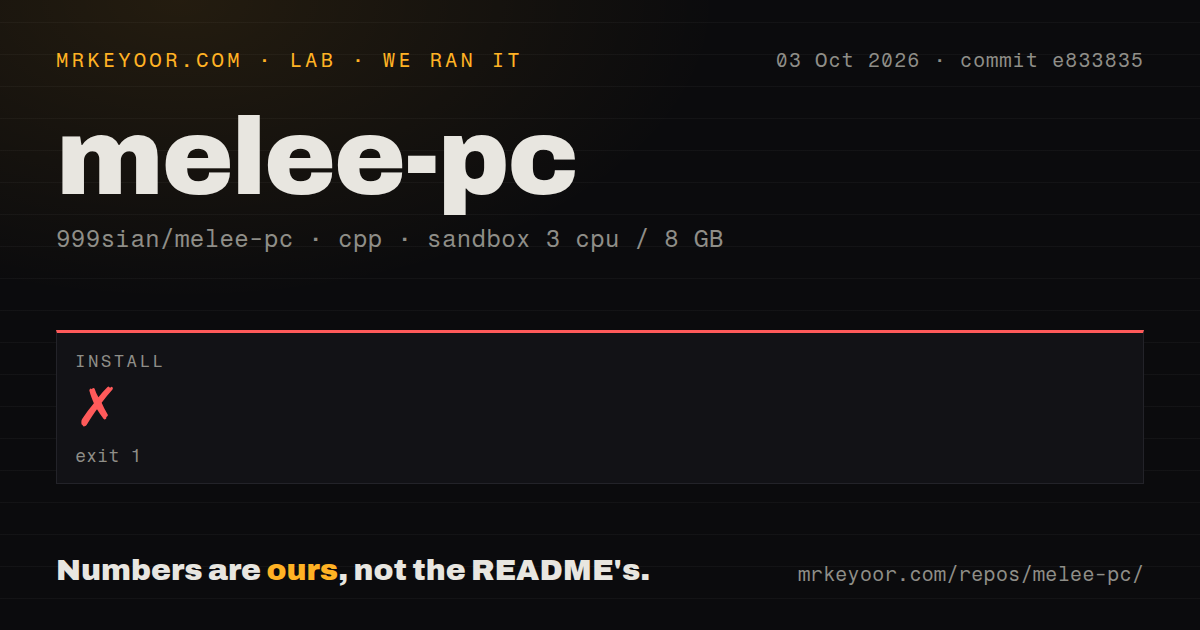
Our sandbox attempted to configure commit e833835 for 48 seconds, then the install step exited with code 1. The environment was an unprivileged container with 3 CPUs, 8 GB of RAM, and the project's C++ lab image. No secrets were present. Because configuration failed, there was no completed build, test run, package count, disk total, or vulnerability audit to report.
The tail of the log came from SDL's CMake configuration. It linked to SDL guidance for CMake builds without X11 or Wayland support, printed its camera drivers, and ended with Configuring incomplete, errors occurred. CMake named CMakeOutput.log and CMakeError.log for more detail. The provided tail does not identify one missing library, so assigning a specific package as the cause would be guesswork.
The repository is substantial: 2,919 files, roughly 703,401 lines of source, and a 36.6 MB checkout. It has 2 CI workflow files and a tests directory, but no Dockerfile under the lab's signal rule. Those signals show build machinery exists. They do not change the measured result: our fresh container never reached compilation or tests.
GCC and a desktop graphics stack are source-build requirements
The build guide requires GCC 12 or newer because the game reads big-endian disc structures through scalar_storage_order, an attribute Clang does not implement. CMake must be at least 3.25, and Ninja plus a Vulkan driver are also required.
Aurora fetches its own Dawn, SDL3, and nod components. The ordinary Linux commands look short, but SDL still has to find a usable windowing and graphics environment. That is where our container stopped. The project has a Containerfile that mirrors its Ubuntu 24.04 CI package list, though its documentation says the maintainer had verified that list rather than building the image on that workstation.
Platform builds add more branching. Android uses NDK r26, JDK 17, a GCC cross-compiler, and Rust for nod. macOS needs Homebrew GCC alongside Apple Clang. Windows builds are cross-compiled and package runtime DLLs. If your goal is to play rather than alter the port, the release artifacts avoid most of this toolchain.
The disc check is precise, while PAL support stays experimental
The supported image is Melee USA revision 2, identified as GALE01. The launcher reads compressed formats as well as raw images and compares the SHA-1 against the Redump database. It accepts ISO, GCM, CISO, and RVZ files. Verification is not cached between launches, and an unverified image can still run.
A PAL GALP01 image boots experimentally with USA code and English UK text, but the README says trophy tables are stubbed and no reference hash exists. PAL therefore always appears unverified. Anyone debugging gameplay should begin with the supported USA image, since an experimental data set adds another variable to a beta port. No disc contents are needed merely to compile the source.
Online play exists, but the README still calls it a prototype
LAN, direct friend codes, Unranked, and ranked best-of-three sets are implemented. Peers must use the same build and game image, and protocol 9 authenticates datagrams. The game can reconnect after a short link loss, while Slippi-format replay recording is available through MELEE_SLP_DIR.
The limits matter just as much. The README says only Linux x86-64 has played real matches, even though other platform paths are implemented. Broader two-NAT pairing, cross-platform gameplay, and live ranked acceptance remain unverified. A competitive player who mainly wants dependable matchmaking and replay review has a simpler choice in Slippi Launcher. Melee PC's online mode is currently a test surface.
Hardware coverage is wide on paper and uneven in evidence
Linux uses Vulkan 1.1. Windows tries Direct3D 12, then Direct3D 11 and Vulkan; macOS and iOS use Metal. Android needs arm64 and Vulkan 1.1. The browser build targets Chrome or Edge with WebGPU, accepts only a raw USA image, and omits online play and gamepad remapping. OpenGL is not an automatic fallback.
Several status rows carefully separate implementation from physical testing. Intel macOS builds can fail without blocking a release and have not run on Intel hardware. The 1000 Hz official GameCube adapter path is wired but was not confirmed against hardware in the README, and issue 77 reports it not working on one Linux setup. Issue 59 reports an Android device closing before the launcher appears.
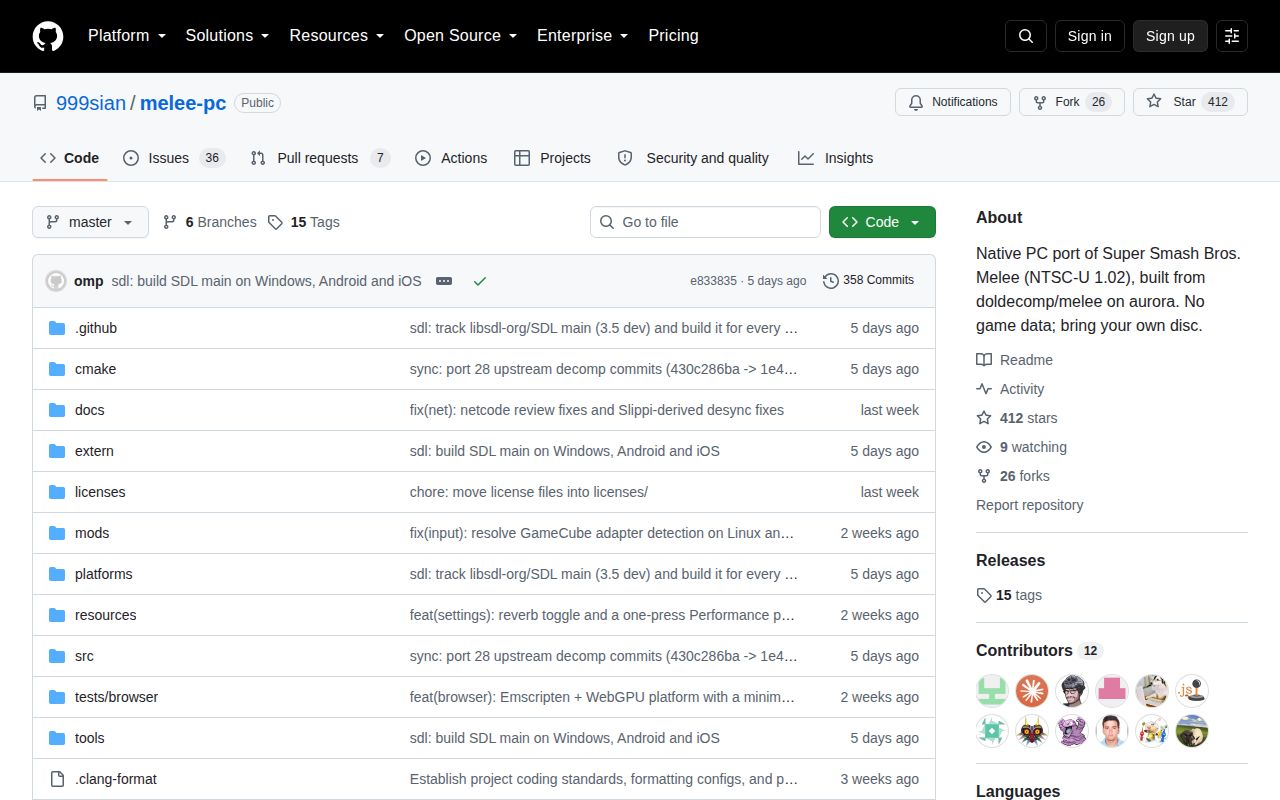
GitHub showed 412 stars, 43 combined issues and pull requests, and a September 29, 2026 push. The v0.2.2-beta release arrived four days earlier, with detailed fixes and known issues. That activity supports continued testing, not a claim of finished compatibility. The project is exciting precisely because it is doing hard, visible porting work. Its own evidence says you should keep another way to play Melee while helping it mature.