Nine tools cover one temporary-number workflow
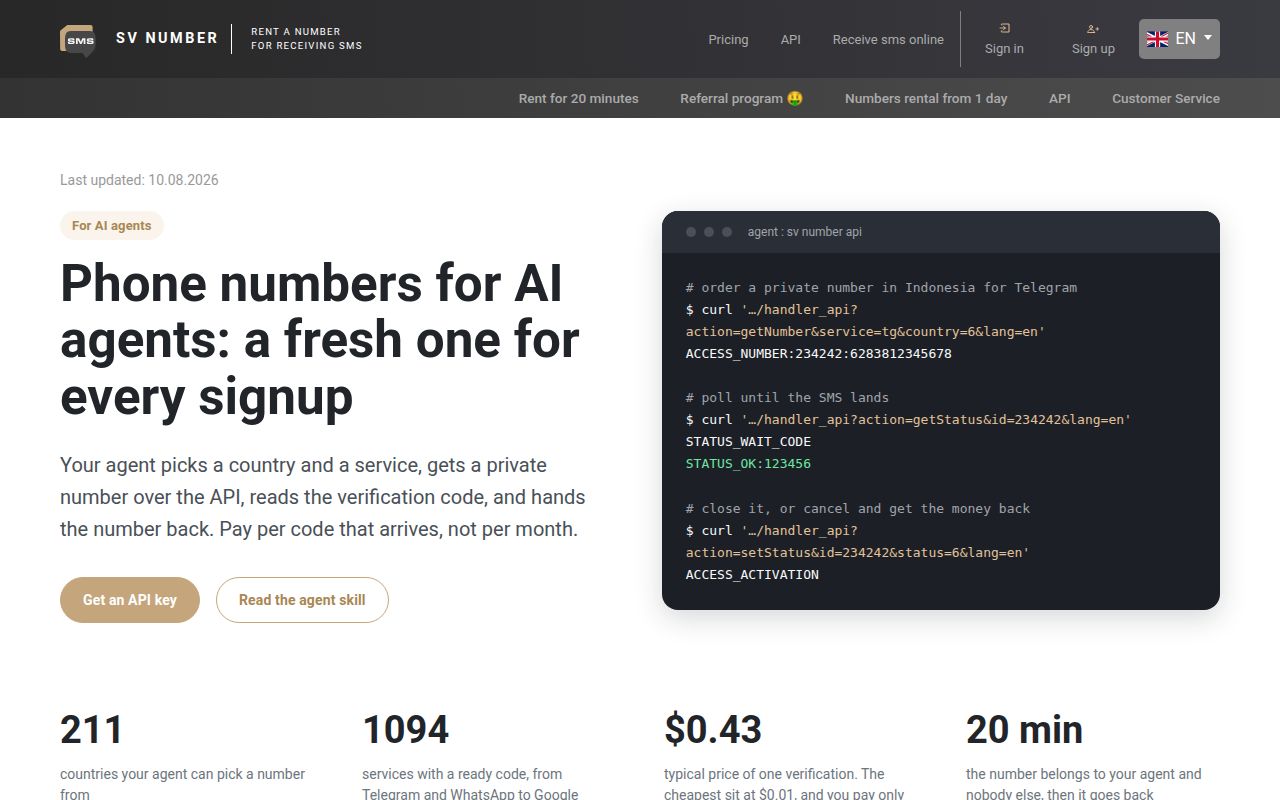
SV Number MCP Server lets a compatible agent check account balance, list countries, find a target service, order a number, wait for a code, request another message, finish the activation, or cancel it. A ninth tool computes an RFC 6238 TOTP code locally. That scope is easy to understand: the server is an adapter for short-lived verification, not a telephone platform.
The README draws useful boundaries. These numbers receive verification texts but cannot send SMS or accept calls. They are not intended for banking, payment, or government accounts. A permanent identity, customer-support number, sales conversation, or account-recovery line belongs with a carrier product. The code is MIT licensed, while inventory and delivery depend on the commercial sms-verification-number.com service.
Service lookup reduces expensive guessing
Temporary-number APIs use terse country IDs and service codes that an agent can misremember. list_services accepts a name or URL, ranks whole words above substrings, and returns price, live inventory, and delivery percentage when statistics exist. The README gives a sharp warning: codes are arbitrary, so uk means Airbnb, re means Coinbase, and tn means LinkedIn. The agent must query rather than infer.
The server translates upstream text markers before parsing. NO_NUMBERS, for example, becomes advice to change country or allow any operator. Polling defaults to every 4 seconds and stops at the number's 20-minute lifetime. Each call includes the configured language because leaving it out can change the currency used for prices. These choices prevent several avoidable failures, but they cannot force inventory or make a destination accept rented numbers.
Delivery data has a specific limitation. deliveredPercent can be null, and the README says that is common for country-service pairs without statistics. Current online inventory becomes the next signal, not proof that a code will arrive. A workflow should set a maximum acceptable price, cancel unsuccessful activations where refunds apply, and stop after a defined number of attempts.
What happened when we ran it
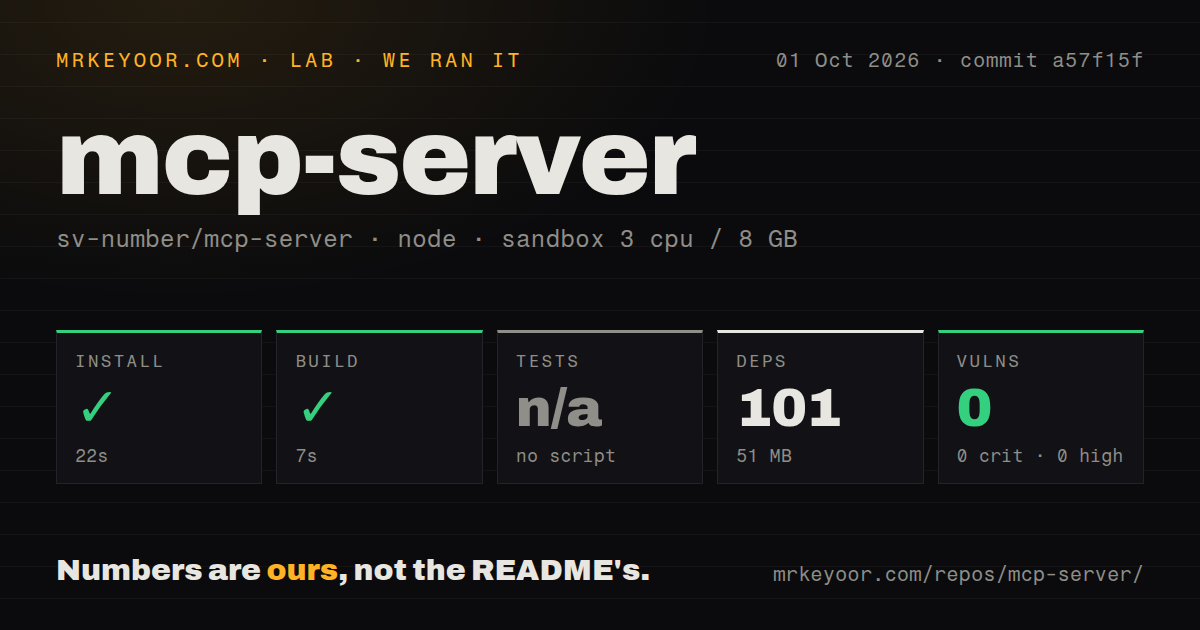
Our sandbox installed 101 npm packages in 65 seconds at commit a57f15f. Dependencies occupied 51 MB, and the build succeeded in 13 seconds. There was no npm test script or other test target, so we skipped tests instead of calling the build a test. Npm audit reported 0 known vulnerabilities across the installed dependency tree.
The checkout was small: 14 files, about 429 source lines, and 0.1 MB before installation. Our scan found a Dockerfile but no CI workflow and no tests directory. The run used a fresh unprivileged Debian container with Node 22, 3 CPUs, 8 GB of RAM, and no secrets. We did not fund an account, order a number, or receive an SMS.
Those measurements make code inspection cheap. They do not establish delivery rates, country coverage, refund behavior, or compatibility with every MCP client. The README claims more than 200 countries and tells users to verify the count with list_countries; our no-secret sandbox did not make that paid-service call, so we treat the figure as the project's documented scope rather than our measurement.
One command installs it, then every order costs money
Claude Code can add the server with one claude mcp add command. Codex, Cursor, Claude Desktop, and other JSON-configured clients start npx -y sv-number-mcp and pass SVN_API_KEY in the environment. Package metadata requires Node 18 or newer. Optional settings change the API base URL, language, or polling interval. There is no database or dashboard to deploy.
The account setup is the real entry point. A user must register, obtain a key, and add money because the API has no free tier. The server says it does not return the key or quote it in errors. The calling agent can still spend the linked balance and receive sensitive authentication messages, so environment isolation alone is insufficient. Limit which workflows can invoke order_number, and require approval for new services or countries.
Logs need similar care. Record the service, country, decision, price, activation outcome, and cancellation without retaining the received code or full phone number longer than necessary. The locally generated TOTP tool keeps its calculation away from the number provider, but its seed remains a credential and should not sit in a broad agent context.
No release or issue history limits confidence
GitHub showed 559 stars, 0 combined issues and pull requests, and a last push on August 10, 2026. The latest-release endpoint returned no release. An empty tracker does not mean the connector has no bugs, especially when there is no public test target or CI workflow. Pin the npm version and repository commit used in a trial rather than assuming a moving package is equivalent.
The documentation is better than the maintenance history. It describes all 9 tools, service matching, error translation, configuration, polling, commercial limits, and unsuitable account types. That is enough for a supervised proof of concept. Production use should add contract tests with a funded test account, spending caps, explicit target policies, and a manual fallback when inventory or delivery fails.
Use it for supervised verification, not phone identity
SV Number MCP Server makes a cramped provider API easier for an agent to use correctly. The 13-second build and 0 audit findings make the package straightforward to inspect, while the missing test target and public issue history keep confidence modest. Its value depends on whether temporary rented numbers are appropriate for the target service and authorized for the person operating the workflow.
Start with one approved service and country, a small balance, and human confirmation before ordering. Measure cancellation and delivery outcomes on your own workload. If the number must survive past 20 minutes, send messages, accept calls, or support account recovery, stop here and use a permanent programmable-number provider.