The first 4 modules form the useful beginner course
MCP for Beginners starts with the client-server idea, protocol primitives, security, and a first server and client. Module 3 then adds language-specific samples, VS Code integration, stdio and HTTP transports, testing, deployment, simple authorization, host configuration, the MCP Inspector, sampling, and MCP Apps. A new learner can stop there with a reasonable mental model and one working implementation.
The repository keeps going through modules 4 to 12. Those sections cover pagination, multimodal output, OAuth, routing, scaling, web search, Entra ID, custom transports, protocol features, case studies, a Foundry workshop, PostgreSQL labs, and Copilot tooling. That breadth makes the project useful as a reference shelf, but weakens the promise of a single beginner path. Choose one language and one use case before downloading dependencies.
Six programming languages make comparison possible and setup uneven
Basic calculator servers are provided in C#, Java, JavaScript, Python, TypeScript, and Rust. Advanced samples again branch across several stacks. Seeing the same concepts in two languages can reveal what belongs to MCP and what belongs to an SDK. It also means commands, package managers, environment files, model clients, and error behavior vary between lessons. There is no one root command that proves every sample works.
The course's June 2026 changelog records targeted validation for TypeScript and Python first-server samples, dependency updates across 15 npm lockfiles, and audits of selected Python requirements. That maintenance work is specific and useful. It is not a substitute for a repository-wide executable curriculum test. Our own measured slice found a build path in 05-AdvancedTopics, but no test target to run after it.
What happened when we ran it
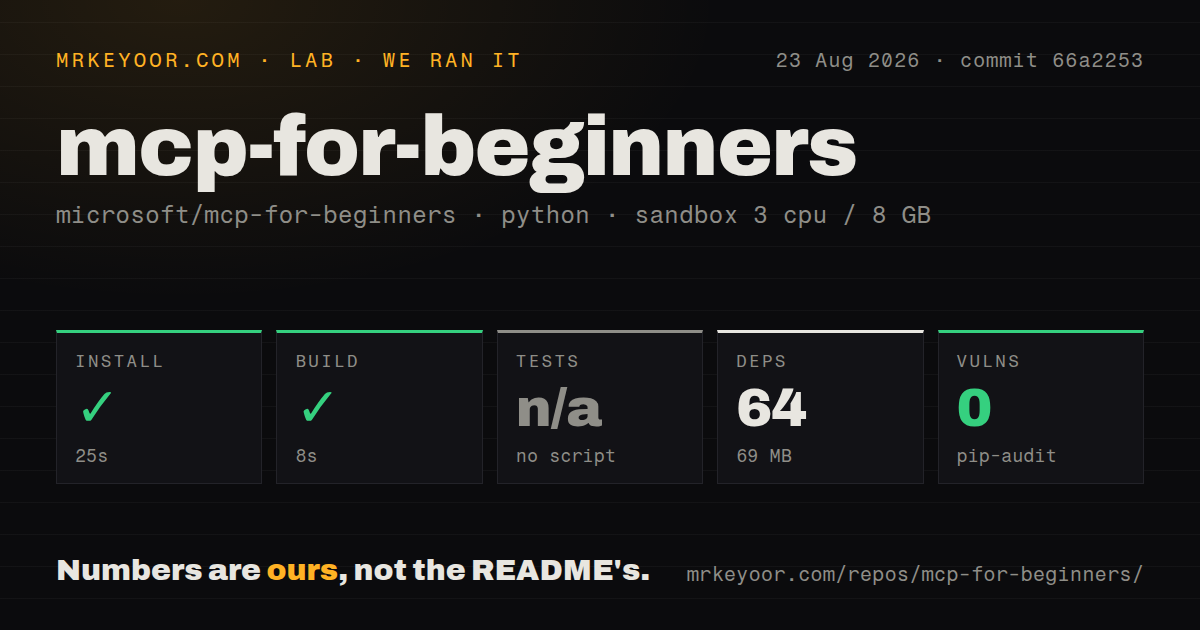
Our sandbox installed 64 Python packages in 25 seconds for the project under 05-AdvancedTopics. The installed environment used 69 MB, and its build succeeded in 8 seconds on 3 CPUs with 8 GB of RAM. Pip-audit reported 0 known vulnerabilities in that measured Python dependency set. No install or compiler error appeared in the supplied results.
The project exposed no test script or target, so the harness skipped tests. There is no passing or failing test count to infer. commit 66a2253 contained 13,732 files, roughly 11,070 source lines by the lab's source counter, and occupied 445.9 MB. The scan found 0 CI workflow files, no Dockerfile, and no tests directory.
The large checkout includes more than 50 translated editions and translated images. Microsoft documents Git sparse-checkout commands that retain the English course while omitting translations and translated_images. Our 445.9 MB figure applies to the full measured checkout, so a sparse learner can avoid much of that transfer. The 69 MB environment applies only to the advanced Python slice, not C#, Java, JavaScript, TypeScript, Rust, PostgreSQL, or Azure labs.
Security appears early and names the dangerous patterns
Module 2 discusses prompt injection, tool poisoning, session hijacking, confused-deputy attacks, token passthrough, excessive permission, and supply-chain risk. It states that an MCP server must reject tokens not issued for that server and explains why passing an upstream token through breaks audience checks and audit boundaries. The material also maps threats to identity, secret storage, content filtering, network controls, and monitoring.
Much of the advanced security advice uses Microsoft's stack, including Entra ID, Key Vault, API Management, Prompt Shields, and Azure monitoring. That is useful for an Azure team and still teaches transferable threat models. A reader on another cloud will need to translate the product choices. The curriculum links the official MCP security guidance and an OWASP-oriented Azure guide, so protocol requirements can be separated from Microsoft implementation examples.
The specification timeline needs a fresh consistency pass
The main README labels MCP 2025-11-25 as the stable baseline and says a 2026-07-28 release candidate is scheduled to ship on July 28. The changelog has a July 29 entry saying a reliability lesson is aligned with the final 2026-07-28 specification. Advanced modules also retain forward-looking release-candidate callouts. Those statements describe different stages of the same protocol update and should not be read as one current status.
This matters because the course says the newer version changes transport state, authorization, extensions, and the status of Roots, Sampling, and Logging. A learner can still use the dated chapters to understand evolution. Before implementing those details, open the official specification version named by the lesson and confirm the SDK version in that sample. Educational prose ages faster than a protocol's canonical schema and requirement language.
Advanced labs require services the Markdown cannot provide
The 13-part database path uses PostgreSQL, row-level security, authentication, Docker, Azure resources, vector embeddings, pgvector, monitoring, and deployment. Web-search lessons can require SerpAPI. LLM clients need a model provider. Enterprise identity sections need tenant and application configuration. These are real dependencies, not optional polish, and a student can spend more time on cloud setup than MCP if they choose the capstone too early.
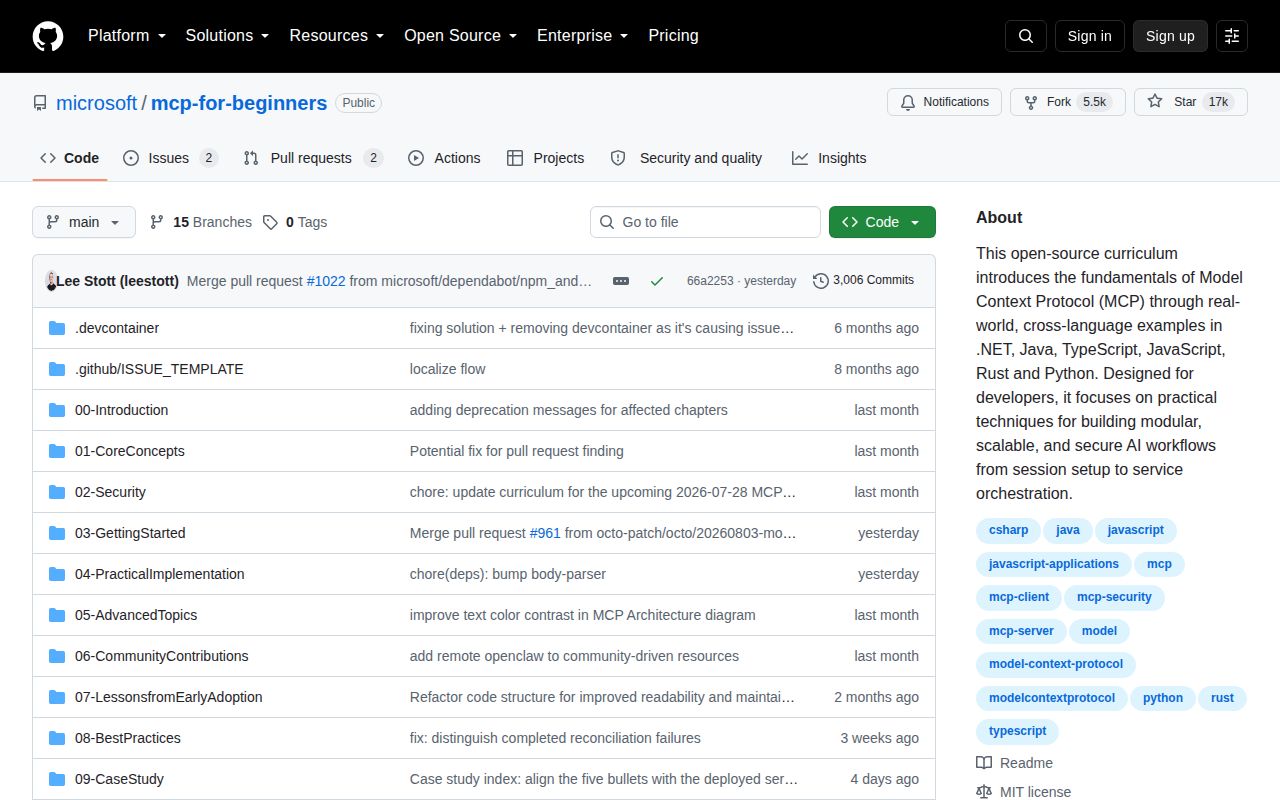
GitHub recorded 17,089 stars, 2 combined issues and pull requests, and a source push on August 26, 2026. There was no latest release tag. Recent source activity and the detailed changelog support continued use, while the tiny open queue should not be read as a count of every curriculum error. Start with the English sparse checkout, select one SDK, run its local examples, and consult official MCP pages whenever a lesson makes a version-sensitive claim.