Seven servers teach the protocol rather than fill a catalog
The repository currently names Everything, Fetch, Filesystem, Git, Memory, Sequential Thinking, and Time as reference servers. Together they show MCP's three main surfaces: tools a model can call, resources it can read, and prompts a client can expose. Everything is a test fixture, while the others demonstrate a recognizable capability.
That distinction changes the recommendation. A reference Filesystem server can demonstrate allowed directories and file operations without becoming the right file-access policy for a company. A Memory server can show persistent graph operations without supplying backups, quotas, encryption, or recovery. The maintainers put a warning near the top: these projects are educational examples, and deployers must evaluate security requirements and add safeguards for their own threat model.
The 145-file workspace built in 18 seconds
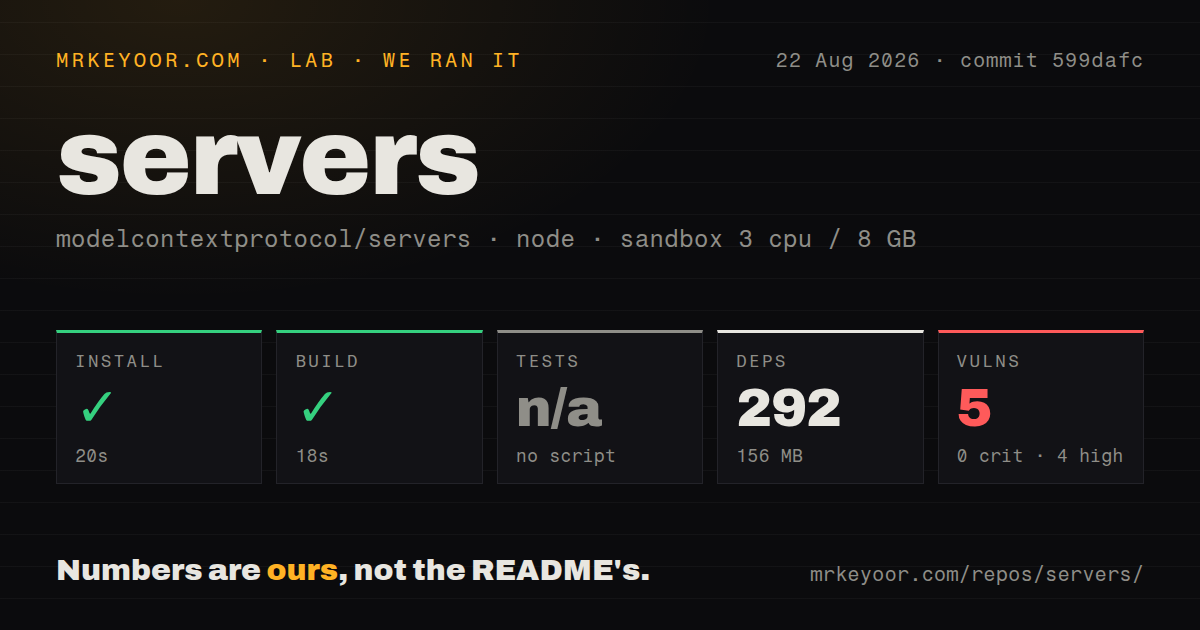
We cloned commit 599dafc into an unprivileged Node 22 Debian container with 3 CPUs, 8 GB of RAM, and no secrets. The checkout had 145 files, roughly 15,036 source lines, and occupied 1.4 MB. Installing 292 npm packages took 20 seconds and used 156 MB. The monorepo build succeeded in 18 seconds. Five CI workflow files were present, but no Dockerfile or tests directory was found.
The JavaScript examples can run through npx, while Git and Fetch have Python distributions usable through uvx or pip. A client configuration supplies the command and arguments. On Windows, the README wraps npx with cmd /c. Starting a process is easy; deciding which directories, repository, network targets, and persisted files it may touch is the larger job.
What happened when we ran it
Our install and build both passed, taking 20 seconds and 18 seconds respectively. No tests script or target existed, so we skipped tests rather than reporting a pass. That absence matters in a repository intended to demonstrate protocol behavior: consumers cannot use one top-level command to verify the examples against their current Node environment. A client or SDK author should add its own protocol-level checks for initialization, discovery, valid calls, invalid arguments, cancellation, and shutdown.
Npm audit reported 5 known vulnerabilities in the installed tree: 4 high and 1 moderate, with no critical or low advisories. The measurement does not identify exploitability in each reference server, and an advisory count is not proof of a reachable attack. It is still a release gate for any team copying this code into a service. Resolve or assess every advisory against the package path and enabled capability before exposing tools to a model.
File and memory tools need stronger operational boundaries
MCP lets a model request actions through typed schemas, but the server remains responsible for enforcing authority. Filesystem takes configured allowed directories, which is a useful first boundary. Production policy may also need read-only modes, path and file-size limits, extension restrictions, audit logs, per-user roots, symlink handling, and confirmation for writes or moves. Prompt injection can influence the model's requested arguments, so a model instruction is not an access-control rule.
Issue 4614 reports that Memory writes its complete graph directly to one file rather than writing a temporary file and renaming it. The reporter argues that interruption during the write can leave partial state. Issue 4117 asks for safer persistence defaults, quotas, redaction, backups, and destructive-operation guards. These are concrete gaps for long-lived use. An educational memory example is fine for learning; a valuable organizational memory store needs storage engineering around it.
Tool schemas can disagree with runtime behavior
An MCP client relies on advertised schemas to decide which arguments are required and how to construct a call. Issue 4651 reports that Sequential Thinking omits nextThoughtNeeded from the schema's required list while runtime validation still requires it. A client following the schema receives an invalid-arguments error. This type of mismatch is precisely why reference packages need consumer tests even when they build successfully.
Fetch has a separate limit. Issue 4448 reports a hardcoded 30-second request timeout with no command, environment, or per-call override. A fixed bound is safer than an unlimited request, yet one value cannot suit quick health checks and slow large files. A production fetch tool also needs rules for private network addresses, redirects, response size, content types, credentials, and untrusted page text. The example does not promise to settle that policy.
Archived servers make old configuration snippets risky
The README lists 13 archived servers, including GitHub, PostgreSQL, Slack, Redis, Google Drive, and Puppeteer. Some moved to official or external maintainers; others live in a separate archive. The same README still shows GitHub and PostgreSQL entries in a longer Claude Desktop configuration example. Readers who copy that block may install packages that are no longer part of the maintained reference set. Check the registry and each project's current owner before adopting an old package name.
Release 2026.8.18 updated Everything, Time, Fetch, and Git. GitHub showed 89,894 stars, 549 combined issues and pull requests, and a last push on August 20, 2026. Those facts show active protocol interest and current package work, not production certification. The right use is narrow: read the seven examples, borrow patterns, test your client, and then design the real server around the data and actions it can expose.
A reference server should end where your threat model begins
The repository lowers the cost of understanding MCP because each capability is visible in a small package and can be launched with one client entry. Apache-2.0 covers new contributions, with existing code under MIT according to the README. That makes reuse possible, but licensing permission does not supply authentication, tenancy, availability, or safe defaults.
Our 38 seconds of combined install and build time makes the code easy to inspect. The missing test target and 4 high-severity advisories make blind deployment hard to defend. Use the examples as protocol documentation that runs. For a real service, start with the official SDK, publish only the minimum tools, enforce permissions in code, and test failure paths before letting an agent call them.