Short answer: inspect the meal as well as the price
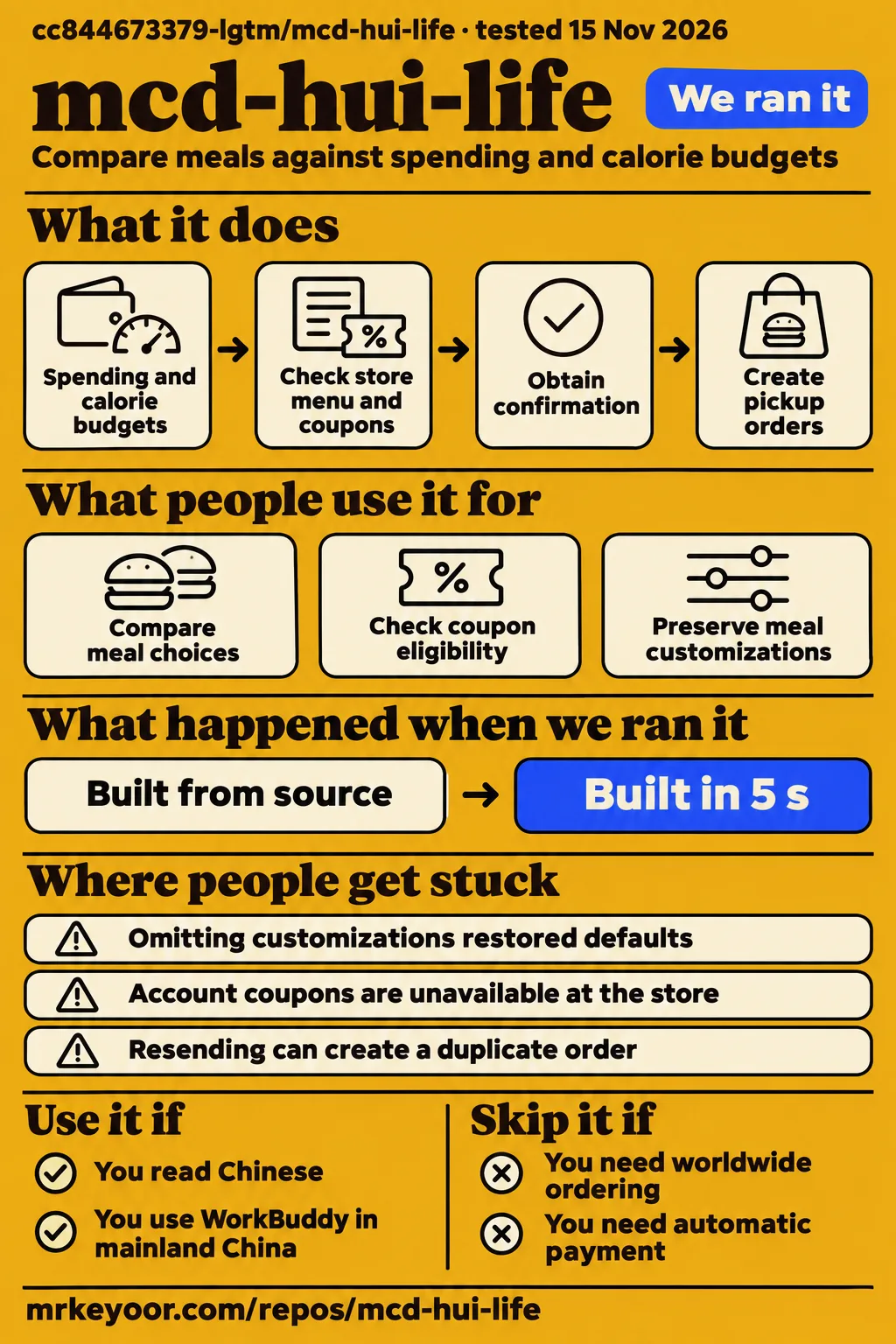
Use mcd-hui-life to examine a confirmed meal's contents as well as its price. The skill suits Chinese-reading WorkBuddy users comparing McDonald's China meals against spending and calorie budgets. Its README describes two orders with the same price but different contents when customization fields were omitted. That comparison gives developers a specific question to investigate: does the proposed order preserve the meal the user selected? Project README and author verification account.
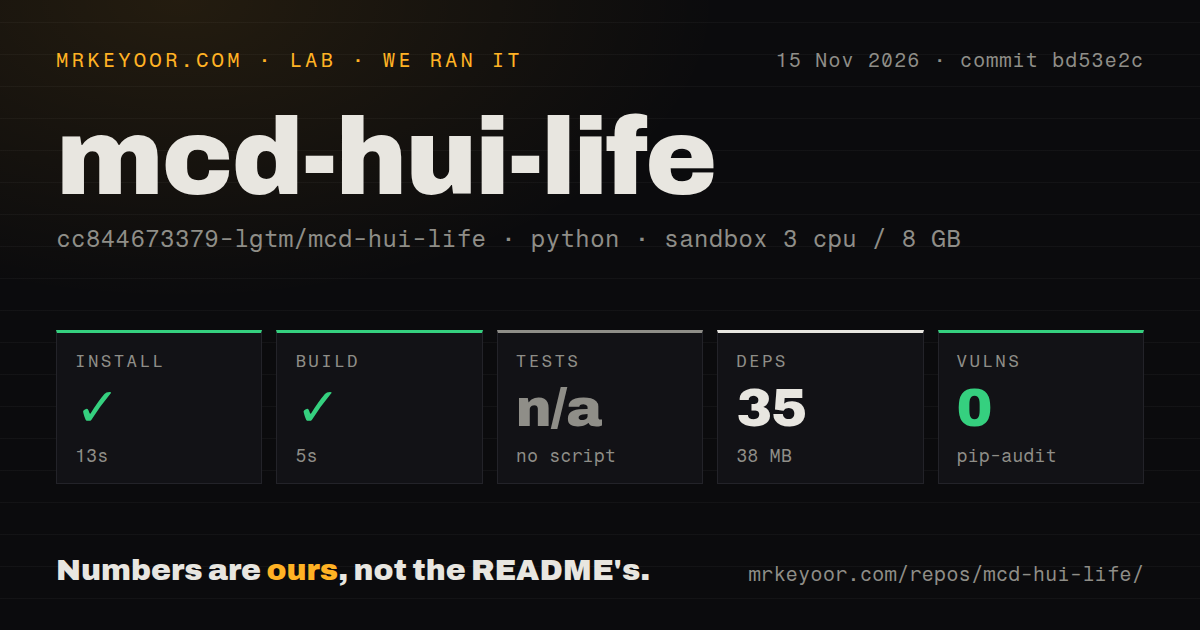
Our sandbox installed mcd-hui-life in 13 seconds and built it in 5 seconds at commit bd53e2c. Those measurements accompany a review of the documented selection-and-confirmation workflow. The upstream service operates in mainland China, excluding Hong Kong, Macau and Taiwan. The practical inspection is whether the assistant presents the intended restaurant, channel, items, substitutions and amount together. A price alone leaves out the details that distinguish one meal from another. Official service scope.
What people use mcd-hui-life for
mcd-hui-life's README describes spending-and-calorie comparisons, store coupon checks and explicitly confirmed order creation. Its examples also cover keeping a requested item fixed while filling out a meal, answering a single-item calorie question and selecting a restaurant from a location anchor. These requests turn a general preference into a specific meal whose price and contents can be inspected together. Each use below comes from the project's documented workflow rather than an independent customer account.
| Documented use | Source | What the account describes |
|---|---|---|
| Plan within spending and calorie limits | README worked example | Compare choices and explain the trade-off when the low-greasiness preference cannot be met. |
| Preserve meal customizations | README order comparison | Including customization fields retained changes; omitting them restored defaults. |
| Check store coupon eligibility | README coupon example | Include a coupon only when the selected store returns it. |
| Create pickup or delivery orders | README verification account | Obtain confirmation and carry the quoted meal into order creation. |
The author reports creating four real orders on October 12, 2026, cancelling all four and using no coupons. The account covers pickup, delivery and a customization comparison. Passing roundList and modification preserved the selected changes; omitting them restored the default meal. Both orders cost 27.5 yuan. The example therefore gives an ordering assistant a more useful check than matching totals: inspect the drink and ingredient selections as well. Author's order comparison.
The README's budget example asks for a meal below 500 kcal and 20 yuan. Its recommended coupon combination costs 15.9 yuan and contains 224 kcal, with a fat-energy ratio of 60.3%, classified by the skill as greasy. A 16.5-yuan alternative contains 369 kcal with a 41.5% ratio. The example separates the spending, calorie and greasiness answers instead of presenting the cheapest choice as satisfying every preference. README budget example.
What happened when we ran it
Our November 15, 2026 hands-on safety step failed because its runner required a Compose file and found none. The failure names compose.yaml, compose.yml, docker-compose.yaml and docker-compose.yml. The recorded error occurred at that prerequisite check. The separate source harness completed its install and build steps at bd53e2c, so the two records describe different outcomes. Neither record should replace the other when reporting what happened.
Another lab record says the repository was deployed with its own Docker Compose and every port bound to 127.0.0.1. That description conflicts with the failed prerequisite record. The teardown entry says "teardown: ok". All three records belong in the account: a deployment description, a failed prerequisite check and a successful teardown entry. The documented installation route instead configures a remote MCP connector and loads a client skill.
| Source-harness observation | Recorded result |
|---|---|
| Install | Succeeded in 13 seconds |
| Dependency record | 35 dependencies, 38 MB on disk |
| Build | Succeeded in 5 seconds |
| Tests | No tests script or target; skipped |
| pip-audit | 0 known vulnerabilities |
| Checkout | 20 files, approximately 1,075 source lines, 0.5 MB |
| Repository signals | 0 CI workflow files, no Dockerfile, no tests directory |
Our run used a configured sandbox with 3 CPUs, 8 GB RAM and image label ghcr.io/astral-sh/uv:python3.12-bookworm. The README describes the helper scripts as standard-library-only; the harness records 35 dependencies for its install environment. These are separate observations about the scripts and the recorded environment. The timings describe this checkout and sandbox, while the pip-audit figure describes the known-advisory check recorded by the harness.
Where people get stuck: a menu is not a quote
The README reports an oat-milk coffee with a 9.9-yuan menu price and a 23-yuan transaction price. It also reports 11 account coupons but only two available at the selected store. Those author-recorded examples explain the workflow's quote and coupon checks. A menu entry identifies a candidate; the store's coupon response identifies applicable offers; the price calculation supplies the amount presented for the proposed meal. Pricing and coupon examples.
The environment checker returns unavailable with reason_code probe_required when either --network or --probe-results is omitted, according to the README. That response identifies a missing probe input. The documented sequence calls now-time-info, writes the result in the setup guide's format and supplies it to the checker. The reason code directs the reader to that input rather than to a fresh installation of the skill. Environment-check instructions.
| Symptom or boundary in the docs | Documented response | What to inspect |
|---|---|---|
| unavailable with probe_required | Supply the network option and probe-results file | Whether the prerequisite probe was supplied |
| 401 from the official service | Check the Authorization header and MCP Token configuration | Missing, expired or invalid authentication |
| 429 from the official service | Reduce request frequency and control call intervals | Request rate for the token |
| 60006 while pricing | Treat that candidate as sold out or unavailable | The current candidate and sales channel |
| Coupon appears in the account but not at the store | Exclude it from the comparison | Store, channel and validity window |
| Creation request times out | Query the order before retrying | Whether an order already exists |
The skill README supplies the checker, pricing, coupon and retry guidance. The official MCP error guide supplies the 401 and 429 responses. The table summarizes those documented instructions. Its most consequential step concerns a timed-out creation request: query the order before repeating the write. The README warns that blindly resending can create a duplicate order, so the next action is a state check. Skill troubleshooting, official MCP error guide.
Confirmation rules preserve the proposed transaction
The README requires user confirmation before create-order and directs the agent to stop when the returned amount differs from the confirmed quote. It also requires the order parameters to preserve the quoted substitutions and customizations. These instructions connect the confirmation to a particular transaction: the user approves a meal at a specific restaurant and price, and the agent is instructed to carry those selections into the request. Order-creation rules.
Cancellation has another confirmation step. The README says the agent should restate the order number, amount, restaurant and products, then obtain explicit agreement before executing the request. Card controls send messages into the conversation for the agent to handle. For payment, the skill supplies the payment link and guidance; after the user reports the payment result, it queries the latest order status. Card interaction and payment instructions.
The official service requires an Authorization header containing a bearer token and tells users to keep the token private. Follow the connection guide when configuring the client. When inspecting the ordering workflow, compare the displayed restaurant, channel, meal and amount with the intended request. The author's same-price customization example explains why this inspection includes individual selections: a correct total can accompany a different drink or an omitted ingredient change. Official authentication guide.
Setup uses a client skill and a hosted service
The README requires Python 3.10 or later, a McDonald's China MCP Token and network access to open.mcd.cn. Its WorkBuddy instructions configure https://mcp.mcd.cn using Streamable HTTP, enable and trust the connector, and place the repository in a user-level or project-level skill directory. The official guide describes the MCP server as remotely hosted. Together, these instructions describe connecting a client to an existing service. Skill installation, hosted-service connection.
The skill README explains its meal-selection policy in Chinese, including missing nutrition matches, coupon eligibility and order selections. The official service's English guide covers the connection and available tools. An English-speaking developer can use that guide to understand the service beneath the skill, then consult the skill's README for its WorkBuddy setup and selection rules. The two documents answer different parts of the setup question and should be read together.
Remote request limits affect repeated comparisons
The official service allows a maximum of 600 requests per minute per token and returns HTTP 429 when that ceiling is exceeded. Its documented tools include nearby-store lookup, menu retrieval, coupon lookup, nutrition retrieval and price calculation. A client that combines these tools needs to account for the requests involved in a meal discussion, including requests triggered when the user changes the proposed restaurant or meal. Official request limit and tool list.
A restaurant change causes the skill to retrieve that store's menu, coupons and quote rather than reuse the previous restaurant's product codes and prices. The README describes this behavior for its card interaction. For a user inspecting the revised proposal, the confirmation should identify the new restaurant and meal details. For a developer tracing the conversation, the restaurant change is a concrete point at which to inspect the refreshed inputs. Store-change behavior.
mcd-hui-life vs mcd-budget-meal and the official MCP service
mcd-budget-meal compares up to three quoted meal candidates and stops at recommendations. mcd-hui-life documents calorie constraints and confirmed order creation, while the official MCP service supplies hosted tools beneath these workflows. The choice depends on the desired endpoint: a spending comparison, a meal proposal with an ordering handoff, or service tools for a workflow you design. Budget skill scope, mcd-hui-life workflow, official tool list.
| Option | Documented emphasis | Choose it when |
|---|---|---|
| mcd-hui-life | Money and calorie constraints, store coupon checks, confirmed order creation | You want both budgets considered and an ordering handoff. |
| mcd-budget-meal | Up to three quoted candidates for one person's immediate pickup meal at one store | You want a spending comparison that stops at recommendations. |
| Official McDonald's China MCP service | Hosted tools for menus, nutrition, pricing and orders | You want to design selection and confirmation behavior yourself. |
The budget skill offers a token-free preview and report example using anonymized historical quotes. Its README says those pages do not fetch current prices or place orders. They show how the comparison presents meal contents, budget differences and substitutions before the reader connects an account. Its live workflow queries the selected store for current results. Keep the historical label attached when explaining what those preview reports show. Budget skill previews.
What popularity pages do not establish
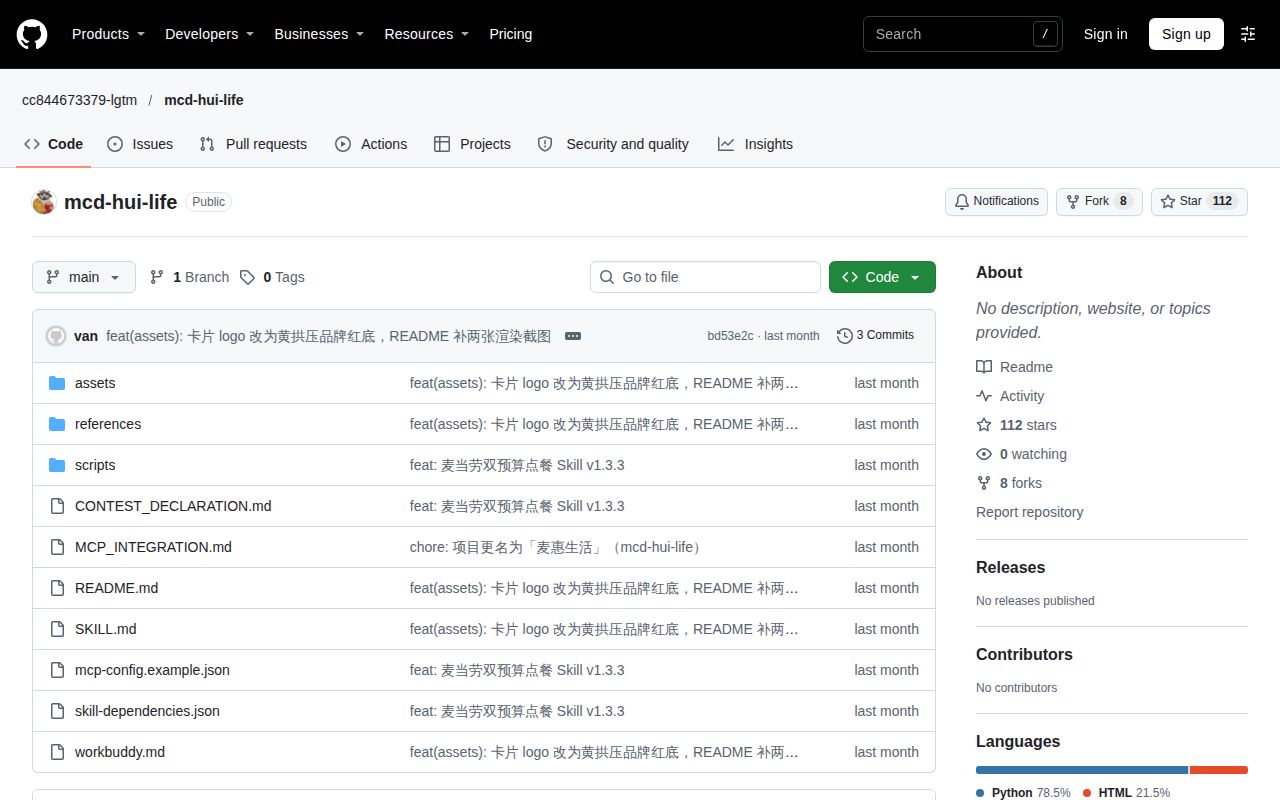
Repository attention does not establish ordering accuracy, runtime safety or support reliability. GitNova labels its description as an AI-generated README summary and says details may be inaccurate. It also excludes runtime safety from its star-growth assessment. Those disclosures identify what the page measures and where its description comes from. The project's README supplies the detailed selection and ordering instructions used in this review. GitNova summary and disclosures.
GitNova lists 112 stars. Trendshift records two stars gained, eight forks gained and zero merged pull requests in its October 12 to November 15, 2026 window. These figures describe attention and repository activity. The author's customization comparison answers a different, more practical question: which meal details should survive from a proposal into the order? That example gives readers something specific to inspect beyond a popularity count. GitNova snapshot, Trendshift activity window.
FAQ
The README's McChicken example lists 369 kcal, and its single-item question asks the skill for nutrition without starting the complete meal-selection workflow. Other examples ask about coupon eligibility and building a meal around a Big Mac. These documented user questions distinguish a simple lookup from a recommendation with additional constraints. Installation is included below as a starting question for readers connecting the skill for the first time. README user questions.
How do you install mcd-hui-life?
WorkBuddy installation has two parts: configure the remote connector, then place the repository in a skill directory. The README's environment check uses a now-time-info probe result supplied with --network and --probe-results. Its returned states distinguish ready, partial, needs_setup and unavailable. Follow the returned reason code when the check stops; probe_required specifically identifies the missing probe input described in the troubleshooting section. Installation and checker instructions.
How many calories are in a McChicken?
The README's displayed McChicken example lists 369 kcal, 15 g protein, 17 g fat and 731 mg sodium. Its single-item question directs the skill to retrieve nutrition data without starting the full meal-selection workflow. The official list-nutrition-foods tool returns energy and other nutrition fields. That documented route suits a request about one item rather than a comparison of complete meals. Skill nutrition examples, official nutrition tool.
Can I use a coupon from my account at this store?
The README requires the coupon to appear in the selected store's results before including it in the comparison. Its example asks whether a medium-fries buy-one-get-one coupon can be used. When the store result excludes it, the skill is instructed to explain the store, channel or time restriction and show the validity window. An account listing alone does not qualify the coupon for that meal. Coupon eligibility example.
Can it help me build a meal around a Big Mac?
The README's Big Mac example keeps that requested item fixed and fills out the surrounding meal. It also checks whether the selected store has relevant coupons. The named product becomes a constraint on the recommendation. Include the item you want to keep in the request, then inspect the resulting complete meal and quoted amount before proceeding to the documented confirmation step. Anchored recommendation example.
The documentation score reflects written coverage
Documentation receives 4/5 for the README's setup steps, worked examples, troubleshooting and explicit operating rules. The coverage rubric awards 1 for a basic description, 2 when setup steps are included, 3 when worked examples are included, 4 when troubleshooting and operating boundaries are also included, and 5 when that coverage is corroborated through the documented workflow. This score assesses written guidance; the other dimensions appear as N/A, with the assessment gaps below.
What we have not tested yet
Our lab has no completed authenticated WorkBuddy ordering session: the evidence contains a source install and build, plus a separate hands-on attempt stopped by its Compose prerequisite. It contains no completed current-store meal comparison, nutrition match, checkout or payment from our lab. The conflicting deployment description does not resolve that gap. The author's four cancelled orders used no coupons, leaving real coupon consumption outside that account. Our pip-audit result covers known dependency advisories rather than agent permissions, credential protection or transaction safety.
The README's two card images use demonstration data for the restaurant, order and recipient. They illustrate interfaces rather than completed purchases. The pack contains no lab screenshot records, applicable firsthand community account, project-specific video demonstration or answered support thread. Agent adherence to confirmation instructions, client credential protection and behavior through repeated live failures remain outside our observations. Setup ease, community support and production maturity therefore remain unassessed. Rendered layout, accessibility, automatic related links, recommendation modules and template content also remain untested in this text-and-evidence review.
The 600-request service allowance is not a measured meal throughput. We have no concurrent-user, completed-meal latency or sustained-volume measurement. The configured image label supplies no actual runtime or operating-system version, and the dependency summary does not explain individual packages. The metadata has no verified latest-release result and records no detected repository license. A reusable licensing grant and a complete English-language experience need separate checks. The useful next result is an authenticated, read-only comparison of a selected store's returned quote and meal contents.