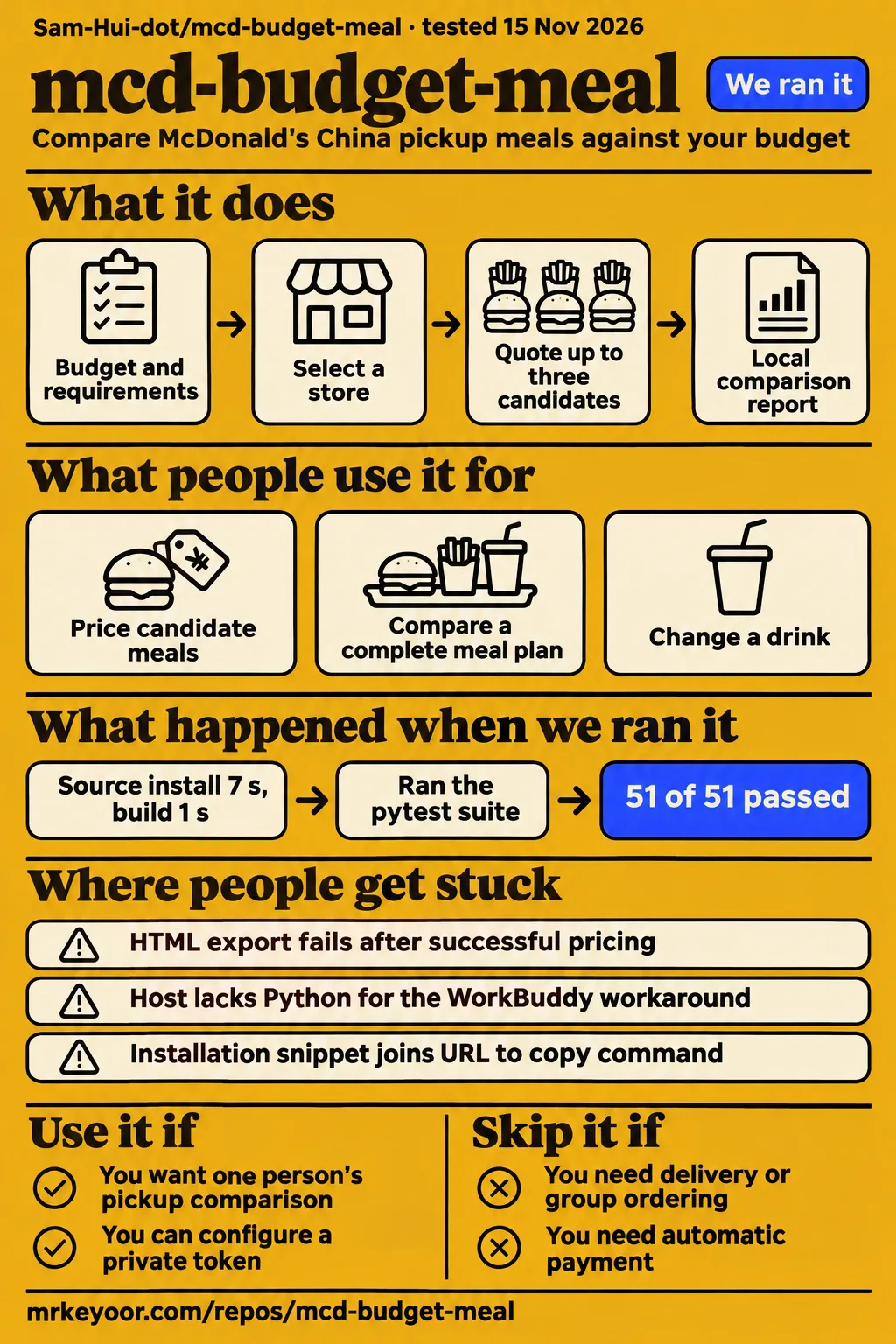
Our sandbox passed all 51 tests for mcd-budget-meal, a skill for comparing McDonald's China pickup meals. Use it if you already have a compatible AI client and want a clearer comparison before choosing lunch. Skip it if you need delivery, group ordering or a tool that buys the meal for you. The project stops at recommendations. Project README
The useful idea is to quote the complete meal again whenever you change it. A cheaper-looking drink on a menu is not enough evidence that a modified combination will cost less. That discipline makes this worth considering for a technically comfortable customer in China, even though the name attracts searches about dollar menus elsewhere.
What people use mcd-budget-meal for
The author reports real meal quotes and drink repricing; Skill Harbor separately reports a sandbox installation, a different kind of result.
| Who used it | What they did | Reported outcome |
|---|---|---|
| Project author, in instructions reproduced by TypingMind | Used the direct MCP client to price candidate meals and change a drink | Three meal quotes and one drink-substitution quote completed. Upstream report |
| Project author, in the same reproduced instructions | Used the batch workflow to price and compare a complete meal plan | Three quotes, a local report and drink repricing completed; the account had no usable coupons that round. Batch report |
| Skill Harbor | Installed the pinned skill in its test sandbox | The listing records a sandbox installation on October 18, 2026. Installation record |
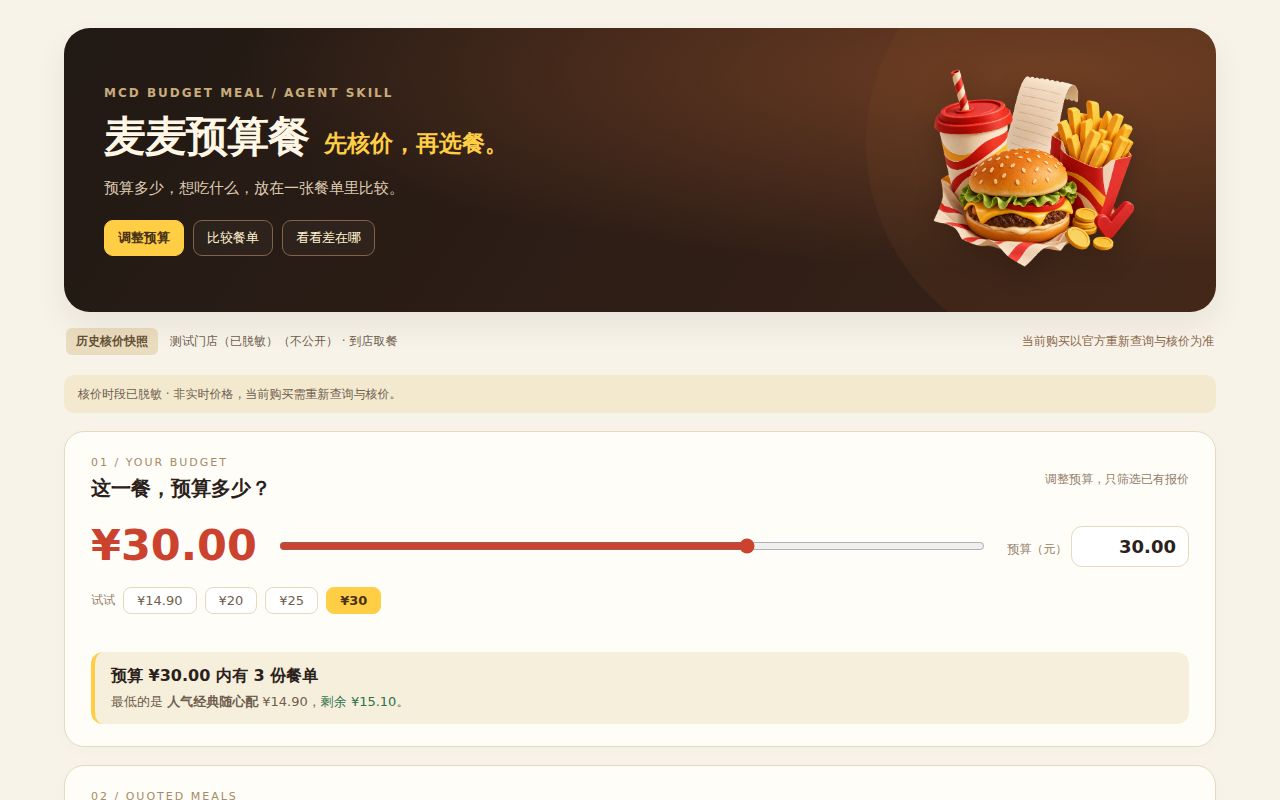
The batch example is the clearest reason to try it. You give a budget and requirements, select a store, and compare up to three candidates. The README's historical example changes a cola to a sugar-free cola and gets another whole-meal quote. Its value is that the new total comes from the pricing service, rather than arithmetic performed on display prices. README
The local report then lets you inspect composition and differences between successful quotes. If every valid candidate exceeds your budget, the instructions say to show the closest option and the excess. That is a useful refusal: the assistant should leave the decision with you instead of quietly loosening your requirements. Reproduced instructions
What happened when we ran it
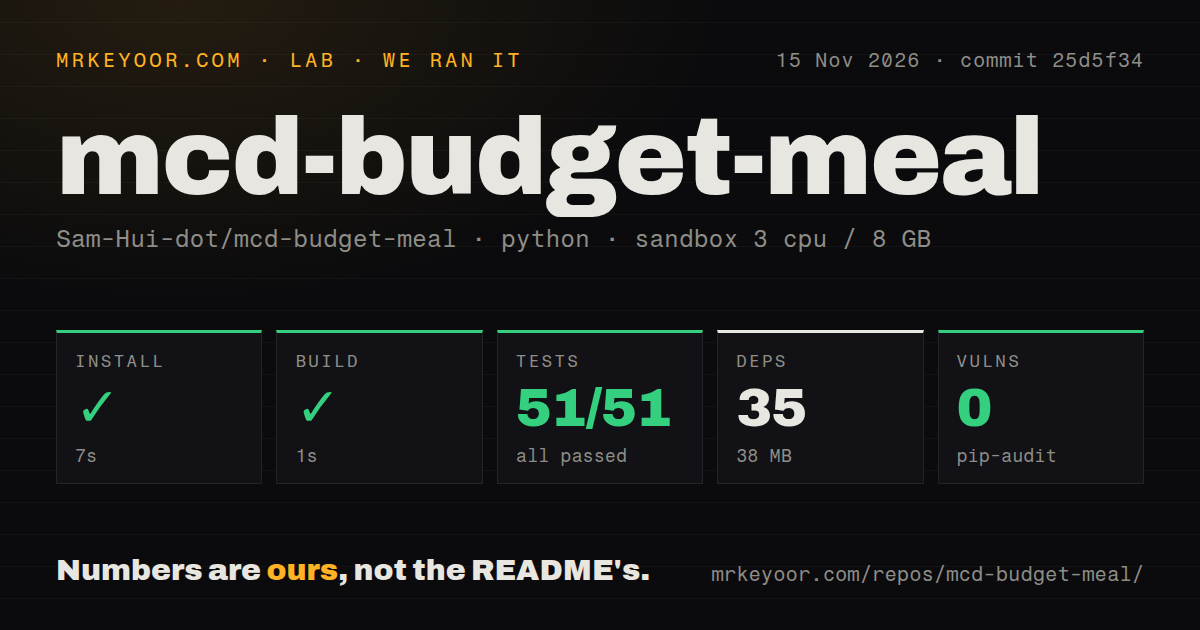
Our November 15, 2026 sandbox run at commit 25d5f34 installed successfully in 7 seconds, built in 1 second and passed all 51 tests in 3 seconds.
| Source check | Recorded result |
|---|---|
| Installation | Succeeded in 7 seconds |
| Dependencies | 35 recorded, 38 MB on disk |
| Build | Succeeded in 1 second |
| Tests | Succeeded in 3 seconds; pytest reported 51 passed, 0 failed of 51 |
| Dependency audit | pip-audit reported 0 known vulnerabilities |
| Repository scan | 50 files, about 1,637 source lines, 12.2 MB checked out |
| Automation signals | 0 CI workflow files, no Dockerfile, a tests directory present |
The configured sandbox had 3 CPUs, 8 GB of RAM and image label ghcr.io/astral-sh/uv:python3.12-bookworm. Those are the recorded settings. Actual runtime and operating-system versions require the raw toolchain logs. The quick source checks support looking through the code without a large recorded dependency footprint; the separate account and client setup still matters.
The hands-on deployment attempt hit a harness requirement before a meal-pricing task. Its safety step failed because none of compose.yaml, compose.yml, docker-compose.yaml or docker-compose.yml existed. The rule required a Compose file. That is a mismatch with this skill's documented client-based workflow, rather than evidence that its pricing code failed.
There is also a contradiction in that attempt's records. The run summary says it deployed with its own Docker Compose and bound every port to 127.0.0.1; the failed safety step says there was no Compose file. We cannot treat the summary as proof of deployment over that specific failure. Teardown records success.
Where people get stuck: host execution and report export
The documented WorkBuddy workaround needs local Python execution, while a failed report export can be recovered without throwing away successful quotes.
| Problem in the supplied records | Documented response | What to preserve |
|---|---|---|
WorkBuddy's deferred tool entry reports /items: must be array |
Stop using that entry and follow the project's direct MCP client path | The actual schema, arguments and original error |
| Host lacks Python or permission to run local scripts | Tell the user that this host cannot complete the documented workaround | The distinction between a menu display price and a quoted payable total |
| HTML or comparison-JSON export fails after successful pricing | Keep terminal results; regenerate HTML offline if comparison.json exists | Successful quotes and their original timestamps |
| DevSly's Claude Code command joins the repository URL to the copy command | Run clone and copy as separate commands, as TypingMind documents | The whole skill folder, including scripts and references |
WorkBuddy and export instructions, DevSly snippet.
The array error needs careful diagnosis. The reproduced instructions explicitly distinguish an actual array from a string containing array-shaped text. They also say the error alone cannot locate the fault in the client or prove a connector bug. Save the original inputs before trying an evidence-based correction. Repeatedly changing argument shapes would make the next failure harder to understand. TypingMind's reproduced instructions
Report export is a different failure. Once the service has returned valid quotes, a local file-writing error should not trigger more pricing calls. The documented recovery uses report_meals.py with --from-comparison, keeps the old quote timestamp and labels the report historical. That makes the saved comparison useful for inspection without presenting it as a fresh offer. Recovery instructions
Security: keep the token private and redact reports
The README says the direct client restricts authentication to a fixed official endpoint and refuses redirects; generated private reports still contain the actual store and quote time.
That is a sensible boundary for a meal-comparison tool. The direct client allows store, menu, coupon, meal-detail and price queries. The reproduced instructions exclude order creation, payments, coupon claiming, points redemption and new addresses. The skill's narrower permissions are a reason to choose it when you only want advice. Project README, tool restrictions
Keep authentication in your own private client configuration or environment. The project says raw requests, responses and private reports stay in a local private/ directory excluded from Git. A local HTML report can still disclose where and when you intended to eat when you share it. Redact those fields before sending it to someone else. The supplied records describe these safeguards; our dependency audit is a separate check with a narrower purpose. README privacy guidance
English readers need to work with Chinese instructions
The project README is Chinese-first, and the repository tree contains no separate English README.
The upstream McDonald's MCP service does provide an English README, which explains its region, token application and client configuration. That helps with connecting the service. It does not translate this skill's meal-selection rules or WorkBuddy recovery instructions. An English-speaking developer should read those rules with translation before granting the host execution permissions. Project, official English service guide
The region matters more than the language of your prompt. The official service describes mainland China coverage, excluding Hong Kong, Macau and Taiwan. An English model does not turn it into a US or worldwide menu service. If you arrived looking for American value meals, this repository answers a different question. Official service scope
At volume, the service limit matters more than the HTML report
The official service documents a limit of 600 requests per minute per token and returns 429 above it.
For an ordinary lunch comparison, the skill's limit of up to three candidates keeps the task small. Its instructions say to stop the round on rate limits or network errors rather than automatically retrying. Do not turn a failed quote into a loop of slightly different candidates. The saved records make it possible to distinguish completed work from a failed request. Official service limit, skill failure handling
The README also excludes nutrition, ingredients and allergens from its recommendation rules. A requirement such as keeping a burger is a composition constraint; it is not an allergy-safety check. The reproduced instructions direct allergy questions to the store and prohibit inferring information that the service did not return. Choose it for budget comparison within that boundary. README, allergy instructions
mcd-budget-meal vs mcd-party-planner and the official MCP service
Choose mcd-budget-meal for one person's pickup comparison; mcd-party-planner documents group planning, while the official service supplies the underlying tools.
| Option | Evidence-supported distinction | Choose it when |
|---|---|---|
| mcd-budget-meal | One store, one person, up to three meal candidates; recommendations stop before ordering | You want to inspect meal composition and whole-meal quotes before choosing |
| zcbacxc/mcd-party-planner | Its README describes group meal plans and party-session queries | You are organizing food for several people or exploring party arrangements |
| M-China/mcd-mcp-server | The official hosted service documents pickup, delivery, group meals and other tools | You want to design your own workflow in a compatible MCP client |
Budget skill README, party planner README, official service.
Mid or Real places mcd-budget-meal and mcd-party-planner side by side using public metrics and editorial verdicts, and explicitly declares neither a winner. That comparison helps identify the adjacent project; it supplies no functional head-to-head result. The practical distinction in the table comes from their documented scope. Comparison record
Attention is easier to count than successful lunches
GitHub's November 15 snapshot showed 1,328 stars, 42 forks and zero open issues and PRs, with the last push on October 24, 2026.
Those figures show attention and a recent source history, not how many customers use the skill. The source scan found no CI workflows. A tests directory and our passing run are useful evidence for this checkout, but the absence of open issues is not a support-response record. GitHub metadata
The search material also contains unrelated food content. In the supplied transcript for the video titled "I Tried the Cheapest Meal From Every Brand!", the creator compares inexpensive meals across brands. That is a food comparison, not corroboration of this repository's use. Similarly, wallstengine's X post discusses McDonald's value-menu news attributed to the WSJ, rather than running the skill. Counting either as developer adoption would mislead readers. The records do not provide the video's channel name, so we attribute it by its supplied title. Video transcript, X search record
For the documentation card, our editorial scale runs from 1 for fragmentary instructions to 5 for instructions independently checked across the documented paths. A 3 means a usable documented path; 4 means detailed setup and recovery guidance. This project earns 4 for explaining tokens, quote handling and export recovery. Setup ease, support quality and production maturity have no numerical rating because our evidence does not cover those complete experiences.
What the other reviews get wrong
TypingMind's generic claims about file execution and idle token cost conflict with details on its own listing, and Skill Harbor overpromises affordable results.
TypingMind says bundled files are never executed. Its reproduced instructions explicitly allow local script execution when the host permits it, and the WorkBuddy workaround depends on Python. Skill Harbor also identifies command execution. A host's restrictions should not be described as a property of the whole project. TypingMind, Skill Harbor
TypingMind also says an unused skill costs no tokens while explaining that its name and description sit in the system prompt. Loading detailed instructions only when needed can reduce overhead. It does not justify a literal zero-token claim for the installed description. TypingMind loading description
Skill Harbor describes three priced meals inside your budget. The detailed skill instructions construct at most three candidates and explicitly handle the case where none fits. A useful meal planner should say the budget is too low when the returned quotes show that. It cannot promise three affordable results just because it can compare three candidates. Skill Harbor headline, actual budget handling
Questions people ask
mcd-budget-meal queries menus and quotes up to three meal candidates for one person's McDonald's China pickup decision; it does not order or pay. Project scope
What does mcd-budget-meal actually do?
It checks a selected store's menu and coupons, obtains whole-meal quotes and compares the successful candidates against your budget and required items. A changed drink needs another complete quote. README
How do I install mcd-budget-meal in TypingMind?
TypingMind documents Plugins → Skills → Install from GitHub. Paste https://github.com/Sam-Hui-dot/mcd-budget-meal/tree/main/skills/mcd-budget-meal, then enable the skill in the chat. Importing those instructions is separate from configuring the authenticated MCP service and providing any execution capability the chosen path needs. Installation instructions
Which AI models can use mcd-budget-meal?
TypingMind says its connected GPT, Claude, Gemini, Grok and local models can load the Markdown skill. That is a claim about reading instructions. Useful operation also requires the host's MCP connection and the capabilities required by the selected workflow. Choose the host as carefully as the model. Model and execution descriptions
Is mcd-budget-meal free?
The README says the original skill, scripts and examples use MIT licensing. Skill Harbor lists the skill and token activation as free. Your model provider's token charges and any meal you buy are separate costs. README licence statement, cost description, provider charges
How is an AI skill different from a plugin or MCP server?
A skill supplies instructions and supporting resources for carrying out a task; an MCP server supplies callable tools. Here the skill describes meal selection and comparison, and the official server returns menus and quotes. This particular instruction bundle also includes Python scripts, so installing a skill does not imply that no code can run. Skill description
Is McDonald's still a budget-friendly option compared with cooking at home?
This repository compares McDonald's meal candidates, not groceries or cooking costs. GOBankingRates' supplied comparison uses McDonald's app prices from a Florida location, so its family-meal comparison cannot answer the China pickup decision this skill serves. Geographical price caveat
Is the McDonald's $1 menu still available in 2026?
This China-focused skill cannot establish US menu availability. The supplied EatHealthy365 article describes an evolved dollar menu, but it is not a current official menu for your store. Check the relevant local McDonald's channel before relying on a dollar-menu search result. Supplied food article, service region
Does McDonald's still have a national $5 meal deal?
The supplied EatHealthy365 article says there is no permanent nationwide deal, but that article does not establish current national availability. mcd-budget-meal's documented scope is China pickup pricing, so use the official channel for the country and store you intend to visit. Article's claim, skill scope
Do sauce and topping add-ons cost the same at every McDonald's?
The supplied food article says add-on prices can vary by franchise and location. For this skill, the useful rule is to query the selected store's options and quote the complete changed meal, rather than transferring an add-on price from another store. Food article, repricing rule
Can McDonald's meal customizations be ordered through the drive-thru?
This skill does not place drive-thru orders. Its scope ends with recommendations for single-person pickup now; the supplied food article discusses explaining customizations at a drive-thru and recommends using the app for complex requests. That food advice adds no ordering capability to this project. Skill scope, food article
What we have not tested yet
Our evidence supports successful source checks at 25d5f34, not an independently completed live meal comparison with a customer's account.
We have not tested token activation, live store selection, quote accuracy at checkout, drink repricing or coupon-assisted savings. The author's reported batch had no available coupons. Neither those records nor our source checks quantify savings against manual ordering or establish the cheapest meal across an entire menu.
The failed Compose safety step leaves the separate hands-on attempt without credible deployment or meal-task results. There are no known-answer meal questions or screenshots from that attempt. We also have not tested English conversations, TypingMind's full execution path, WorkBuddy skill discovery, sustained load or the direct client's security controls against an adversary. The recorded zero-vulnerability audit is not a security certification.
The next useful check is one authenticated comparison at a selected store, followed by a changed-drink quote and a manual check in the official ordering channel. Keep the store, items, quote time and actual payable total together. That would test the promise that matters to lunch: whether the comparison survives the trip to checkout.