MarkText v0.19.1 edits local files on three desktop systems
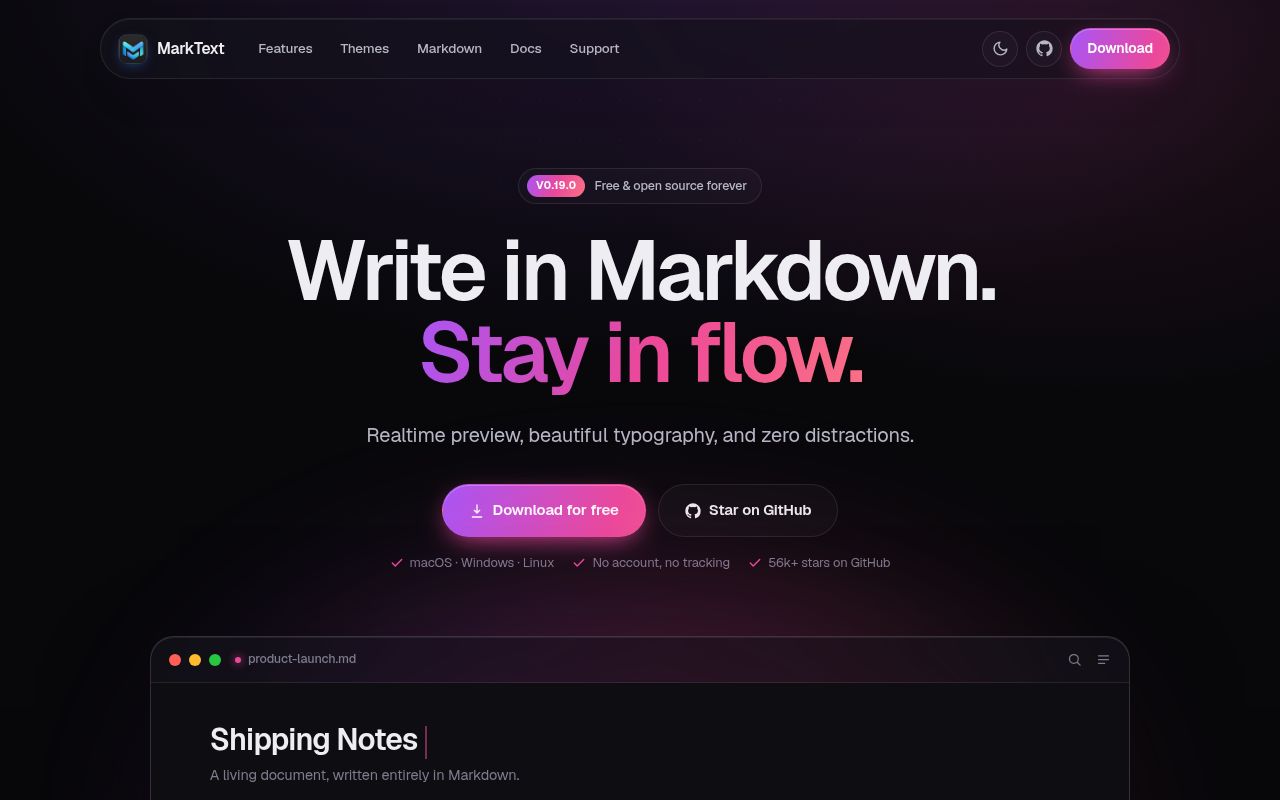
MarkText is an MIT-licensed desktop editor for people who like Markdown's portable files but dislike writing every marker by hand. The v0.19.1 app runs on Linux, macOS, and Windows. Its formatted view updates as you type, while source mode exposes the text. There is no proprietary document format, making it a practical front end for notes, READMEs, and articles stored in folders or Git.
The MarkText README lists CommonMark, GitHub Flavored Markdown, and selective Pandoc syntax support. Math uses KaTeX, while front matter and emoji extensions cover common publishing needs. Focus and typewriter modes reduce visual noise. HTML and PDF export are built in, and the export guide adds page size, margins, themes, headers, and footers. Page numbering is still unsupported.
The editor has 35 encodings but no knowledge graph
MarkText's settings go deeper than its spare interface. The current preferences reference lists 35 text encodings, configurable line endings, folder search exclusions, image paths, custom CSS, and polling for network shares. You can paste images, choose relative asset folders, set an editor width, and enable footnotes or superscript syntax. These controls help when Markdown files must survive several operating systems or publishing tools.
MarkText's FAQ calls it a pure Markdown editor without knowledge management or tags. It has a filesystem explorer and task lists, but does not replace a synced notebook or linked-note database. That restraint works if folders already provide structure. People seeking backlinks, mobile capture, shared notebooks, or a graph view should use a notes app built around those jobs.
What happened when we ran it
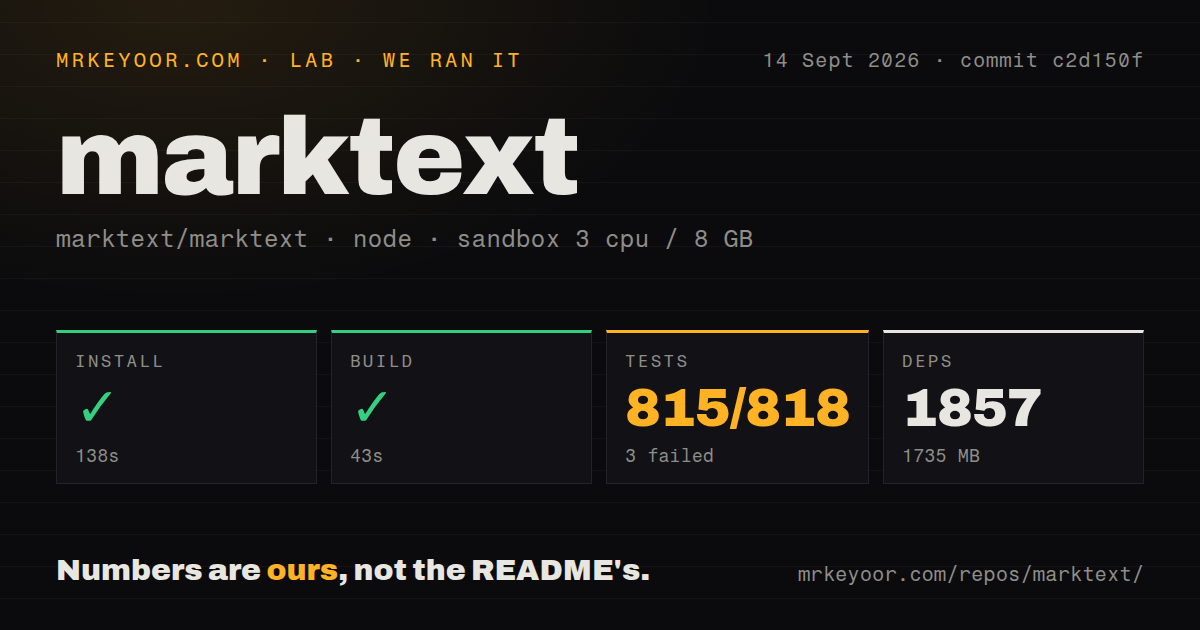
Our sandbox installed commit c2d150f in 138 seconds. Pnpm added 1,857 packages and left 1,735 MB on disk, then the build succeeded in 43 seconds. The checkout contained 1,911 files, about 175,838 lines of source, and occupied 34.4 MB. This workspace monorepo had 14 CI workflow files, no Dockerfile, and no top-level tests directory.
The test command failed with exit code 1 after 31 seconds. Vitest passed 815 tests and failed 3 out of 818, with 58 test files passing and 1 failing. All 3 failures were in test/unit/specs/pdf.spec.ts; the log tail showed 5,000 ms timeout errors. It did not show why they exceeded the limit, so we cannot label the failure a missing package, product defect, or slow-container problem. The result applies to our test method and this commit.
A source build needs Node.js 20.19.0 and native Linux packages
The build guide requires Node.js 20.19.0 or newer, pnpm 10 or newer, Python 3.12 or newer, and C++ build tools. Linux contributors also need headers for X11, xkbfile, libsecret, and fontconfig; Debian packaging adds rpm. Its container example uses Node 22 Bookworm and installs those packages before pnpm install, so the two-command recap on the installation page is the short version.
End users can avoid source setup by downloading a release. MarkText v0.19.1 ships x64 and Arm installers or archives, including 5 Linux package formats. Windows gets setup and portable builds; Linux gets AppImage, deb, rpm, snap, and tar.gz choices. The installation guide says portable Windows and Linux AppImage installs do not update themselves, so those users must fetch later releases manually.
The v0.19.1 macOS release is unsigned
Mac users face a security-policy decision before the first document opens. The v0.19.1 release notes say its macOS builds have no Apple Developer ID signature and tell users to clear quarantine after copying the app to Applications. The installation page describes the builds as not notarized and suggests approval through Gatekeeper. A personal Mac can accept that exception, but many managed workplaces will refuse it.
If Chromium's SUID sandbox cannot start on Linux, the FAQ gives 3 remedies: enable unprivileged user namespaces, set root ownership and mode 4755 on the sandbox helper, or launch with --no-sandbox. The last choice weakens process isolation, while the first two require system control. A locked-down workstation may need administrator help even when the AppImage downloads and opens without package installation.
The September 14 push fixed 2 footnote reports within hours
GitHub recorded 61,396 stars, 545 combined issues and pull requests, and a last push on September 14, 2026. Raw totals do not show response quality, but that day's history does. Issue 5340 reported that Backspace inside a nested footnote could break later edits; issue 5343 described an empty definition. Pull request 5347 added regression tests and closed both less than 2 hours after the first report opened.
That September 14 commit, c2d150f, is the one our sandbox tested. The quick footnote response and 14 CI workflow files show active engineering, while 3 failing PDF tests leave an unclean baseline on our box. A stale stable tag would tell the wrong story: v0.19.1 shipped on June 6, 2026, yet code and issue work continued on this review's date. Maintenance is current even though the release and source experiences carry different risks.
Pick MarkText for file editing and Joplin for a note library
MarkText v0.19.1 fits when the unit of work is one local Markdown file and the desired upgrade is visual editing. Zettlr is better suited to academic citations, Pandoc publishing, and Zettelkasten workflows. Joplin supplies notebooks, tags, mobile apps, plugins, and encrypted sync. HedgeDoc moves editing into a shared browser session for teams.
Our 138-second install and 1,735 MB dependency footprint should not stop a writer from trying a prebuilt MarkText package. They should make a contributor budget time for the source tree and reproduce the 3 PDF failures before changing export code. MarkText is a good fit when local files, inline formatting, and a quiet screen are enough. Sync, collaboration, citations, or institutional Mac approval each make an alternative easier to live with.