It turns Arknights maintenance into a repeatable workflow
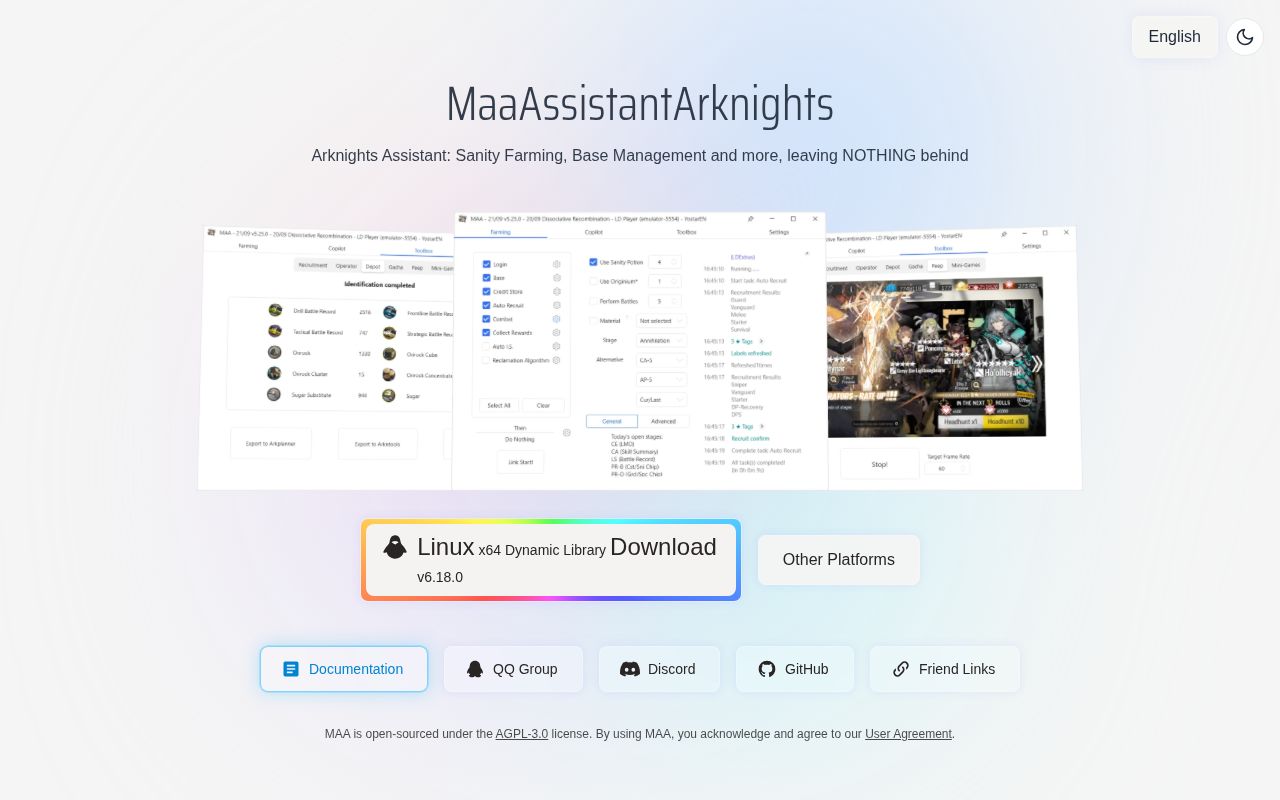
MAA tackles Arknights' recurring chores: spending sanity, rotating base staff, processing recruitment, collecting rewards, and farming stages. It combines image recognition with automated control in a player-facing assistant. The project dates to 2021, has 22,884 GitHub stars, and targets Windows, Linux, and macOS. This is an established specialist tool built around one game's changing interface, not a generic macro recorder.
The feature list is unusually complete. MAA can recognize stage drops and upload results to Penguin Statistics and Yituliu, calculate efficient base rotations, run recruitment with optional expedited permits, inspect an operator roster, recognize development materials, and export planning data. It also automates roguelike runs, routine credit and reward collection, friend visits, and user-selected battle-plan JSON files. For people who already use several Arknights planning sites, that makes MAA a useful bridge between decisions made outside the game and repetitive actions performed inside it.
Our install and build worked, but the Go tests did not
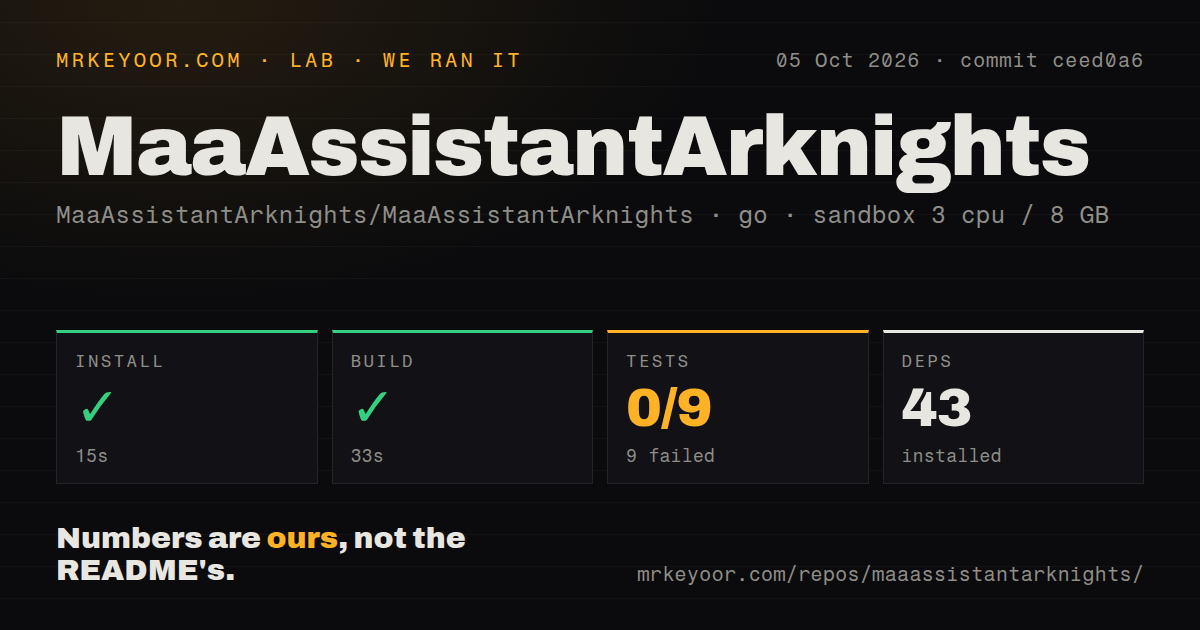
We cloned commit 88106ab and tested the Go project under ./src/Golang/ in a fresh, unprivileged Debian container with 3 CPUs and 8 GB of RAM. The repository contained 12,509 files, about 411,080 lines of source, and occupied 498.7 MB when checked out. Installation succeeded in 13 seconds and installed 43 packages. The build also succeeded, taking 20 seconds. Those are encouraging results for getting the measured Go component compiled, although they do not prove that the full desktop automation stack can see or control a live game client.
The test step was the clear rough edge in our run. It ended after 6 seconds with 0 passed and 9 failed of 9. The supplied log identifies build failures in MaaAssistantArknights, MaaAssistantArknights/maa, MaaAssistantArknights/server/http, and MaaAssistantArknights/server/http/params; it also shows internal/store and server/http/db reporting no test files. The available excerpt does not reveal the compiler errors that caused those package failures, so blaming a dependency, platform assumption, or code defect would be speculation. What we can say is simpler: a clean install and successful build did not lead to a passing Go test command on our box.
That result changes how we view setup. An ordinary player should start with the official v6.16.8 release, website, and newcomer manual, not by cloning nearly 500 MB of source. A contributor or integrator should budget time to reproduce the test failure and inspect the complete compiler output. The repository includes 25 CI workflow files and a tests directory, but no Dockerfile, so its automation story is substantial without offering a single canonical container environment. The README points users toward detailed manuals, yet source-level setup remains a different and more demanding job than downloading the application.
Its strongest advantage is depth, not simplicity
MAA goes beyond clicking fixed coordinates. Image recognition supports drop detection, recruitment decisions, operator and material recognition, while custom base schedules and battle-plan files give experienced users control over automation policy. Its interface surface is also broad: the README lists C, Python, Go, Dart, Java, Rust, TypeScript, Java HTTP, and Rust HTTP options, alongside callback, task-flow, integration, and automated-battle protocols. That breadth makes the project relevant to desktop users, script authors, companion-app developers, and people building private automation around the same core.
Cross-platform and international support are meaningful, but the README gives an important warning. It says most features support the US/global, Japanese, Korean, and Traditional Chinese servers, while also noting that smaller overseas user populations and limited project staffing mean many features have not been comprehensively tested. Simplified Chinese is the source language for translations. In practice, global-server users get an unusually capable tool, but they are also part of the compatibility feedback loop and should expect occasional version-specific breakage after game updates.
Activity is high, while issue volume signals ongoing maintenance work
The health signals are stronger than the latest release date alone suggests. Version 6.16.8 shipped on August 11, 2026, and the repository was pushed on August 30, the day of this review. Combined with 22,884 stars and 25 workflow files, that indicates an actively maintained, widely adopted project. The 684 open issues are substantial, however. In a project tracking a live game's UI across several operating systems and regional servers, a large queue can reflect both popularity and a persistent compatibility burden; it should not be read as either proof of failure or proof that reports are quickly resolved.
The ecosystem reinforces its maturity. The README links MaaFramework, website, battle-plan, backend, and machine-learning projects, and credits OpenCV, PaddleOCR, ONNX Runtime, FastDeploy, MaaTouch, and game-data sources. That investment also explains the 498.7 MB repository and contributor complexity: MAA solves perception, control, planning, localization, distribution, and integration together.
It belongs beside the game client, with planning services around it
In a real setup, MAA sits at the execution layer: the game client or emulator is the thing it observes and controls, while services such as Penguin Statistics provide data and receive recognized drops. Planning tools can produce material goals, and MAA can export or consume relevant structured data and battle plans. Its CLI makes scheduled or headless workflows possible on 3 supported desktop platforms, while the APIs suit custom launchers and dashboards. It is not a replacement for a general orchestration platform, nor is it merely a drop calculator.
For most players, the practical decision is straightforward. Choose MAA when daily Arknights upkeep has become tedious and you want one maintained tool covering far more than farming. Choose a narrower planner when you only need recommendations, or a base-focused assistant when scheduling is the sole pain point. For developers, the successful 20-second build is promising, but the 9-of-9 failed test result is a firm reason to validate your exact integration and platform before depending on it. MAA earns a recommendation for capability and momentum, with a clear testing caveat rather than a blanket endorsement.