Luvus tracks several coding agents inside one terminal workspace
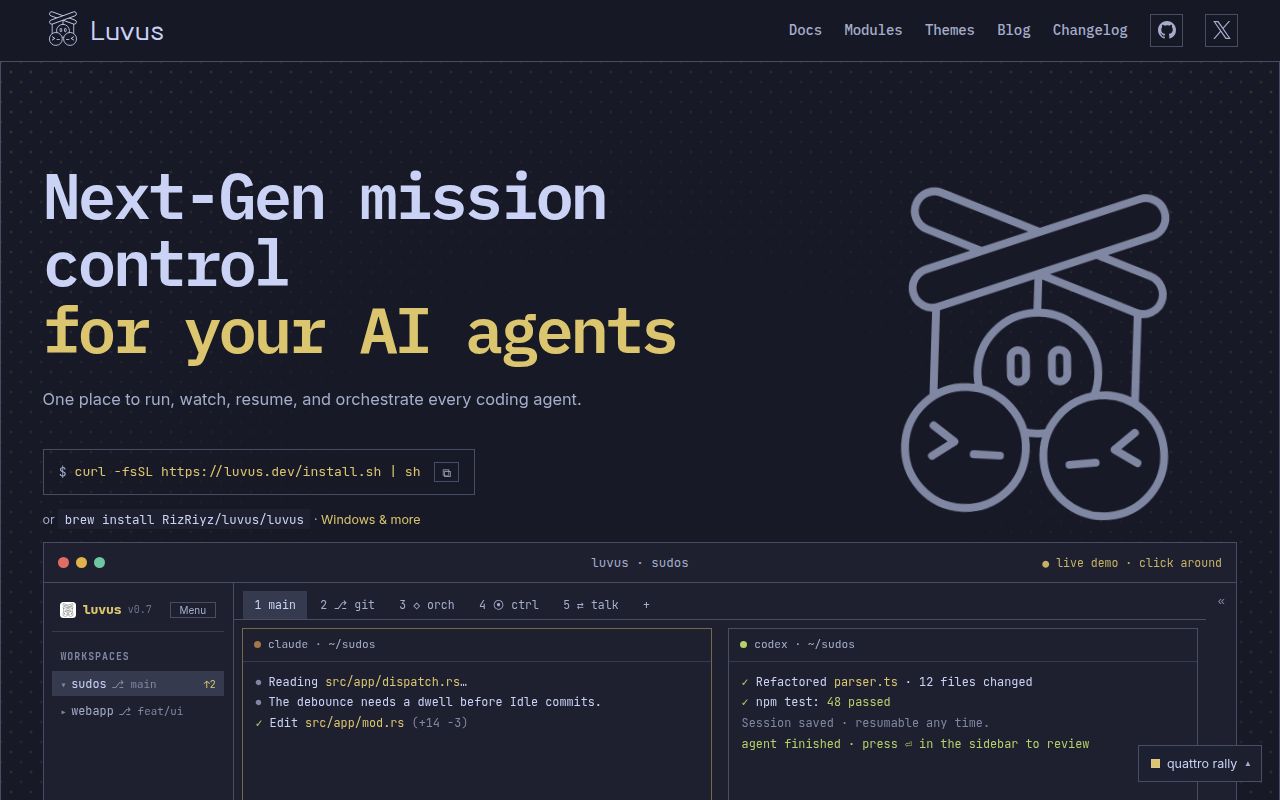
Luvus combines a terminal multiplexer with an agent dashboard. Workspaces, tabs, panes, layouts, names, and terminal state persist behind a background server. The sidebar detects whether supported agents are blocked, working, finished, or idle, and can show session title, tokens, cost, and context use. Developers can message or resume sessions, send keys, and fork selected Claude, Grok, Codex, and Pi conversations while keeping the original alive.
That is more specialized than tmux or Zellij. Luvus also browses Git-aware files, shows changes and repository activity, creates worktrees, reserves paths, assigns agent tasks, runs quality gates, and merges completed work. The payoff appears when several sessions and branches are active at once. With one agent in one repository, the dashboard and orchestration layer may cost more attention than it saves.
Agent support ranges from exact hooks to status detection
Claude Code, GitHub Copilot CLI, Codex, OpenCode, Kimi, and Grok have live status, session resume, and precise hook events in the README table. Pi supports live status and resume without precise hooks. Cursor uses its own resume command. Gemini, Aider, Amp, Droid, Qwen, and Kiro are detected but do not have resume or hook support listed. Fx has status only.
The distinction matters when deciding whether Luvus can recover an interrupted workflow or merely label a running process. Live detection needs no agent integration, which makes initial discovery convenient. Accurate lifecycle events and context-preserving forks depend on the host's supported hooks or session interface. Test the exact agent and version your team uses before building automation around a green status badge.
What happened when we ran it
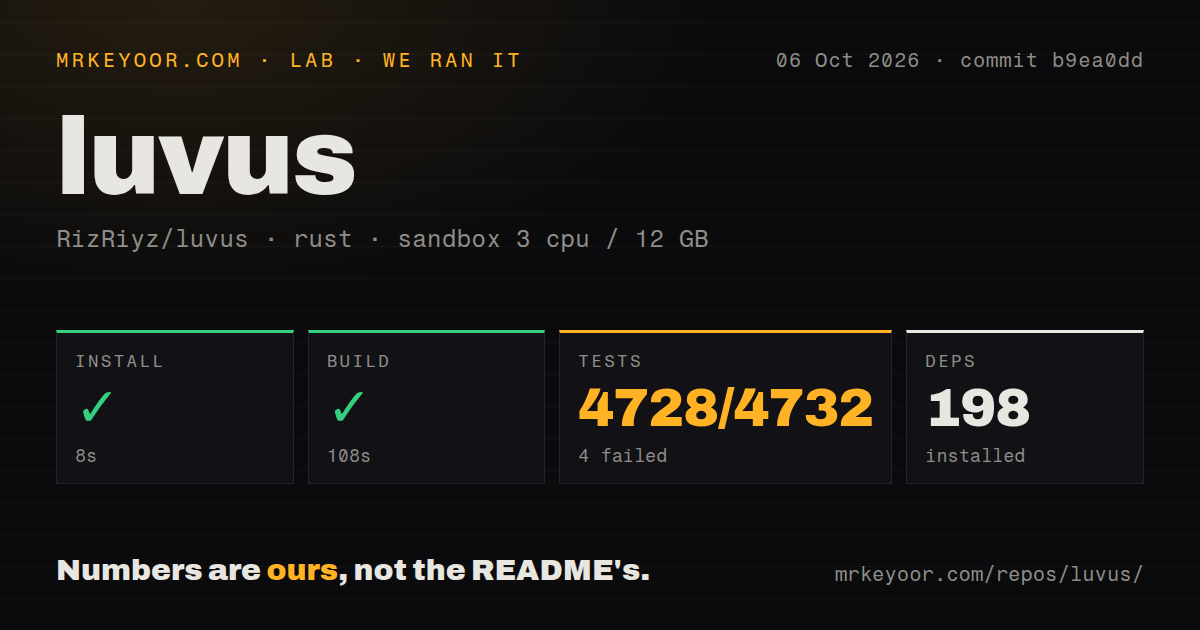
Our sandbox installed 148 Rust packages in 16 seconds and built commit 9619250 successfully in 77 seconds. The checkout contained 426 files, about 117,102 source lines, and occupied 47.2 MB. Our scan found 2 CI workflow files, no Dockerfile, and no top-level tests directory. Rust tests can live beside application code, so the directory result does not imply their absence.
The suite failed with exit code 101 after 71 seconds. Cargo reported 1,838 passing tests and 2 failures out of 1,840. The supplied tail names app::tests::keyboard_copy_mode_yanks_history_and_cancel_restores_its_viewport; that binary's summary showed 919 passed and 1 failed. The excerpt also shows a value comparison of Some("$") against Some("li"), but it does not connect that comparison to a named cause.
A 99.9 percent pass rate can still hide a bug in daily interaction. Copy mode, scrollback, and viewport restoration are basic terminal behaviors, so we would rerun those exact cases on the intended operating system and shell. The successful 77-second build makes source evaluation accessible, while the failed command means this commit should not be described as fully green.
Persistent sessions expand the trust boundary
Luvus keeps shell processes, pane history, layouts, and agent bindings alive in a background server. It supports several clients with independent viewport sizes and can attach over SSH. That is convenient for moving between a desk and a narrow screen, but the server sits near source code, command output, agent credentials, and potentially sensitive prompts. Owner-only local IPC in UHP 1.0 is a relevant control, not a substitute for host security.
The environment also needs the tools behind each panel. Agent CLIs require their own login or API keys. GitHub features depend on gh and its authentication, while remote work needs SSH configuration. luvus doctor checks Git, GitHub CLI, and SSH setup. Operators should inspect socket permissions, saved history, worktree locations, module sources, and update behavior before placing Luvus on a shared machine.
UHP 1.0 exposes orchestration beyond the interface
The Universal Harness Protocol provides a versioned method registry for sessions, terminals, agents, and harnesses. Its stated pieces include schemas, capability discovery, snapshots, event streams, exact input, semantic waits, and conformance fixtures. That interface lets another local tool supervise Luvus without scraping the terminal display. Modules can add actions, events, settings, startup hooks, panes, docks, and bar widgets.
Extensibility raises compatibility and supply-chain questions. A community module executes inside a workspace that can already reach code and terminals, so review it like an editor extension. Pin releases where repeatability matters and keep orchestration commands scoped to dedicated worktrees. The AGPL-3.0-or-later license also deserves counsel when a company modifies or distributes the system, especially when network service obligations may affect the intended use.
Release 0.13.1 is active, but usage figures need skepticism
GitHub recorded 410 stars, 11 combined open issues and pull requests, and a last push on August 26, 2026. Version 0.13.1 was released the same day with mobile controls, a redesigned Mission Control view, UHP 1.0, agent skills, a Codex plugin, and interface translations across 8 languages. It also changed rendering so hidden pane output does not force a full repaint.
Open issue 133 reports that Mission Control showed no cost and about 5 times the expected context for Claude Fable and Mythos 5, alongside stale prices for other models. That report does not establish behavior for every provider. It is enough to treat dashboard costs as estimates and reconcile bills against the provider. Luvus is promising for agent-heavy terminal work, provided terminal correctness and usage accounting remain verification points rather than assumed facts.