Read this archive to investigate Lunar for Roblox 1.0.16
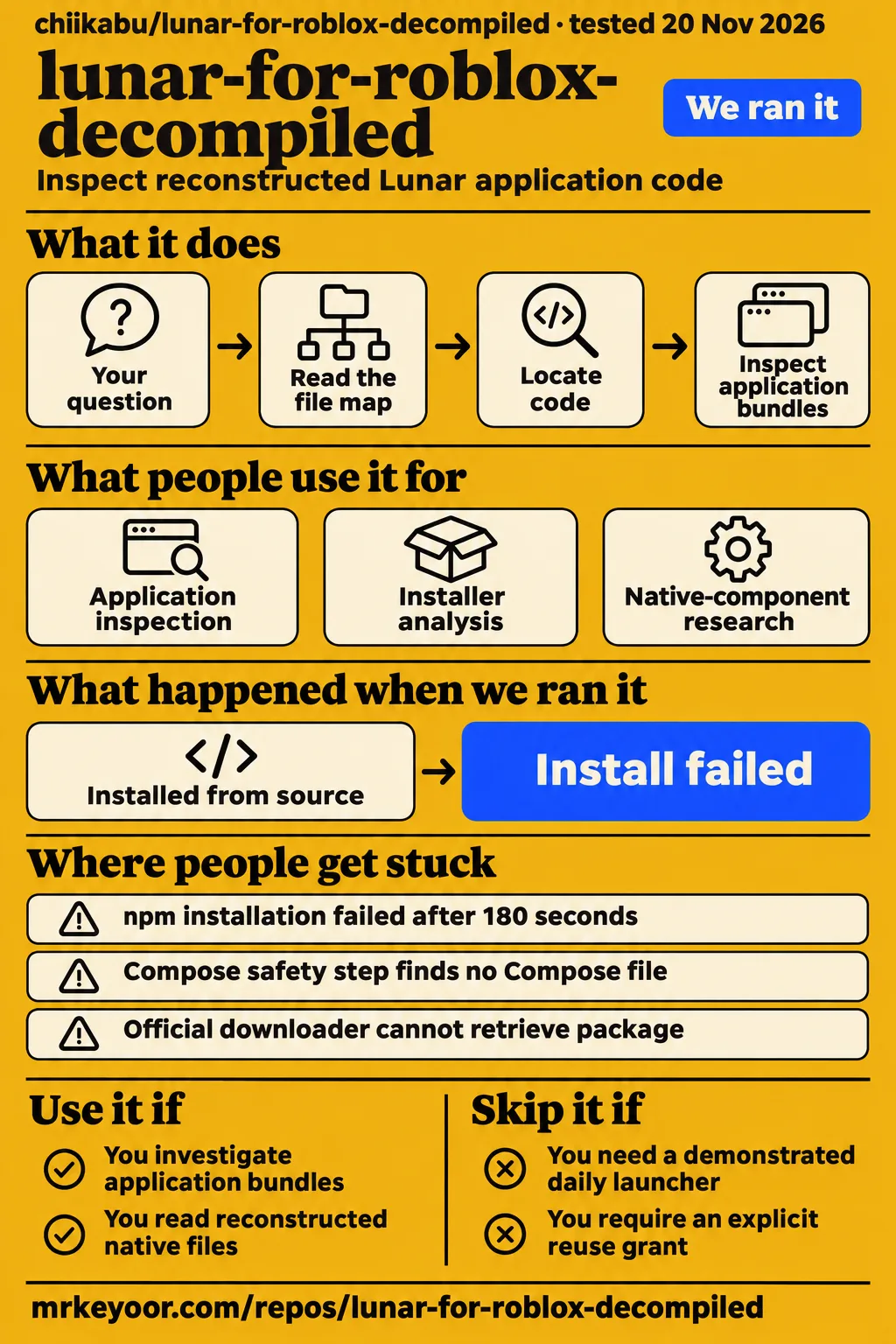
Our npm installation of lunar-for-roblox-decompiled failed after 180 seconds, while the README identifies files for inspecting Lunar for Roblox 1.0.16. Use the archive for application-bundle inspection, installer analysis or native-component research. Skip it if you need a demonstrated daily launcher or an explicit open-source reuse grant. Those are different decisions, and the repository's contents answer the inspection question more directly than the adoption question.
The project README describes decompiled output for the Roblox launcher by Moonsworth, including its Electron application, NSIS installer and native DLLs. Decompiled output is code reconstructed from a distributed application. Here, the layout separates cleaned application bundles from installer text and reconstructed native files. That division gives a researcher somewhere specific to begin instead of treating the repository as an ordinary source-development project.
The relevant unit of investigation is the file or component behind your question. An installer question belongs in the installer material; a question about communication between application processes belongs in the documented channel index. A package-retrieval error matters to the npm route, but reading an existing text file does not depend on completing that installation. This review follows those distinctions through setup, privacy reporting, permissions and alternatives.
What people use lunar-for-roblox-decompiled for
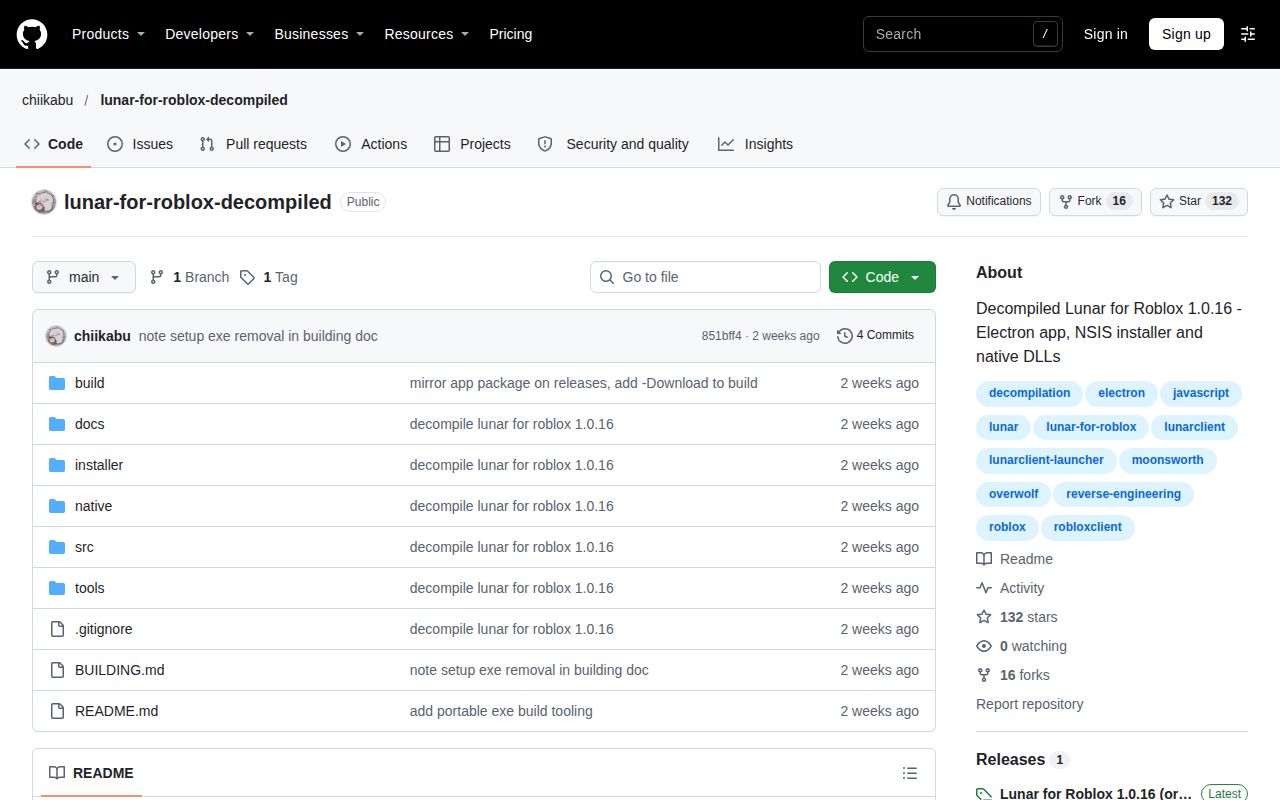
Application-bundle inspection, installer analysis and native-component research are the three inspection tasks supported by the README's file map. The README layout places cleaned main, preload and renderer bundles in src/, the dumped NSIS script in installer/, and decompiled C output in native/. These are entry points derived from the documented contents, rather than claims about customers completing projects with the archive.
For application behavior, begin with docs/, which the README describes as an index of IPC channels and services, bundle outlines and owutility notes. IPC channels let application processes exchange messages. That index can help connect a behavior to the relevant bundle before you read the larger files. The distinction between main, preload and renderer bundles also preserves the README's own organization instead of flattening every application file into one category.
For packaging questions, the README's tools and build entries distinguish extraction scripts from the portable-executable source and script. Installer analysis can start with the dumped text, while native-component research can start with the reconstructed .c files and their subdirectories. The practical choice is which artifact answers your question: an application bundle, an installer script, a native component or the packaging wrapper.
What happened when we ran it
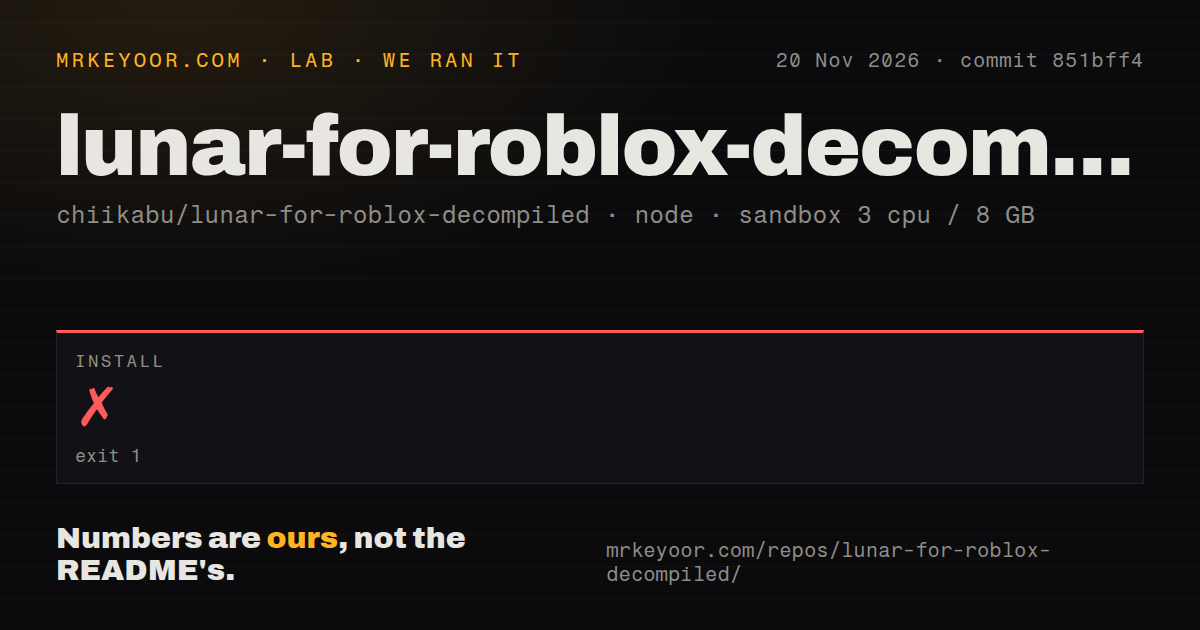
Our November 20, 2026 npm installation at commit 851bff4 failed with exit 1 after 180 seconds. The attempt targeted ./src/, and npm returned E404 for @lunarclient/icons@^0.0.9. The error identifies a failed registry request and allows two explanations: the resource could not be found, or access permission was missing. It does not select either explanation, so the result should stay a dependency-retrieval failure.
| Sandbox observation | Recorded result | What it means for you |
|---|---|---|
| npm installation | Failed, exit 1, 180 seconds | The npm attempt stopped during dependency retrieval |
| Registry request | https://registry.npmjs.org/@lunarclient%2ficons, 404 |
The named request failed |
| Package specification | @lunarclient/icons@^0.0.9 |
This is the dependency named by the error |
| Configured resources | 3 CPUs, 8 GB RAM | These are sandbox configuration values |
| Image label | lab-node:22 |
This is the recorded image label |
| Checkout | 43 files, approximately 163,908 source lines, 68.4 MB | These figures describe the repository checkout |
| Repository scan | 0 CI workflow files, no Dockerfile, no tests directory | These are file-scan findings |
The installation log also contains npm warn using --force Recommended protections disabled. The request still ended in a 404. The log therefore supplies no successful fix based on forcing installation, and it gives no reason to rename the dependency or substitute another package. The concrete result is the named package request, its response and the failed installation at the recorded commit.
The separate functional-evaluation records conflict. The November 20 run summary says deployment used the repository's own Docker Compose configuration, with every port bound to 127.0.0.1. The safety step instead records FAILED because none of the four accepted Compose filenames existed. Its “unsafe repo” label names that missing prerequisite, rather than a malware finding. The teardown record reports success, which records cleanup rather than resolving the deployment conflict.
Where people get stuck: package retrieval and setup routes
The npm attempt requested @lunarclient/icons, while BUILDING.md describes packaging an existing Lunar application on Windows. Keeping those routes separate makes the error useful: the package name identifies what blocked npm, and the packaging instructions identify what material the documented wrapper expects. A researcher reading extracted bundles and someone preparing a portable executable are starting from different inputs.
| Obstacle | What to do with the finding | Resolution status |
|---|---|---|
| npm returns E404 for the icons package | Establish legitimate package availability or access before retrying that route | The recorded attempt ended at the 404 |
| Compose safety step finds no Compose file | Read the conflicting records in the run section together | Reconciliation belongs to a future functional evaluation |
| Old official downloader cannot retrieve the package | Follow the documented mirror or local-package route | The release notes describe the replacement input |
| You need a source development environment | Start with the documentation's description of extracted, cleaned bundles | The archive is organized around reconstructed application artifacts |
The original-package release notes say the official setup executable is deliberately absent because it was a downloader for the application package and no longer installs on its own. BUILDING.md adds that the setup can use a local package file. That explanation points to a specific input problem; changing Node or installing Docker would not address the downloader behavior described by those notes.
The Windows rebuild retains runtime network activity
BUILDING.md describes a Windows-only portable build and says the application retains update checks, Overwolf packages and analytics. Its portable-build instructions accept a downloaded mirror package, a local .7z package or an extracted application folder containing LunarForRoblox.exe and resources/app.asar. The documented operation packages existing application material with a C# launcher.
The instructions say the script extracts the package when necessary, zips the application folder and compiles build/PortableLauncher.cs with that archive embedded. The launcher then extracts the application on first run and starts LunarForRoblox.exe; later runs skip extraction. These are the maintainer's descriptions of the wrapper. They explain why “portable” refers to distribution and extraction here, rather than removal of the application's embedded services.
The build notes also identify the output executable as unsigned. They explicitly distinguish removal of the installer/package download from normal runtime network activity. For inspection, keep the wrapper, extracted application and modified files identifiable as separate artifacts. That preserves the distinction between a packaging change and a change inside the Lunar application itself.
RTC distinguishes telemetry controls from dormant email code
RTC reports that Lunar analytics and ad optimization have off switches, while Sentry crash and performance reporting has none. In RTC's leaked-build examination, the two Lunar settings are on by default. RTC also describes Overwolf ad controls as limiting targeting while leaving ads enabled. These are attributed findings about the build RTC examined, with individual controls attached to named services.
RTC reports that nothing in the examined version runs the email-hashing code and no email data is collected there. The email-code passage describes code connected to the Overwolf advertising system, then explicitly separates its presence from execution. That distinction changes the privacy claim: a function that can transform an email address is different evidence from an observed path that obtains an address and calls the function.
The useful reading of RTC's report keeps the service, setting and execution claim together. Turning off Lunar analytics answers a question about Lunar's own setting. RTC's Sentry statement answers a different question about crash and performance reporting. Its email passage makes another distinction between dormant code and collection. Combining those passages into a blanket claim that the application collects email would contradict the report's explicit account.
Public decompiled files do not supply a reuse grant
The README attributes the code to Moonsworth, Overwolf and its original authors, while the repository metadata lists no license. The ownership statement identifies whom the uploader regards as owning the material. It does not state permission to modify, redistribute or sublicense those files. For teams whose intake rules require an explicit open-source license, public access and an ownership statement answer different questions.
The original service's terms restrict copying, modification, distribution, reverse engineering and source extraction, with exceptions for company authorization or applicable law. Both the restrictions and exceptions belong in a permissions decision. A reuse decision therefore needs the permission covering the particular files and intended use, rather than an assumption based on the archive's visibility or the availability of a GitHub fork button.
For an inspection project, the README's attribution is relevant context about the material being examined. For a project that ships copied components, the missing grant becomes a concrete intake question. Keep those purposes separate when deciding whether to read a file, modify a local artifact or distribute a component. The repository's file map helps locate code; its ownership statement does not supply redistribution terms.
Stars and automated flags describe attention
TrueStars dates its repository figures to November 10 and explicitly says a flag is a reason to look closer, not proof. Its repository snapshot identifies very low watcher activity as a warning signal and describes checking forks, watchers, issues and the arrival of stars. The source itself limits the conclusion that should be drawn from its automated flag.
The GitHub metadata checked on November 21, 2026 lists 132 stars, 0 open issues and PRs, and a last push on November 9, 2026. Those are dated repository facts, distinct from TrueStars' earlier snapshot. Stars count attention to the repository; the empty tracker supplies no examples of issue resolution. Neither source turns repository attention into a completed installation result, so the adoption decision rests on the artifacts and recorded setup outcome instead.
lunar-for-roblox-decompiled vs Rocket Launcher and LunaUX
LunaUX handles Luau bytecode, while this archive contains reconstructed Lunar desktop-application artifacts. Rocket Launcher appears in an X user's comparison with the original Lunar launcher. Those distinctions determine whether each name belongs in your search: application inspection, another launcher candidate and bytecode reconstruction are separate tasks. A similar name or a favorable design comment does not make them interchangeable tools.
| Choice | What the source describes | When it belongs on your shortlist |
|---|---|---|
| lunar-for-roblox-decompiled | Reconstructed Lunar application, installer and native files | You want to inspect this application's implementation |
| Rocket Launcher | YojanderGaming praises its design over Lunar and offers to beta test | You want to follow another launcher candidate discussed on X |
| LunaUX-Decompiler | Its README describes reconstructing Luau source or disassembly from bytecode | Your input is Luau bytecode |
YojanderGaming's Rocket Launcher comment praises its design and offers to beta test. That is the comparison supported by the discussion: a named user's design opinion about Rocket Launcher and Lunar Client for Roblox. The beta-test offer is part of the same comment. It gives readers a lead to another project without supplying a performance ranking or an account-safety assessment.
LunaUX's README describes a decompiler and disassembler for Luau. The LunaUX project description says its algorithm takes raw Luau bytecode and attempts to reconstruct readable source or low-level disassembly. A researcher examining a Lunar installer needs application artifacts; someone reconstructing a game script from bytecode needs a bytecode tool. Choosing by input material resolves the confusing similarity between the names.
FAQ
BUILDING.md requires Windows and an application package or extracted application folder for its documented portable route. That is the direct setup answer for a first-time reader. The questions below also separate the similarly named LunaUX project and the repository's ownership statement, so the choice of tool, the expected input and permission to reuse code remain distinct decisions.
What does the documented portable route require?
The documented portable route requires Windows and either an application package or an extracted application folder. BUILDING.md describes download and local-input options, using Windows' tar.exe and .NET Framework compiler. Its inputs are an existing application package or application directory. This is the route to read when your question concerns the portable wrapper rather than the npm dependency request recorded in our run.
Is this the same thing as LunaUX-Decompiler?
No. This repository contains Lunar for Roblox 1.0.16 application artifacts, while LunaUX describes reconstructing Luau source or disassembly from bytecode. Compare the Lunar archive README with the LunaUX README by input and output. The former maps an Electron application, installer and native libraries; the latter describes an algorithm for raw Luau bytecode.
Does the README give permission to reuse the code?
The README attributes ownership to the original authors and supplies no explicit open-source reuse grant. Its ownership statement names Moonsworth, Overwolf and whoever wrote the code. A team planning to redistribute components needs permission that covers those components and that use. The archive's public location supplies access to the files, while the statement identifies ownership rather than licensing conditions.
What we have not tested yet
Our measured result is an npm installation failure at commit 851bff4, not the behavior of a running Lunar application. The Windows portable route, extraction-only operation, application launch, Roblox sign-in, game launching, updates and continued operation after installation remain outside this evaluation. There are no application-memory, latency, frame-rate, build-duration or passing-test results. The lab-node:22 image label also does not identify actual Node, npm or operating-system versions without raw toolchain logs.
The Compose deployment summary and failed prerequisite check need reconciliation before they can support a successful functional evaluation. No screenshots or known-answer task results document one. RTC's findings also need independent examination of the exact files and execution paths at the reviewed commit, followed by controlled observation of network behavior. The npm error supplies no security assurance, and the original service's terms do not settle the legality of a particular inspection or reuse in a particular jurisdiction.
A future runtime evaluation would need to identify the exact application package, follow the documented Windows route and record the toolchain and observed behavior. The application version 1.0.16, release tag v1.0.16 and measured checkout 851bff4 should remain distinct identifiers. For the present decision, use the archive when its documented files can answer your investigation; choose a different basis when you need evidence of a working daily launcher.