Choose the source tree for the work you need to do
Use torvalds/linux when your question concerns the upstream Linux kernel implementation or a proposed kernel change. For a working server or desktop, begin with the maintained kernel route supplied by your operating system. The source-tree checkout and the documentation-project result below do not establish deployment readiness.
The repository README routes hardware vendors to driver documentation, researchers to kernel internals, and maintenance engineers to stable-kernel and backporting guides. Start with the behavior you need to understand, then identify its subsystem.
What happened when we ran it
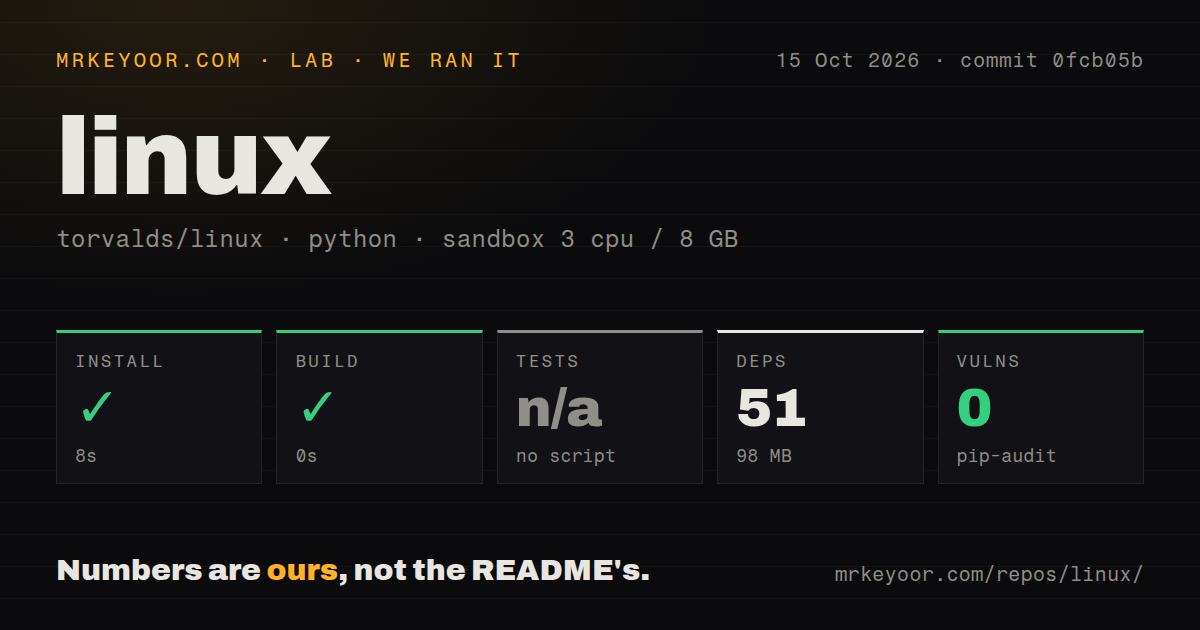
The October 15, 2026 sandbox targeted the Python project under ./Documentation/sphinx/ at commit 0fcb05b. Installation succeeded in 8 seconds, recording 51 dependencies and 98 MB on disk. The build step succeeded with a reported duration of 0 seconds. Tests were skipped because the harness detected no script or target.
The checkout contained 95,846 files, about 34,572,685 source lines, and occupied 1,638.8 MB. These source-tree measurements are separate from the installed Python environment. Neither establishes the memory or storage requirements of a running kernel with your chosen configuration.
pip-audit reported 0 known vulnerabilities. The harness records audit.packages as 0; without raw audit output, we cannot establish dependency coverage. The result cannot establish that the installed dependencies were fully audited or that the kernel source is free of vulnerabilities.
The sandbox configuration recorded 3 CPUs and 8 GB RAM. Its image label was ghcr.io/astral-sh/uv:python3.12-bookworm; actual interpreter and operating-system versions remain unverified without raw toolchain logs. Build commands and artifact details are also absent. The reported 0-second success therefore does not establish what the build produced. No kernel compilation, boot, driver exercise, or hardware validation was performed.
Mainline development and stable maintenance follow different paths
The development-process guide describes a merge window followed by release-candidate stabilization. Once a stable release is made, its ongoing maintenance passes to the stable team. Following upstream development and maintaining a deployed kernel therefore require different source-selection decisions.
For development, record the source revision and target configuration relevant to the problem. A mainline checkout does not establish that its configuration matches the machine where a bug occurred.
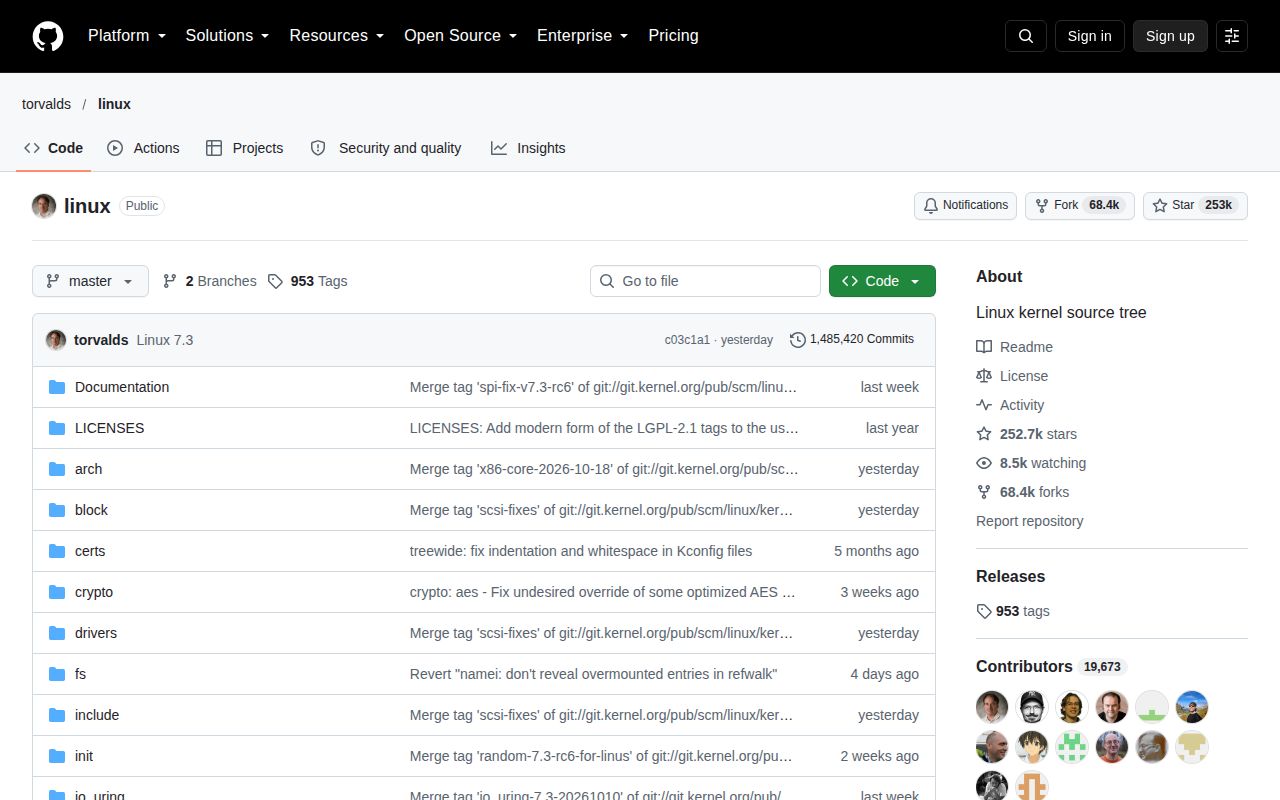
The supplied repository metadata records a last push on October 18, 2026 and shows GitHub Issues disabled. The README points readers to mailing lists and a bug-reporting guide. Release lookup and current mailing-list response activity remain unverified in the supplied evidence. A recent push establishes activity, not support quality.
Check the maintainer's tree before preparing a patch
The patch-submission guide says most subsystem maintainers run their own trees and want patches prepared against those trees. It directs readers to the subsystem's T: entry in MAINTAINERS, or to ask the maintainer if no tree is listed. The repository you browse to understand a problem may differ from the tree required for its fix.
The guide also requires copying the appropriate subsystem maintainers and lists. Patches should be submitted as inline email, with git send-email strongly recommended. Teams accustomed to GitHub pull requests should account for this submission and review process before committing to an upstream delivery date.
Alternatives depend on the operating-system target
FreeBSD's source tree contains kernel sources alongside system libraries and utilities. Consider it when you want to study or modify the FreeBSD base system, including its userland. Choosing it changes the operating system you are targeting; it does not answer a Linux-specific driver question.
Zephyr is a real-time operating system optimized for resource-constrained devices. Its README describes a small-footprint kernel and supported architectures and boards. Consider it when that operating-system model fits your embedded target, then check the target's board support. This review supplies no comparative timing, hardware-compatibility result, or migration test for either alternative.
For Linux source work, write down the subsystem, target configuration, and source revision. Then identify the maintainer tree and submission requirements. The measured documentation-project steps leave kernel build and target-specific validation unresolved.