LingChat is a visual novel, desktop pet, and companion
LingChat wraps model conversation in a game-like presentation. Characters can change expressions, actions, clothing, backgrounds, and music as the conversation changes. Each save has its own persistent memory, while a script system supports several characters, relationship stories, choices, and achievements. Desktop-pet mode keeps the character visible outside the main window. A pomodoro timer, schedule, and task list give the companion reasons to interrupt beyond ordinary chat replies.
The primary README is Chinese and assumes a Chinese community context, including QQ support groups. Release v0.5.0 says the application now has simplified Chinese, traditional Chinese, English, and Japanese interfaces, plus text-to-speech for Chinese, Japanese, English, and Korean. That is broader than the repository documentation itself. English-speaking users should expect to navigate screenshots, translated app labels, and source rather than a full English setup manual.
Version 0.5.0 lets characters use tools on the computer
The August 14 release added agent functions, skills, plugins, web search, automatic script generation, and an editor that can repair script errors. Users can place skills and plugins in folders under game_data, then assign available tools to a character in advanced settings. The release describes this as allowing the AI to operate the computer and handle work. That makes permission review more important than it is for a text-only companion.
Screen awareness already lets a character examine the desktop when prompted or during proactive conversation. A vision-capable provider can handle the image, and release configuration can reuse the active conversation model. Issue 716 reports that a per-conversation token limit can prevent image recognition. Even when it works, desktop captures may contain messages, credentials, or documents unrelated to the chat. Keep proactive observation off until you know when screenshots are taken and which provider receives them.
What happened when we ran it
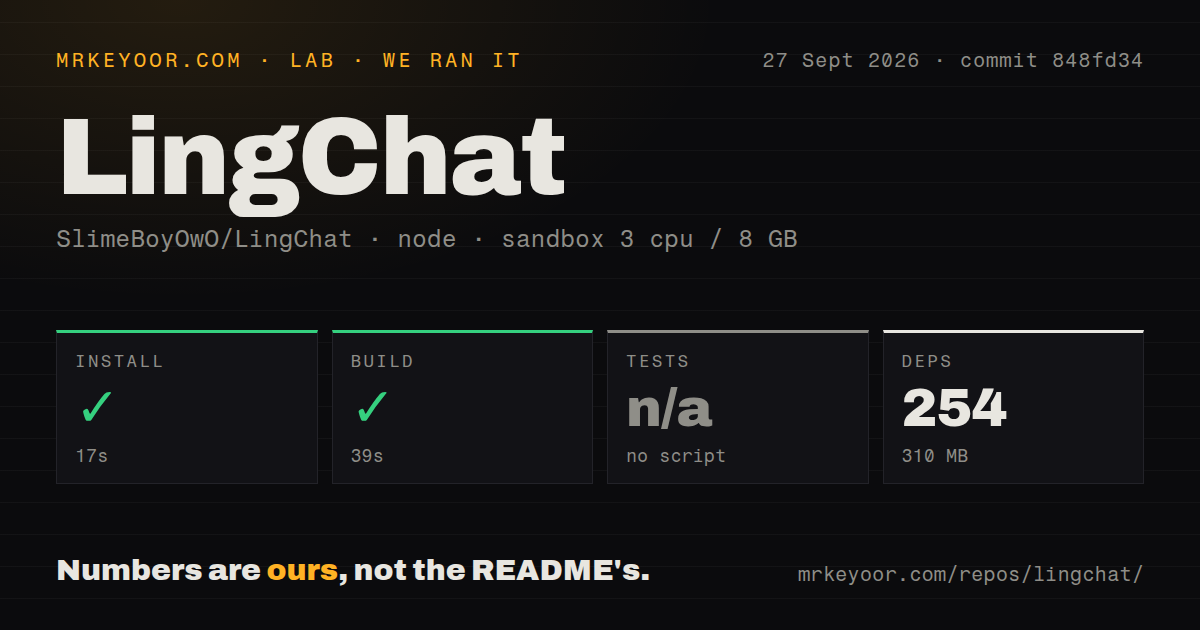
Our sandbox installed 232 pnpm packages in 24 seconds, using 228 MB on disk. The monorepo build then succeeded in 28 seconds. There was no test script or target, so the harness skipped tests rather than producing a pass or failure count. commit eae0d66 therefore has a verified install and build, but no automated regression result from the repository's own commands.
The checkout contained 925 files, approximately 120,568 source lines, and 5.5 MB before packages. It used pnpm workspaces and included 5 CI workflow files. Our scan found no Dockerfile and no top-level tests directory. The combination suggests a packaged application rather than a service-oriented deployment. A green build proves the TypeScript and bundled workspace can compile; it does not exercise conversation memory, tool permissions, audio playback, scripts, or window behavior.
A local acceptance pass should cover those user-facing paths. Create a disposable character, restart and inspect memory, run one script choice, test model failure, disable and enable vision, and verify which tools a character can invoke. Repeat at the display scaling and window size you use daily. Without an automated test target, each release transfers more of that burden to users and maintainers.
Voice can be built in or served by a separate engine
LingChat can use its built-in speech engine or external providers such as VITS-family services. The README's older setup route asks users to download a separate archive and launch an API service. It warns that one sentence may take about 1 minute on integrated graphics, while a GPU can reduce that to about 1 second. Those figures come from the project documentation, not our lab, and performance will depend on the selected model and machine.
Custom characters point at a voice model through their settings file. Release v0.5.0 expanded provider options and added mobile access to built-in speech. Issue 723 asks for multiple reference voices because the current GPT-SoVITS path can choose an unsuitable emotion. That request matches the larger product challenge: facial state, generated text, translated speech, and audio tone all have to agree for the companion to feel coherent. One mismatched layer is conspicuous.
Current UI reports affect ordinary Windows use
Issue 707 documents v0.5.0 problems on Windows 11 when changing application zoom or resizing the window. The report shows controls leaving the viewport, creative-workshop navigation disappearing, transparent unfilled areas, and overlapping names. It also says the zoom level persists across restarts, which can make a missing exit option look like a permanent layout. This is a direct concern for a visual application, not cosmetic issue-list trivia.
Issue 666 describes screen graying that could be avoided by running as administrator, followed by script choice buttons failing to appear. Running an entertainment application as administrator is a poor general workaround, especially after v0.5.0 added computer tools and plugins. The README separately warns that Windows Defender may remove the executable and tells users to allow it. Those reports justify testing the package in a standard account before granting extra privileges or antivirus exclusions.
The code license is clearer than the bundled asset rights
GitHub listed 1,905 stars, 68 combined issues and pull requests, and a push on August 26, 2026. The repository uses AGPL-3.0 for code. The README adds separate restrictions for included material: some interface audio and bubbles come from named games and must not be used commercially, while default character art also carries a no-commercial-use request. Forks must separate code permission from asset permission.
LingChat is appealing when the animated companion is the product, not decoration around a chatbot. The 28-second build makes source inspection accessible, but zero automated tests and active UI reports call for caution. Start without administrator rights, screen observation, or agent tools. Add each permission only after the basic chat, memory, script, and voice paths behave reliably on your system.