The recommended model makes 60-frame clips for 5 to 70 joints
UniMate generates text-conditioned motion for skeletons that do not share one fixed body plan. The recommended v2 checkpoint accepts rigs with 5 to 70 joints and produces 60 frames at 30 fps, a 2-second clip. Output includes per-joint position, rotation, and velocity features. The repository can render those features to MP4 or drive a rigged mesh and export GLB or FBX. It also includes motion in-betweening, joint-constrained editing, and prompt chaining for longer sequences.
This is useful research scope, with a visible limit. The model card says clips longer than 2 seconds require expansion, and four Truebones species sit beyond the v2 joint limit. The Mixamo checkpoint is narrower still: it learned one 22-joint rig. UniMate's claim is therefore about sharing a model across many admitted topologies. It does not mean every skeleton can enter unchanged, or that one prompt yields a production-ready loop without retiming and cleanup.
A 60-frame result still needs a carefully prepared rig
The current custom-asset guide provides three entry points. A script can export a GLB, GLTF, or FBX, while another command canonicalizes one rig for inference. You must identify a facing pair or body axis, and the pipeline cleans joint names before extracting topology features. The guide says an asset with no action can still produce a rest-only conditioning file.
The checkpoint model card gives a stricter rule: there is no skeleton-only input, and a new rig needs at least one animation clip. The top README also marks the official out-of-distribution preprocessing path as unfinished. Those statements do not fit neatly together. For a known dataset rig, follow the pinned dataset revision and extraction command. For your own character, budget an experiment to prove which inputs the sampler really needs before building tools around it.
What happened when we ran it
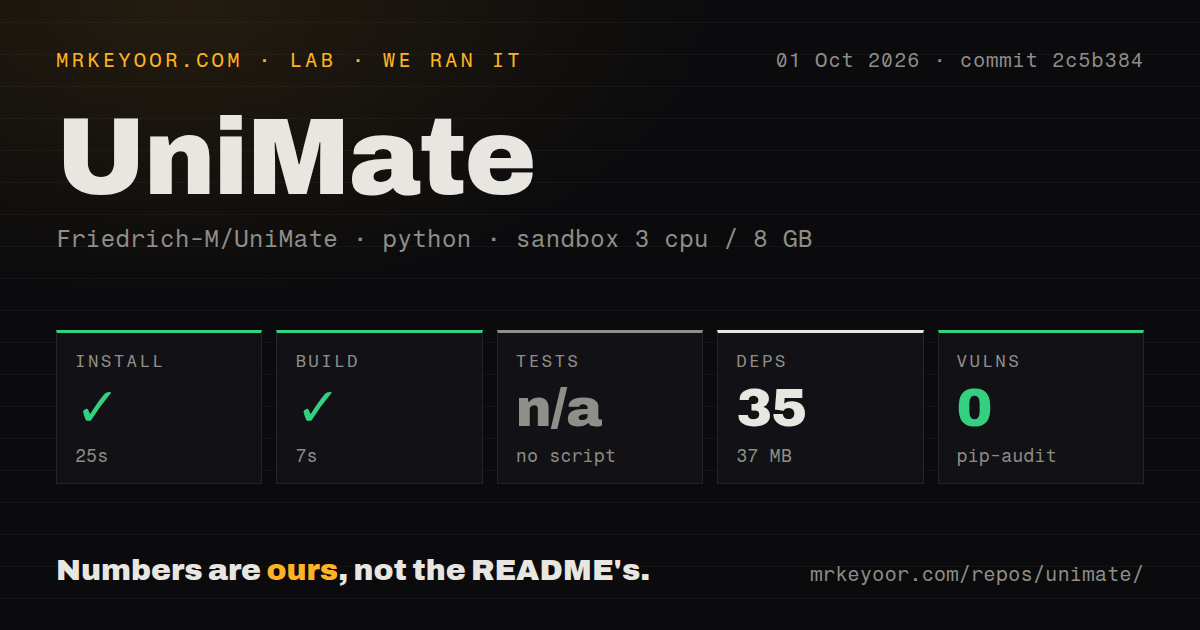
Our run installed commit 2c5b384 in 25 seconds, pulled 35 Python packages, and occupied 37 MB on disk. The build completed in another 7 seconds. Our test method used a fresh unprivileged Debian container with 3 CPUs, 8 GB of RAM, Python 3.12, and no secrets. Pip-audit reported 0 known vulnerabilities. That is a clean result for repository setup, and it says nothing about the visual quality of generated motion.
No test script or target was available, so the harness skipped tests. The 169-file checkout contained about 37,291 lines of source and measured 31.5 MB before installation. Our scan also found 0 CI workflow files, no Dockerfile, and no tests directory. The README's intended environment uses Python 3.10 and CUDA 12.4 packages, while the maintainer says inference currently requires an NVIDIA GPU. We did not download checkpoints, build dataset features, or render a 60-frame sample.
A 36-joint tiger exposed the unseen-rig failure mode
Open issue 8 documents an unseen 36-joint tiger generated with its body nearly upright by both v2 architectures. The reporter included the rig, generated arrays, images, and controls. The maintainer suspected the out-of-distribution preprocessing path and asked for comparison against dataset rigs. That response is reasonable, but it leaves the central adoption question open: whether the model failed on the body plan or the input conversion failed before sampling.
Open issue 6 adds a second warning. A user could not reproduce much of the project-page quality. The maintainer explained that release captions were regenerated with stronger models, so prompts from the paper and site may no longer match the checkpoints well. Dataset-specific normalization also matters for outside rigs. The repository itself says many motions and skeletons still fail. Save the seed, prompt, checkpoint, normalization choice, and source rig for every evaluation.
The 13,006-sequence dataset carries three licensing regimes
UniML3D joins 13,006 text-paired motion sequences drawn from Mixamo, Objaverse-XL, and Truebones ZOO. Its body plans include bipeds, quadrupeds, birds, marine animals, insects, snakes, and articulated objects. The repository documents 5 processing stages for export, rendering and captioning, joint annotation, feature extraction, and mesh animation. Reproducing that pipeline can require Blender, a CUDA GPU, and either local models or external model credentials.
The downloadable pieces differ by source. Objaverse assets retain per-object licenses, Mixamo stays under Adobe's terms, and the Truebones pack is commercial. UniMate publishes Truebones annotations and renders, but it cannot redistribute those motion files. Buying that pack may be necessary to rebuild the same animal side of the dataset. This matters even when the 35-package code environment is clean, because data rights and data access sit outside pip-audit.
September 30 activity is fast, but the release process is young
GitHub showed 965 stars and 9 open issues and pull requests on October 1, 2026, split into 7 issues and 2 pull requests. The default branch was pushed on September 30. Training and inference code arrived on September 6, preview checkpoints followed on September 27, and the GitHub releases endpoint returned no release. Maintainer replies on September 30 addressed CUDA support, memory questions, checkpoint licensing, reproduction trouble, and the quadruped report.
The code and checkpoints are MIT licensed. Issue 4 also records the maintainer's statement that generated motions may be used commercially. Training data need separate attention: Mixamo retains Adobe's terms, Objaverse assets carry their individual licenses, and Truebones motions come from a commercial pack that the project cannot redistribute. UniMate is ready for a disciplined research trial. A production decision should wait for your own rig cohort, visual acceptance criteria, and an executable regression suite around the exact checkpoint you ship.