mrkeyoor.com_
Thu 01 Oct 03:25 UTC
Dev Toolsevaluationupdated 01 Oct 2026

libuv review

libuv is a C library that gives programs one asynchronous I/O model across Linux, macOS, Windows, and several less common systems. It supplies the event loop, sockets, file operations, DNS, child processes, signals, timers, and a thread pool beneath runtimes such as Node.js and Julia.

Verdict

Our libuv run installed in 10 seconds and built in 30 seconds, but CTest ended with 0 passed and 2 failed targets after 49 seconds. libuv remains the sensible C foundation when cross-platform event loops and a stable v1 ABI are core requirements. Adopt it with platform-specific integration tests, because the supplied log did not explain the two target failures and current issue activity shows that small process and pipe changes reach downstream runtimes.

We ran it

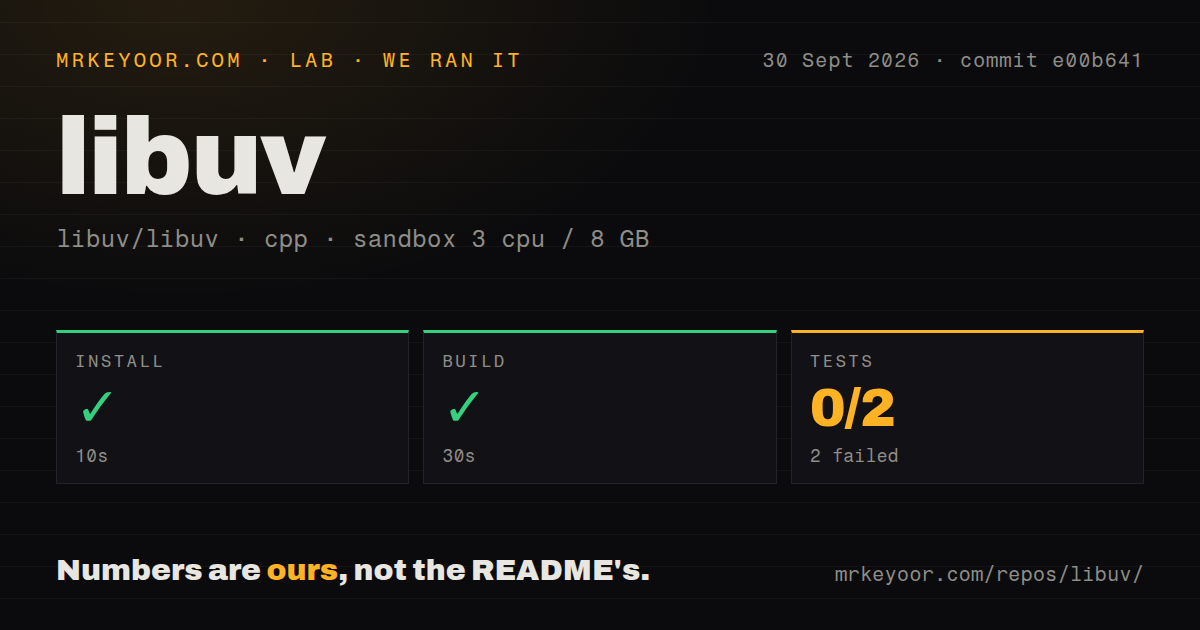
Lab card: what happened when we ran libuvScreenshot of libuv (libuv.org)
Install✓ · 10s
Build✓ · 30s
Tests✗ · 49s0 passed · 2 failed of 2 (ctest)
Repo483 files~116,675 lines of source · 4.7 MB · 9 CI workflows · tests dir

Answers from our run

Does libuv build from source?

Dependencies installed in 10 seconds, and the build succeeded in 30 seconds. We cloned commit e00b641 into a clean Debian container with 3 CPUs and no project-specific setup.

Do libuv's tests pass?

Not all of them: 0 of 2 passed and 2 failed when we ran the project's own test command (ctest). Some failures need services or credentials a bare container does not have.

Who should not use libuv?

Application developers looking for HTTP, TLS, WebSocket, or coroutine abstractions: libuv exposes lower-level handles, requests, streams, and callbacks.

What are the alternatives to libuv?

libevent, libev, Asio. Our libuv run installed in 10 seconds and built in 30 seconds, but CTest ended with 0 passed and 2 failed targets after 49 seconds.

Setup3/510-second install and 30-second build, followed by two failed targets
Docs5/5Detailed API, design, platform, build, and test documentation
Community5/527,220 stars and active issue work through September 30
Maturity4/5Stable v1 ABI and v1.53.0 release, but our CTest run failed

Discussed on

  1. hnLibuv – Linux: io_uring support289 points
  2. hnUvloop – Ultra fast implementation of asyncio event loop on top of libuv127 points
  3. hnMoving the joyent/libuv repository to libuv/libuv101 points
  4. hnShow HN: LuaJIT FFI binding to libuv with coroutines101 points
  5. hnTxiki.js: Tiny JavaScript runtime built with QuickJS and libuv96 points

Who it’s for

Runtime and database authors who need the same event-loop API over epoll, kqueue, IOCP, and event ports.
C projects that need asynchronous sockets, subprocesses, file work, DNS, signals, and timers in one dependency.
Language binding authors who value a stable C ABI across the v1 release line.
Systems teams prepared to test operating-system behavior on every platform they support.

Who it’s NOT for

Application developers looking for HTTP, TLS, WebSocket, or coroutine abstractions: libuv exposes lower-level handles, requests, streams, and callbacks.
Designs that need one event loop to be freely called from many threads: the design guide says loops and handles are not thread-safe except where documented.
Builds that cannot use -fno-strict-aliasing: the README recommends it because libuv's ad hoc inheritance may conflict with alias-based compiler optimization.
Teams requiring a green fresh-container release gate: our CTest run reported 0 passed and 2 failed of 2, even though the final ten displayed TAP cases were ok.
Products expecting the same CI guarantee on every listed system: FreeBSD and AIX are Tier 2, while Android, MinGW, and other targets are Tier 3.

Setup reality

Our sandbox installed commit e00b641 in 10 seconds and built it in 30 seconds. Tests failed with exit code 8 after 49 seconds: CTest reported 0 passed and 2 failed of 2. The log tail showed TAP cases 531 through 540 as ok, but it did not include the earlier line that made either CTest target fail.

Source builds use CMake on every supported desktop platform, with autotools also available on Unix-like systems. Windows needs Visual C++ tools and basic Unix commands for some tests. Package-manager routes include Homebrew, vcpkg, and Conan. libuv itself needs no credential, daemon, or hosted service.

Some tests are timing-sensitive, and the README documents UV_TEST_TIMEOUT_MULTIPLIER for slow machines. Projects should also use -fno-strict-aliasing. Support guarantees differ by tier, and z/OS needs ZOSLIB while AIX file events need an extra system package.

libuv gives C one model across epoll, kqueue, and IOCP

libuv wraps epoll on Linux, kqueue on macOS and BSD systems, IOCP on Windows, and event ports on SunOS behind one C API. The event loop is the center, while handles represent long-lived objects such as TCP servers and requests represent shorter operations such as writes or DNS lookups. This makes it a runtime foundation rather than an application framework.

The libuv README lists TCP, UDP, DNS, file operations, file watching, terminals, IPC, child processes, signals, clocks, and synchronization primitives. It does not provide HTTP, TLS, or an application framework. Node.js, Julia, Luvit, and uvloop use it under higher-level APIs. The v1 line follows semantic versioning and promises a stable ABI across minor releases, which matters when bindings and system packages update on different schedules.

A 4.7 MB checkout supports CMake and autotools

commit e00b641 contained 483 files, about 116,675 source lines, and occupied 4.7 MB. Unix-like systems can build with autotools or CMake, while Windows uses CMake with Visual C++ tools. The repository documents Homebrew, vcpkg, and Conan paths too. It needs no account or daemon. Setup trouble usually appears in downstream native integration rather than an installer.

The test and benchmark programs double as examples. CMake can generate shared and static test executables, and a named test can run inside the driver for gdb or under a child process with fork-aware settings. The README recommends -fno-strict-aliasing because its C API uses an ad hoc inheritance pattern. That flag gets awkward when libuv arrives through several layers of native dependencies.

What happened when we ran it

Our sandbox installed commit e00b641 in 10 seconds and completed the build in 30 seconds. The unprivileged container had 3 CPUs, 8 GB of RAM, no secrets, and no Docker daemon. We counted nine CI workflow files and a tests directory, with no Dockerfile. Those results show that a normal C toolchain could produce the artifacts quickly in our environment. They do not measure network throughput, timer precision, or cross-platform behavior.

CTest failed with exit code 8 after 49 seconds, reporting 0 passed and 2 failed of 2 targets. The final log lines showed TAP cases 531 through 540 as ok, including UTF conversion, handle walking, file watching, and signal cases. That does not turn the CTest targets green. The supplied tail omits the earlier failure line or final target-level reason, so we cannot say whether timing, environment, or a particular assertion caused the result.

The event loop belongs to one thread

The design guide says an event loop is tied to a single thread and that loop or handle APIs are not thread-safe unless documented otherwise. Network I/O remains on the loop thread. File-system work, selected DNS calls, and user work submitted through uv_queue_work use a global thread pool. This model requires disciplined ownership when a runtime has several loops or worker threads.

Resource cleanup is equally explicit. A successfully initialized handle must eventually reach uv_close, and its memory cannot be reused until the close callback runs. Requests usually clean themselves up, with named exceptions for file-system and address-resolution requests. A binding must translate those lifecycle rules correctly. A garbage collector does not know that a native handle is still waiting for its close callback.

Tier 1 covers three major desktop families

The supported-platform matrix gives Tier 1 status to GNU/Linux 3.10 or newer with glibc 2.17, macOS 11 or newer, and Windows 10 or newer. FreeBSD, AIX, IBM i, z/OS, and musl Linux are Tier 2. Android and MinGW are Tier 3, where community maintainers may need to repair accidental breaks.

The README notes that some tests are timing-sensitive and lets slow machines increase timeouts with UV_TEST_TIMEOUT_MULTIPLIER. That knob is useful when a host is overloaded. It should not erase a repeatable failure without finding the responsible case. Our run had a 45.93-second real CTest time inside the reported 49-second step, yet the visible tail only showed successful individual cases. Preserve the full log in CI so the first failing line is not lost.

v1.53.0 is active, and small changes reach runtimes

v1.53.0 was released on September 24, 2026, and the repository was pushed on September 30. GitHub showed 27,220 stars and 240 combined issues and pull requests. The release addressed Windows pipes and sockets, Unix process creation, file systems, UDP handling, documentation, and test races. Ordinary-looking changes here sit between operating systems and programs with different runtime models.

Open issue #5313 reports an extra observable SIGCHLD after a process-creation change between v1.52.1 and v1.53.0. The report includes a C reproducer and describes the effect on a downstream runtime. Active discussion and a quick follow-up pull request are healthy signs. They also show why ABI stability alone is insufficient: behavior around signals, cancellation, pipes, and process spawning still needs application-level regression coverage.

libuv is a strong choice for authors who genuinely need a portable C event loop and accept its callback and lifetime model. It is excessive for an application that only wants an HTTP client, and Asio will feel more natural in a modern C++ codebase. Our two failed CTest targets stop short of disqualifying a project this established, but they do require a rerun with complete logs before shipping the exact revision we tested.

Alternatives

ProjectWhat it isPick it when
libeventA C event-notification library with networking and timer utilities.pick this instead when your existing C stack already uses libevent APIs or you need its event and buffer ecosystem.
libevA focused event-loop library modeled loosely after libevent.pick this instead when a smaller event-loop scope is enough and libuv's process, file, and Windows abstractions add little.
AsioA C++ asynchronous I/O library with executors, sockets, timers, and coroutines.pick this instead when the codebase is C++ and its type system and coroutine support matter more than a C ABI.

What people are saying

  1. [velocity-scout] libuv/libuv

Sources

  1. libuv README
  2. libuv design overview
  3. libuv supported platforms
  4. libuv v1.53.0 release
  5. Issue #5313: observable SIGCHLD downstream
  6. libuv repository facts

More dev tools reviews

fframes · Ikemen-GO · gander · lipgloss · roundhouse · GhostTrack · the whole board →