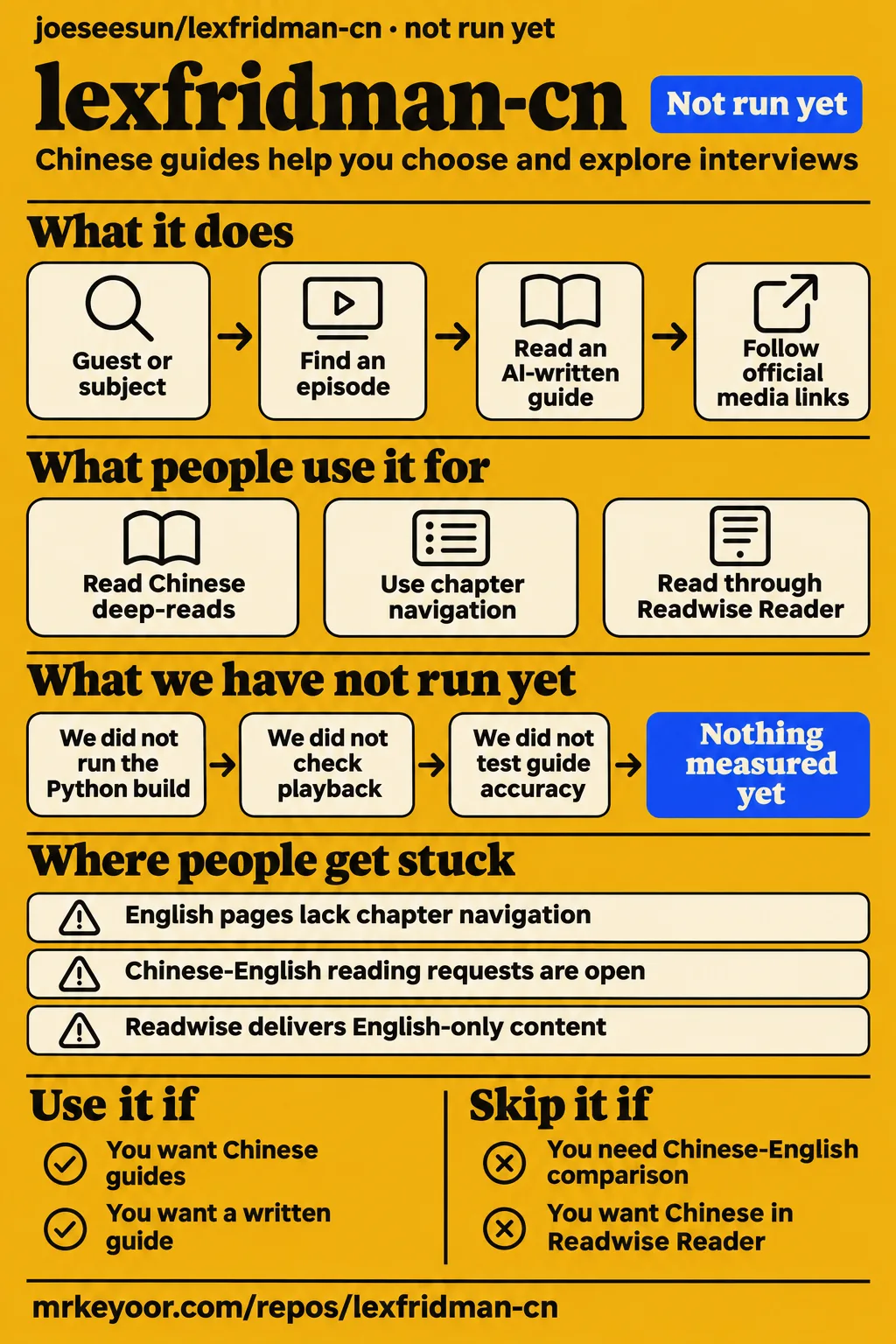
lexfridman-cn suits readers who want Chinese guides before committing to a Lex Fridman interview. It offers a route through finding an episode, reading an AI-written guide and returning to the original conversation. The README describes 506 episode entries and 463+ Chinese deep-reads, so the catalogue and guide collection have different reported totals. For someone who wants to read rather than maintain the publishing machinery, the hosted lexfridman-cn site is the direct starting point.
What you can do with lexfridman-cn
Use it to find interviews, read AI-written Chinese guides and follow links to official media. The README describes lexfridman-cn as a Chinese companion to the Lex Fridman Podcast. Its Chinese documentation calls it an unofficial fan project, and its English documentation describes guides based on the full interviews. Start with a guest or subject that interests you, read the guide and use the episode's official media links to return to the conversation. Project README.
The documented search accepts multiple words together, ranks guest names above titles and descriptions, and supports exact episode numbers. These give readers several ways into the archive: a known guest, a subject or a particular interview. Shareable search URLs and keyword highlighting also appear in the README. If you recommend an interview to someone else, a search URL can preserve the query you used instead of sending them to the homepage without that context.
The README also lists remembered playback speed, resume playback, a mini player, reading progress and a contents sidebar. These controls support returning to long interviews and guides. They sit alongside the main reading task: deciding whether a conversation deserves more time and keeping a written reference available while exploring it. The project describes its Chinese deep-reads as AI-rewritten long-form guides, rather than machine translations, so readers should approach them as a separate treatment of the interview.
What people use lexfridman-cn for
Two GitHub readers describe using Chinese deep-read pages and subscribing through Readwise Reader. Their reports show how the companion fits into existing reading habits: one reader wanted navigation across languages, while another wanted the site's material in a preferred subscription app. The table keeps those experiences attributed to the people who reported them, so readers can compare the circumstances with their own intended use.
| Reader and activity | Reported outcome | What it means for your choice |
|---|---|---|
| The author of GitHub issue #2, reading Chinese deep-reads with their chapter sidebar | Called the project convenient and requested equivalent English navigation and Chinese-English comparison reading | Treat Chinese guide reading and parallel bilingual study as separate requirements |
| The author of GitHub issue #3, subscribing through Readwise Reader | Reported English-only content in Reader while the browser supported three languages | Choose the reading destination as well as the content language |
The first report starts with a reader already using the Chinese pages and asking for a corresponding English reading experience. The second starts with a subscription app and describes a different result there. These are useful selection criteria: decide whether you want to browse the site's own pages, study corresponding passages in two languages or collect new material in another application. Each task asks something different of the companion.
What happened when we ran it
Our harness evaluation at commit 7046f02 lasted 3 seconds on November 16, 2026 and stopped before application execution. The harness classified the repository as HTML, found no supported ecosystem and found no Dockerfile. Our run recorded an allocation of 3 CPUs and 8 GB RAM, with image n/a. The outcome was NOT RUN, reached at the deployment decision rather than after a build or reading session.
| Recorded evaluation | Result |
|---|---|
| Repository execution | NOT RUN: no supported ecosystem, language classified as HTML |
| Container path | No Dockerfile in the harness observation |
| Hands-on safety step | FAILED because no supported Compose filename existed |
| Cleanup | Teardown reported ok |
The hands-on safety record names the failed requirement: none of compose.yaml, compose.yml, docker-compose.yaml or docker-compose.yml existed, and the rule required a Compose file. The teardown record reports successful cleanup. The failure describes eligibility for that deployment route. The README documents a different route, using a Python script to generate the static site and Python's HTTP server to preview its output.
The hands-on run summary says the repository deployed on November 16, 2026 using its own Docker Compose configuration, with every port bound to 127.0.0.1. That statement conflicts with both the failed safety step and the harness's NOT RUN result. This review uses the detailed failure and harness result as the recorded outcome. The summary remains part of the record, but it does not change where the documented attempt stopped.
Where people get stuck: English navigation and Readwise
Issue #2 requests English chapter navigation and Chinese-English comparison reading; issue #3 reports English-only subscription content in Readwise Reader. Both records show open issues with zero comments. For a reader choosing a regular workflow, the practical response is to match the desired task with the documented reading route. The table separates the requested behavior from the next step available in the evidence. English navigation request, Readwise language report.
| Symptom or requirement | Evidence | Practical next step | Resolution in the record |
|---|---|---|---|
| English transcript needs the Chinese page's chapter sidebar | Issue #2 describes the navigation difference | Consult the official transcript for English chapter navigation | Requested, open |
| Chinese-English comparison reading is essential | Issue #2 requests this reading mode | Keep the original interview and Chinese guide available as separate references | Requested, open |
| Readwise delivers English when Chinese was expected | Issue #3 describes the subscription result | Start with the browser's Chinese reading route | Reported, open |
Keeping the guide and original interview open gives each reference a clear purpose. The guide provides Chinese written orientation; the original supplies the conversation itself. A reader who wants English chapter navigation can also consult the official Peter Steinberger transcript discussed below. These are reading arrangements supported by the documented sources, rather than repairs to either GitHub issue. Choose the arrangement that fits the material you want to consult most often.
Episode coverage exceeds deep-read coverage
The README reports 506 episode entries and 463+ Chinese deep-reads as separate totals. QingQ77's project announcement makes the same distinction, describing an independent page for each episode and more than 463 AI-written guides. An archive entry and a long-form guide are different pieces of content. For a reader choosing a particular guest, the relevant question is which material appears on that episode's page. QingQ77 announcement, project coverage documentation.
The README says guide production continues to fill the collection. Its broader description of all 506 episodes therefore needs to be read alongside the separate guide total. Use the catalogue to locate an interview, then look for its Chinese treatment. This is a more useful way to choose an episode than treating the larger archive figure as a promise that every entry contains the same set of materials or the same depth of written coverage.
Reading the site and maintaining the pipeline are different jobs
The README documents a Python static-site generator and a separate macOS-oriented content-generation pipeline. Readers can begin at the hosted lexfridman-cn site. Maintainers have a different starting point: generating pages from the committed metadata and guide corpus. Obtaining new transcript material, producing more guides and deploying updates belong to the content workflow described separately in the documentation. README quick start.
For local output, the README instructs users to clone the repository, run python3 tools/build.py, then run python3 -m http.server 8123 -d site and open http://127.0.0.1:8123. It says the build uses Python's standard library, with metadata and the Chinese deep-read corpus committed to the repository. These are upstream instructions for generating and serving the static pages. They are presented here as the documented route, with our execution outcome recorded above.
The content pipeline reads its LLM key from macOS Keychain and defaults to the author's private Magpie gateway. External users are directed to change BASE_URL in tools/gen_zh.py to their own OpenAI-compatible endpoint. The README also describes mlx-whisper for local transcription and an rsync deployment destination that maintainers replace with their own host path. Someone maintaining fresh content therefore needs to consider credentials, transcript retrieval and deployment in addition to the static build command.
MIT covers the code, not the whole archive
The README applies MIT to code only and gives separate terms for Chinese deep-reads and metadata. It asks republishers to attribute and link to the corresponding original episode page. English transcripts have a further distinction: the README assigns their rights to Lex Fridman, guests and producers, and says the repository excludes them from distribution. README content and license boundaries.
This matters when the intended use is a mirror, derivative archive or another reading product. Browsing a guide and redistributing its text involve different choices. Identify whether you intend to copy software, Chinese guide content, metadata or transcript material, then read the corresponding terms. The repository's MIT label answers the software question; the content section supplies the additional instructions relevant to the archive. Keep attribution connected to the episode page when following the README's republication instructions.
lexfridman-cn vs official transcripts and FreshRSS
Official Lex Fridman transcripts provide English source reading, while FreshRSS aggregates feeds. The comparison is therefore about the job each option performs: reading a Chinese guide, consulting an interview transcript or collecting subscriptions. The official transcript evidence concerns the Peter Steinberger episode. FreshRSS's own README supplies its product category. Those sources support the purpose-based choices below without treating the three options as interchangeable products.
| Option | Documented purpose or behavior | Pick it when |
|---|---|---|
| lexfridman-cn | AI-written Chinese guides, episode pages and official media links | Chinese reading helps you choose and explore interviews |
| Official Peter Steinberger transcript | Chapter directory and timestamps linking to the interview video | You want English source text with navigation on that episode |
| FreshRSS README | A self-hosted RSS feed aggregator | You want to collect feeds from multiple sources |
The official Peter Steinberger transcript includes chapter links and clickable video timestamps. Its introduction identifies it as the transcript of Lex Fridman Podcast #491 and explains that timestamps open the corresponding point in the main video. FreshRSS is a self-hosted RSS feed aggregator. These descriptions give readers concrete starting points: open the transcript for that interview's English text, or examine FreshRSS when the problem is managing subscriptions from multiple sources.
What directory summaries leave out
The directory listings condense coverage and licensing details that the README explains separately. The Agent Skills Hub listing labels the project MIT licensed, while the README distinguishes code from Chinese deep-reads and metadata. Someone considering redistribution needs the project's content terms alongside that short label. The directory field identifies the repository's software license, but the README gives the material-specific instructions relevant to reuse.
The GitHubSignals listing repeats a broad description of AI deep-reads and official audio and transcripts for all 506 episodes. The README separates episode entries from the 463+ guide collection and explains that English transcripts are obtained locally rather than distributed in the repository. Read together, these details help a prospective reader or maintainer ask a more precise question: which material is available for the chosen episode, and where does it come from?
Questions people ask
Read on the hosted site or follow the README's Python local-build instructions; GitHub issues request English navigation and report Readwise language trouble. The answers below cover those reader questions, then explain the project's identity, setup, language classification and licensing. For a first visit, hosted reading is the shortest documented route. Maintaining pages or reusing archive content calls for the additional build and content-rights instructions linked in the relevant answers.
Can English transcript pages have a clickable chapter directory like Chinese deep-read pages?
Issue #2 requests a clickable chapter directory for English transcripts. Its author asks for links to corresponding transcript sections and for Chinese-English comparison reading. The record shows the request open with zero comments. For English reading on the Peter Steinberger episode, the official transcript provides a chapter directory and links into the conversation. Issue #2 request, official transcript navigation.
Why does lexfridman-cn RSS show only English in Readwise Reader when the browser supports three languages?
Issue #3 reports English-only content through Readwise Reader. The author describes Simplified Chinese, Traditional Chinese and English in the browser, then English content through the subscription app. The issue is open with zero comments. The report identifies the two reading destinations and their different language results, making it relevant to readers who specifically intend to use Reader. Issue #3 subscription report.
What is lexfridman-cn?
lexfridman-cn is an unofficial Chinese companion to the Lex Fridman Podcast. The README describes episode pages, AI-written Chinese guides, bilingual titles, search and official media links. It presents the guides as long-form treatments based on the interviews. A first-time reader can begin with the hosted site, choose a familiar guest or subject, and move between the written guide and the linked official conversation. Project README.
How do I install or use lexfridman-cn?
The README offers hosted reading and a Python local-build route. To generate local output, it documents cloning the repository, running python3 tools/build.py and serving site/ with Python's HTTP server on port 8123. It describes the build as using only Python's standard library. Automatic syncing and guide generation belong to the separately documented content pipeline. Documented quick start.
What programming language is lexfridman-cn written in?
GitHub's repository metadata lists HTML as the primary language, and the README identifies a Python static-site generator. For someone assessing local setup, the actionable instructions are the Python build and preview commands. The language label alone is less useful for deciding how to generate the pages. Read it alongside the documented build route when evaluating the repository. GitHub repository facts, build documentation.
What license does lexfridman-cn use?
The README applies MIT to code only. Chinese deep-reads and metadata have separate content terms, including attribution and a link to the original episode page when republishing. English transcripts are described separately by ownership and distribution. Before reusing material, identify which of those categories you intend to copy and consult the matching instructions in the project's documentation. Content and license boundaries.
What we have not tested yet
The 3-second harness evaluation supplies no application performance result. We did not run lexfridman-cn because the harness supported neither its HTML classification nor a Dockerfile path. The 3 CPUs and 8 GB RAM describe allocation rather than consumption; image n/a identifies no operating-system or runtime version. The records contain no executed Python build, browser session, search assessment, playback check or reproduced Readwise subscription, and the conflicting deployment summary supplies no successful execution evidence.
The evidence contains no application timings, passing-test totals, memory measurements, vulnerability results, load test or competitor benchmark. Guide accuracy against complete interviews, catalogue completeness, offline media behavior, automatic content generation and endpoint costs are outside the recorded work. The reader issues supply no technical cause or tested repair, and FreshRSS compatibility with this feed's language delivery remains untested. The README says the unofficial AI-generated guides may contain errors and that the original interviews are authoritative.
The latest-release lookup contains no release record and leaves release availability unknown. Repository metadata observed on November 16, 2026 records a last push on November 11, 2026; those dates and two sampled open issues supply no release cadence or support commitment. Setup ease, documentation accuracy through execution, community response quality and operational maturity therefore remain unassessed. A useful next step is to compare a familiar interview with its guide and try the subscription app intended for regular reading.