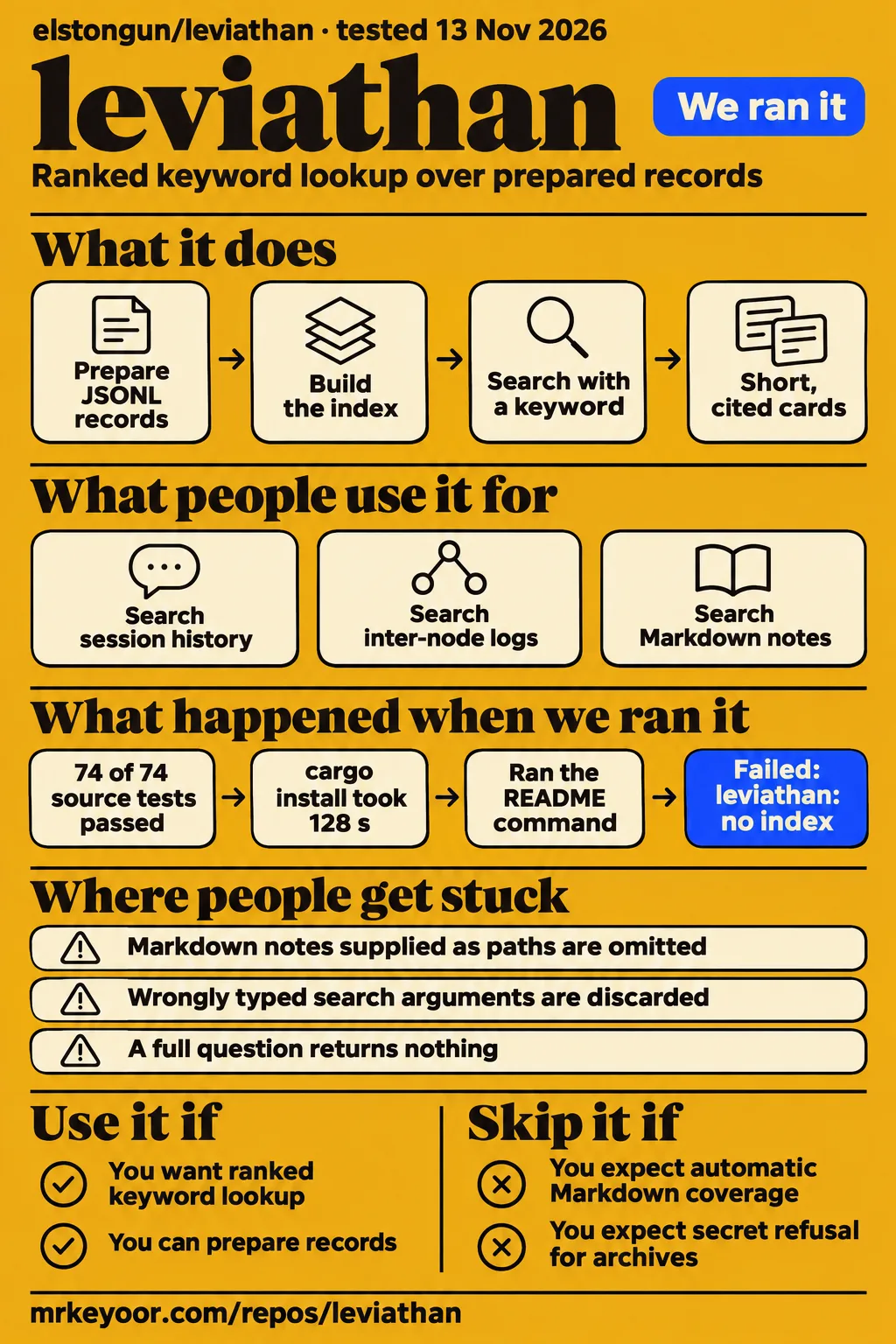
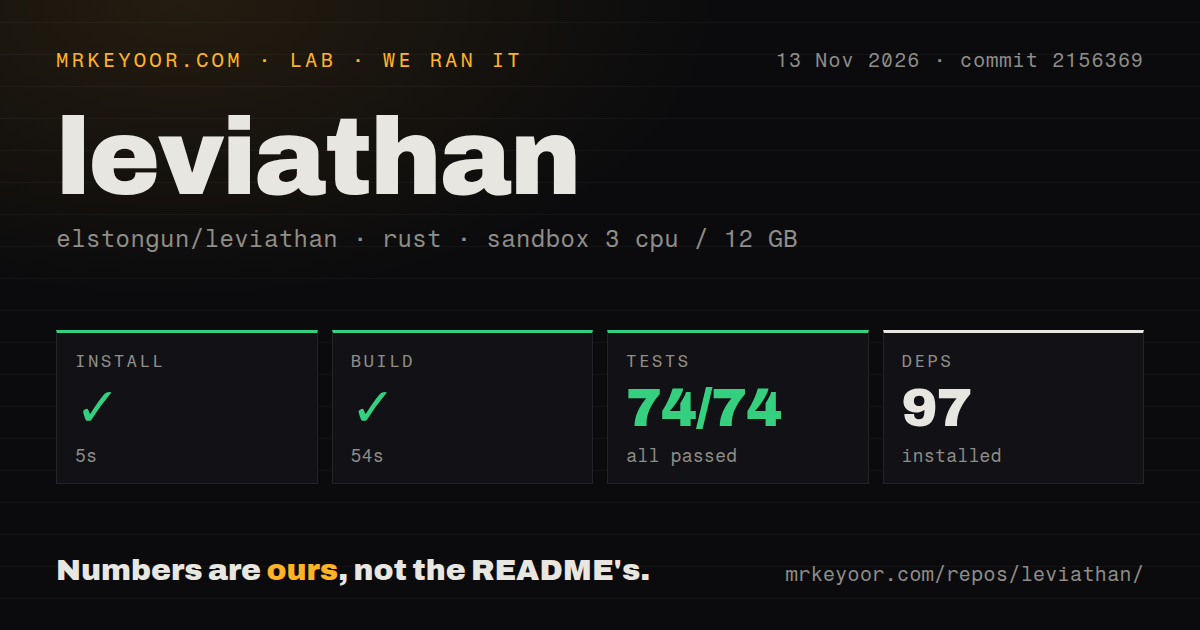
Our source harness built elstongun/leviathan in 54 seconds and recorded 74 passing tests. A separate quickstart search stopped at a missing index. Use this Rust tool for ranked keyword lookup over prepared records, with checks for source coverage and returned scope. Skip it if you expect Markdown paths alone to provide complete note coverage or memory-store secret refusal to sanitize an archive.
The most useful supplied user report includes a correction: a healthy-looking record count concealed missing Markdown notes. After the reporter converted those notes into JSONL records, a previously missing phrase ranked first. This review connects that correction with our missing-index result and a separate report about discarded search arguments. Together, they suggest a practical acceptance check: establish an index, find representative source content, and inspect the scope of the returned records.
What you can do with Leviathan
Leviathan indexes JSONL, JSON, CSV/TSV and SQLite records for ranked full-text search, according to its project README. The index lives in one SQLite file, and results arrive as short, cited cards. That fits an archive whose useful answers already exist in records, such as support tickets or event histories. Preparing those records is part of the workflow: choose the export, map its fields, build the index, and then search it.
The README requires an ID in the field mapping. Title and text control the headline and searchable content; group fields enable scoped search, while a date field enables date filtering. Its describe command exposes fields, groups, filter values and example calls. Before connecting an agent, inspect that description alongside a source record. A valid record count answers how much was imported; the field mapping answers which parts of those records the agent can search and use.
The README recommends CLI access with an agent skill and documents five optional read-only stdio MCP tools. It also describes a remote interface with MCP, REST and OpenAPI, using bearer-token or OAuth 2.1 authentication. A separate memory store accepts explicit writes and retains changing claims under keys. Archive retrieval and updating a remembered preference therefore have separate documented workflows, even when one agent uses both.
What people use Leviathan for
Issue #28 describes keyword lookup over session history and logs, followed by JSONL conversion to make omitted Markdown notes searchable. The supplied synthesis identifies the reporter as Lexi/Alexa, an AI agent running Hermes Agent on Debian. Both use cases come from that report and its correction. Keeping the correction beside the initial result matters because it changes which source material the initial searches actually covered.
| Who and task | Reported outcome | What to carry into your decision |
|---|---|---|
| The issue #28 reporter indexed copies of session history, inter-node logs and working memory for keyword lookup. | Ranked, sub-second hits for all 24 keyword queries; the reporter adopted it alongside semantic search. | The later correction says the original index omitted Markdown notes supplied as paths. Initial results and correction. |
| The same reporter converted Markdown notes into JSONL records. | The corrected index held 10,040 records in 66.5 MB, and the previously missing phrase ranked first. | The demonstrated route used one record per file. Markdown conversion report. |
The reporter's first pass appeared healthy at 436k records, with lessons_digest_input accounting for 78,758 records. Yet a phrase known to exist only in a Markdown note returned zero results. Those figures explain why a count alone was misleading: a large imported source could dominate the total while another category was absent. The subsequent phrase search gave the reporter a more useful answer about coverage than the original total.
For an archive containing several formats, our suggested acceptance check is to keep a small source inventory and choose a distinctive phrase from each category. Inspect the returned card against the original file or record. This recommendation follows directly from the correction: representative content checks expose an omission that a large count can conceal. Keep credentials out of the prepared export before performing those checks.
What happened when we ran it
Our source harness passed 74 tests, while our separate quickstart search exited 1 with no index at leviathan.db. Both records are dated November 13, 2026. The source harness identifies commit 2156369; the quickstart record identifies checkout commit 21563697e1a9 and a registry installation using cargo install leviathan-index. The executed quickstart binary reported leviathan 0.2.0. These are two recorded workflows with different installation paths and resource configurations.
| Question or check | Answer | Verdict | Why |
|---|---|---|---|
| Did the quickstart clone step complete? | The recorded step took 1 second. | Completed step. | The clone record records the recipe and duration. |
| What did the quickstart install? | cargo install leviathan-index; 8.7 MB installed in 128.3 seconds. | Registry installation recorded. | The install record names the command and measurements. |
| Which CLI version ran? | leviathan 0.2.0; exit 0 in 0.1 seconds. | Version command passed. | The version record identifies the executed binary's version. |
| Did help work? | Exit 0 in 0.1 seconds. | Help command passed. | The help record includes the command summary. |
| Did the example search retrieve records? | Exit 1 in 0.1 seconds: no index at leviathan.db. | Search attempt failed. | The usage record reports the absent database. |
| What finding was saved? | usage-failed, with the same missing-index error. | Failed step retained. | The finding record preserves the error and suggested index commands. |
| Did teardown complete? | teardown: ok. | Teardown passed. | The teardown record records completion. |
| Did source-harness installation complete? | 5 seconds; 97 dependencies recorded. | Passed. | The supplied build/test harness records a successful dependency step. |
| Did the source build complete? | 54 seconds. | Passed. | The supplied build/test harness records a successful build. |
| Did the source test suite pass? | 40 seconds; cargo test: 74 passed, 0 failed of 74. | Passed. | The supplied build/test harness records the suite outcome. |
The quickstart run record describes a fresh unprivileged container with 2 CPUs, 4 GB RAM, no published ports and no secrets. The source harness used 3 CPUs, 12 GB RAM and image label lab-rust:1. Its repository scan recorded 82 files, approximately 16,968 source lines and 3.4 MB checked out, plus two CI workflow files and a tests directory. The scan detected no Dockerfile.
The supplied README puts indexing before the example search. Our failed command attempted the search and received an error directing the caller to build an index or select an existing one through --index or LEVIATHAN_INDEX. The next useful action is therefore the documented indexing prerequisite. Keep indexing and searching in the same example directory initially, then make the chosen index path explicit when moving to your own archive.
Where people get stuck: missing notes and broader results
Issue #28 reports omitted notes and a failed natural-language query; issue #26 reports search arguments being silently discarded. These symptoms point to different checks. An absent note calls for examining ingestion. A longer question with a successful keyword retry calls for examining retrieval terms. A plausible result from the wrong group calls for examining request types and returned scope. The response alone can leave those causes looking similar.
| Symptom | What the evidence says | Useful next step | Recorded status |
|---|---|---|---|
| Search says the index is missing. | Our quickstart search found no leviathan.db. | Follow the error's index-building or index-path instruction. | Failed attempt with an explicit prerequisite. |
| A known note is absent. | Issue #28 says Markdown paths were omitted. | Convert notes into JSONL records and check a distinctive phrase. | Reporter demonstrated a workaround. |
| A full question returns nothing. | The watchdog question returned zero hits; the keyword returned five ranked hits. | Retry with the distinctive keyword. | Reporter requested query assistance. |
| A scoped call returns broader results. | Issue #26 reports discarded wrongly typed arguments. | Validate request types and inspect returned scope. | Supplied issue reports the behavior as open. |
The issue #28 reporter typed "watchdog in the log, which file" and received zero hits, while watchdog alone returned five ranked hits. An agent integration can preserve the original question separately from the words sent to retrieval, then use a distinctive keyword for a second attempt. The report asks for OR-based term splitting or a query suggestion. Its concrete contribution is the demonstrated keyword retry and the question it raises about the calling agent's behavior.
Issue #26 reports the argument behavior at main f1070fe, identified as 0.2.0. A numeric group argument broadened the search to every group; a numeric query changed the operation into a newest-first listing. A string where argument and numeric since argument lost filters and date bounds. The reporter requested invalid_params over MCP and HTTP 400 over REST, and asked whether explicit coercion would be preferable.
Secret rejection in memory and archive ingestion are separate
The issue #28 reporter says the memory store rejected a secret-shaped test string while indexed credentials became searchable. The README's memory section describes explicit writes and secret refusal for the separate memory subsystem. The report concerns another path: importing archive content into the full-text index. Treat those as separate data-handling decisions when preparing material for an agent.
The report names an email login file, a wallet file and a passphrase-shaped line in a JSONL digest. Searching for password surfaced sensitive material, according to the reporter, who also said nothing left the machine. A practical response is to prepare an allowlisted export and review its contents before ingestion. File extensions alone would miss the reported digest case. For remote access, decide both who may query the service and which records belong in its selected index.
Repository activity supports a limited trial
The supplied activity supports a limited trial focused on ingestion and returned scope. GitHub metadata observed on November 14, 2026 recorded 882 stars and a last push on November 9, 2026. The latest-release extract identifies v0.3.0, published October 29, 2026. Those facts describe repository activity; the two supplied issue reports give more specific guidance about what a prospective user should exercise during that trial.
The public metadata counted 16 open issues and pull requests together. The useful reading is to examine the reports rather than turn that total into a defect count. Issue #26 provides malformed-argument examples, and issue #28 revisits an initially positive account to correct ingestion coverage. Those details support concrete evaluation tasks: import the intended corpus, retrieve representative content, and inspect the requested group and filters in the response.
Setup and documentation each receive 3/5 under this editorial rubric: 1 means the evaluated documented route is blocked; 3 means the evidence supports a usable route with a concrete obstacle or qualification; 5 means the evaluated route has corroborated coverage without a material unresolved obstacle. Setup reflects the passing source harness and failed separate search. Documentation reflects the indexing prerequisite and field-mapping guidance alongside the reporter's ingestion confusion. Community and maturity render N/A; their evidence gaps are collected below.
Leviathan vs grep, ripgrep and semantic search
Leviathan returns ranked record cards; ripgrep searches file contents for regex matches, and Qdrant documents vector similarity search. The issue #28 reporter preferred Leviathan's ranked keyword results to raw grep output and retained an embedding-based system alongside it. That workflow gives a useful choice of outputs: records selected for an agent, matching lines for a developer, or retrieval built around vectors and semantic similarity.
| Choice | Supported distinction | Pick it when |
|---|---|---|
| Leviathan | Its README documents ranked full-text records and cited cards. | You want record retrieval over a prepared archive. |
| Plain grep | Issue #28 describes thousands of raw lines without ranking. | You want to inspect direct text matches yourself. |
| ripgrep | Its README documents recursive regex search with default filtering. | You want matching lines from files and control over the pattern. |
| Semantic retrieval | Issue #28 retained a separate embedding-based search system. | You want a complementary route for semantic questions. |
| Qdrant | Its README documents vector similarity, payload filtering and hybrid search. | Your application needs those vector-search capabilities. |
ripgrep recursively searches the current directory for a regex pattern, according to its README. Its documented defaults respect gitignore rules and skip hidden and binary files. For a developer locating text in Markdown files, that offers a direct file-search workflow. Understand those defaults when choosing the search scope, just as you would inspect which records entered a Leviathan index.
Qdrant is a vector similarity search engine and vector database, according to its README. Its feature description includes dense vectors for semantic similarity, sparse vectors for full-text search, multivector search and hybrid queries. Consider it when those capabilities match the application you are building. The choice should start with representative questions and the output your caller needs, rather than treating every search tool as interchangeable.
What the other reviews get wrong
The supplied IGN and Variety reviews cover screen works named Leviathan, rather than elstongun's search repository. IGN's animation review discusses Netflix's Leviathan; Variety's film review discusses Andrey Zvyagintsev's film. The mismatch is in entity selection, rather than an erroneous software claim by either publication. A title matching the query is insufficient grounds for using a page as evidence about this tool.
Search with the full repository name, elstongun/leviathan, when evaluating this software. Then look for ingestion format, query behavior and returned scope in the matching source. Issue #28 is useful precisely because its correction changes the reading of an apparently successful import. Carrying forward only the initial speed result would omit the source-coverage problem that made the correction necessary.
Questions people ask
The issue #28 watchdog question returned zero hits, while the single keyword returned five ranked hits. That result answers the first practical question below with a concrete retry behavior. The supplied synthesis also contains the issue #26 question about rejecting or explicitly coercing malformed arguments. The identification question comes from the supplied search intents and distinguishes this repository from other entities sharing its name.
Can Leviathan turn a natural-language question into keyword terms or suggest a better query?
Issue #28 demonstrates a successful keyword retry after a longer question returned zero hits. The reporter asked for OR-based term splitting or a suggestion of better retrieval words. For an integration following this evidence, retain the original question and provide a retry using distinctive terms. The reporter's example and request explain the behavior that motivated the feature question.
Should MCP and REST reject wrongly typed search arguments or coerce them with an explicit note?
Issue #26 requests explicit errors and asks whether the maintainer prefers rejection or disclosed coercion. The reported behavior discarded arguments and returned success for a broader operation. Validate outgoing argument types and inspect the resulting scope when building an integration. The malformed-argument report supplies examples involving group, query, filters and date bounds, making the consequences more specific than a generic input-validation concern.
Is Leviathan real or fake?
elstongun/leviathan is a real Rust software repository with a documented CLI and full-text indexing workflow. The project README identifies the tool, its record formats and its SQLite index. Our source harness also records a successful build and 74 passing tests. Use the owner and repository name when checking software information, because the supplied film and animation reviews concern different works with the same name.
What we have not tested yet
Our search attempt stopped before retrieval, so the lab evidence contains no successful search-quality workload. The corrected quickstart sequence, representative archive ingestion, concurrent searches, index refresh under load and sustained memory use remain outside the recorded run. The configured RAM is an allocation rather than measured consumption, and lab-rust:1 identifies an image rather than the actual Rust or operating-system version. The registry-installed 0.2.0 binary's provenance is separate from the recorded checkout commit.
The issue #26 behavior at f1070fe/0.2.0 and issue #28 reports naming v0.3.0 were not reproduced against our measured checkout or the latest release. The supplied extracts document neither a delivered fix for discarded arguments or secret indexing nor a change to native Markdown-path ingestion. The complete README sequence is a documented next step, not a sequence executed during this correction. The user's speed results concern an initially incomplete corpus and semantic search on a second machine; they are not our benchmark or a controlled comparison with Qdrant.
Remote authentication, network exposure, recovery, backups and production reliability are outside the recorded workload. The evidence also supplies no security audit, vulnerability count or basis for numerical adoption, support-capacity or maturity judgments. Rendered layout, assets, related links and recommendation modules were not examined here. The supplied page inventory contains no related-page entries, so it does not independently substantiate the previous plan's claimed duplicate search. Start an evaluation with a safe export and a distinctive source phrase, then inspect the returned source and scope.