mrkeyoor.com_
Thu 03 Sept 06:55 UTC
AI Toolsevaluationupdated 03 Sept 2026

learnopencv review

LearnOpenCV is a large collection of code companions for computer vision, deep learning, and AI articles. Each directory tackles a separate subject, so developers can study or adapt a worked example without expecting one shared application or library.

Verdict

Our LearnOpenCV subproject install pulled 96 packages and occupied 7,002 MB, making this archive best suited to developers who need a specific worked example and can isolate it. Use it as a map into a topic, then audit that directory's dependencies, data, and hardware needs before carrying code into a product. The missing test target, 10 audit findings, and undetected repository license rule it out as a drop-in production dependency.

We ran it

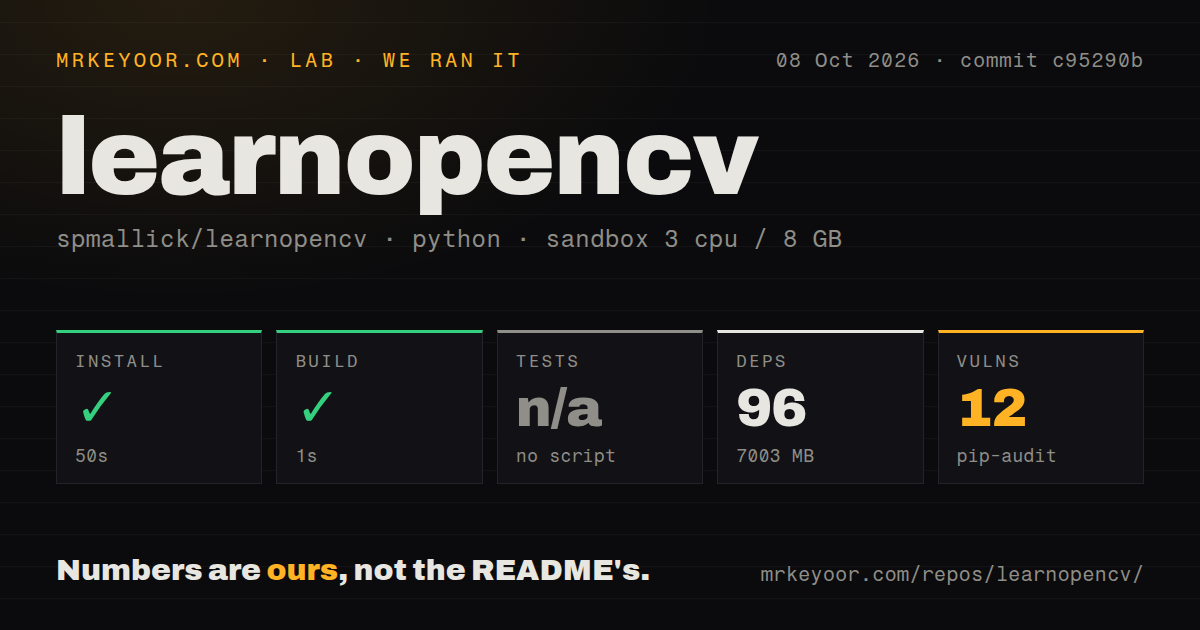
Lab card: what happened when we ran learnopencvScreenshot of learnopencv (www.learnopencv.com)
Install✓ · 70s96 packages · 7002 MB
Build✓ · 3s
Testsn/ano test script
Known vulns10(pip-audit)
Repo14352 files~552,079 lines of source · 4797.4 MB · 0 CI workflows

Answers from our run

Does learnopencv build from source?

Dependencies installed in 70 seconds (96 packages), and the build succeeded in 3 seconds. We cloned commit 371c972 into a clean Debian container with 3 CPUs and no project-specific setup.

Does learnopencv have tests you can run?

Not through a standard command: the project exposes no test script or target that our harness could run.

Does learnopencv have known vulnerabilities in its dependencies?

pip-audit flagged 10 known advisories in the dependency tree at the time of our run.

Who should not use learnopencv?

Teams needing one stable package or API: the root README is an index of independent article projects, and the measured code lives several directories down.

What are the alternatives to learnopencv?

OpenCV, Computer Vision Recipes, Dive into Deep Learning. Our LearnOpenCV subproject install pulled 96 packages and occupied 7,002 MB, making this archive best suited to developers who need a specific worked example and can isolate it.

Setup2/570-second install, 7,002 MB, and each project needs its own setup
Docs3/5Huge article index, but individual project instructions stay brief
Community4/523,118 stars with August 2026 code and issue activity
Maturity3/5Long-lived archive lacks one license, CI gate, or test contract

Who it’s for

Computer vision developers looking for runnable companions to specific LearnOpenCV articles.
Students who learn best by reading Python, C++, and notebook examples alongside an explanation.
Engineers comparing older OpenCV techniques with newer detection, tracking, and vision-model projects.
Researchers willing to isolate one directory and pin its dependencies before adapting the code.

Who it’s NOT for

Teams needing one stable package or API: the root README is an index of independent article projects, and the measured code lives several directories down.
Small CI runners or offline workshops: our measured checkout was 4,797.4 MB, and one subproject occupied 7,002 MB after installation.
Buyers requiring a repository-wide automated regression gate: our scan found 0 CI workflows and no tests directory, while the measured project had no test target.
Security-sensitive deployments that cannot pause for dependency review: pip-audit reported 10 known vulnerabilities in our installed environment.
Organizations whose policy requires a detected license before reuse: GitHub's repository metadata and license endpoint did not identify one.
Learners expecting every older model download to remain intact: open issue 768 reports multiple broken URLs in getModels.sh.

Setup reality

Our sandbox installed the Python project in 70 seconds, adding 96 packages and occupying 7,002 MB. The build succeeded in 3 seconds. The 4,797.4 MB checkout contained 14,352 files and about 552,079 source lines. There was no test script or target, so tests were skipped; pip-audit reported 10 known vulnerabilities.

The measured project sits in 3D-LiDAR-Object-Detection/, requires Python 3.12.x, and expects KITTI data plus the included checkpoint layout. Its documented commands do not require hosted credentials. TensorBoard is optional for viewing training logs on port 6006.

The root repository has no single setup path because it collects unrelated article projects. The LiDAR README shows inference and training with GPU index 0, and the checkout has no Dockerfile. Treat each directory as its own environment and check its article, assets, paths, and hardware assumptions before running it.

The 14,352-file checkout is an archive, not one application

LearnOpenCV pairs computer vision articles with source code, notebooks, models, images, and small projects. Our measured checkout contained 14,352 files and about 552,079 lines of source, which explains both its appeal and its awkwardness. You can find classical OpenCV operations, camera geometry, object tracking, neural-network examples, LiDAR work, and recent vision models in one place. The root README is mainly a long article index. It does not describe one architecture, command, or dependency set that governs every directory.

That structure works when you arrive with a precise question. A developer who wants 3D LiDAR detection can enter that folder, read the linked article, and inspect a complete training and inference path. Someone seeking a general-purpose package will spend time separating relevant code from years of unrelated material. The repository's current primary language is listed as Jupyter Notebook, yet many entries use Python or C++. Directory names and article dates matter because examples belong to different tool generations.

Python 3.12 gets the LiDAR example installed, while data remains your job

The measured project lives in 3D-LiDAR-Object-Detection/, whose README specifies Python 3.12.x and a requirements file with pinned packages. It implements a Keypoint Feature Pyramid Network workflow around KITTI data, with commands for point-cloud visualization, inference, video output, single-GPU training, and distributed training. A pretrained checkpoint is present in the documented layout, and TensorBoard can read saved training logs at port 6006.

There is no hosted account or API credential in that path. You still need the expected KITTI directory structure, local model files, enough storage, and suitable hardware for the command you choose. The README's shown inference and training invocations select GPU index 0. Source code exposes a CPU flag for testing, but the page does not explain CPU performance or provide a CPU training recipe. That makes a GPU machine the clearest documented route for reproducing the tutorial.

What happened when we ran it

Our sandbox installed the LiDAR project in 70 seconds, bringing in 96 packages and leaving 7,002 MB on disk. The build succeeded in 3 seconds. Those are acceptable wait times, but the storage cost is unusually high for a tutorial subproject, especially after a 4,797.4 MB repository checkout. Our test method used commit 371c972 in a fresh unprivileged Debian container with 3 CPUs, 8 GB of RAM, and no secrets.

No test script or target existed for the project, so we skipped tests instead of inventing a substitute. The checkout scan also found 0 CI workflow files, no Dockerfile, and no tests directory. A successful build therefore answers a narrow question: the prepared dependency set could complete its build step in our container. It does not establish model accuracy, successful KITTI inference, GPU compatibility, or regression safety across the rest of the archive.

Ten known vulnerabilities need review before copied code becomes a service

Pip-audit found 10 known vulnerabilities among the installed Python environment. The lab result does not say which findings are reachable through this tutorial or whether a newer compatible pin fixes each one. It does say that copying the environment unchanged into an exposed service would be careless. Review the audit output, update what the model code permits, and rerun the specific inference or training path you intend to keep.

The repository gives little central help with that job. There is no root Dockerfile to capture system libraries, and 0 root CI workflows means no visible shared matrix checks these independent projects together. Asset age is another concern: open issue 768 reports that several URLs in an older getModels.sh no longer download their resources. That report concerns a different example, but it shows why each chosen directory needs its own asset check.

August 2026 activity is current, while old examples keep their old edges

GitHub recorded 23,118 stars and 220 combined open issues and pull requests when we fetched the repository. The last push was August 30, 2026, and the latest release was published on August 29. Recent issue activity includes a July 2026 report and a pull request updated that month. Those dates show ongoing work; the combined open count should not be read as 220 bugs.

Current activity does not turn the collection into a versioned software product. The latest release concerns a SAM 3.1 article companion, while our sandbox measured an older LiDAR directory at commit 371c972. GitHub also returned no detected repository license. If your organization requires clear reuse terms, resolve that before copying code. Treat updated articles as individual snapshots and judge each by its own dependencies, source history, linked data, and open reports.

A 4,797.4 MB checkout only makes sense when the exact example is worth it

LearnOpenCV is useful when a specific article answers a problem you already have. The 4,797.4 MB checkout is poor value for someone seeking a tidy OpenCV course or one supported SDK. In those cases, OpenCV's own samples, Dive into Deep Learning, or a focused toolkit such as Ultralytics will be easier to track. For the right example, copy or clone deliberately, isolate its 96-package environment, and keep the article beside the code so its assumptions stay visible.

Alternatives

ProjectWhat it isPick it when
OpenCVThe main OpenCV library, with official samples and documentation beside the implementation.pick this instead when you need canonical API examples tied to the library's current source.
Computer Vision RecipesMicrosoft's collection of notebooks and guidance for common computer vision tasks.pick this instead when you want a smaller recipe collection organized around repeatable workflows.
Dive into Deep LearningAn interactive deep learning book with notebooks, math, and multi-framework examples.pick this instead when you need a structured course rather than an article archive.
Ultralytics gh↗A focused toolkit for modern detection, segmentation, pose, and tracking workflows.pick this instead when shipping a current YOLO-based application matters more than surveying many techniques.

What people are saying

  1. [velocity-scout] spmallick/learnopencv

Sources

  1. LearnOpenCV repository and article index
  2. 3D LiDAR Object Detection README at commit 371c972
  3. Pinned LiDAR project requirements
  4. Latest LearnOpenCV release
  5. Broken model download report

More ai tools reviews

go-micro · vit-pytorch · Scrapegraph-ai · Deep-Live-Cam · frontend-slides · genesis-world · the whole board →