Choose OpenCV by the vision operations your application needs
OpenCV supports image processing, camera geometry and video analysis, with interfaces for C++, Python, Java and JavaScript. Shortlist it when one application needs several of those operations. For example, a camera application may need both image correction and motion tracking. That is a reason to investigate OpenCV's breadth; our documentation build does not establish whether those operations work on your target.
A developer who only needs image resizing has a narrower decision. Start with the required operation and language, then compare suitable libraries. The supplied evidence contains no equivalent application workloads that would establish a performance winner.
What happened when we ran it
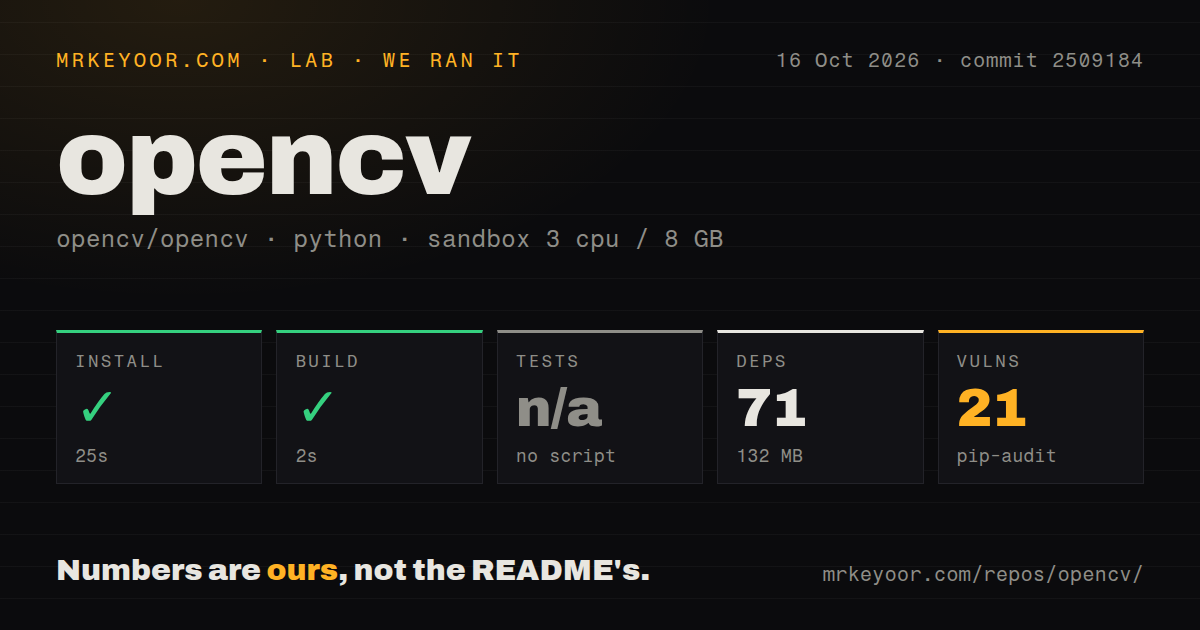
Our OpenCV documentation run installed 71 dependencies in 25 seconds. It built in 2 seconds at commit 2509184 on October 16, 2026, and recorded 132 MB on disk. Both steps succeeded. The selected Python project was ./docs_sphinx/; the run did not reproduce installation or execution of the native computer-vision library.
Tests were skipped because the selected project had no test script or target. Pip-audit reported 21 known vulnerabilities. The supplied summary does not identify the affected packages or their severity, so it cannot establish that OpenCV's image-processing code has those vulnerabilities. Review the recorded audit before reusing this documentation environment.
The recorded configuration was 3 CPUs and 8 GB of RAM, using the image label ghcr.io/astral-sh/uv:python3.12-bookworm. That label alone does not establish the actual Python or operating-system version. The harness scanned 7,417 files, about 1,967,599 source lines and a 160.7 MB checkout. It detected 2 CI workflow files, no Dockerfile and no tests directory. Those are scan results, not proof that the wider OpenCV project lacks testing.
Check API requirements before migrating to OpenCV 5
The OpenCV documentation says C++17 is the minimum required standard and the legacy C API has been fully removed. The former calib3d module is split into geometry, calib, stereo and ptcloud. Check your application's API calls and module references before choosing the major version.
The documentation provides separate tutorial entry points for Python and JavaScript, along with main-module references and pre-built-binary guidance. The repository README mainly directs readers to these resources. Our documentation score reflects those entry points and the specific migration and platform warnings, rather than a completed vision task.
Select the Android package and qualify Windows-on-Arm devices
The OpenCV 5.0.0 release, published June 6, 2026, warns that the original Android SDK includes a standard C++ library improperly aligned for devices with 16 KB pages. It directs Google Play releases to the package with the "16kb-page-fix" suffix. Check that package name when selecting the SDK.
The same release notes say Windows-on-Arm binaries were validated on Qualcomm Snapdragon devices. They warn that PPL auto-partitioning may fail on devices with private L2 caches and recommend building with OpenMP for those devices. These are maintainer warnings; our sandbox did not reproduce either platform condition.
Consider alternatives for a narrower workload
scikit-image describes its scope as image processing in Python. Consider scikit-image when Python image processing is the whole job and OpenCV's other language interfaces add little value. This is a recommendation based on scope, not measured speed or compatibility.
libvips is a demand-driven image-processing library. Its README lists resampling operations and support for image formats including JPEG, PNG and WebP. Consider libvips for an image-conversion or resizing service. The supplied evidence does not establish a throughput or memory advantage for your workload.
A recent repository push does not validate a backend
The supplied GitHub repository metadata records a push on October 23, 2026. That establishes recent repository activity, but says nothing about support response quality, resolution times or correctness on your device. No issue or pull-request feed was supplied for this assessment.
Before adopting OpenCV, take one representative input through the exact artifact you intend to ship and record the selected modules and backend. For an existing application, include the C++17 requirement, removed C API and module changes in that check. Native setup and application correctness remain unassessed by this run.