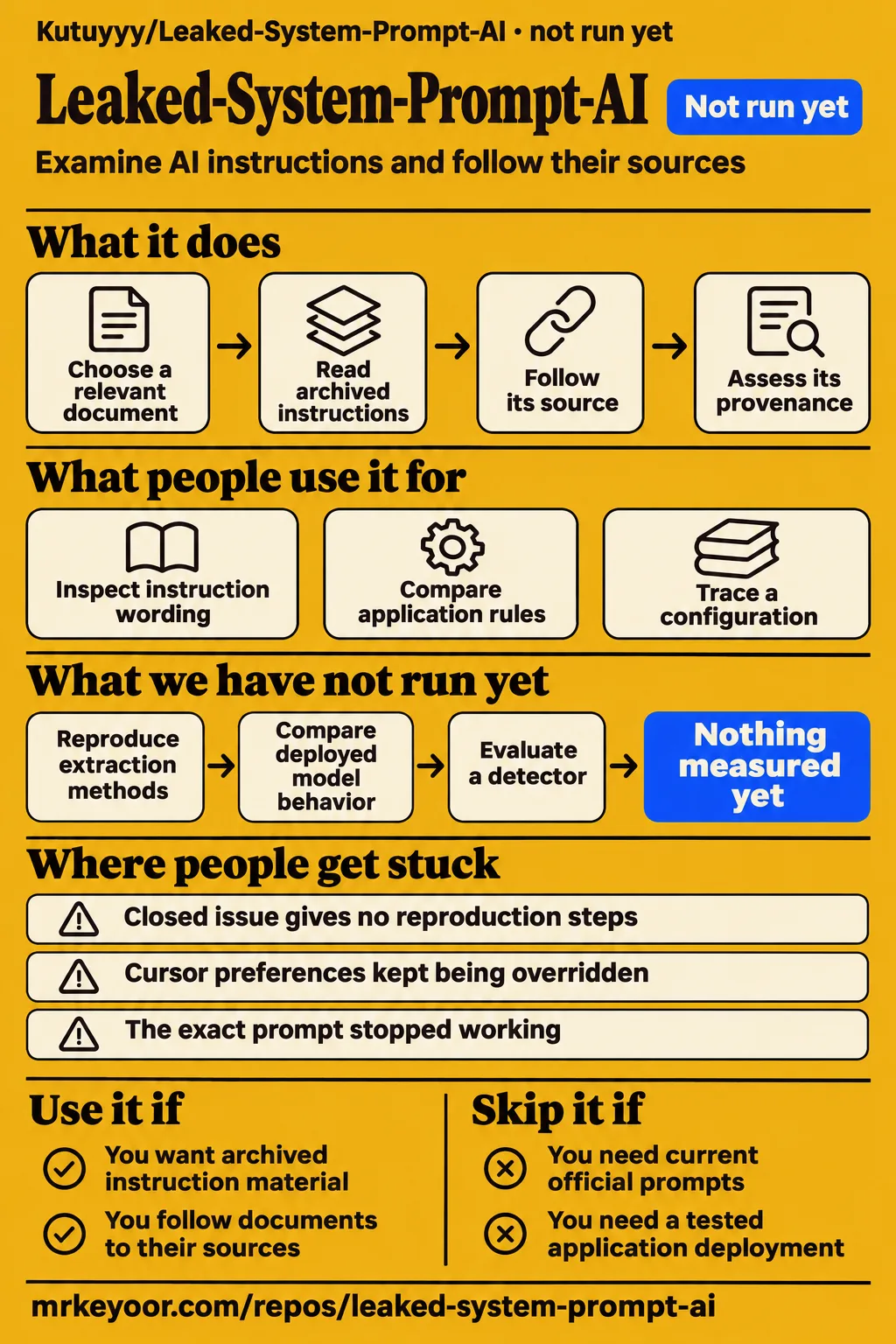
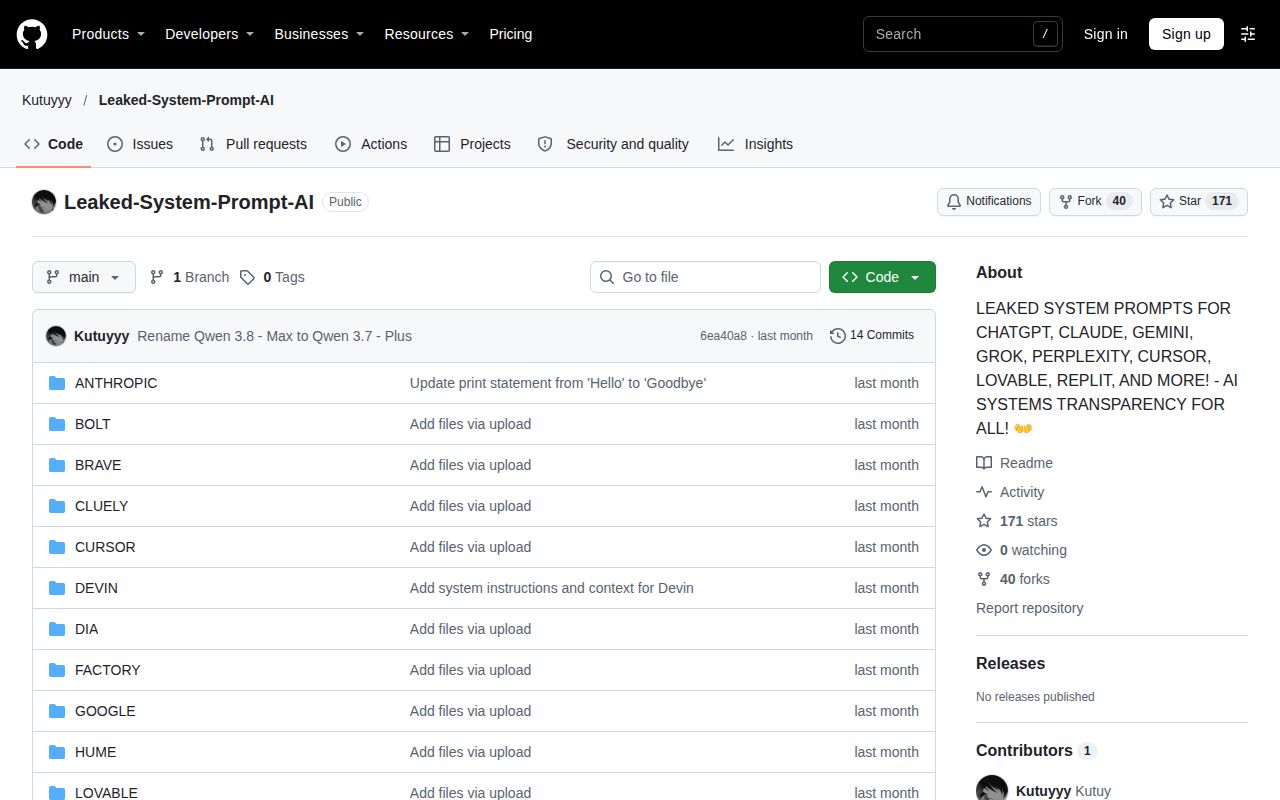
Kutuyyy/Leaked-System-Prompt-AI is a research archive for readers who want to examine AI instructions and follow their sources. Its README describes system prompts, behavioral instructions and tool definitions, with contribution rules covering dates, versions and context. Use it for document research; skip it if your decision requires guaranteed current official prompts or a tested application deployment. The practical starting point is a relevant entry and its source trail. Leaked-System-Prompt-AI README.
Repository ownership matters here. The supplied coverage also discusses asgeirtj/system_prompts_leaks and jujumilk3/leaked-system-prompts, which are separate collections. An article about one owner does not describe another owner's files or contribution process. This review keeps those identities separate and uses the wider research to explain how to assess archived documents. The governing question is what a particular document can support, rather than how convincing an archive's headline sounds.
What people use Leaked-System-Prompt-AI for
The README describes research into system prompts, behavioral instructions and tool definitions across AI models and agent platforms. Its platform list includes OpenAI, Anthropic, Cursor and Windsurf. For a reader, that creates several possible starting points: inspect an instruction's wording, compare it with an application rule, or trace how a documented configuration was collected. The README asks for sources and context alongside the text, giving those reading tasks a concrete evidence trail to follow. Project scope and contribution guidance.
The supplied community records illustrate how people read this kind of material. Devon discusses a packaging-rule conflict, Efimenko compares alleged instructions, and illyism describes a prompt-audit workflow. These examples concern the archives and documents those authors encountered. Keeping their names attached makes the examples useful without transferring their experiences to Kutuyyy's collection. Each offers a reading task that a researcher can adapt to the specific document in front of them.
| Reader or creator | What they did or proposed | What the record supports |
|---|---|---|
| Joe Devon on X | Read an archived Cursor prompt alongside his custom rules | He attributed overridden uv and pyproject.toml preferences to requirements.txt appearing in the archived instructions. Devon's Cursor report |
| Alex Efimenko on Medium | Compared alleged Claude, Gemini and ChatGPT instructions | He disclosed uncertainty about the files' authenticity while discussing their wording. Efimenko's document comparison |
| illyism on X | Described a skill for auditing their own prompts against archived agent instructions | The proposed output includes file links, exact excerpts and a takeaway for each finding. illyism's audit workflow |
The supplied video transcript gives another concrete example: its creator describes using a read-file tool for a known file. That passage shows the kind of operational instruction a reader might inspect alongside persona or response rules. It also suggests a useful way to organize notes: separate instructions about finding information from instructions about editing or answering. The example belongs to the video's commentary on archived agent instructions. Video transcript on reading a known file.
What happened when we ran it
Our run assessed commit 6ea40a8 on 2026-11-13 and recorded NOT RUN because the harness found no supported ecosystem or Dockerfile. Language was null. The configured sandbox had 3 CPUs and 8 GB RAM, with image n/a. Those values describe the assessment environment. The result establishes why execution stopped; it supplies no installation, build or test outcome. This is the distinction that matters when reading the separate deployment summary in the hands-on records.
| Lab item | Recorded result | Meaning for this review |
|---|---|---|
| Execution | NOT RUN | The assessment stopped before application execution |
| Ecosystem detection | No supported ecosystem; language null | The harness found no supported execution path |
| Container entry point | No Dockerfile | The harness found no Dockerfile-based entry point |
| Recorded sandbox | 3 CPUs, 8 GB RAM; image n/a | These are configured resources rather than application requirements |
The hands-on safety step failed because none of compose.yaml, compose.yml, docker-compose.yaml or docker-compose.yml existed. The harness required a Compose file and labeled the failure "unsafe repo." In this record, that label identifies a failed harness rule. It is not a finding of malicious content. Teardown was recorded as "ok." Both the failed step and cleanup belong in the result, rather than being replaced by a generic successful-run description.
A separate hands-on summary says the project was deployed with its own Docker Compose and every port bound to 127.0.0.1. That statement conflicts with the missing-Compose failure and the harness's NOT RUN result. The recorded outcome is therefore a stopped execution assessment with a contradictory summary attached. For this documentation collection, the harness mismatch explains the assessment outcome; it does not establish a defect in the archived documents.
Where people get stuck: a closed test issue explains no defect
The target's supplied issue #1 is titled "test," contains "testing," and is closed with 0 comments. It gives a reader no reproduction steps, diagnosis or resolution to follow. Someone arriving through that issue should return to the relevant document and its source rather than interpret closure as a support outcome. The issue is useful chiefly because it prevents a misleading account of the target's troubleshooting history. Leaked-System-Prompt-AI issue #1.
Devon's Cursor discussion supplies a more specific investigation. He reports that preferences for uv and pyproject.toml kept being overridden and connects that behavior to requirements.txt appearing in an archived prompt. His proposed next step is to compare the archived instructions with his Cursor rules in Gemini. That gives readers a concrete question to ask of competing passages: which instruction requests the behavior they are seeing? The explanation and proposed comparison remain Devon's account. Devon's instruction-conflict report.
| If you get stuck on this decision | Useful next step | Evidence behind that advice |
|---|---|---|
| A search result describes another owner's archive | Check the repository owner and name before importing a feature claim | The supplied developer guide discusses asgeirtj's collection. Developer guide |
| A custom rule appears to lose to an application instruction | Compare the relevant passages and reproduce the behavior in your environment | Devon describes the conflict and proposes comparing the texts. Cursor discussion |
| An old extraction trick is presented as universal | Read the author's stated model scope and later replies | The author names gpt-4-turbo; a later reply says the exact prompt stopped working. Extraction discussion |
Provenance belongs to the individual file
The README asks contributors to distinguish confirmed information from assumptions, reconstructions and speculation. It also requests the model or system, collection date, source and context. These fields answer different questions: the model name identifies the subject, the date locates the observation, and the source lets another reader inspect its origin. Keeping them beside the quoted instruction makes the evidence easier to assess than relying on the archive's name alone. Target contribution rules.
The supplied empirical study identifies a mixed corpus containing vendor-published material alongside leaked or reconstructed documents. It identifies Anthropic's published release-note system prompts within system_prompts_leaks. That distinction changes how a reader should describe a file: an official publication can be cited as a publication, while a reconstruction should retain that label. A useful research note records the document's origin, named system, capture date and supporting reference before drawing conclusions from its wording. Study's provenance discussion.
Raw file totals can exaggerate distinct coverage
The empirical study reports 407 raw documents and 370 after duplicate accounting in its merged corpus. It identifies 29 duplicate clusters covering 66 files, with mean cluster size 2.3 and maximum size 4. These are the researchers' corpus figures, rather than counts for Kutuyyy's repository. They explain why archive selection benefits from asking what distinct document, version or source an additional file contributes. A raw total leaves those questions unanswered. Study's duplicate analysis.
The researchers keep duplicate files with cluster labels because agreement across repositories can itself provide evidence about capture fidelity. Overlap can therefore be informative. For a reading project, group related entries by system, version and provenance, then examine whether repeated text has independent sourcing or simply repeats the same reference. This recommendation follows the study's treatment of overlap and keeps the focus on evidence quality rather than turning deduplication into a contest over collection size.
Security guidance starts with what you contribute
The target's responsible-research guidance asks contributors to avoid publishing personal information, credentials and authentication secrets. Its contribution rules also prohibit presenting reconstructed or modified prompts as official originals. Before submitting a passage, preserve the context needed to understand it and remove account-specific information covered by those rules. The practical responsibility sits with the contribution itself: its origin, labeling and contents should remain understandable to the next reader. Responsible research and contribution guidance.
The README credits Claritas as the original creator and describes this repository as an updated and modified version. That attribution gives readers the maintainer's account of the project's foundation. It is a useful identity detail when following references, particularly among similarly named collections. Record that lineage as the README states it, then examine the source attached to the individual material you intend to cite or reuse. Project attribution.
Leaked-System-Prompt-AI vs System Prompts Leaks and leaked-system-prompts
The three repositories present different descriptions and contribution guidance, making document provenance a useful basis for choosing a starting point. Kutuyyy asks for dates, context and clear labels; asgeirtj describes a broad prompt collection; jujumilk3 explicitly requires checkable sources or reproducible prompts. The table compares those documented statements. Start with the collection named by your source or containing the relevant document, then follow that entry's references. Kutuyyy README.
| Project | What its cited documentation says | When to start there |
|---|---|---|
| Kutuyyy/Leaked-System-Prompt-AI | Requests collection context and separation of confirmed information from reconstruction | You want to examine this archive's material under its stated research principles. Target README |
| asgeirtj/system_prompts_leaks | Describes leaked system prompts of ChatGPT, Claude, Gemini and more | Your source specifically names System Prompts Leaks. System Prompts Leaks description |
| jujumilk3/leaked-system-prompts | Requires checkable sources or reproducible prompts for submissions | That submission requirement fits the evidence trail you need. Submission policy |
The jujumilk3 policy gives a particularly direct question to ask of a submission: can another person check its source or reproduce how it was obtained? Kutuyyy's requests for collection dates and preserved context add useful questions about when and where a document originated. For archive research, use those questions together. A traceable entry gives a reader more to work with than a large headline count without a source trail.
What the other reviews get wrong
AIThinkerLab describes an archived ChatGPT prompt as exact, using "Word for word" and "The actual system prompt." The supplied study instead distinguishes official publications from a larger leaked or reconstructed corpus. Its treatment supports a more precise editorial rule: name the provenance demonstrated for the document being discussed. The particular Medium file's authenticity is a separate question, addressed by its own evidence rather than by certainty about the whole category. AIThinkerLab article, study's provenance analysis.
The forum's universal extraction claim also needs narrowing to its reported circumstances. The author says their model testing covered gpt-4-turbo, and a later participant says the exact prompt no longer works. Those statements belong together when recounting the thread. Likewise, the developer guide's description of captures as non-vendor documents misses the study's identified Anthropic publications. Accurate coverage distinguishes historical reports, official publications and reconstructions instead of assigning one status to every archived instruction. Forum scope and later reply, developer guide, official subset in the study.
Questions people ask
Archived prompts can suggest instruction conflicts, but the supplied reports establish neither a universal leak-prevention strategy nor an effective detector. The questions below come from the supplied Cursor discussion and prompt-leak forum. Their answers identify what participants reported and proposed, giving a first-time reader a way to distinguish an investigation technique from a demonstrated resolution. The detailed testing boundaries appear together in the final section. Cursor discussion, prompt-leak discussion.
Can Cursor's system prompt conflict with my custom rules?
Joe Devon reported overridden packaging preferences and attributed the conflict to requirements.txt appearing in an archived Cursor prompt. He wanted uv and pyproject.toml instead. His suggested comparison places the archived prompt beside the user's rules and asks Gemini to identify conflicts. As a reading method, this focuses attention on competing instructions and gives the reader a specific behavior to investigate in the application version they use. Devon's Cursor account.
Can system prompt strategies prevent hidden instructions from leaking?
One forum participant says middleware prompts usually helped but that they could not find one prompt covering all use cases. The discussion also proposes other approaches, including a detector and pattern matching. The useful answer from this thread is therefore a set of participant reports and proposals. Keep the named approach and reported outcome attached to the person describing it when using the discussion to plan an investigation. Middleware and extraction discussion.
Does adding a second AI to detect extraction attempts simply move the vulnerability to that detector?
A forum participant raises exactly that concern, asking whether an attacker would instead persuade the detector. Replies discuss constraining the detector's output, including a single-token decision, and describe the approach's attack surface. That exchange helps define the question a detector evaluation would need to answer: whether the added decision step resists the relevant attempts while handling intended requests. The thread presents the design discussion rather than a measured resolution. Detector discussion.
What we have not tested yet
Individual-entry authenticity, completeness, capture dates, coverage and duplicate content remain outside this assessment. The README's provenance rules are policies, and its claimed improvements over the Claritas foundation have not been assessed. Its English README also does not establish the language of every archived file. Community reports about other collections supply reading examples, not adoption or outcome evidence for Kutuyyy's repository. The study likewise limits its leaked and reconstructed findings to observed documents rather than deployed behavior. Study's stated scope.
We did not run an application, reproduce extraction methods, compare deployed model behavior or evaluate a detector. Actual runtime and operating-system versions require raw toolchain logs. The contradictory deployment summary needs reconciliation before it can support a deployment claim. The supplied pack contains no screenshot records or hands-on question-and-answer task records. The sandbox configuration therefore supports neither resource requirements nor setup-speed, security or model-performance conclusions.
GitHub metadata observed on 2026-11-14 records the last push as 2026-10-14 and 0 open issues and pull requests. Those observations do not settle support quality or maintenance reliability. The supplied latest-release lookup is null, so release availability remains unverified. GitHub's license field is also null; reuse permissions require a separate check. The next useful assessment is document-specific: choose the entry relevant to your question, follow its source, and record whether its provenance supports the claim you intend to make. Repository metadata.