The AI World's Secret Diaries
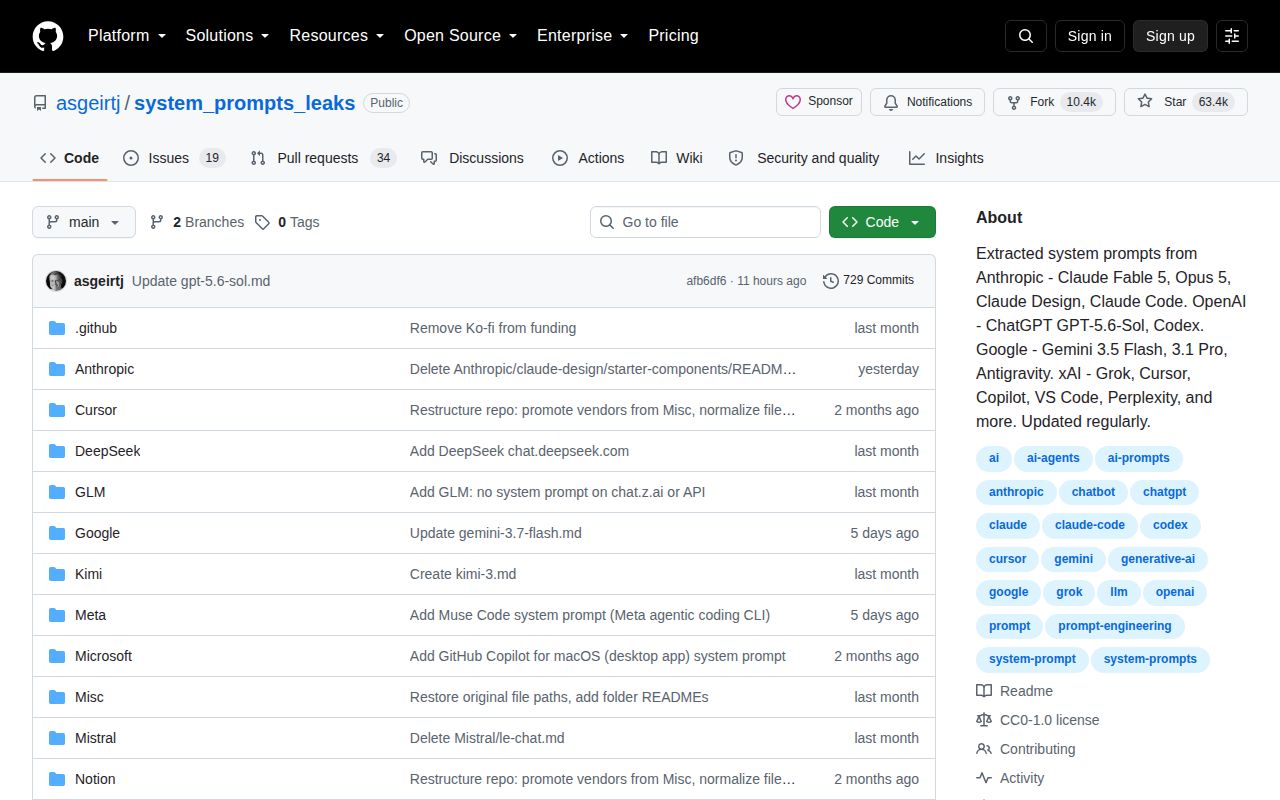
Large Language Models are often described as 'black boxes.' We know they work, but the precise instructions guiding their witty responses, careful refusals, and creative outputs are corporate secrets. The asgeirtj/system_prompts_leaks repository is the closest thing we have to a master key for these boxes. It isn't a software tool but a meticulously organized library of purported system prompts, the foundational text that shapes an AI's persona and behavior before you type your first word. With over 62,000 stars and citations in major publications like The Washington Post, this project has evolved from a niche curiosity into a vital resource for the entire AI ecosystem.
A Treasure Trove of Unfiltered Insight
The repository's primary strength is its staggering comprehensiveness and timeliness. This is not a static archive of old prompts. The 'Recently Updated' section shows a project in lockstep with the industry's breakneck pace. As of early August 2026, it contains prompts for cutting-edge models like Claude Opus 5 and Codex GPT-5.6 (Sol variant), updated just days after their supposed release. This dedication to freshness makes it an invaluable intelligence tool for tracking the rapid evolution of AI capabilities.
Beyond just listing the latest models, the repository excels in its granular detail. It doesn't just give you one prompt for 'Claude'; it breaks it down into numerous specific contexts. You can find distinct prompts for the main Claude.ai web interface, the specialized Claude Code models, and even integrations like Claude for Microsoft 365. The entry for Claude Design is a prime example of this depth, listing not just the main prompt but also links to its 53 tools, 22 skills, and 10 starter components. This level of detail allows for a sophisticated analysis of how a single AI provider tailors its models for different tasks and environments. The organization is impeccable, with prompts sorted logically by company, product, and version, making it easy to compare, for instance, ChatGPT 5.5 with the newer 5.6 or to contrast OpenAI's approach with Anthropic's.
Important Caveats and Considerations
While the repository is an incredible resource, its very nature requires a healthy dose of skepticism. The term 'leaks' is key; none of this information is officially confirmed by the companies themselves. The prompts could be incomplete, sourced from non-production environments, or subtly altered. They represent a likely, but unverified, snapshot of the models' instructions.
Furthermore, a system prompt is only one piece of the AI puzzle. The model's underlying architecture, the vast datasets it was trained on, and the subsequent reinforcement learning (RLHF) process play an equally, if not more, significant role in its behavior. Looking at a system prompt is like reading a country's constitution; it tells you the stated rules and ideals, but it doesn't capture the full complexity of the culture, history, and legal precedents that shape daily life. This repository provides the what (the instructions) but cannot fully explain the why or the complete how.
Finally, it's crucial to remember that this is a data collection, not a software project. The 48 open issues are not bug reports but more likely discussions about the authenticity of a prompt, requests for new leaks, or suggestions for better organization. Anyone expecting an executable program or an API will be disappointed.
Community Health and Where It Fits
The project's health is undeniable. The massive star count, frequent commits, and media citations from outlets like The Washington Post and CEPS' AI World demonstrate its authority and widespread adoption. It has become a de facto primary source for journalists and researchers investigating the inner workings of commercial AI.
In a practical workflow, system_prompts_leaks is not a dependency you install in your application stack. It is a vital research and intelligence asset. For a prompt engineer, it's a masterclass in what works, what doesn't, and how the biggest players structure their instructions. For a developer building on the ChatGPT or Claude API, it provides crucial context for understanding why a model behaves in a certain way, helping to debug unexpected outputs. For a policy analyst or academic researcher, this repository is a longitudinal dataset for studying AI alignment, bias, and the evolution of safety guardrails over time. It makes the abstract concept of 'AI rules' concrete and analyzable.