One terminal replaces repeated Docker status and log commands
Lazydocker arranges projects, services, containers, images, and volumes into terminal panels. Select an object and the main pane shows logs, configuration, statistics, or command output. Common actions such as restart, stop, remove, rebuild, attach, and prune sit behind key presses. The gain is modest but real: during a failing Compose startup, you can watch one service, restart it, and keep its context visible.
The program is intentionally local and interactive. It does not add a control plane, user database, or web server. Release v0.25.2 was published on April 19, 2026 and includes support for the Compose -p flag plus changes to project views. That narrow role keeps the tool understandable, while users still need to know what Docker actions do before confirming removal or pruning.
The 48-second lab path was clean from install through tests
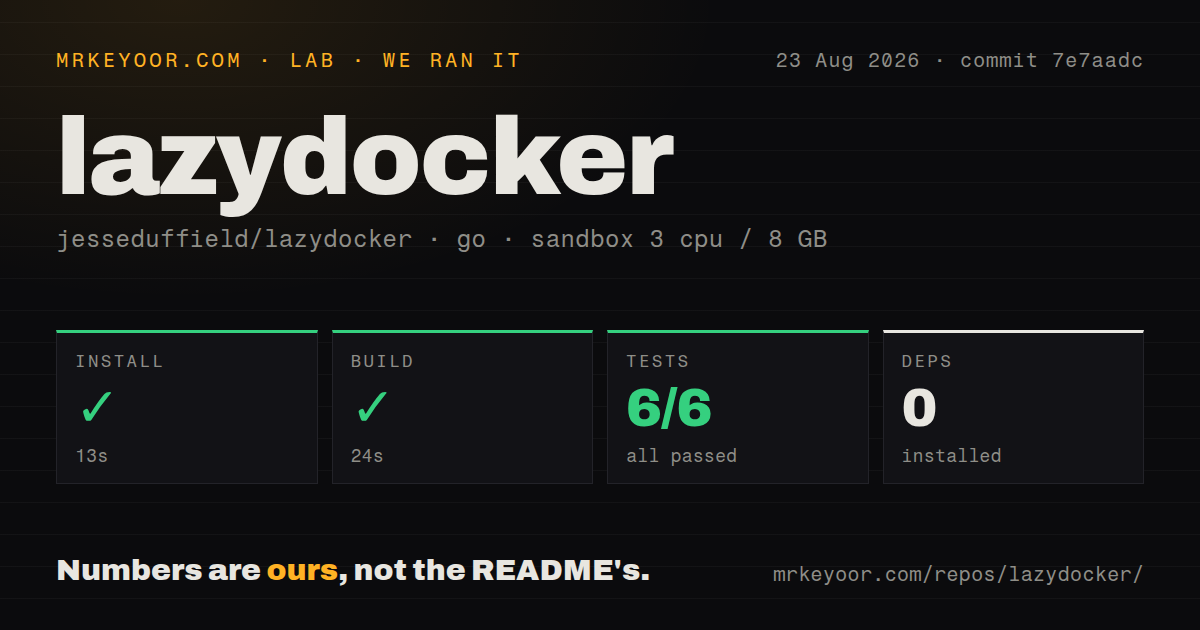
Our sandbox installed the Go project in 13 seconds without adding system packages. The build succeeded in 24 seconds. Tests finished in 11 seconds, with 6 passed and 0 failed out of 6. The complete measured path therefore took 48 seconds on commit 7e7aadc in an unprivileged Debian container with 3 CPUs and 8 GB of RAM.
The repository was also compact beside the other projects in this batch: 140 files, about 12,757 lines of source, and 10.6 MB checked out. Our scan found 3 CI workflow files, a Dockerfile, a Compose file, and a tests directory. These signals line up with the successful build and test result, though 6 measured tests cannot cover every Docker daemon, terminal, operating system, or remote connection.
What happened when we ran it
Our run produced no install error, compiler error, or failing test. Go dependency resolution did not install any extra system package, and the resulting build completed in 24 seconds. All 6 tests passed in 11 seconds. That is strong evidence that the checked-out commit is straightforward to compile in the stated Go 1.24 Debian image. It is not a usability or daemon-compatibility benchmark.
We did not connect the binary to a live Docker workload in this measurement. The test result therefore does not cover log streaming, container stats, Compose discovery, socket permissions, or a destructive action against a real daemon. Those behaviors depend on the Docker client and server around Lazydocker. The README currently states Docker 29.0.0 or later, with API 1.24 or later, and optional Compose 1.23.2 or later.
Binary installs avoid Go, while the container route adds socket risk
Homebrew, Scoop, Chocolatey, asdf, Arch packages, release binaries, go install, a shell installer, and a Docker image are all documented. A release binary is the least surprising choice for most developers because it avoids a compiler and runs directly against the existing Docker client. The project requires Go 1.19 or later when building through the current go install path.
The container installation mounts /var/run/docker.sock. Any program with that access can control containers and, in common setups, reach host-level capabilities through the daemon. Mount only a trusted image, pin the version, and avoid exposing the TUI to untrusted users. The README also says the containerized route has a known issue where logs or CPU usage may not appear, which undercuts two of the interface's most useful panels.
Remote hosts and duplicate service names need a trial
Open pull request 831 addresses a case where DOCKER_HOST=ssh:// fails with Tailscale SSH. Open issue 767 reports a Docker client version error, and the README suggests rebuilding the image with a Docker version matching the host if its bundled client is incompatible. If remote daemon access is part of the purchase decision, test the same SSH transport, Docker versions, and authentication setup used in production.
Compose users should also read issue 833, opened in August 2026, which reports trouble when multiple projects have the same service names. A related pull request is open. Those collisions are common in development fleets where every repository names a service web, api, or db. Until a fix is released and verified, launch Lazydocker from the intended project and confirm every action targets the expected Compose scope.
Mouse handling and one-key actions trade safety for speed
Mouse support lets users click panels, but terminal selection needs a modifier because the program consumes mouse events. The README explains how to disable them, and issue 835 requests native selection in the logs view. This sounds small until incident work requires copying a specific trace quickly. Keyboard users will have fewer complaints, especially after learning the documented bindings.
Speed also raises the cost of a mistaken prune or remove command. Lazydocker does not reduce Docker authority; it makes that authority easier to invoke. Issue 828 reports that a Compose project label could be used unescaped in command construction on shared hosts, with pull request 829 proposing validation. Even when fixed, the safe operating model is one trusted user controlling a daemon, rather than a terminal shared among tenants.
April code and August issue activity show a maintained but uneven pace
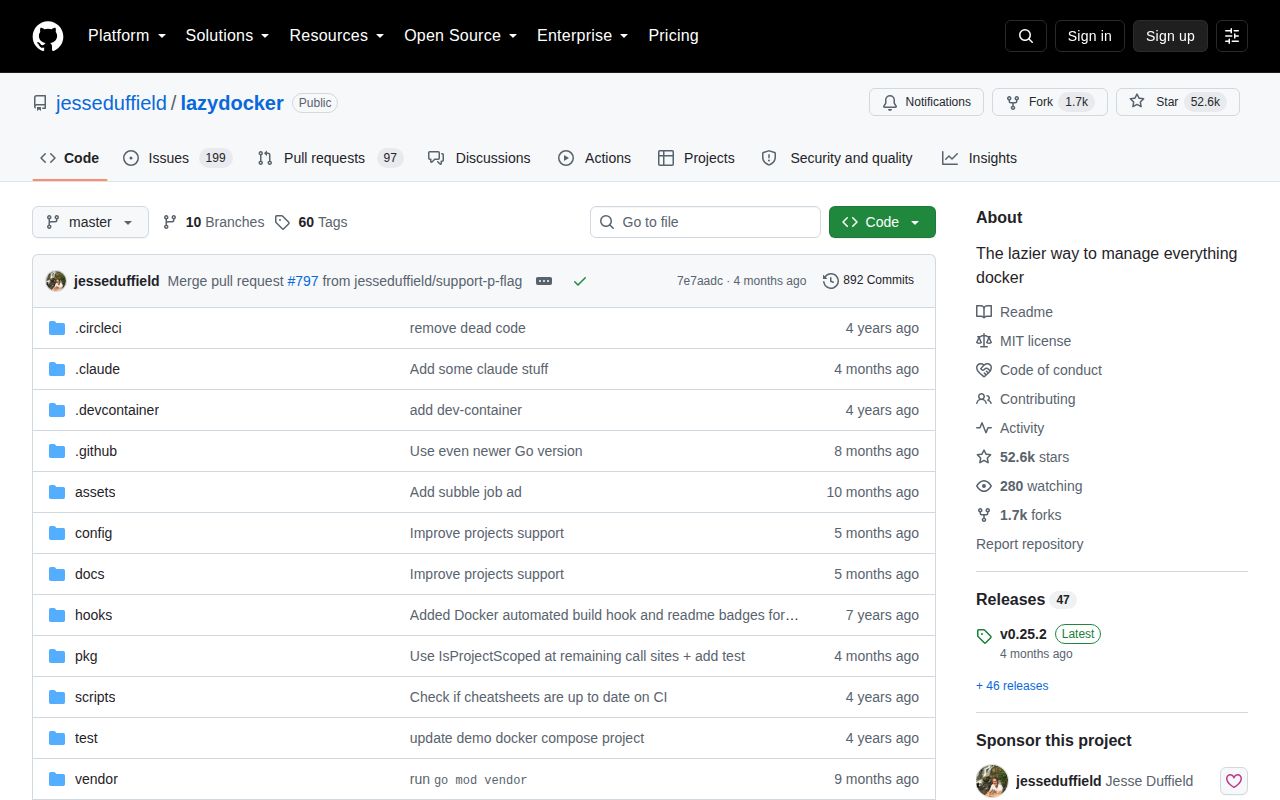
GitHub recorded 52,624 stars, 296 combined issues and pull requests, and a last repository push on April 19, 2026. Users and contributors were still active in issues and proposed changes during August 2026. That split points to ongoing interest and patch work, while the default branch had not received those later proposals when we fetched the facts.
Lazydocker earns a place in a developer's terminal because the 48-second measured path passed and the interface addresses a frequent annoyance without introducing a service. Portainer is better for shared browser administration, and Dockge is more focused on Compose stack files. For personal debugging, install the binary, review the bindings, test the exact Docker host, and keep the convenience in proportion to the socket authority behind it.