This is the Laravel starter, not the framework source
The most useful fact about laravel/laravel is easy to miss in its README. Composer describes it as the skeleton application for the Laravel framework. The reusable framework implementation lives in laravel/framework. This repository is what a new application starts from: an app directory, configuration, database migrations, routes, tests, Vite assets, and scripts that pull in the framework as a dependency.
That division keeps the starter small. Our checkout at commit 4a27aea contained 63 files, around 1,963 lines of source, and occupied 0.2 MB before dependencies. A team can own and reshape this code as its application grows. Someone fixing Laravel's router or ORM should work in the framework repository instead, where the code and test surface are entirely different.
The setup script spans PHP, SQLite, and Vite
Composer's setup script shows what a real first run requires. It installs PHP dependencies, copies .env.example when needed, generates an application key, runs migrations, installs npm packages with scripts disabled, and builds the frontend. Composer.json requires PHP 8.3 or newer and Laravel Framework 13.17 or a compatible release. The starter also includes Tinker and development tools for testing, formatting, logs, and generated data.
The example environment chooses SQLite, database-backed sessions, a database queue, and a database cache. Mail is logged, while Redis and AWS settings are placeholders until the application needs them. Those defaults let a local project avoid collecting cloud credentials on day one. Production still needs deliberate database, queue, mail, storage, logging, and secret choices rather than a copied development file.
What happened when we ran it
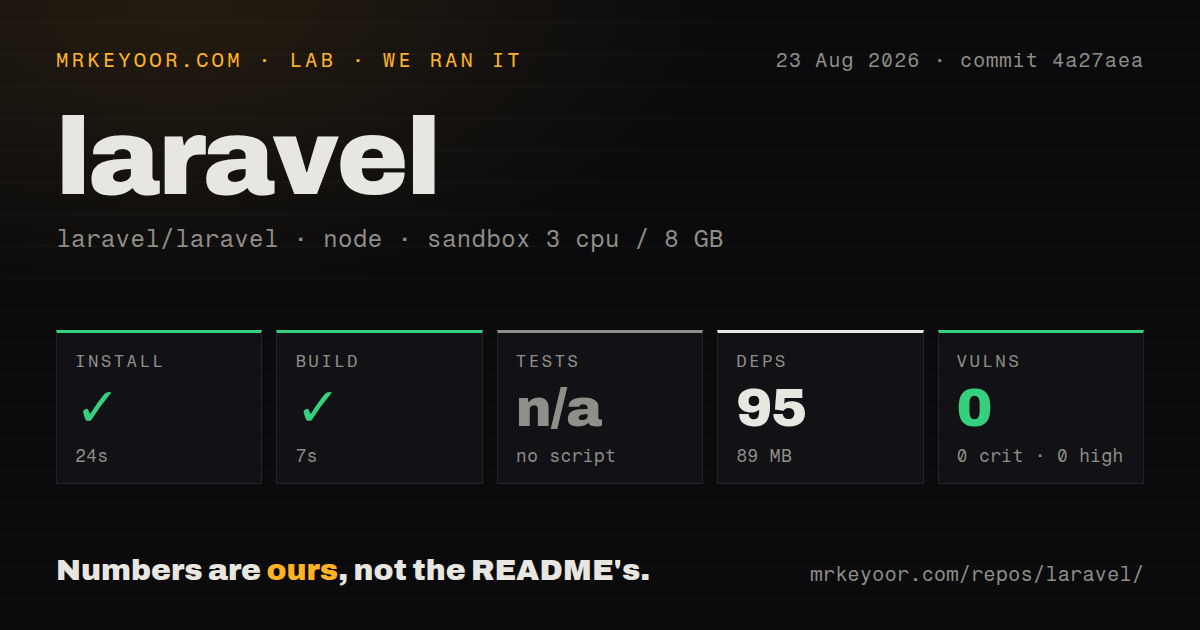
Our sandbox measured the Node side at commit 4a27aea. Npm installed 95 packages in 24 seconds and used 89 MB on disk. The Vite build succeeded in 7 seconds. Npm audit reported 0 known vulnerabilities: 0 critical, 0 high, 0 moderate, and 0 low in the installed dependency tree.
Package.json defines build and dev scripts but no npm test target, so the lab skipped tests. The checkout does contain a tests directory, and composer.json defines a PHP test command through Artisan. Our Node 22 Debian run did not install Composer packages, generate the application key, migrate SQLite, execute the PHP suite, or start a web server. The result proves that the starter's frontend assets built, nothing more.
That boundary matters because a green 7-second Vite build says little about routes, database access, queues, or application behavior. Before choosing the stack, run the documented Composer setup on the PHP version you will deploy, then execute Artisan tests against the database and services your application actually uses.
Laravel trades explicit assembly for consistent conventions
Laravel bundles common web application needs behind one set of conventions. The README points to routing, dependency injection, sessions, cache backends, Eloquent ORM, schema migrations, background jobs, and event broadcasting. A developer who knows the framework can enter a new codebase and predict where controllers, models, jobs, migrations, and configuration belong.
That consistency saves time when the application genuinely needs those pieces. It also means Laravel shapes the project more than a small routing library would. Teams with a narrow HTTP service may not want an ORM, migration system, queues, and framework lifecycle in the same dependency tree. The choice is less about whether Laravel can handle a task and more about whether the team wants its way of organizing the work.
Vite handles assets while Artisan runs the application
The Node package is intentionally short. Vite builds assets, Tailwind CSS 4 supplies styling, and the Laravel Vite plugin joins the frontend output to PHP templates. The optional Multiplex dependency and a concurrent process helper support the development experience. None of those packages replaces PHP or serves the Laravel backend on its own.
Composer's development command calls php artisan dev after disabling the Composer process timeout. That keeps the canonical workflow on the PHP side. Frontend specialists can work inside Vite, but deployment planning must include Composer's production install, environment configuration, database migrations, writable storage, queues where used, and the web server or runtime that executes PHP.
Agent support is an optional development layer
The README recommends Laravel Boost for Claude Code, Cursor, and GitHub Copilot. Installation adds a development Composer package and runs an Artisan installer. It provides more than 15 documented tools and skills intended to teach agents the application's framework context and conventions. That may reduce generic suggestions that ignore Laravel's established patterns.
Boost is optional and does not change the basic evaluation. An agent-aware tool still has access to application code, configuration, and possibly connected services, so teams need permission boundaries and review. Developers who do not use coding agents lose nothing from the core starter; the framework's normal documentation and commands remain the main path.
August 2026 activity confirms the skeleton is current
GitHub recorded a push on August 25, 2026, and release v13.10.1 on the same date. The repository had 84,877 stars and 31 combined issues and pull requests when fetched. The release note only links the comparison with v13.10.0, so it does not support a long feature story. It does show that the starter tracks an actively published 13.x line.
The best way to try Laravel is to create a disposable project, complete the Composer setup, and build one route backed by the intended database. Our 24-second npm install makes the asset layer easy to verify. The deciding work begins after that, when the team tests PHP 8.3, migrations, queues, deployment, and the framework conventions it will live with.