The repository indexes 117 Chinese-language viewing resources
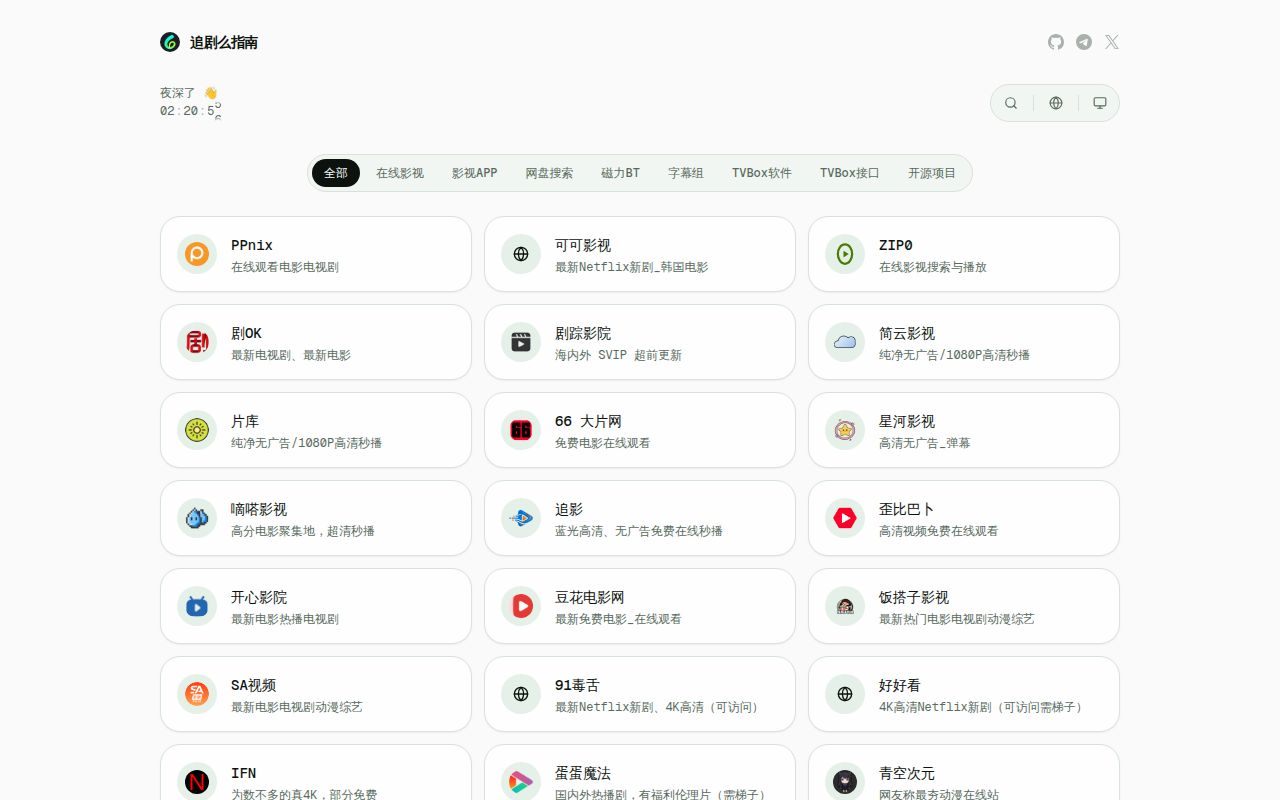
The README listed 117 resources on October 6, 2026. Awesome Zhuiju Free is a directory rather than a viewing application, with links to online video sites, media apps, cloud-drive search, BitTorrent indexes, subtitles, TVBox configurations, IPTV, and open-source projects. There is no English README in the tree, so the labels, cautions, and contribution instructions require translation for readers who do not read Chinese.
The useful asset is resources/resources.json, not a player binary. Our checkout contained 72 files, about 2,024 lines of source, and occupied 0.9 MB. Each record can carry scores, a verification summary, provenance, and four separate risk labels. That structure is easier to reuse than scraping a long Markdown table, and CC BY 4.0 permits reuse with attribution.
A green badge confirms a homepage response only
A scheduled checker requests the first 1,024 bytes of each featured resource, follows redirects, and classifies the HTTP result as reachable, restricted, or unreachable. The README says the job usually runs around 09:00 Beijing time. It also states the important limit in plain language: the status reflects the GitHub Actions network at that moment and does not replace a full experience review.
That distinction matters because the lab found 5 CI workflow files but no tests directory. The checker does not start a film, inspect a download, follow every advertisement, or reproduce your ISP and country. The weekly W40 release reported 65 reachable resources, 20 restricted, and 10 unreachable. Those figures make churn visible. They do not certify what a visitor meets after the landing page.
What happened when we ran it
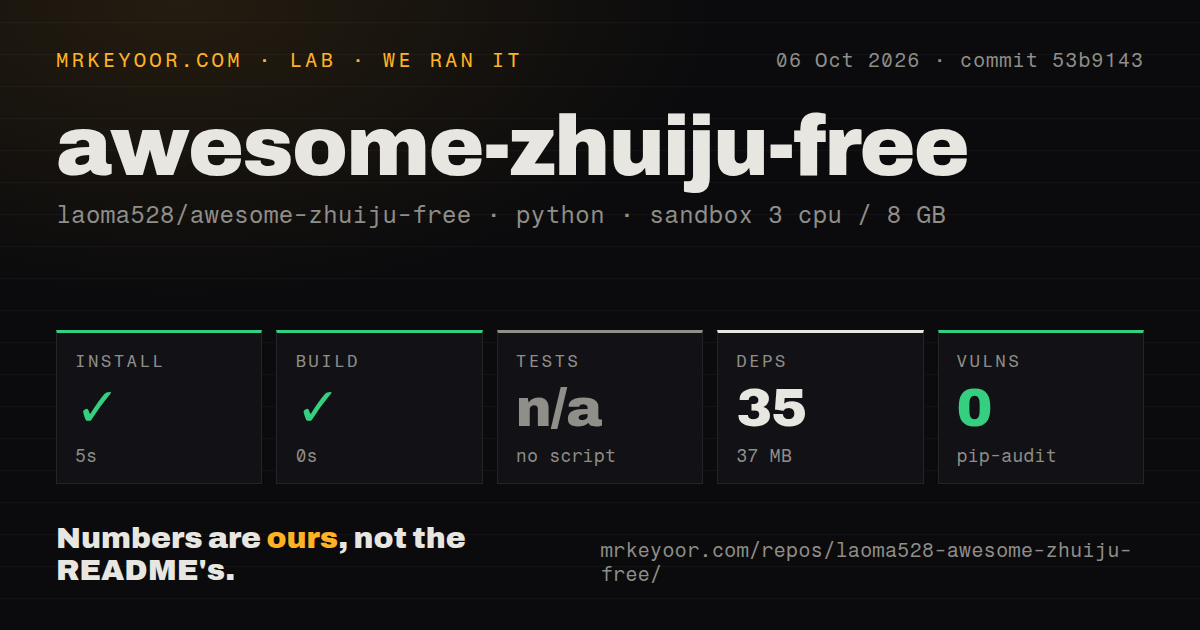
Our lab measured a 5-second install at commit 53b9143. The installation added 35 packages and consumed 37 MB on disk, then the build completed successfully in 0 seconds. This ran in an unprivileged Debian container with 3 CPUs, 8 GB of RAM, Python 3.12, and no secrets. Pip-audit reported 0 known vulnerabilities in the installed environment.
There was no test script or target, so our run skipped tests. The 0.9 MB repository also had no Dockerfile and no tests directory. Five CI workflows handle availability checks, data validation, open-source statistics, issue conversion, and weekly releases, but the supplied project has no conventional suite for us to execute. The successful build proves the maintenance step ran; it does not test the 117 destinations as products.
Four risk labels still leave the decision with the reader
The repository schema records 4 distinct risks: copyright, safety, privacy, and payment. Each can be low, medium, high, or unknown. The README also says the project indexes resources and does not host, upload, copy, or sell third-party media. Its disclaimer offers no guarantee that an outside site is legal, available, or safe in your location.
Issue 28 reported gambling advertising inserted into video on one listed service. Issue 32 asks for another service to be removed because it introduced registration, points, and payment. These reports show why 35 cleanly installed packages cannot make the destinations safe. The repository can record a complaint and change a row. It cannot control an operator's APK, redirects, tracking, catalog, or licensing after you click away.
October activity is strong, while individual links remain volatile
The repository was pushed on October 6, 2026, and its W40 release arrived on October 4. GitHub showed 11,304 stars plus 17 open issues and 2 open pull requests. Several open issues are new resource submissions, while recent closed reports concern ads, paid access, and abandoned tools. That mix looks like an actively maintained directory rather than a finished catalog.
The automation is proportionate to a 72-file project: five workflows update the list and preserve weekly changes. Documentation quality is less even. The current README still sends several badges and issue links to the former laoma2053 owner while the repository now lives under laoma528. GitHub redirects may hide that drift today, but copied links and integrations should use the current owner.
Use the catalog as evidence for where to look next
For a Chinese-reading viewer, 117 dated rows beat a folder of forgotten bookmarks. Start with the risk fields, check the latest verification date, and treat restricted or unreachable results as warnings about volatility. Before installing an app or importing a TVBox configuration, inspect its origin and permissions. Before watching or downloading, check local law, the content license, and the service terms.
English-only users get less value because every decision-bearing explanation is in Chinese. Teams consuming the JSON also inherit a source with no supplied test target, despite the 5 CI workflows. The right use is narrow: let Awesome Zhuiju Free tell you which door answered recently, then decide for yourself whether opening that door is lawful and sensible.