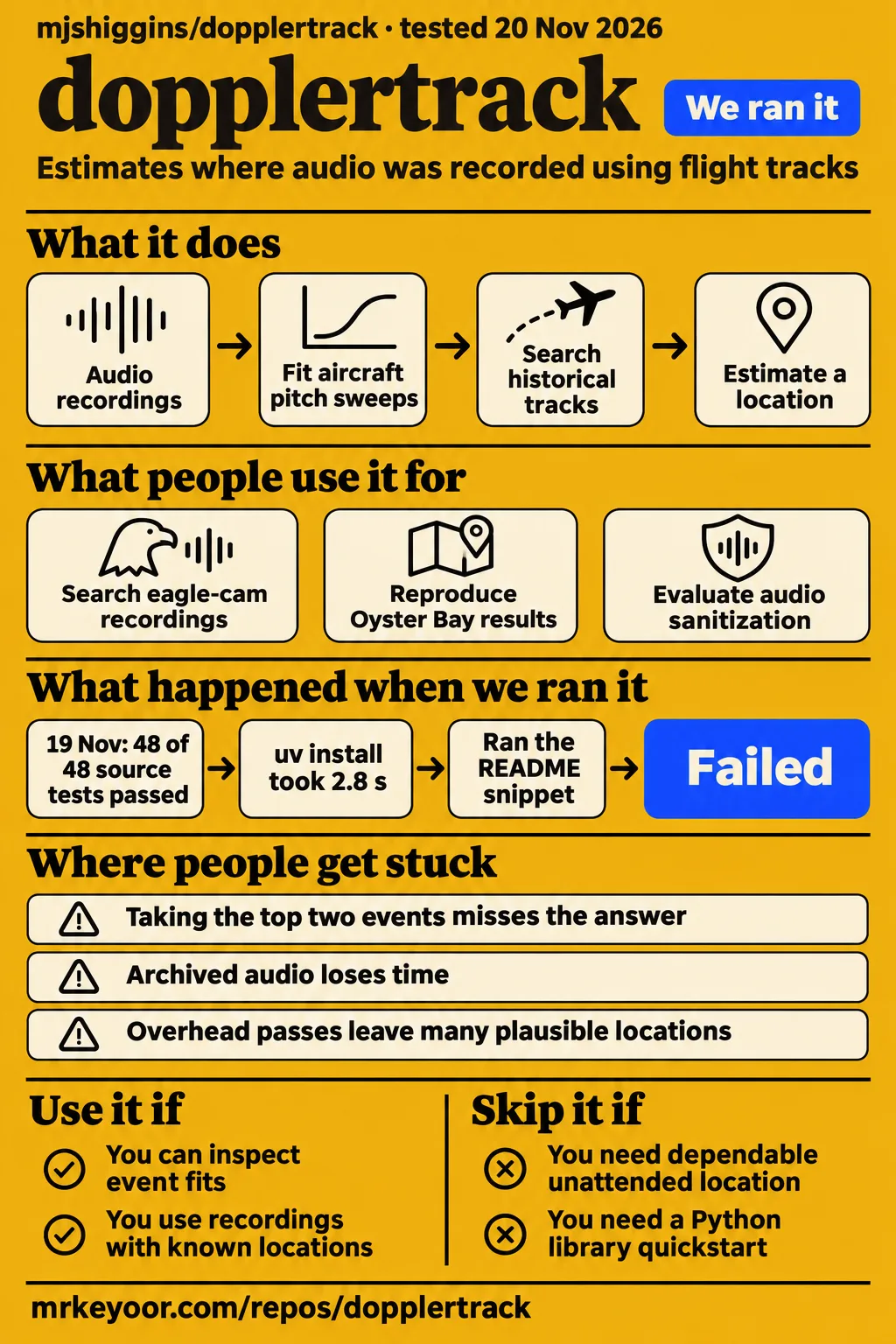
Short answer: use it for controlled research
Use dopplertrack for controlled aircraft-audio geolocation research when you can inspect event fits and compare results with a known location. Skip it if you need a dependable unattended recording-to-address service. Our repository run installed it in 12 seconds and completed its build and test steps, with 48 tests reported passed. The project README's nationwide examples report two successful recordings and a failed Atlanta search, giving readers specific outcomes rather than an exact-location promise.
The distinction is between fitting a sound and choosing enough appropriate sounds to support a location. In roadmap issue #4, the maintainer describes research-fork results where taking the detector's top two events failed on both development recordings. Oyster Bay's second-event fit was biased; on the eagle cam, the second selected event belonged to a different flyover. These are workflow failures that successful package installation cannot resolve.
What people use dopplertrack for
Dopplertrack matches aircraft pitch sweeps against historical ADS-B flight tracks to estimate a microphone's location. ADS-B broadcasts describe aircraft positions and movement. This review concerns mjshiggins/dopplertrack, the audio project. The similarly named DopplerTrack research concerns FMCW LiDAR tracking. The audio project's examples search recordings against flight histories; the LiDAR paper concerns tracking moving objects from point clouds.
| Who used it | Recording or task | Reported outcome |
|---|---|---|
| Project author | Oyster Bay reference recording, searched across the continental US without a region hint | The true flight pair ranked first; the best point was 32 m from truth. |
| Project author | Public eagle-cam stream from North Fort Myers, Florida | The best point was 627 m from truth; further flyovers moved the true pair from rank 15 to rank 1. |
| Project author | Atlanta railway-camera recording | The search failed: real flight pairs ranked 6 to 32, while an incorrect smoother track won. |
| GitHub contributor SokolskyNikita | Reproducing Oyster Bay on an Apple M4 Pro running macOS | Committed fits reproduced the published result; fresh fitting and archive fetching exposed bugs later fixed on main. |
| Doppler-scrubber project | Removing aircraft tones from two validation recordings | Blind detections disappeared, while checking a suspected location retained weak confirmation. |
The eagle-cam result shows why additional events change the decision. With two events, the right aircraft pair ranked 15th; further flyovers moved it to first. The README labels both two-event searches ambiguous, including Oyster Bay, whose true pair already ranked first. A candidate can therefore win the ranking while the project's own verdict still calls for stronger evidence. Ranking and accepting a location are separate stages of the workflow.
What happened when we ran it
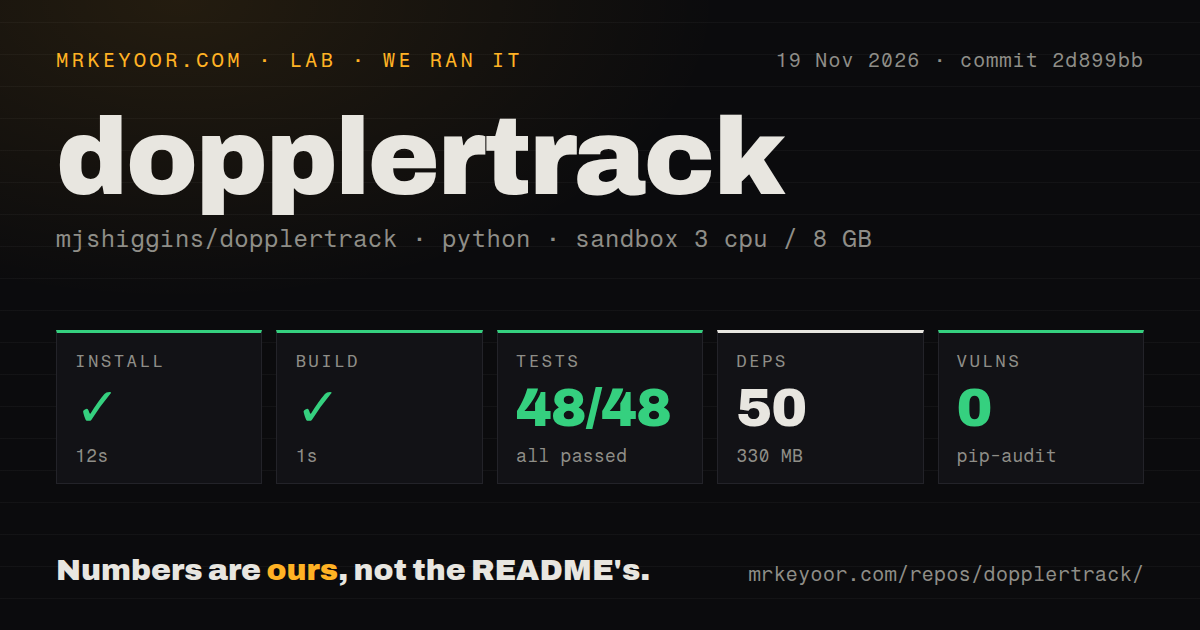
Our November 19 run at commit 2d899bb installed in 12 seconds, built in 1 second and completed the test step in 230 seconds. We measured repository setup and checks in our sandbox run. Those timings belong to installation, build and tests; the author's location-search timings belong to the reference recordings. The repository run and the location examples answer different questions about getting the project running and obtaining a location result.
| Check | Our recorded result |
|---|---|
| Install | Succeeded in 12 seconds; 50 dependencies recorded; 330 MB on disk |
| Build | Succeeded in 1 second |
| Tests | Step succeeded in 230 seconds; parser reports 48 passed, 0 failed, 3 skipped |
| Dependency audit | pip-audit reported 0 known vulnerabilities |
| Checkout | 71 files, approximately 3,026 source lines, 17.4 MB |
| Repository signals | Two CI workflow files, a tests directory, no Dockerfile detected |
The repository sandbox configuration was 3 CPUs, 8 GB RAM and image label ghcr.io/astral-sh/uv:python3.12-bookworm. A separate November 20 library recipe used commit 2d899bbfe152 and a fresh unprivileged container configured with 2 CPUs and 4 GB RAM, without published ports or secrets. That recipe installed the PyPI package and then attempted to extract a Python example from the README.
| Hands-on question | Answer | Verdict | Why |
|---|---|---|---|
| Did the recipe clone the project? | Clone step completed in 3 seconds. | Completed | Checkout preceded the package steps. |
| Did the package install? | Dopplertrack 0.3.0 installed in 2.8 seconds. | Completed | The recipe used uv pip install dopplertrack in a fresh virtual environment. |
| How much space did site-packages occupy? | 295.0 MB after installation. | Measured | The measurement covers virtual-environment site-packages. |
| How many other packages were installed? | 22 packages besides dopplertrack. | Measured | The count excludes dopplertrack itself. |
| Could the recipe run a README Python example? | FAILED; the README has no python code block to run | Stopped | The recipe expected Python; the README documents a CLI workflow. |
| Was the missing snippet recorded as a finding? | The no-snippet finding records the same missing Python example. | Recorded | This records the snippet failure, rather than a second execution attempt. |
| Did cleanup finish? | Teardown returned ok. | Completed | Cleanup followed the stopped snippet step. |
The failed snippet step identifies an onboarding mismatch: the README documents CLI commands, while this recipe expected a Python example. Its documented sequence is spectrogram creation, detection or fitting, flight-day fetching, search and refinement. The 295.0 MB and 22-package observations belong to the library recipe; the 330 MB and 50-dependency observations belong to the repository harness. They describe different measured environments.
Where people get stuck: old fitting bugs and event selection
Issue #1 records two version-0.2.0 reproduction failures and the maintainer's confirmation that their fixes merged on main. The contributor first reproduced the published result using committed event files, then found that freshly generated fits behaved differently. That sequence separates a regression in preparing search inputs from the later ranking stage. The maintainer's closing comment identifies archive sorting and the fitting objective as the two corrections.
| Symptom | What the report found | Resolution or next decision |
|---|---|---|
fetch-day crashes on a split archive |
Sorting archive dictionaries raised TypeError: '<' not supported between instances of 'dict' and 'dict' |
Fixed on main by sorting assets by name. |
| Fresh Oyster Bay event 2 yields no candidates at the true point | Fresh fitting diverged from the committed event fit | Mean-brightness fitting restored as the default; the maintainer says README commands reproduce the committed fits again. |
Taking detect's top two events misses the answer |
The roadmap describes a biased fit in one case and a different flyover selected in the other | Issue #4 records both failures. |
| High overhead passes leave many plausible locations | Similar curves fit a broad ground area | The README uses further events through --extra. |
| Archived audio loses time | Atlanta's stream lost 107 seconds, putting extra flyovers on a different clock | The project retains Atlanta as a failed case. |
The current README usage sequence uses fetch to write a day index and search --day to consume it. The older issue discusses fetch-day, so command names belong with their documented version. For diagnosing a known recording, --point LAT LON scores the known location directly. That distinguishes a true point excluded during candidate generation from one that entered the candidates and scored below another location.
A nationwide search needs more than the package
The README describes a flight-day fetch that streams roughly 4 GB of history and writes a reusable index. That flight-data stage is separate from our installed-environment measurements. The CLI also uses ffmpeg to decode audio or video before building a spectrogram. Installing the Python package therefore completes one part of preparing a recording for the documented search sequence; the day index supplies the historical trajectories used by the search.
The controls manage different parts of that sequence. --bbox restricts the search region, --archive DIR reads flight archives already on disk, and --cands caches candidates so changing the scorer can reuse them. The README's refinement stage lays a 50 m grid around a result, optionally using more events. These commands expose separate artifacts: event files, a day index, candidate output and refined results.
Issue #5 reports CI and release actions targeting deprecated Node.js 20, with jobs running through a Node.js 24 compatibility shim. The contributor's update describes action upgrades on a fork, SHA-pinning release actions and adding Dependabot configuration. Its release dry run drops the PyPI job and uses a throwaway branch. This concerns the automation that tests and publishes the project, separate from the README's audio-analysis commands.
Security: cleaned audio can still confirm a suspected location
Doppler-scrubber reports that cleaned recordings lost dopplertrack's blind detections while retaining weak confirmation at a suspected location. Its evaluation uses dopplertrack's two validation recordings, attacking cleaned audio with event fits from the originals. The two outcomes answer different privacy questions: whether a detector finds flyovers without a location hint, and whether scoring an already suspected location distinguishes it from wrong candidates.
The scrubber's frequency discussion says tones above its 1.7 kHz upper frequency are left intact, while DOPPLERGEIST's detector looks up to 8 kHz. Removing tones in one band changes what particular detectors see. A defensive evaluation therefore needs to identify the detector, frequency coverage and location hint behind each result. The reported suspected-location confirmation and untouched tones describe specific residual signals after cleaning.
Dopplertrack vs doppler-scrubber, DOPPLERGEIST and doppler_experiments
Doppler-scrubber removes tones, DOPPLERGEIST appears in a higher-frequency detector comparison, and doppler_experiments houses diverged research. Their documented roles give readers a way to choose where to start. Dopplertrack searches for recording locations; the others address sanitization, detector coverage or experimental methods. The README's comparison with colsto's video also identifies the manual curve-fitting steps that dopplertrack automates.
| Option | What the comparison supports | Pick it when |
|---|---|---|
| Dopplertrack vs colsto's original method | The video fits curves manually; dopplertrack's fit and detect use grid search plus Nelder-Mead. |
You want released code for investigating the method |
| Doppler-scrubber | A defensive companion that removes aircraft tones and evaluates cleaned audio against dopplertrack. | You are assessing audio sanitization |
| DOPPLERGEIST | The scrubber comparison says its detector looks up to 8 kHz and still sees tones above the scrubber's edited band. | You are studying higher-frequency detector coverage |
| SokolskyNikita/doppler_experiments | The contributor moved diverged experiments to an independent repository and proposed shared benchmarks. | You want to study alternative research methods |
Outdated claims, corrected
The current README reports 32 m for Oyster Bay and 627 m for the eagle cam, alongside a failed Atlanta search. Those recording-specific results replace the broad accuracy impression created by Grok's claim of typical recovery within 50 to 70 m. Each error belongs to its named recording; the successful Oyster Bay result supplies one measured example rather than a general accuracy specification.
The older Oyster Bay benchmark scored 328 pairs and reported 43 m after refinement; the current continental-US README benchmark scores 9,669 pairs and reports 32 m. The scrubber's results table preserves the older figures, while the current dopplertrack README gives the newer search scope. Combining the old error figure with the new nationwide scope would describe a result neither benchmark reports.
OSINT Jarno's explainer describes an exact-location fingerprint, but also reports zero successes in a separate test of 56 ordinary YouTube videos. Its demonstration includes a simulated microphone and two planes. The simulation, the named dopplertrack reference results and that separate video experiment need separate labels. They address the geometry of the technique, reproduction on reference recordings and performance in another recording sample.
Doppler-scrubber's opening promise that removal prevents geolocation sits alongside its reported weak suspected-location confirmation. Its results describe changed detections and scores under particular attacks, with untouched higher-frequency tones discussed separately. The narrower conclusion is that cleaning changed those attack outcomes. The residual confirmation belongs in the description of the result, rather than disappearing behind the opening promise.
FAQ
The README's two successful location examples and failed Atlanta search answer the accuracy question through named recordings. Questions about reproduction and confidence also appear in the project's issue discussions. The answers below distinguish benchmark scope, input-generation bugs and the meaning of a winning score. The detailed measurements and error messages remain in their respective tables so readers can find the full result without repeating it here.
Are the claims about sub-100-metre geolocation and dopplertrack's 43-metre result accurate?
The 43 m result belongs to the older 328-pair Oyster Bay benchmark; the current README reports a different nationwide benchmark. The current README's recording-specific outcomes include a sub-100-metre Oyster Bay result, a larger eagle-cam error and the Atlanta failure. The corrections section gives the figures and search scopes together, keeping a successful reference example separate from claims about typical accuracy.
Why does the Oyster Bay example fail to reproduce on version 0.2.0?
Issue #1 identifies split-archive sorting and a changed second-event fit as the two reported failures. The maintainer confirms both fixes merged on main, with mean-brightness fitting restored by default. Committed event files reproduced the published result before the contributor investigated fresh fitting. That comparison narrowed the problem to preparing search inputs, and the troubleshooting table records the archive exception and missing true-point candidates.
Does a large margin over the runner-up mean a location is reliable?
No: the README says a search area excluding the answer still returns a winner. Its verdict procedure compares the winner with wrong-pair scores, and twenty railcam searches with no right answer produced two located verdicts. The README calls its p < 0.1 threshold a weak claim. A first-place result and its lead therefore need to be read alongside the search geometry and the additional events.
Can dopplertrack become a recording-to-verdict locate command with an uncertainty region and HTML report?
Issue #4 proposes a recording-to-verdict command with an uncertainty region and HTML report. The current README documents separate fitting, search and refinement commands. The roadmap discussion describes the proposed destination; the README describes the staged CLI workflow readers can follow. Our library recipe's missing Python snippet is a separate onboarding finding, rather than evidence that the proposed command exists.
What we have not tested yet
Our runs cover repository checks and a stopped library recipe, with no completed geolocation task. Search latency, location error, recording-device behavior, audio quality and peak nationwide-search memory were outside those runs. Actual runtime and operating-system versions require toolchain logs; configured image labels alone do not establish them. The November 20 recipe recorded PyPI version 0.3.0, while the repository harness identifies its checkout by commit 2d899bb rather than proving a release-tag checkout.
The harness reports 48 passed, 0 failed and 3 skipped while also recording total 48; complete logs are needed to reconcile a unique test total. Pip-audit's zero known vulnerabilities is a dependency-audit result, rather than a code security assessment. The scrubber's current-version blind location search was not rerun. These checks supply no shared-corpus accuracy comparison, general privacy guarantee, institutional validation study or success rate across ordinary recordings.
The maintainer labels the research fork's trajectory-provider and phone-recording findings unreproduced in issue #4: alternative providers reportedly moved the true pair to rank 2 or 3, straight-pass range error had a reported median of 15.6%, and the 40 to 450 Hz band reportedly lost 8 of 40 phone-recorded passes. Our runs did not reproduce those findings or measure country coverage beyond the US examples, production adoption, search demand or the number of independent successful operators.
The issue #7 challenge claim contains no checkable accuracy result; the maintainer rejected the challenge-sharing thread. The CI contributor's fork dry run likewise supplies no evidence of completed upstream migration or PyPI publication. Rendered layout, resolved links, recommendation modules and template behavior are outside this text review. For a controlled next experiment, the README's --point LAT LON mode supplies a documented starting point using a recording whose location is already known.