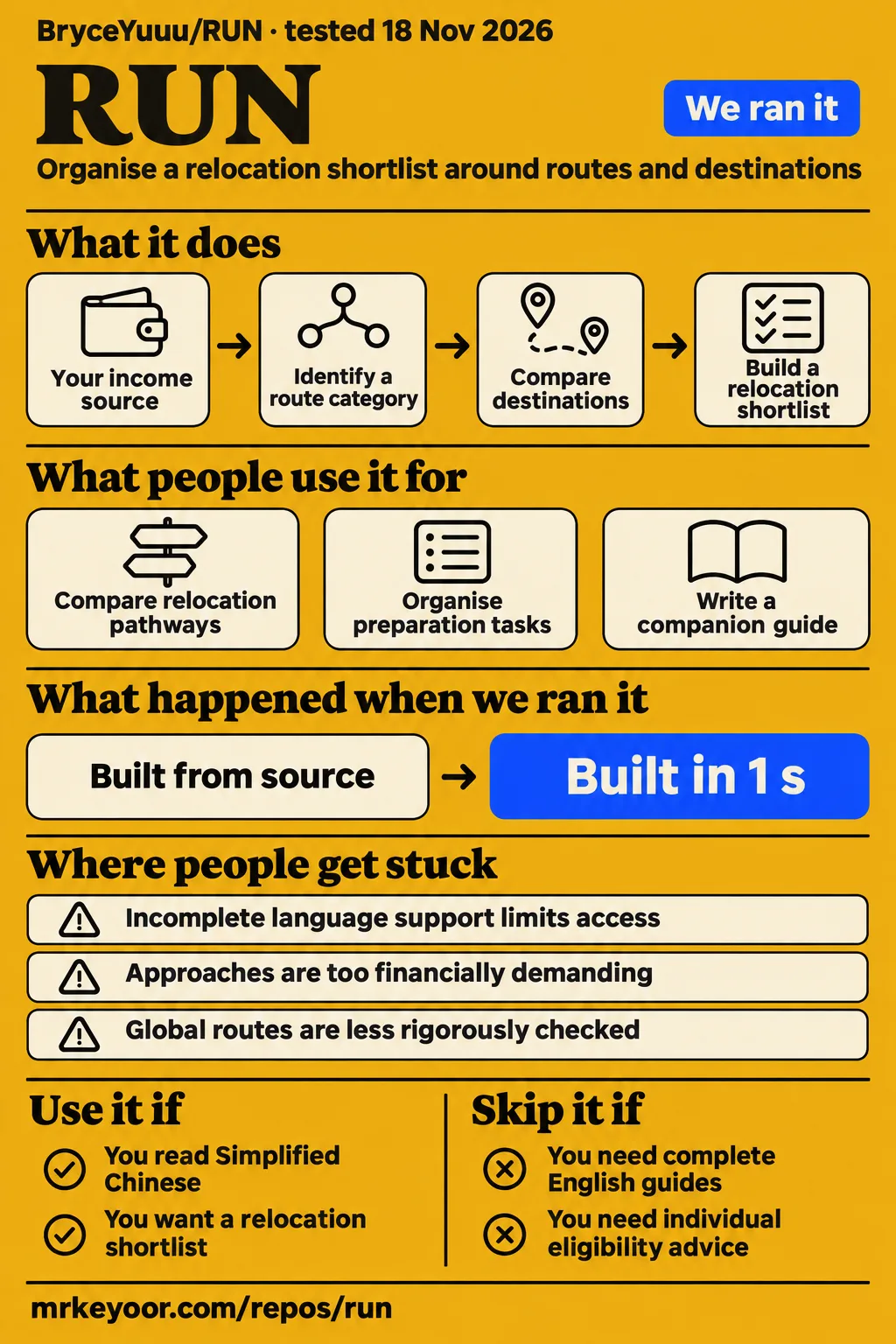
Short answer: use RUN to build a relocation shortlist
BryceYuuu/RUN suits Chinese-reading readers building a relocation shortlist; readers needing complete English guides or individual eligibility advice should choose another starting point. The English README identifies Chinese mainland passport holders as its audience and describes guides organised by route and destination. The useful first decision is therefore whether its language and applicant assumptions match yours. A reader comfortable with both can use that organisation to decide which official requirements to read next.
The handbook starts with situations rather than a single preferred destination: remote employment, local employment, study, self-employment, passive income and investment. That makes it a practical index for someone whose first question is which category fits their circumstances. Start with your income source, identify a route category, and then compare destinations within it. Keep the route name and its source link together so that a promising summary leads to a specific page you can examine.
What you can do with RUN
RUN's English README lists route guides, country pages, comparison tables and practical preparation guides. Those components answer different reading questions. Route guides group similar circumstances across destinations; country pages group options within a destination. The comparison tables cover subjects such as living costs, salaries, income tax, citizenship timelines and dual citizenship. The practical guides introduce document preparation for Chinese applicants, tax residency and the first 90 days after landing.
A useful shortlist can keep those questions separate. First record the route category that matches your income or employment situation. Next record the destination and the official source attached to that route. Then write down the condition that matters most to your decision, such as the applicant nationality, employment arrangement or required documents. This is a suggested way to organise reading. It follows the handbook's structure without turning a country summary into a personalised application procedure.
The practical material gives readers another entry point when they already have a destination in mind. The English overview names apostille, police certificates and degree verification among its document topics. Someone preparing those questions can use the handbook to collect terminology before reading the relevant application instructions. Keeping preparation questions beside the route name also makes a later correction easier to track: the reader can see which source informed the note and which part needs replacing.
What people use RUN for
FluentRemote reports publishing an English companion breakdown and execution checklist featuring RUN. In issue #6's publication report, its author describes comparisons of relocation pathways and preparation topics including remote contracts, banking and language preparation for interviews. This is a concrete example of editorial reuse: another publisher says it used the repository as reference material for a companion guide. The issue identifies the author and the kind of material published.
That example also suggests a useful distinction between reading paths. RUN's route and country organisation helps a reader locate subjects; a companion checklist arranges preparation tasks around those subjects. A reader can borrow that organisational approach by keeping a short list of questions beside each candidate destination. The supplied issue describes its own checklist, so its contents should remain attributed to FluentRemote rather than presented as a workflow developed or completed in our run.
What happened when we ran it
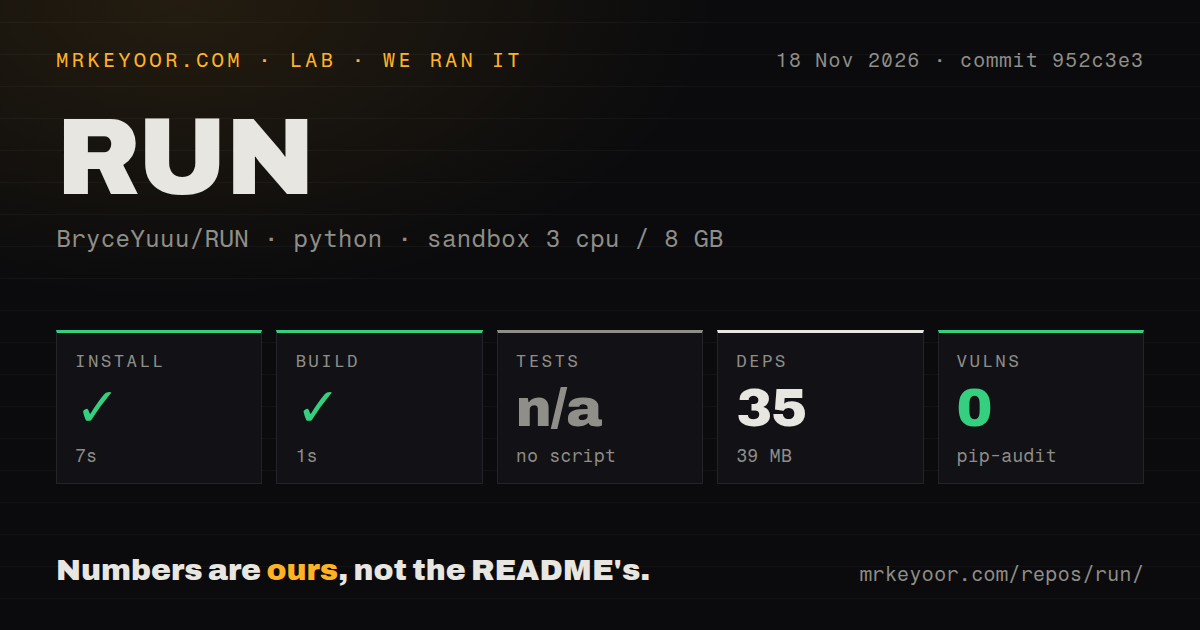
Our November 18, 2026 run at commit 952c3e3 installed in 7 seconds and built in 1 second. We measured 35 dependencies and 39 MB on disk. The source-run harness recorded a successful install and build, skipped tests because no test script or target existed, and reported 0 known vulnerabilities through pip-audit. The table preserves each recorded observation and separates the source setup from the additional deployment attempt.
| Source-run observation | Recorded result | Meaning for a reader |
|---|---|---|
| Install | Succeeded in 7 seconds | The recorded dependency setup completed |
| Build | Succeeded in 1 second | The recorded build step completed |
| Dependencies | 35 recorded; 39 MB on disk | Dependency footprint recorded for this run |
| Tests | No tests script or target; skipped | The harness skipped the test step |
| pip-audit | 0 known vulnerabilities | The audit reported no known dependency advisories |
| Repository scan | 149 files; approximately 573 source lines; 1.3 MB checked out | Recorded repository footprint |
| Project signals | 0 CI workflow files; no Dockerfile; no tests directory | Files and directories detected by the scan |
The separate hands-on safety step failed because the required Compose file was absent. Its failed prerequisite record names all four checked filenames: compose.yaml, compose.yml, docker-compose.yaml and docker-compose.yml. The hands-on summary nevertheless describes deployment through the repository's own Docker Compose with every port bound to 127.0.0.1. Those records conflict; the concrete step result is a blocked deployment prerequisite. The teardown record reports success.
The recorded sandbox configuration was 3 CPUs, 8 GB RAM and image label ghcr.io/astral-sh/uv:python3.12-bookworm. Reading RUN on GitHub is a separate activity from installing its developer dependencies. The Chinese README describes a documentation generator that reads source material and produces country documentation, charts and automatic README blocks. This explains why the source-build result belongs in a repository review while the handbook's reading structure remains the main reason to consider using it.
Where people get stuck: language, money and policy changes
Issues #1, #2, #4 and #5 raise budget, translation, packaging and policy-maintenance questions. Each supplied issue is open with no comments. These reports concern different decisions: whether a reader can comfortably access the material, whether a route fits their finances, whether a requested format exists, and whether a named pathway needs updated sourcing. Keeping those questions separate makes the issue sample more useful than treating every open request as the same kind of defect.
| Report | What the issue actually says | Resolution in the supplied record | Practical response |
|---|---|---|---|
| Issue #2: translation request | A contributor requests complete English and Spanish translations | Open, no comments | Use the English overview to assess the Chinese guides' scope |
| Issue #1: budget request | A reader considers the approaches too financially demanding | Open, no comments | Write down the financial questions that determine your shortlist |
| Issue #5: Hungary proposal report | An author reports a proposed investor-route change | Open, no comments | Read the named route's official source |
| Issue #4: skill request | A reader suggests packaging RUN as a skill | Open, no comments | Treat skill packaging as a requested format |
Issue #5 reports a proposal to stop issuing Hungarian guest-investor visas and abolish the related permit from January 1, 2027. The author links a WeChat article and uses wording describing a proposal. The report belongs beside the affected route because it gives readers a specific maintenance question to pursue. It should retain that attribution and proposed status rather than become a statement that the change has been enacted.
English overview, Chinese guides
The English README says the content is written in Simplified Chinese. It introduces the project in English and recommends browser translation for the guides. Issue #2's translation request asks for complete English and Spanish versions and also mentions the work involved in maintaining multiple languages. For an English-reading newcomer, the overview is the place to assess the structure before deciding how to approach the country material.
The passport framing matters alongside language. The English README says its document preparation and passport notes are written for Chinese mainland passport holders, while many routes concern non-EU nationals more generally. A reader using another passport should identify which notes address that particular audience. Keep the original route names in your shortlist alongside translated notes. That preserves a stable reference when moving between an English overview, Chinese documentation and the official source linked for a route.
Freshness differs between the European and global sections
The English README labels itself updated November 3, 2026 and describes the global section as less rigorously checked than the European section. It says the European material is reorganised from LetsMigrate.org country pages, programme records and guides, with official sources cross-referenced. It describes the global section as compiled from government and third-party sources. These are the project's own descriptions of its sourcing process, and they give readers a concrete reason to distinguish the two sections.
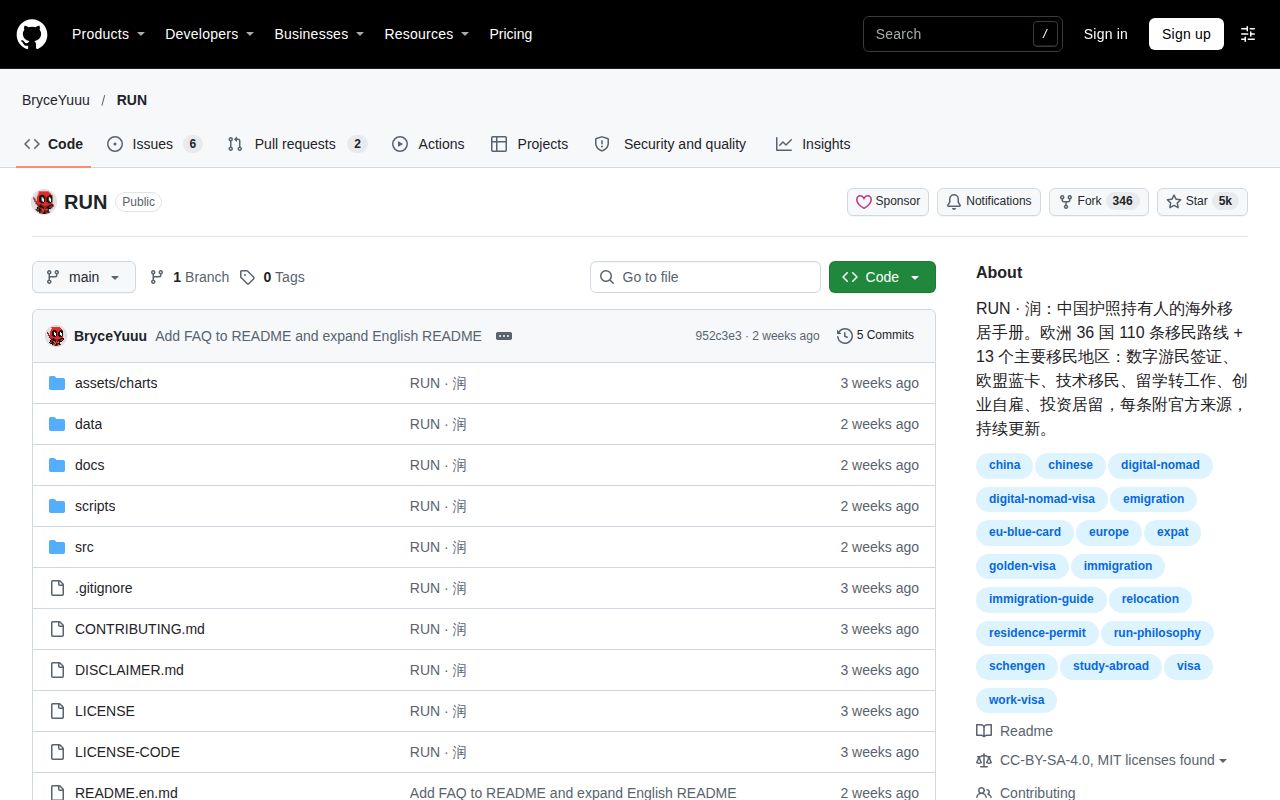
The README advertises 110 immigration routes across 36 European countries and 13 destinations outside Europe. Those are attributed coverage figures, useful for understanding the project's intended scope. GitHub metadata records the last repository push on November 7, 2026. A front-page update date, a repository push and a route's policy date answer different questions. When keeping a shortlist, record the particular official page you read and the condition relevant to your choice rather than relying only on the repository's overall date.
Contributors edit source material before generating pages
The Chinese README directs country-content edits to src/ before running python3 scripts/build_docs.py. It describes src/details/<country>.json as holding route details and src/notes/<country>.md as holding deeper country notes. The generator uses data and src to produce European documentation, charts and automatic README blocks. This is the documented contribution workflow, and the command below is reproduced from that README.
python3 scripts/build_docs.py
The README asks contributors reporting outdated information to attach official source links. A useful correction therefore identifies the disputed passage, the route it concerns and the official page supporting replacement text. Following the documented source-first workflow also keeps the proposed edit connected to the material used to generate pages. The source-run measurement reports a completed build; the README supplies the command shown here. They are separate pieces of evidence with different jobs in this review.
Free access and reuse have different terms
The English README lists CC BY-SA 4.0 for documentation and MIT for scripts. That distinction matters when someone plans to copy a country guide, adapt a checklist or reuse generator code. Start by identifying which material you want to reuse, then read the corresponding licence. The upstream repository also provides a direct place to read the handbook before deciding whether a separately offered product adds something useful for your circumstances.
In issue #8's resale allegation, a reporter says a Xiaohongshu account is selling copies of RUN's freely available handbook. The issue includes attachment links and suggests a platform copyright complaint. The allegation belongs to the reporter, including their description of infringement. For a reader evaluating a paid copy, the practical question is what the seller supplies beyond material already available from the named upstream repository and under which terms.
RUN vs awesome-run and the broader run collection
Knowckx/awesome-run focuses on technical talent, while The-Run-Philosophy-Organization/run invites personal relocation experiences. BryceYuuu/RUN names both among its organisational references. Their documented emphases give readers a way to choose the next collection to inspect: route and document organisation, career-oriented comparisons, or contributed accounts. The comparison below uses those stated purposes rather than assigning content-quality rankings or transferring this repository's setup timings to another project.
| Project | Documented emphasis | Pick it when |
|---|---|---|
| BryceYuuu/RUN | Route guides, country pages and document preparation for Chinese mainland passport holders | You want an organised starting shortlist |
| Knowckx/awesome-run | Immigration-path comparisons for technical talent | You want to organise questions around a technical career |
| The-Run-Philosophy-Organization/run | Relocation reasoning, destinations and contributed experiences | You want personal accounts alongside route research |
The awesome-run README says it aims to give programmers and similar technical professionals a clear comparison of permanent-residence and citizenship paths. The Run Philosophy README asks contributors to include details such as education, costs, destination, visa and resulting status when sharing experiences. These are useful differences in presentation. Choose according to the question you are trying to organise, and keep an account of someone's circumstances distinct from the requirements attached to your own route.
FAQ
Issue #1 asks for less financially demanding options, and its supplied record has no comments. The three project-specific questions below come from the sampled GitHub issues: budget, complete translations and skill packaging. They address decisions a new reader may face before spending time with the handbook. Each answer keeps the request attached to its source rather than turning a reader suggestion into a delivered feature or a documented application result.
Does RUN offer relocation options for people with very little money?
Issue #1 asks for less financially demanding approaches, while the README organises its material by route category. The budget request expresses dissatisfaction with financial requirements and asks for a cheaper approach. For a first reading, use the route categories to identify the financial questions you need answered. Keep income requirements, preparation expenses and living costs as separate entries in your notes rather than treating one advertised threshold as a complete moving budget.
Could RUN provide complete English and Spanish translations?
Issue #2 requests complete English and Spanish translations; the English README describes the guides as Simplified Chinese. The translation request also discusses the continuing work of maintaining several language versions. A reader deciding whether to begin can inspect the English overview's route categories and practical-guide descriptions first. That gives a concrete view of the handbook's contents before choosing how to read the underlying Chinese material.
Could RUN be packaged as a skill?
Issue #4 suggests packaging RUN as a skill, and the supplied extract contains the request title with an open status and no comments. The skill-packaging request is therefore best read as a proposed way to access the material. RUN's documented form in the README is a handbook with source data and a documentation generator. Readers can evaluate that existing structure while treating the issue as a request for another format.
What we have not tested yet
Our measurements cover repository setup at commit 952c3e3, not policy accuracy, personal eligibility or completed applications. This review concerns BryceYuuu/RUN specifically, and the supplied evidence contains no verified RUN-assisted relocation outcome. We have not tested translation accuracy, demonstrated a low-budget route, reconciled unique current pathways or audited the advertised official links. The Hungarian proposal lacks supplied government corroboration and evidence of incorporation into the handbook; the resale allegation lacks a supplied legal finding or takedown outcome.
The deployment summary needs additional logs or correction before it can support a successful-service claim. The pack contains no screenshot records or known-answer task results, and the sandbox image label does not establish actual runtime or operating-system versions. The displayed generator command comes from the README; this correction did not execute it. Support responsiveness, comparative policy quality, rendered layout and the effects of any related-page modules also fall outside the supplied measurements. Use the shortlist to carry a named route and its official source into your next decision.