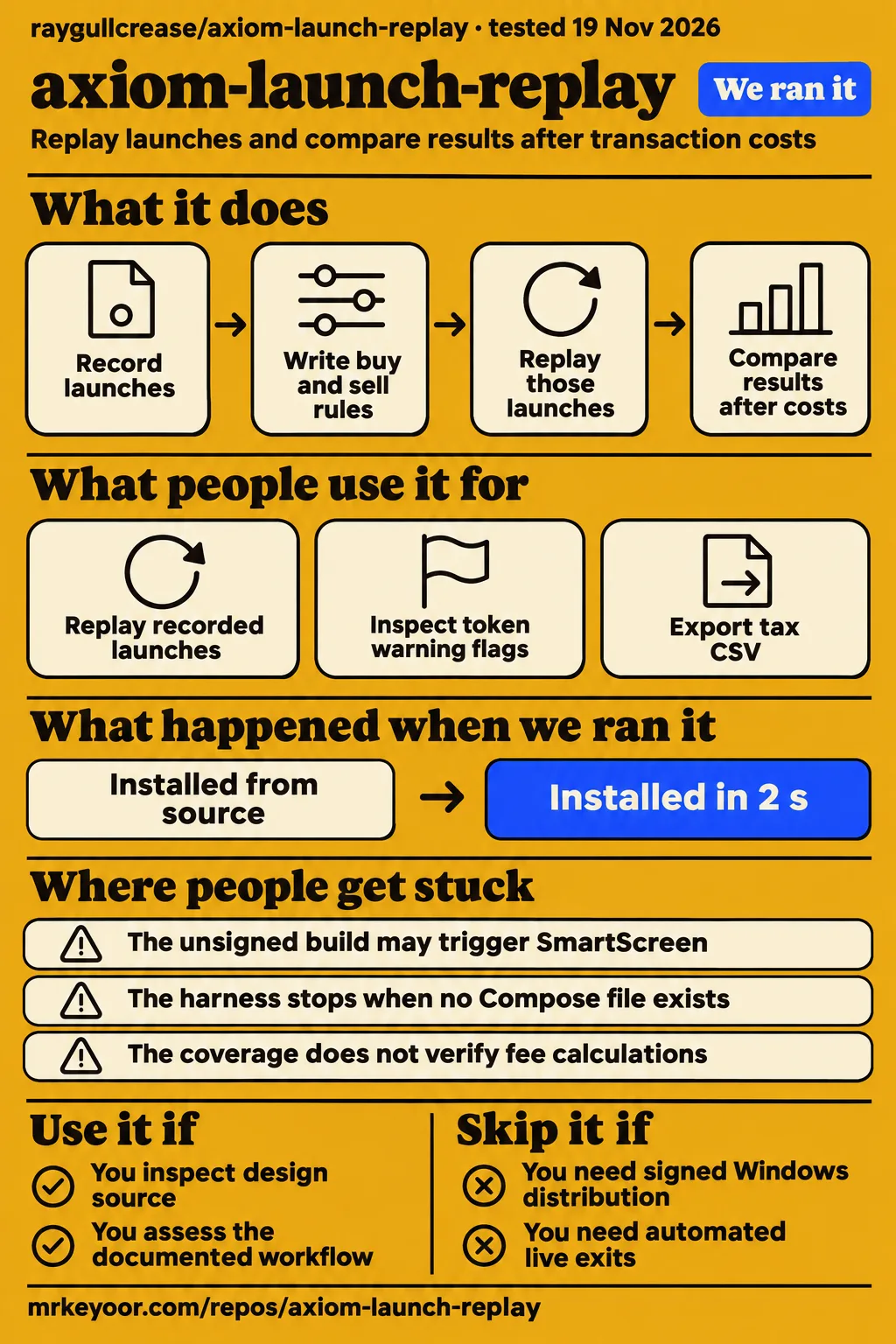
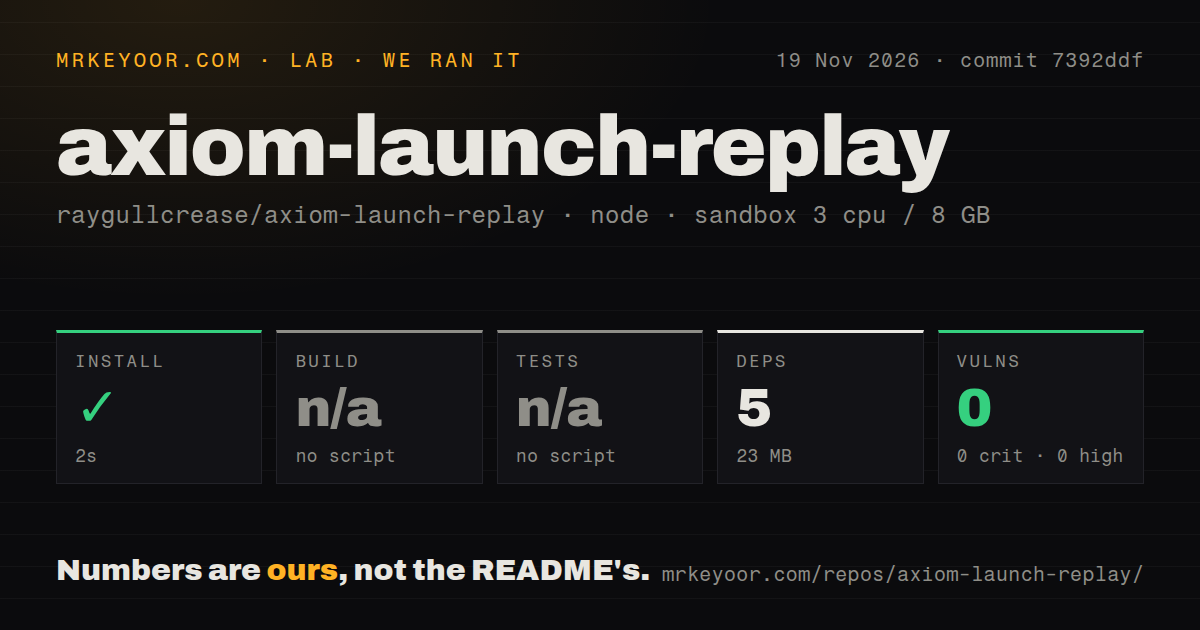
Our npm install finished in 2 seconds in Lemma's design workspace. That makes this repository useful to designers inspecting its interface source and technical evaluators assessing its documented workflow. Traders choosing software on demonstrated fee accuracy should look elsewhere for that evidence, and users requiring signed Windows distribution should skip the unsigned download. Lemma is the product name used in raygullcrease/axiom-launch-replay; the pinned design README explains the workspace our run reached.
What you can do with Lemma
Lemma's README advertises recorded-launch replay, paper trading, token checks and a trade journal with tax CSV exports. The author describes Lemma as an independent desktop companion for Axiom traders and says it never places trades for you. Its proposed sequence is to record launches, write buy and sell rules, replay those launches, and compare results before and after transaction costs. The Lemma README presents those capabilities as the product's purpose.
The cost breakdown is central to that description: fee tier, priority fees, tips and slippage appear as separate items. The journal begins with a public address and promises reconstructed trades plus a tax-ready CSV. The token screen lists mint and freeze authority, pool identity, same-slot bundles, holder concentration, developer launch history, copied names and pictures, and recently renamed X accounts. These are specific advertised checks, rather than a single unexplained token score.
What people use axiom-launch-replay for
Lemma's author proposes launch rehearsal, token inspection and public-address accounting as its main uses. Those three jobs provide a clearer way to evaluate the project than treating every feature as part of one trading terminal. The replay workflow starts with recorded launches and strategy rules; the token workflow starts with an address; the journal workflow starts with a public address and ends with an export. Each has a different input and a different promised output in the author's feature description.
| Who describes the use | Proposed job | What the source actually contributes |
|---|---|---|
| Repository author | Replay launches and then paper-trade the rules live | A description of recording, rules and before/after-cost curves |
| Repository author | Paste a token address to inspect warning flags | A feature list covering authorities, holders and related launches |
| Repository author | Reconstruct trades from a public address and export CSV | A claimed journal and export workflow |
| AI Release | Replace manual fee calculations and inspect tax exports | An editorial assessment describing local calculations and tax CSV |
The distinction between the first and third jobs is useful. A replay asks how a set of rules performs on recorded launches, while the journal promises to rebuild activity associated with a public address. A trader interested mainly in accounting can therefore start with the journal description instead of interpreting a strategy chart. AI Release also singles out the tax CSV and token check in its assessment of Lemma's value.
What happened when we ran it
Our November 20 hands-on attempt stopped at its safety step because the repository had no Compose file. The failed safety step names four accepted filenames: compose.yaml, compose.yml, docker-compose.yaml and docker-compose.yml. Its "unsafe repo" label comes from the harness rule requiring Compose. The earlier November 19 sandbox run used commit 7392ddf and installed the dependencies in ./design/, which the design README identifies as the asset-rendering workspace.
The November 20 metadata contains conflicting outcomes. Its run header says deployment used the repository's own Docker Compose and bound every port to 127.0.0.1; the detailed safety step says the required file was absent. We use the failed step as the outcome rather than counting the header as a successful deployment. The final recorded event is successful teardown, with the exact result teardown: ok.
| Recorded question | Answer | Verdict | Why |
|---|---|---|---|
| Did the November 20 attempt pass its safety prerequisite? | No | Failed | None of the four accepted Compose filenames existed |
| Did the deployment header agree with the detailed step? | No | Conflicting metadata | The header describes deployment, while the safety step records a prerequisite failure |
| Did teardown finish? | Yes | Completed | The teardown record says teardown: ok |
| Sandbox check at 7392ddf | Recorded result |
|---|---|
| npm dependency installation | Succeeded in 2 seconds |
| Dependencies and footprint | 5 dependencies recorded; 23 MB on disk |
| Build | Skipped: no build script or target |
| Tests | Skipped: no tests script or target |
| npm audit | 0 known vulnerabilities: 0 critical, high, moderate or low |
| Checkout | 60 files; approximately 269 source lines; 5.9 MB |
| Repository signals | 1 CI workflow file; no Dockerfile; no tests directory |
In our run, npm dependency installation succeeded in 2 seconds. The sandbox measurement also records 3 CPUs, 8 GB of configured RAM and image label lab-node:22. These figures describe the setup check at 7392ddf. Build and tests have the explicit outcome "skipped," and the audit reports zero known vulnerabilities in the checked npm environment. Keeping those labels intact makes the successful installation and absent build/test targets visible together.
Where people get stuck: the unsigned Windows download
The README says the Windows build isn't code-signed and may trigger SmartScreen. Its documented response is to choose More info, then Run anyway. That is the author's launch workaround for the warning. The same download instructions describe a single Lemma-setup.exe, while the release link targets axiom-launch-replay.rar; readers following that link should keep the documented filename and linked archive distinct.
| Obstacle | Documented response | What that response resolves |
|---|---|---|
| SmartScreen warning | Author describes More info, then Run anyway | Permission to launch the unsigned file |
| A copy asks for credentials | Author says a credential-requesting build isn't Lemma | A stated rejection signal for a suspicious copy |
| Our lab requires Compose | Safety step stops when no accepted Compose filename exists | Eligibility under this harness's Compose rule |
The Windows download and the Compose prerequisite belong to different execution paths. The README advertises a Windows file; the hands-on harness required a Compose file before proceeding. That explains the recorded stop without turning Compose into an installation requirement for the advertised desktop product. For users subject to a signed-software policy, the README's explicit unsigned-build disclosure already answers the immediate download decision, regardless of the separate lab prerequisite.
Local replay uses RPC and public APIs
The README says Lemma reads the chain through your own RPC and free public APIs. It then records launches in a local folder and describes backtests, paper trades, token checks and trade-history processing on your PC. That documented data flow contains both remote data access and local processing. "No login" describes the advertised account requirement; the RPC and API references describe how the application obtains blockchain information.
The README also separates analysis from trading: "Lemma never places trades for you." Its FAQ places an opt-in exit manager with spending caps and a transaction allowlist next on the roadmap. That distinction gives the current feature list a clear boundary. Backtests, paper trading and token checks are described as available, while the proposed exit manager belongs to a future workflow involving transaction submission, according to the author's FAQ.
The design source explains the presentation assets
The design README says everything in assets/brand, assets/mockups and assets/readme renders from this folder. It identifies src/kit.js as the home of a seeded sample market, so renders show the same launches, addresses and curve. Each scene is an HTML file under src/, and animated scenes expose window.seek(t). These details connect the repository's images to a documented design and rendering process.
The rendering instructions name npm install, npx playwright install chromium and node render.mjs all. They also describe rendering one group with node render.mjs icon, node render.mjs stills or node render.mjs gifs, and one GIF with node render.mjs gifs hero. GIF generation needs ffmpeg and gifsicle on the PATH; the icon step needs Python with Pillow. These are the design README's commands and requirements, rather than additional commands executed during our dependency check.
The visual direction is unusually concrete: dense rows, 12.5px type, tabular figures, thin separators and monospace addresses. Amber marks the strategy and results after costs; green and red denote profit and loss with a sign. For a designer inspecting the repository, that documentation explains both the shared scene data and the intended visual grammar. The seeded market supplies consistency across assets, while the HTML scenes provide the individual compositions.
Lemma vs trading terminals and narrower tools
Lemma's README positions it around paper replay and separate fee, priority, tip and slippage lines per trade. Solana Explorer and rotki describe different primary jobs. Lemma's README contrasts replay with live trading and lists those costs separately. That is the repository author's positioning. Solana Explorer's README centers on viewing on-chain data, and rotki's README centers on portfolio management, accounting and analytics.
| Choice | Reason to consider it | Basis for the comparison |
|---|---|---|
| Lemma | You want the advertised launch rehearsal and per-trade cost view | Repository author's feature description |
| Trading terminal or bot | You need the live-trading role that Lemma says it doesn't perform | Author's distinction between trading and paper replay |
| Paid analytics terminal | You are comparing support commitments and distribution practices | AI Release credits the category with support, SLAs and signed builds |
| Solana Explorer | You want to inspect transactions, accounts and blocks | Its own README describes those on-chain inspection functions |
| rotki | You want portfolio accounting and analytics | Its own README describes that broader product category |
Solana Explorer is a web application for viewing transactions, accounts, blocks and other on-chain data. Its project README also describes protocol integrations for inspecting transaction and instruction types. rotki describes itself as a privacy-focused portfolio manager, accounting and analytics tool. Its README lists transaction decoding and profit/loss reports, making it relevant to a broader accounting decision rather than specifically to launch rehearsal.
AI Release credits paid terminals with support, SLAs and signed builds in its category comparison. It names no particular product in that passage. The useful selection order is therefore the reader's task: transaction inspection points toward Explorer's documented role, broader accounting toward rotki's, and launch rehearsal toward Lemma's advertised workflow. Support commitments belong to the terms of the particular service being considered, rather than to the word "paid."
What the other reviews get wrong
AI Release says "zero sending your address to someone else's server," while Lemma's README describes RPC and public API access. The correction is to describe local processing alongside RPC and API access, rather than repeat the article's blanket privacy assurance. The article's statement about sending addresses is broader than the README's description of outside data services. Neither description should be silently substituted for the other.
AI Release calls Lemma a Rust utility, whereas the checked design workspace uses Node tooling and HTML scenes. Those statements concern different possible parts of the project; the accurate description of our result is an npm dependency installation in ./design/. The article also explicitly says there isn't a single independent measurement. Its feature discussion and its own measurement qualification should be read together when interpreting its assessment of fee calculations.
FAQ
Lemma's README says it never places trades for you and identifies it as independent of Axiom. Those answers distinguish the advertised analysis companion from an official trading integration. The questions below cover affiliation, trade execution, downloads and the product details raised by AI Release. The repository FAQ supplies the first three answers; the later questions lead to the specific open checks collected in the final section.
Is axiom-launch-replay, now called Lemma, officially affiliated with Axiom?
Lemma is independent of Axiom, according to its README, and uses no private API. The README calls it an independent open-source project working alongside Axiom. Its legal notice also says it is not affiliated with or endorsed by Axiom, pump.fun, Koinly or Awaken. The repository name identifies its intended audience, while the FAQ and legal notice state the relationship directly.
Does Lemma execute trades or only provide backtesting, paper trading and token checks?
The README says Lemma never places trades for you. It advertises backtests, paper trading and token checks, then places an opt-in exit manager next on the roadmap. The proposed manager includes spending caps and a transaction allowlist in the author's description. The answer for someone seeking live exit automation is therefore that the README assigns it to the roadmap.
How can I tell whether a Lemma download is genuine?
Lemma's author directs readers to this repository's releases page and says a credential-requesting build is not Lemma. Those are the two checks stated in the download FAQ. They sit alongside the warning that the Windows build is unsigned and the description of Lemma as requiring no login, no extension and nothing to connect.
Should I run Lemma's unsigned Windows executable or wait for code signing and an external audit?
Lemma's Windows build is unsigned, according to the README; users requiring signed distribution should wait. AI Release raises the choice between running the unsigned executable and waiting for signing and an external audit in its download discussion. The documented SmartScreen workaround changes launch permission; the build's stated signing status stays unsigned.
Can recorded-launch backtests account for slippage encountered in live trading?
Lemma's README includes slippage in its advertised per-trade cost breakdown. AI Release asks specifically about live slippage absent from a recording in its discussion of replay assumptions. That question separates a recorded input from a later execution outcome. The final section identifies the transaction reconciliation needed to assess the advertised cost calculation.
How accurately does Lemma calculate priority fees, tips and slippage?
AI Release says there isn't a single independent measurement of Lemma and asks how it counts priority tips and slippage. The README, meanwhile, names those costs in its feature description. The article's measurement discussion therefore supports asking for transaction-level expected and actual charges, rather than assigning an accuracy percentage to the feature list.
How many launches can Lemma store, and how much memory does replaying weeks of launches require?
AI Release asks how many launches Lemma's local folder can hold and how much memory replaying weeks of launches will use. The README's phrase "weeks of launches in seconds" describes its advertised replay speed, while the article's capacity question concerns storage and memory. Our recorded 8 GB value is the sandbox's configured RAM, not a replay workload result.
What conditions trigger Lemma's same-slot bundle and other token-check flags?
AI Release says the token-check thresholds aren't disclosed. The README lists same-slot bundles among checks covering authorities, pool identity, concentration and developer history, but the article specifically asks when the flag is raised. That makes the triggering rule the useful next detail for interpreting the label, rather than the number of checks shown on a screen.
What we have not tested yet
Our checks reached design dependency installation and a failed Compose prerequisite, not a completed Lemma desktop workflow. The missing Compose file is a harness eligibility failure, not a malware finding or evidence that the Windows application fails. We have not tested the executable, reproduced its build, established its implementation language, or traced the binary to source. The image label lab-node:22 also does not identify the actual runtime or operating-system version.
Fee accuracy, replay correctness and speed, live-fill slippage, storage capacity, replay memory use, token-check thresholds and detection accuracy remain open. The npm audit result concerns the checked dependency environment; skipped build and test steps supply no passing application results. The seeded design scenes are illustrations rather than measured trading outcomes. A useful desktop evaluation would pair known transactions and expected charges with actual output, addressing the calculation questions AI Release raises.
The other gaps concern requests sent to RPC providers and public APIs, sample CSV reconciliation, demonstrated imports into Koinly or Awaken, browser-extension checks and any future trade-submitting exit manager. Support quality, adoption and issue-resolution times also lack a completed user workflow or applicable resolution history in this review. There is no side-by-side run with a terminal, Solana Explorer or rotki. The most useful next artifact is a reproducible desktop session joining inputs, expected results and observed outputs.