This repository is for changing Kotlin, not learning its syntax
Kotlin's repository contains the language implementation and the machinery around it. The README points contributors toward compiler distributions, standard-library tests, Gradle plugin tests, Kotlin/Native, and optional Maven-built artifacts. If your goal is an Android app or a JVM service, cloning 110,429 files is the wrong first move. JetBrains links to a getting-started guide, an online playground, IDE plugins, and published packages for that work.
The source tree earns its size. Kotlin targets the JVM, JavaScript, WebAssembly, and native platforms, while Kotlin Multiplatform shares logic across Android, iOS, desktop, and web. Those targets create different compilers, libraries, test suites, and integration layers. The checked-out commit occupied 320.9 MB and contained about 4,416,905 source lines. This is compiler infrastructure with a language attached, not a weekend interpreter project.
The documented build begins with Gradle and several JDKs
The root workflow uses the included Gradle wrapper. Toolchains can obtain the required JDKs from Eclipse Adoptium, or contributors can supply JDK locations through environment variables and disable automatic detection. That flexibility helps on managed build machines, but it also means a successful local build depends on more than whatever java happens to be on the path. Windows users may need to enable Git's long-path setting before the checkout behaves properly.
First configuration downloads intellij-core and idea-full. JetBrains warns that these dependencies are large enough to trigger network timeouts and provides 60,000-millisecond socket and connection settings. The named tasks are scoped: dist assembles a compiler distribution, coreLibsTest exercises core libraries, compilerTest handles compiler tests, and gradlePluginTest covers the Gradle plugin. Kotlin/Native and some Maven plugin artifacts follow their own instructions.
What happened when we ran it
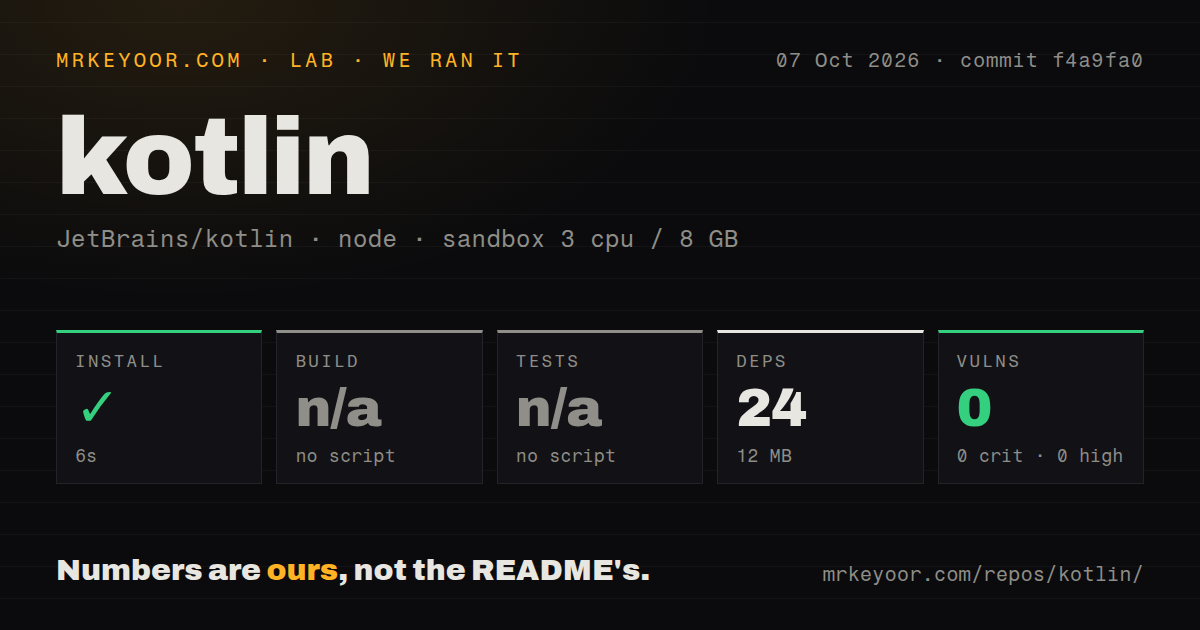
Our sandbox installed 24 npm packages in 6 seconds and used 12 MB on disk. The run used commit f4a9fa0 in a fresh unprivileged Debian container with 3 CPUs, 8 GB of RAM, Node 22, and no secrets. Npm audit reported 0 known vulnerabilities across critical, high, moderate, and low severities.
That clean result applies only to wasm/wasm.debug.browsers. Its package is named custom-devtools-formatters, declares Rollup and the Terser plugin as development dependencies, and contains no npm scripts. There was therefore no build target and no test target to run. Both steps were skipped. The result says nothing about whether the Kotlin compiler, standard libraries, Gradle plugin, or native backend builds at the same commit.
The scope distinction matters because a 6-second npm install can look like a remarkably easy Kotlin source build when removed from its path. It was a small helper inside a 4,416,905-line repository. The checkout does contain a tests directory and one GitHub Actions workflow in our scan, but the README points to public TeamCity for the compiler's main build status. Anyone modifying the compiler should run the relevant Gradle task, not use this npm result as a release gate.
Dependency verification makes local artifacts part of the build contract
Gradle checks MD5 and SHA-256 hashes against verification-metadata.xml. A missing local artifact or a changed hash stops the build with a dependency-verification error. Contributors who change dependencies must regenerate the metadata, and cross-platform artifacts with names such as darwin, linux, or windows need special attention so resolution covers every target. This is sensible supply-chain discipline, though it adds a precise maintenance step to dependency changes.
A local local.properties file can also override the command line and disable Kotlin/Native dependency resolution. That detail is easy to miss: a metadata update may look complete on one workstation while omitting native-only artifacts. JetBrains supplies an update script and a resolveDependencies task. Follow those paths rather than editing hash entries by hand.
October 8 activity shows a maintained compiler with a busy queue
GitHub reported 53,487 stars and 447 open issues and pull requests on October 8, 2026. The repository was pushed that day, and the recent GitHub queue included active pull requests touching JDK requirements, WebAssembly, JavaScript, Gradle, tests, and Kotlin/Native. Kotlin's README directs bug reporting to JetBrains YouTrack, so the GitHub combined count is not a complete bug total and should not be read as one.
Release v2.4.21 was also published on October 8. Its changelog lists fixes across WebAssembly, JVM reflection, JavaScript, serialization, Kotlin/Native tooling, and scripts. That breadth is reassuring for users of released Kotlin. For a prospective compiler contributor, it is also the warning label: a change can cross several backends and toolchains.
Kotlin is an easy recommendation as a released language when its JVM, Android, or multiplatform fit matches your product. This repository is a narrower recommendation. Clone it when you have a compiler-level change and enough time to run the relevant Gradle work. Our npm measurement should guide only the small WebAssembly debugging package it actually covered.