Kopia snapshots selected files, not a bootable machine
Kopia is for file and directory backup. You choose what enters a snapshot, set retention and scheduling policies, and restore individual files or whole directory trees later. The README is explicit that it does not image an entire computer. That rules it out for bare-metal recovery by itself, but it keeps the job understandable for documents, home directories, media, and application data. Windows, macOS, and Linux users can use the command line or official desktop interface.
What happened when we ran it
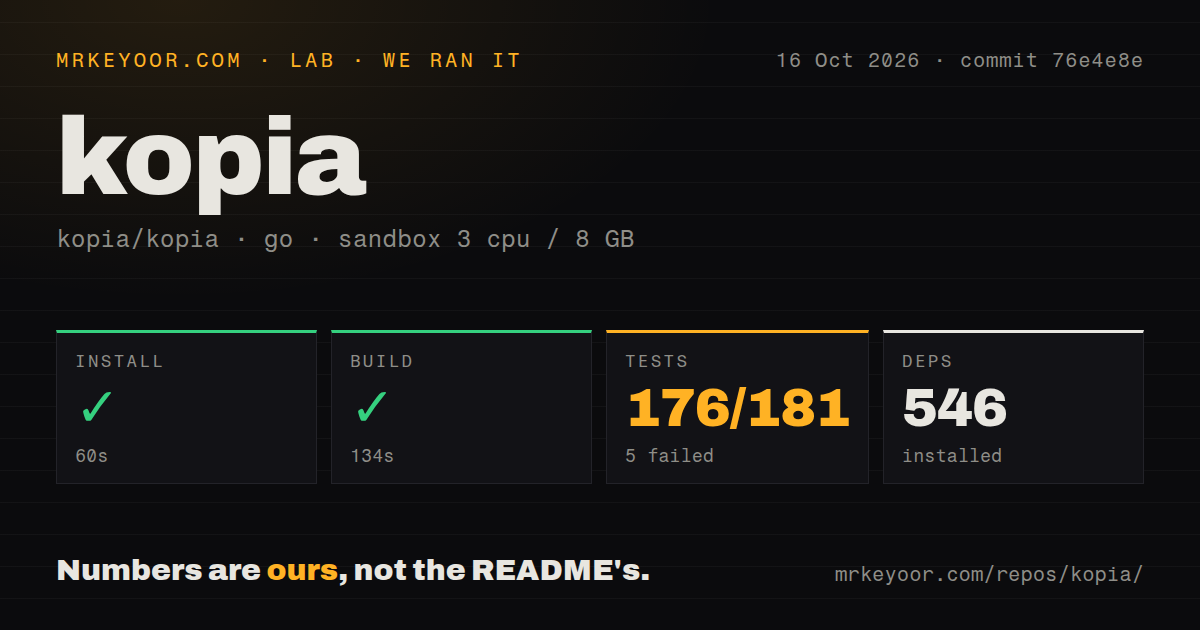
Our run used commit 7de9f36 in a golang:1.24-bookworm container with 3 CPUs and 8 GB of RAM. Installing 508 packages took 72 seconds, and the build succeeded in 99 seconds. The checkout held 1,257 files, roughly 164,183 lines of source, and 7.8 MB before installation. The basic build completed without privileged access or secrets.
The full Go test command failed with exit code 1 after 696 seconds. The harness counted 174 passing and 6 failing targets out of 180. Its final lines named successful packages in the robustness, socket activation, stress, filesystem walker, runner, and CLI documentation areas, then ended with FAIL. The supplied tail did not contain the 6 failing names or their error messages. We cannot assign a cause; this commit did not pass its full suite in our stated environment.
The repository includes a tests directory and 18 CI workflow files. It has no Dockerfile in the checkout according to our scan, though Kopia publishes container images. The test failure outweighs the green build when judging this revision. Teams evaluating commit 7de9f36 should reproduce the suite with the complete log and identify whether the failures affect their platform or storage backend.
One repository password controls every encrypted snapshot
Kopia encrypts snapshots before upload, then compresses and deduplicates their contents. The repository password protects the primary encryption key and is required to list snapshots, see names, or restore files. The official guide says there is no recovery route if you forget it. Store that secret in a protected system that does not depend on the Kopia repository. A healthy backup remains unusable when its only decryption secret disappears with the failed machine.
Directly sharing a repository also means sharing its one password, and the feature guide says this mode has no access-control mechanism. Kopia Repository Server instead keeps storage credentials on the server and authenticates clients separately. It can limit users to their own snapshot and policy manifests. The server documentation notes that underlying contents are different: a user who somehow knows an object ID can read that object. Understand that boundary before treating the server as strict tenant isolation.
v0.23.1 fixes a rare race with possible data loss
Release v0.23.1 from June 16, 2026 carries an unusually direct warning. It fixes a rare compaction race that could create incomplete index sets and lead to data loss, and the project recommends upgrading. Linked issue 5371 is closed and explains the sequence involving gaps between compacted epochs. The fix shows maintainers responding to a serious problem. It also makes casual version pinning a poor policy for backup infrastructure.
Restore behavior needs its own acceptance test. Open issue 5564 reports that v0.23.1 can restore a file by filesystem path with default permissions and an epoch timestamp, while snapshot-ID syntax preserves the stored metadata. The example credentials file becomes more permissive without a warning. Until that path is fixed or documented, test ownership, permissions, links, and timestamps with the exact restore command your recovery runbook will call.
Rclone broadens storage support under an experimental label
Native choices include local and network storage, S3-compatible services, Azure Blob, Backblaze B2, Google Cloud Storage, SFTP, and WebDAV. Rclone widens the list, but the README calls its integration experimental and says some providers may not work. It names Dropbox, OneDrive, and Google Drive as tested. Rclone must be installed separately. Test an unlisted remote with representative data, reconnection, consistency checks, and a restore before relying on it.
The repository server suits several machines when users should not receive storage credentials. It adds TLS, 2 kinds of passwords, network capacity, user administration, and maintenance. Open issue 5595 reports that KopiaUI can leak status-poll sockets when an unresponsive backend leaves timed-out requests open. The report covers a specific failure and remained open. Server operators should alert on missed snapshots and stalled jobs instead of assuming the tray icon proves backups are moving.
A 2015 project remains active with 879 open items
Kopia was created in 2015, released v0.23.1 in June 2026, and received a GitHub push on September 3, 2026. The repository had 14,026 stars and 879 combined open issues and pull requests when fetched. A separate search split that total into 762 issues and 117 pull requests. The current activity is reassuring, while the queue reflects the number of platforms, providers, UI paths, and recovery cases in scope.
Restic is the cleaner encrypted backup CLI. BorgBackup fits a Unix and SSH-centered archive, while Duplicati is closer to a browser-led scheduler. Kopia sits between them with a CLI, GUI, broad storage support, and server mode. Our failed 696-second suite keeps the recommendation conditional: test the release, monitor snapshots, run consistency checks, and practice a metadata-preserving restore.