Multiple dispatch suits numerical libraries with custom types
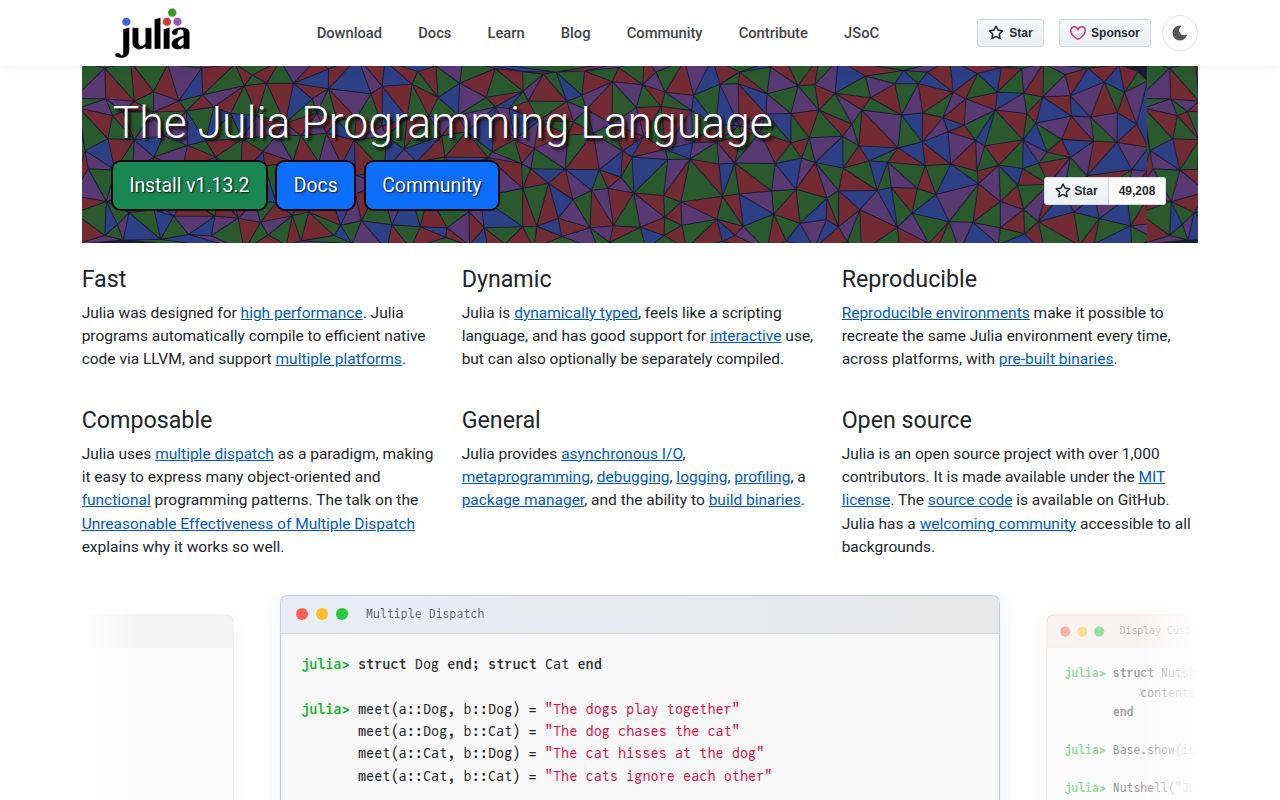
Julia chooses a function's implementation using the types of all its arguments, a behavior called multiple dispatch. A mathematical operation can therefore have different implementations for different combinations of inputs without forcing the operation to belong to one object. For someone building numerical abstractions, that is a reason to learn Julia. For an application mostly calling existing library functions, switching languages needs a stronger justification.
Julia is worth considering when the numerical algorithm itself is your work. You can explore a calculation at an interactive prompt, then organize it into functions that the compiler specializes for their input types. Our 225-second build covered a Rust garbage-collector component inside this repository. It provides no evidence that Julia will accelerate your calculation, so the adoption case starts with how you write and maintain that calculation.
What happened when we ran it
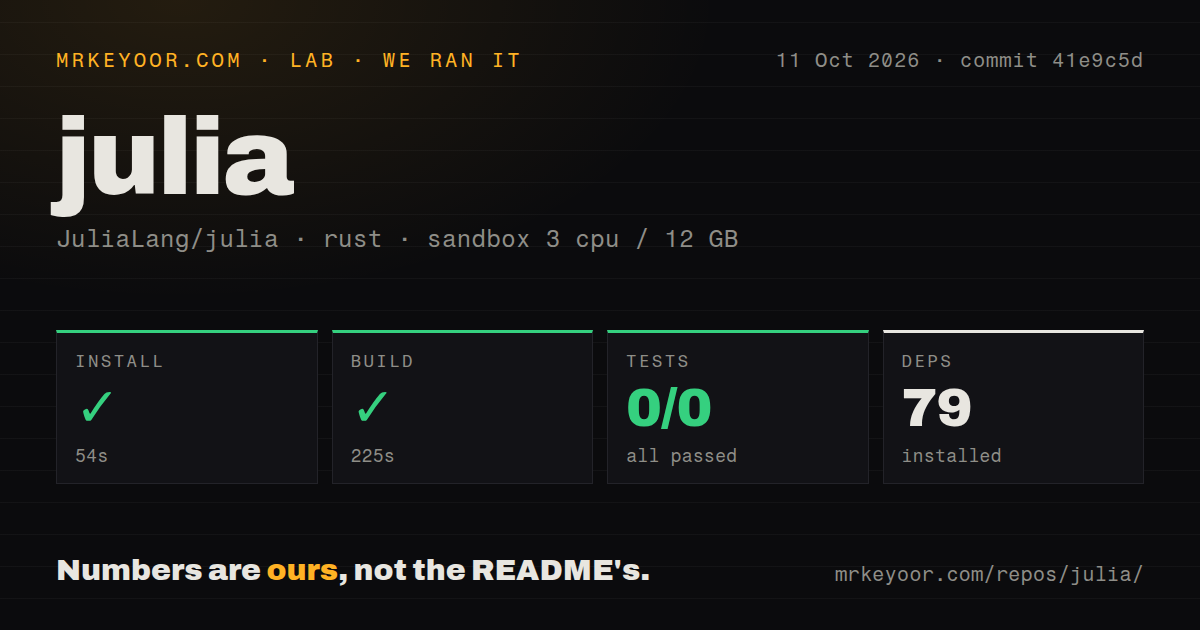
Our run installed 79 packages in 54 seconds and built successfully in 225 seconds at commit 41e9c5d on October 11, 2026. The fresh Debian sandbox had 3 CPUs and 12 GB of RAM, used image lab-rust:1, and contained no secrets. It ran without elevated privileges. The selected project directory was src/gc-mmtk/mmtk_julia, which makes the Rust scope of these results essential to understanding them.
The test step succeeded in 28 seconds. Cargo reported 0 passed, 0 failed, and 0 tests total. That command completed successfully without executing any test cases. It cannot establish the correctness of Julia's language implementation, standard library, or even the component's behavior. Nothing in the supplied results supports describing this as a passing full Julia suite.
The checkout contained 2,058 files, approximately 185,805 source lines, and occupied 35.9 MB. The lab found 6 CI workflow files, no Dockerfile, and a tests directory. Those are repository signals, separate from executed checks. A working Cargo build is useful evidence for a contributor exploring that component, with a much narrower meaning for someone choosing a language. Neither the checkout size nor the presence of automation establishes behavior under a numerical workload.
Official binaries are the documented starting point
The README recommends juliaup, which manages official Julia versions, and links platform support information. It warns that operating-system packages are outside the project's maintenance and endorsement. Local use needs no hosted API credential. Notebook users can choose IJulia for Jupyter or Pluto, while the README recommends the Julia extension for VS Code. You can try the language without becoming a runtime contributor.
Our 79-package install belongs to the Rust component's environment, so don't use that count to budget an ordinary Julia workspace. A source checkout also follows the unstable branch unless you select a release tag. The README warns that spaces or shell metacharacters in parent directory names can break the source-build path. The MMTk documentation also says you must choose that collector when building Julia, because you cannot switch collectors while it runs. Follow the binary route unless changing Julia itself is your goal.
First-call compilation changes which workloads fit
Julia's performance manual explains that first calls can include compilation work. It also recommends putting demanding code inside functions, passing inputs explicitly, and avoiding untyped globals. The benefit takes some learning: the compiler needs useful information about the values flowing through your program. A developer who wants every exploratory script to become fast without restructuring it will find that bargain frustrating.
The 28-second Cargo step tells us nothing about the delay before a Julia function's first result. For a simulation that stays running, initial compilation may be acceptable. A short command repeatedly launched by another process has a different tolerance. Compare the first invocation and subsequent work separately on your own program. Our sandbox supplied neither measurement, and we have no Python-versus-Julia speed result to offer.
Julia 1.13.2 has a reported timer regression
Issue #63882 describes a sleeping task failing to wake promptly while every default-pool thread runs a busy loop that yields. The reporter identifies Julia 1.13.0 through 1.13.2 as affected. PR #63884 proposes a scheduler change and remained open and unmerged on October 17. This is an upstream report, outside our sandbox findings. It deserves attention if your service mixes continuous CPU work with timers.
The 6 CI workflow files found by the lab do not answer whether your scheduling pattern is safe. Equally, this specific report does not establish that every threaded Julia program stalls. A numerical batch job and a service depending on timer wakeups have different exposure. Read the reproducer against your workload and follow the proposed fix's status before committing to the affected release.
Current maintenance supports a trial, with a workload attached
The repository was pushed on October 17, 2026, and v1.13.2 was published on October 15. GitHub listed 49,208 stars and 4,264 open issues and PRs combined. Recent scheduler discussion supplies better evidence of ongoing work than either count alone. Choose Numba if compiling numerical functions inside an existing Python application meets the need. R is a sensible alternative when statistical analysis and graphics already define your workflow.
I'd trial Julia on a numerical routine you expect to keep changing. Require matching answers and acceptable first-call behavior before moving more code. Our 0-test Cargo result leaves that decision to workload validation. If Julia's dispatch makes the algorithm easier to express and maintain, you have a concrete reason to adopt it. If your existing libraries already do the work cleanly, keep them.