One pass scores a changing list of two or more choices
Jevlike 0.1.0 takes a text context, at least 2 text options, and returns a probability for each option in one forward pass. That shape is useful for routing a support request, choosing a link, or selecting an action when the allowed answers change from row to row. A decoder could write an answer and then be parsed, but Jevlike trains directly on the decision you need. The repository is explicit that this is an independent starter, not a reproduction of TypeSafe's private Jev design.
The default encoder learns byte embeddings from scratch. Each option becomes a query over the context, and a shared dot product produces the scores before softmax. That design keeps the moving option list inside the model rather than forcing every possible label into a fixed classifier head. The tradeoff is blunt: context is truncated to 192 bytes and each option to 32 bytes by default. Longer inputs need different settings and training that matches them.
What happened when we ran it
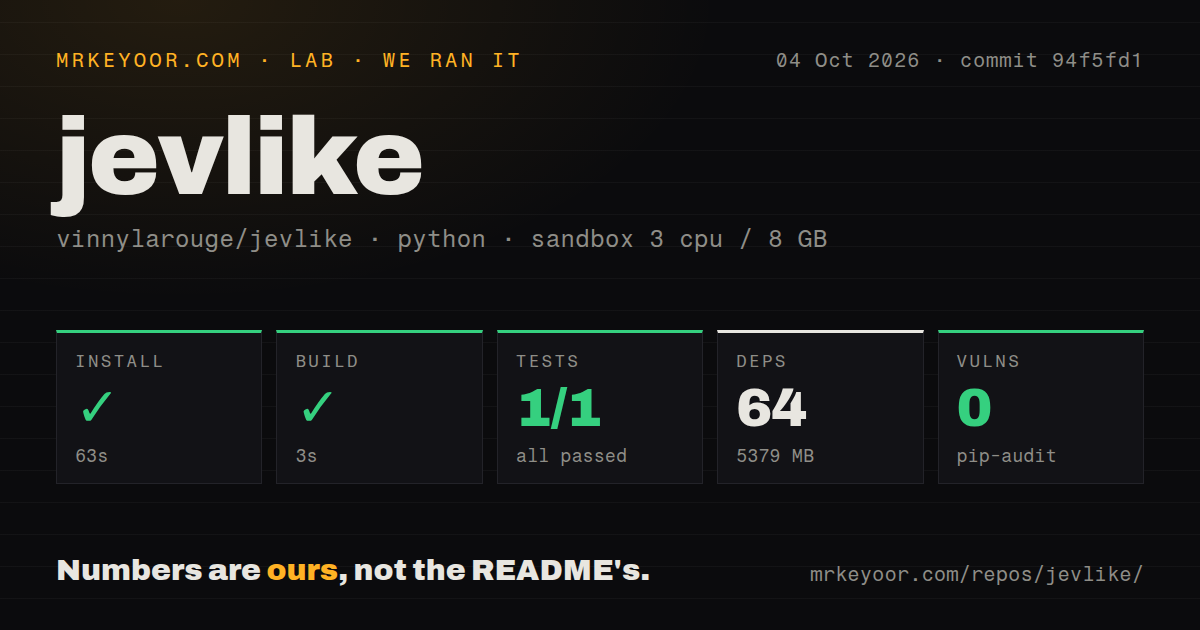
Our sandbox installed commit 94f5fd1 in 63 seconds, pulling 64 packages and occupying 5,379 MB on disk. The build completed in 3 seconds. Pytest then completed in 16 seconds with 1 passed and 0 failed out of 1. Pip-audit reported 0 known vulnerabilities. Those results establish that the supplied package can install, build, and pass its available test in a fresh Python 3.12 Debian container. They do not measure prediction quality or training speed.
The checkout itself contained 52 files, roughly 4,122 lines of source, and used 3.3 MB. Most of the installed size arrived with the Python environment rather than the repository. There is a tests directory, but 1 passing test gives little protection against changes to training, evaluation controls, checkpoint handling, or the optional game examples. The repository also has 0 CI workflow files and no Dockerfile, so adopters must provide their own repeatable check and runtime packaging.
A 29% result depends on a disputed evaluation control
The README reports about 29% accuracy for a small model trained from scratch on 40,000 Wikispeedia clicks. It reports 26% for a frozen Qwen2.5-0.5B encoder with the scorer, compared with roughly 8% for shuffled and random-encoder controls. Those are the author's local experiments, not results from our sandbox. The README says related records should stay in the same split, and the held-out test file should be used once after model selection. That warning deserves more attention than the headline percentages.
Open issue 1 argues that the Wikispeedia shuffled-context control leaks target information because neighboring rows can share the same target. The report measured a 39.4% shared-target rate among shuffled partners and proposes whole-set permutation plus a blank-context control. The issue does not claim the model learned nothing. It says the current control understates the advantage over having no useful page context. Until that evaluation dispute is resolved, compare models on your own grouped split and publish the control logic with the result.
The optional encoder leaves its weights outside the checkpoint
The frozen-encoder path can use a compatible Hugging Face model such as Qwen2.5-0.5B while training only Jevlike's scoring head. The checkpoint records the encoder name but does not copy those weights. Reloading therefore needs access to that same external model. Pin the model revision and preserve it with your deployment artifacts, or a checkpoint alone will not reproduce the service. A wider --rank also adds trainable parameters and memory use, so it belongs in the experiment record.
Checkpoint provenance is a sharper concern. Open issue 3 reports that the library loader calls torch.load with weights_only=False. PyTorch checkpoint loading in that mode can execute code embedded in a malicious file. The issue says a quick-start checkpoint loaded with weights_only=True, but the fix was still open when checked. Train or obtain checkpoints through a trusted path, store hashes, and do not build a public upload feature around the current loader.
The 10-second game reel proves range, not competence
The repository applies the same visual scorer to Doom buttons and chess keys. Its selected 10-second film joins two 5-second windows from supplied checkpoints. The README reports that the Doom checkpoint averaged 0.60 kills and -97.50 reward across 10 recorded episodes. Its stronger chess-only checkpoint managed 4 wins and 46 draws in 50 games against a random mover, then 0 wins, 2 draws, and 48 losses against Stockfish level 0. The author plainly says the selected windows are not typical-play or competence claims.
That candor helps define the project. Jevlike demonstrates one scoring shape across text and visual controllers, but the examples do not establish a general agent or a production policy model. The complete action set must exist before each prediction, and results depend on the training data, split, and encoder. Use the examples to inspect tensor flow and data plumbing. Use your own held-out decisions to judge whether the scorer beats a simple embedding ranker or fixed classifier.
Seven open items and no release point to an early project
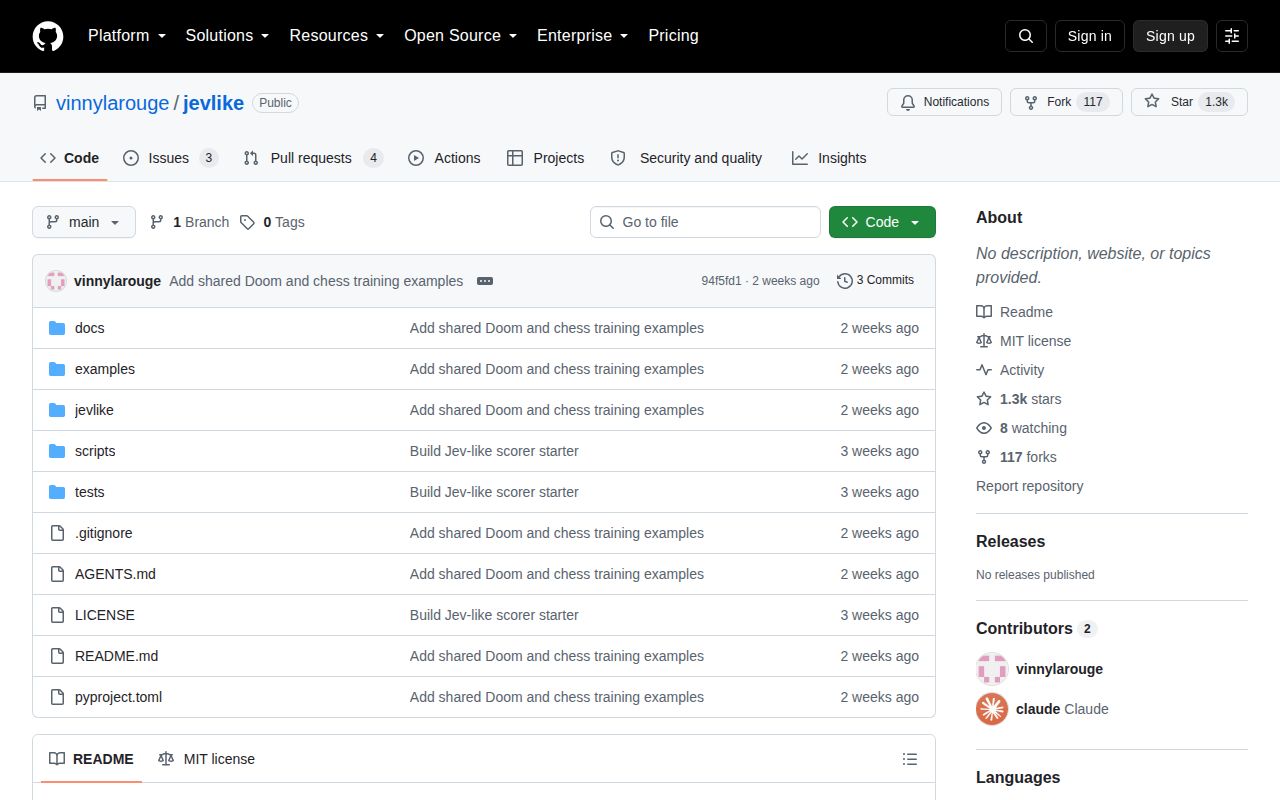
GitHub listed 1,341 stars and 7 open issues and pull requests on October 4, 2026. The last repository push was September 16, 2026, the day the project was created, while several open reports and pull requests arrived through September 25. There is no published GitHub release. That pattern shows immediate outside interest, but it does not yet show a release cadence or sustained maintainer response. The 1-test suite and absent CI matter more than the star count when deciding whether to ship it.
SetFit is a better match for few-shot classification with stable labels. Sentence Transformers gives you a familiar embedding or reranking baseline, and Hugging Face Transformers offers a much broader training stack. Jevlike earns a trial when the variable menu is the point and a one-pass probability distribution is more useful than generated text. Keep the trial narrow: one dataset, grouped splits, explicit controls, and checkpoints you produced yourself.