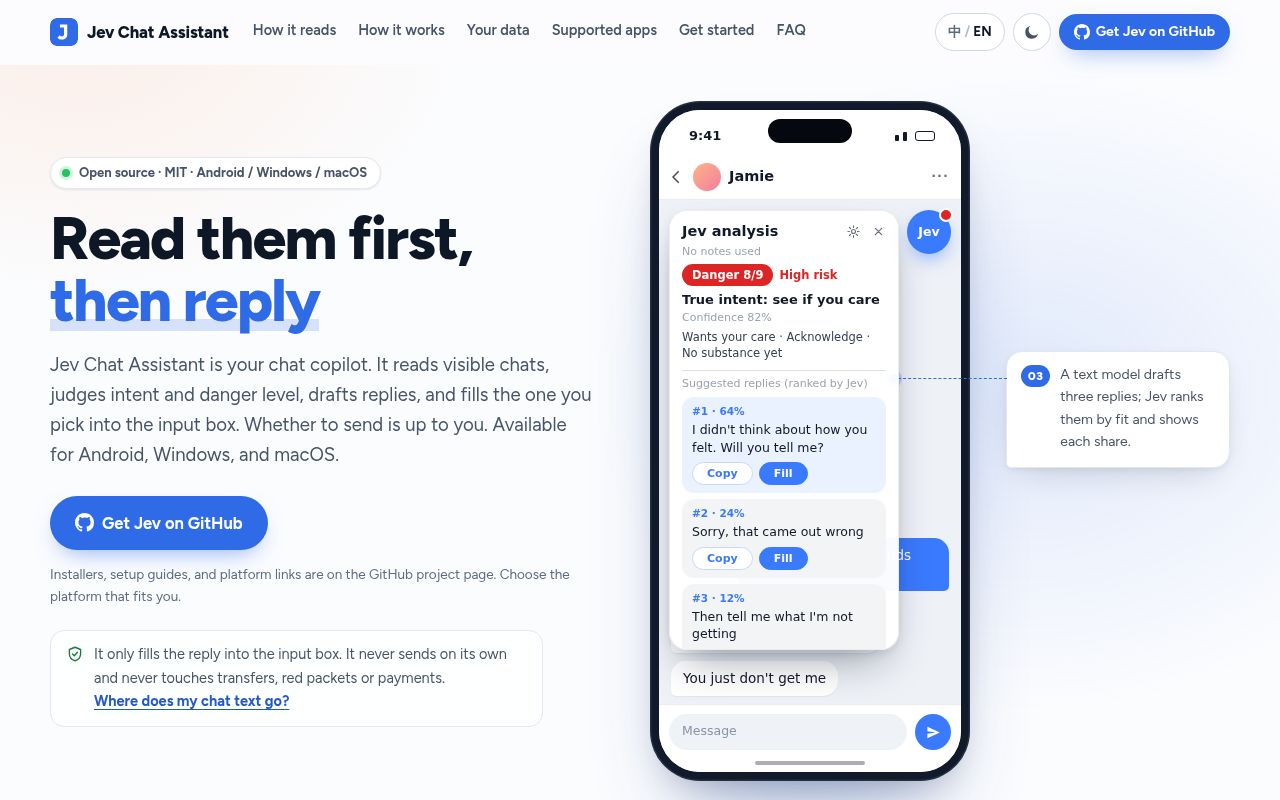
Jev judges the chat before it drafts the reply
Most reply tools start with a prompt box. Jev starts by reading the conversation already visible in a supported app. Its judgment step identifies what the other person seems to want, the risk in the exchange, and possible ways to respond. A generation model then drafts candidates, checks them against that judgment, and ranks them. Choosing one fills the chat input; Jev does not press send.
This repository contains 2 distinct Android builds. The global v0.1.0 preview is an English WhatsApp assistant with its own package and Gradle project. The Chinese v1.7 app supports QQ, Feishu, X, and WhatsApp, with separate adapters for their UI structures. The wider product table links Windows, macOS, and iOS projects, but those codebases are not part of this review.
Local reading still sends text to a model provider
The privacy boundary is explained better than it is in many chat assistants. Screenshots used for OCR stay on the device, and the project says it operates no server for the Android apps. The actual conversation analysis is remote. Chat text, relationship context, the selected response goal, and drafted replies can go to OpenRouter or another endpoint you configure, depending on the edition and settings.
The global edition reads about 24 recent WhatsApp messages by default and can collect about twice that when you ask it to read further back. Its privacy guide says the current round remains in memory for no more than 15 minutes and is not written to storage. The Chinese edition can add matched notes and optional history, with recent history configurable from 0 to 100 messages. Your provider's retention and training rules still apply to everything sent.
What happened when we ran it
We did not run commit fdf8d28. The sandbox runner had no supported ecosystem for this Kotlin and Android project, and the repository supplied no Dockerfile as another execution route. Install, build, and test stages never began, so this review has no measured dependency count, disk footprint, timing, or test outcome.
The unused sandbox had 3 CPUs and 8 GB of RAM in an unprivileged container with no secrets on October 7, 2026. None of those specifications prove that Gradle resolves, either APK builds, or the repository tests pass. The source tree contains Android test code and one GitHub Actions workflow, but presence is not execution. A developer should run each Gradle project on a clean Android build machine before trusting a release change.
Accessibility access is both the feature and the risk
Jev needs unusual privileges because it works inside other chat apps. Android's accessibility tree supplies text where the target exposes it; Feishu falls back to on-device OCR over visible message bubbles. The selected reply goes into the input field with an accessibility action and can fall back to clipboard paste. This avoids modified chat clients and root access, yet it gives Jev a view into sensitive conversations while the service is enabled.
The support matrix has hard edges. Both editions require Android 11 or newer. The Chinese v1.7 APK is ARM64-only, protected windows cannot be captured, and OCR cannot recover hidden parts of truncated messages. Xiaomi and HyperOS may kill the background process even after battery exemptions. X was tested against its Chinese UI, while the English parsing fallback was still unverified in the project documentation.
Preview labels match the current breakage risk
The global release calls itself a preview for good reason. Version 0.1.0 supports only standard WhatsApp on Android, one-to-one chats in English, and was tested against one named WhatsApp version on one phone. Its notes warn that a WhatsApp update can break reading. The Chinese release is broader, but current issues include provider rate limiting and users reporting missing overlays or blocked screenshots in specific chat apps.
GitHub showed 7,445 stars, 25 open issues, and 2 open pull requests on October 8, 2026. The repository was pushed on October 6, the same day the global v0.1.0 preview shipped; Chinese v1.7 arrived one day earlier. That combination points to active development rather than settled behavior. Recent reports are receiving discussion, but app UI changes and provider limits remain outside the maintainer's full control.
The useful question is whether the conversation can leave your phone
Jev's judgment-first flow can be genuinely helpful when tone and boundaries matter more than grammar. It also places private messages from another person into a model request. The fact that you bring the key and the author runs no relay reduces one layer of trust, but it does not remove the provider. Read that provider's policy, disable automatic analysis, and use a conversation whitelist where the Chinese edition permits it.
Version fdf8d28 is best treated as software to inspect and trial, not a silent layer over every chat. Start with low-stakes one-to-one conversations, review the accessibility and overlay indicators, and check every filled reply before sending. If your need is simply cleaner wording, LanguageTool asks for far less access. Jev makes sense only when its conversation judgment is worth the extra permission and privacy cost.