
A 505,865-line business platform, not a small AI wrapper
JeecgBoot contains about 505,865 lines of source across 3,497 files, and that scale matches its ambition. The Java side supplies authentication, roles, menus, data permissions, scheduled jobs, file handling, workflow, reporting, and code generation. The Vue application adds visual builders for forms, dashboards, portals, and processes. An AI application area covers chat, knowledge bases, model management, flow design, and MCP plugins. This is closer to adopting an enterprise application foundation than adding an AI feature to an existing product.
The code-generation approach is the part that may justify the weight. JeecgBoot can produce front-end code, backend code, database SQL, and menu permissions, then expects developers to merge and edit that output. That gives a Java team an escape route from visual configuration when a business rule becomes awkward. The project also supports a monolith or a Spring Cloud deployment. At version 3.9.3, the release notes describe Spring Boot 4, Vite 8, Pinia 3, Vue Router 5, and updated infrastructure components.
What happened when we ran it
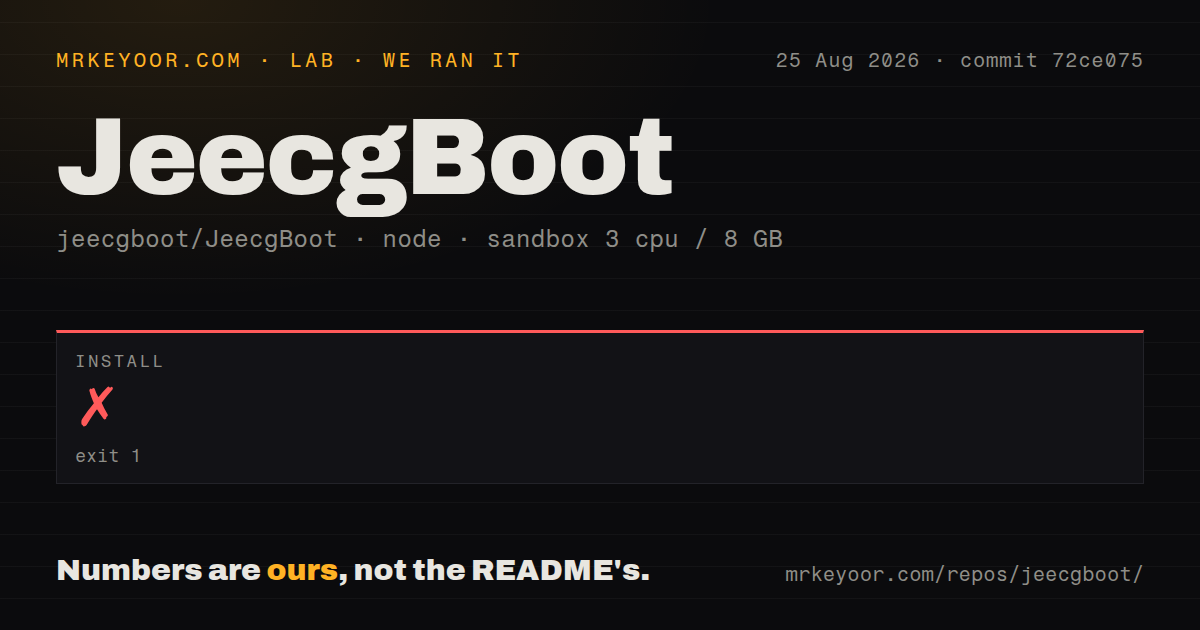
Our pnpm install failed after 9 seconds in ./jeecgboot-vue3/ at commit 72ce075. We ran the 55.2 MB checkout in an unprivileged sandbox with 3 CPUs and 8 GB of RAM, using the lab-node:22 image and no secrets. The final log identified Node.js 20.20.2 and pnpm 11.23.0, then stopped inside pnpm with ERR_UNKNOWN_BUILTIN_MODULE. That log shows where execution ended; it does not establish why the built-in module was unavailable.
Because installation failed, our run never reached a build or test command. The repository did contain a Dockerfile and a tests directory, but our scan found 0 CI workflow files. Those are structural signals, not proof that either route works at commit 72ce075. The useful conclusion is narrow: the documented front-end toolchain did not install in our fresh Debian container, despite the logged Node.js version satisfying the README's stated minimum. A team should reproduce this exact step before budgeting migration work.
The minimum stack starts at 5 named runtime pieces
The README names Node.js 20.19 or newer, pnpm 9 or newer, JDK 17, MySQL 5.7 or newer, and Redis. That is the baseline before enabling a hosted language model or wiring local Ollama. JeecgBoot also publishes admin/123456 as the default login. Treat that account as setup data to replace immediately, especially if someone uses the Docker quick start on a reachable host. The platform handles business records and permissions, so a casual demo configuration carries more risk than a local design tool.
Deployment can expand well beyond those 5 pieces. The documented microservice topology includes Nacos, Gateway, Sentinel, SkyWalking, RabbitMQ, XXL-JOB, Seata, and monitoring components. JeecgBoot does provide Docker instructions for both monolith and microservices, which is helpful, but the two paths solve different operating problems. A small team should begin with the monolith and earn each extra service. An established Spring Cloud shop may value the supplied topology because it maps onto tools its operators already know.
Version 3.9.3 is active, while English details lag
JeecgBoot's primary README and most issue discussion are in Chinese. The 25,621-character English README is substantial enough to evaluate the product, and it links to setup and AI documentation, yet some translated details trail the release. It calls the front end Vite 6 in several places while the August 20, 2026 release says the final upgrade is Vite 8. The same release lists fixes for Docker startup, front-end dependency loading, AI calls, unit-test compatibility, and a stored SSRF flaw. Pin the release and read its notes instead of treating every README version line as authoritative.
Project activity is strong by public repository signals. GitHub showed 47,470 stars, 34 open issues and pull requests, a last push on August 25, 2026, and release 3.9.3 published 5 days earlier. Current discussion covers ordinary UI defects, AI integration, tenancy, and security. That mixture looks like a used platform with maintainers shipping changes, rather than a quiet code dump. It also means upgrades deserve staging because a release can move core framework versions and deployment behavior together.
Open issue #9840 makes a security review mandatory
Issue #9840, opened August 22, 2026, alleges that version 3.9.3 permits an unauthenticated route bypass followed by SQL injection through a dictionary endpoint. The report was still open with 6 comments on August 25. We did not reproduce that claim, so it should be treated as a public report, not a confirmed finding from our sandbox. For an internet-facing deployment, however, the alleged outcome is serious enough to require source review, compensating gateway rules, and a check for an official fix before launch.
Other reports narrow the fit further. Issue #9820 says data-rule assignment through personalized tenant packages fails in 3.9.2, which matters if tenant separation depends on that screen. Issue #9715 says local-model chat through JeecgBoot took much longer than direct Ollama use for that reporter. Neither report proves a universal defect, but both point to acceptance tests worth writing. JeecgBoot makes sense when its broad feature set replaces real planned work. If you only need an admin UI or an AI chat layer, its 3,497 files create obligations you can avoid.