A map for a very large interview syllabus
JavaGuide is written primarily in Chinese. It has an English README that translates the table of contents, but the core lesson files we checked, including the first Java basics article, are still Chinese. That distinction matters: English readers can see what the collection covers, yet they cannot assume the linked course has been translated.
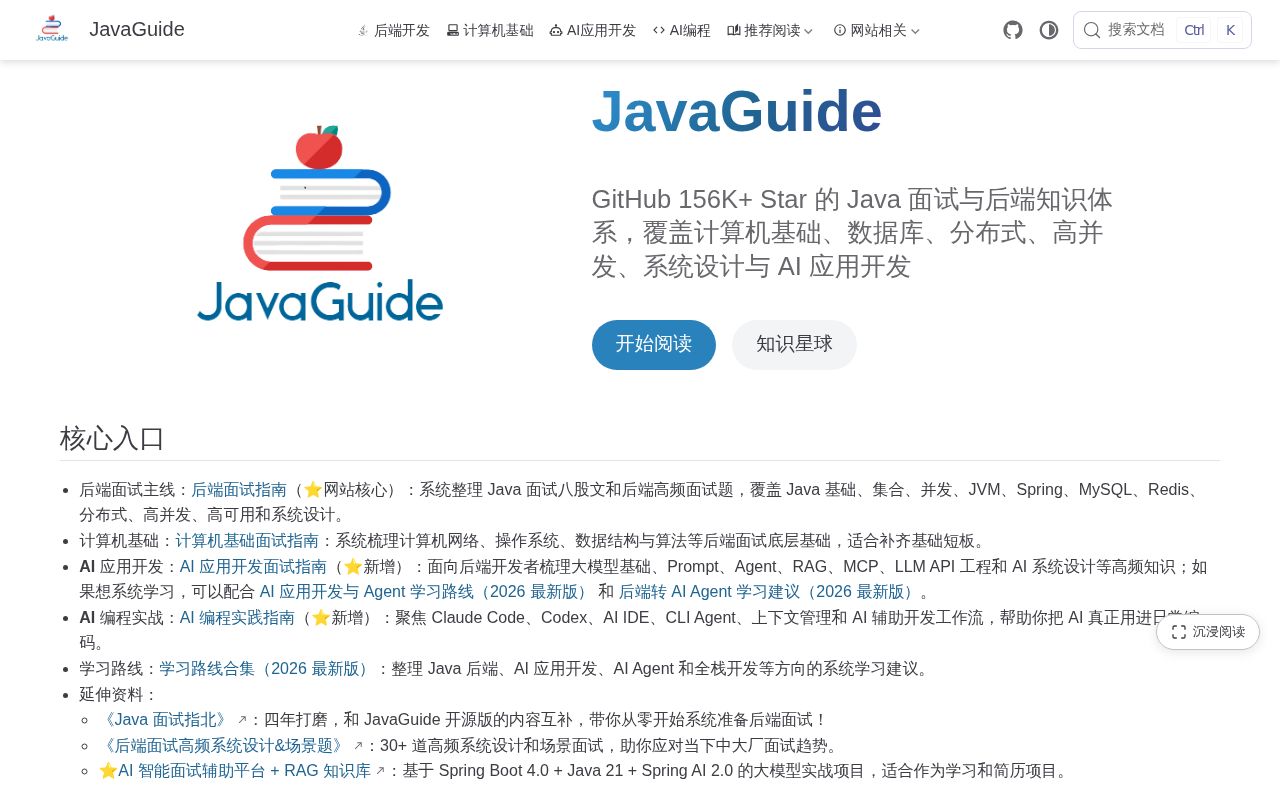
For its intended audience, the repository solves a familiar problem. A Java backend interview can move from language basics to the JVM, concurrency, networking, databases, distributed systems, message queues, security, and system design. JavaGuide puts those subjects into one navigable curriculum. It also includes interview planning, resume advice, project discussion, and a Java learning route. Newer sections point readers toward a separate AI application guide covering LLMs, agents, RAG, MCP, Claude Code, and Codex.
The best way to use it is as a gap finder. Pick an interview plan, mark the sections you cannot explain without notes, then read those chapters and confirm important claims in official specifications or product documentation. Reading the whole repository in order would be slow and would give equal weight to material that may not match a particular role.
The content is broad, sometimes uneven
The Java material reaches beyond syntax. There are dedicated pages for collections internals, concurrency primitives, the Java memory model, garbage collection, class loading, I/O, and language changes through Java 25. Database coverage includes MySQL, Redis, and MongoDB. The system design branch adds caching, distributed coordination, authentication, high availability, and common framework questions. That range is useful when an interview loop mixes coding, runtime behavior, and architecture.
Breadth also raises the verification burden. These are edited study notes, not the Java specification. Open issues discuss details such as constant pools, ConcurrentHashMap behavior, skip lists in Redis, and a HashMap diagram. That is normal for a living technical guide, but it is a warning against memorizing every sentence as settled truth. The repository itself cites the JVM specification and other references in places; readers should follow those links when an answer depends on a version or implementation detail.
The writing style is geared toward interview preparation. Headings frequently frame topics as common questions, while certain pages are labeled must-read. This makes scanning easy. It is less suitable for someone who learns through a sequence of exercises, because the repository does not present a built-in grading loop or a set of executable Java projects. You bring your own practice environment and decide how to test whether you can apply the material.
What happened when we ran it
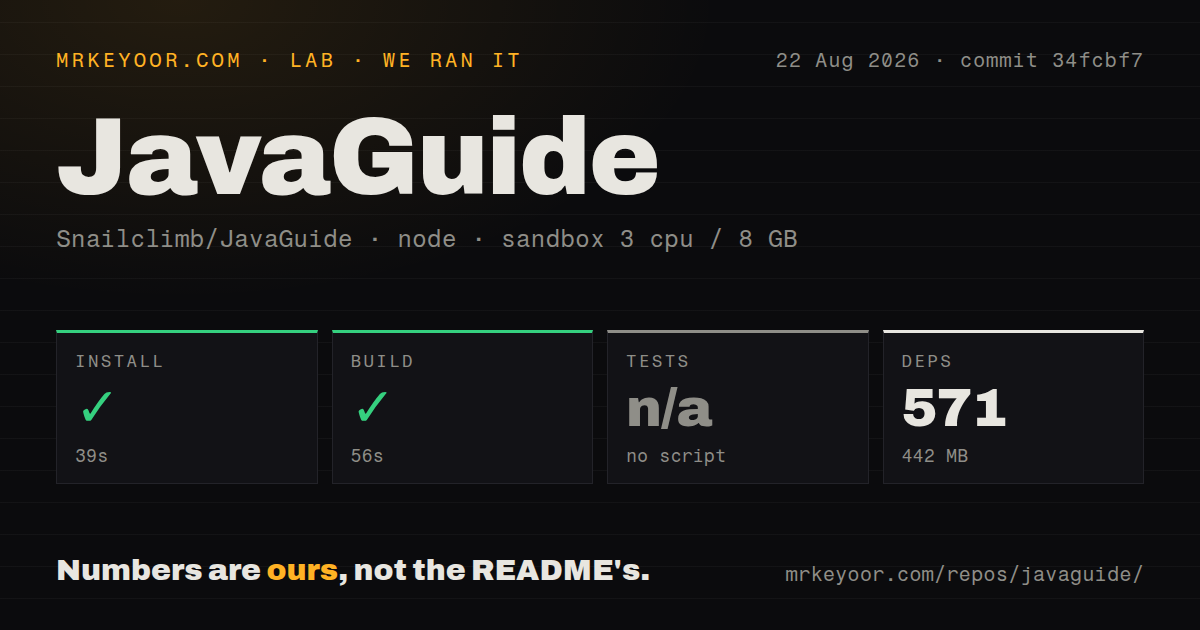
We cloned commit 34fcbf7 into a fresh unprivileged Debian container with 3 CPUs and 8 GB of RAM. The checkout contained 625 files, about 3,945 lines of source, and occupied 12.2 MB. This source count reflects the site code measured by our harness, not the volume of prose in the guide.
The pnpm install completed in 39 seconds. It installed 571 packages and consumed 442 MB on disk, a much larger footprint than the checkout itself. The production documentation build then completed in 56 seconds. Contributors therefore have a working baseline in the measured Node 22 environment, though they should budget for a sizable dependency tree.
There was no tests script or test target, so we skipped tests rather than inventing a result. The repository had one CI workflow, no Dockerfile, and no tests directory. A successful static-site build catches broken compilation and bundling, but it does not prove that every internal link, translated page, technical statement, or browser interaction is correct.
Language and access shape the decision
The Chinese README links to English and Japanese indexes, the hosted site, an interview-focused edition, and paid supplementary material. The mixture is easy to misunderstand. The open repository is substantial, yet some navigation sends readers to commercial interview products, and some linked content is outside the main repository. If you want a fully open path, stay aware of which URL you are following.
English coverage is the firmer limit. Two open issues ask for an English version or offer a translation, while the current English index links into Chinese lesson files. An English-only learner will spend too much time working around language before reaching the technical point. The English System Design Primer is a better starting place for architecture, and official Java documentation is a better authority for runtime or API behavior.
Chinese readers get far more value. The guide uses terminology and interview framing familiar to that job market, covers both foundations and current backend topics, and offers several routes through the material. It can replace a pile of disconnected bookmarks, provided the reader treats it as editorial guidance rather than a specification.
Project health and maintenance
The repository's last push was August 18, 2026, and recent commits corrected a HashMap example, clarified cache behavior, refreshed dependencies, and added or reorganized interview guides. Issues were also active in 2026, including discussion around translations and technical corrections. GitHub's open count was 59, which combines issues and pull requests. The project had 157,942 stars when we fetched its repository record, a sign of reach rather than proof that every lesson is current.
GitHub returned no latest release. That is acceptable for a continuously published documentation site, but it removes a useful checkpoint for teams that want to cite a stable edition. Pin a commit when using JavaGuide in a training program, and keep separate links to the official sources behind version-sensitive material.
JavaGuide is easiest to recommend as an interview index for readers fluent in Chinese. It tells you what to study and gives you a strong first explanation for many topics. It does not replace coding practice, official specifications, or the judgment needed to separate frequently asked questions from skills a particular job will actually use.