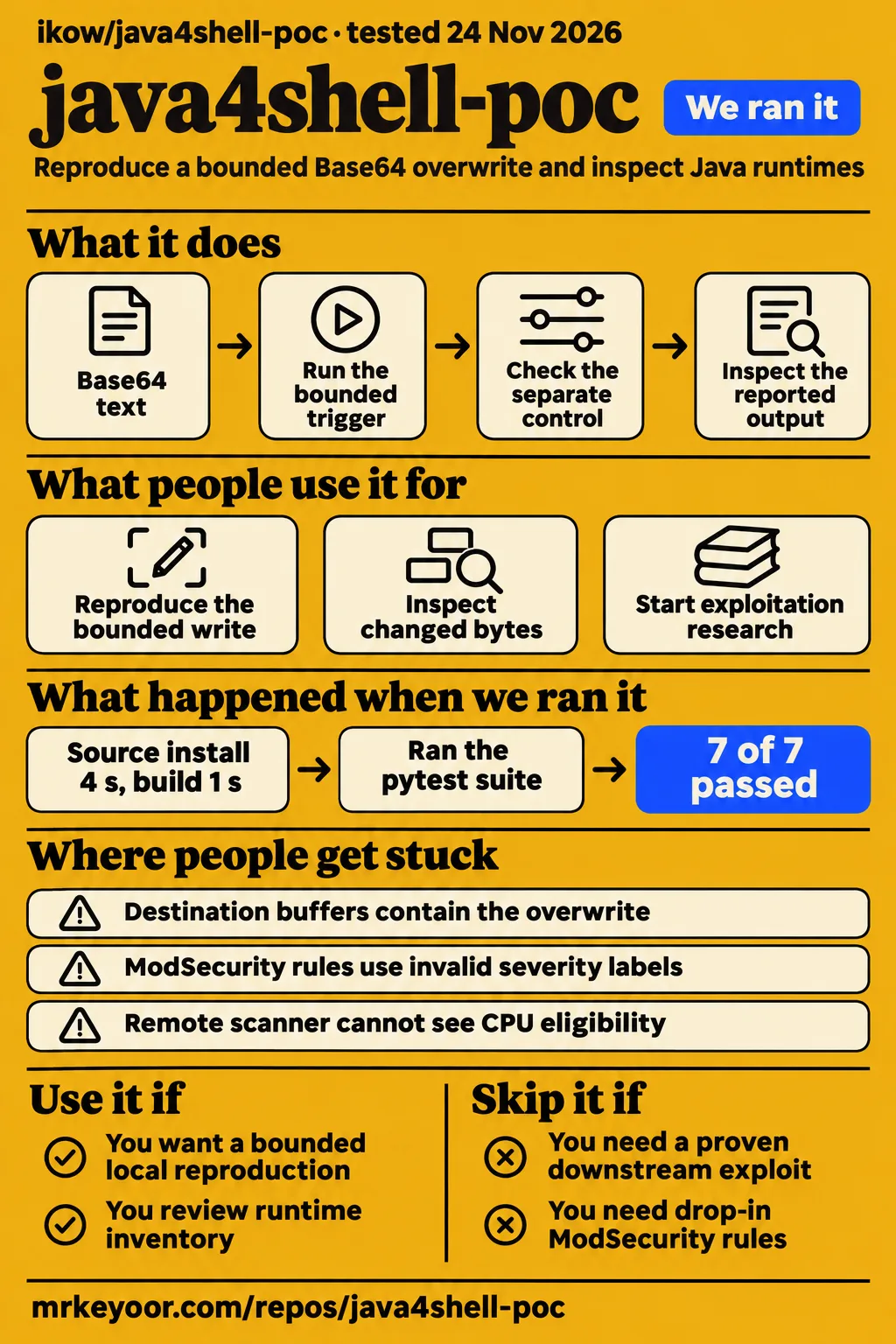
Our run of ikow/java4shell-poc passed all 7 pytest tests, but those repository checks aren't a demonstration of a Java service being compromised. Use it if you're a security engineer examining a bounded reproduction or reviewing runtime-inventory code. Skip it if you need a proven, ready-to-run exploit against Keycloak, Jenkins, Spring Boot or Elasticsearch: the README's downstream modules face specific, unresolved proof objections in issue #3.
The useful distinction is between a decoder writing beyond its expected output and that write reaching another object. A bounded trigger deliberately leaves room to observe the first event. A working exploitation chain has to demonstrate the second, then show what it achieved. This review separates those outcomes rather than treating every file under exploit/ as an equivalent result.
What people use java4shell-poc for
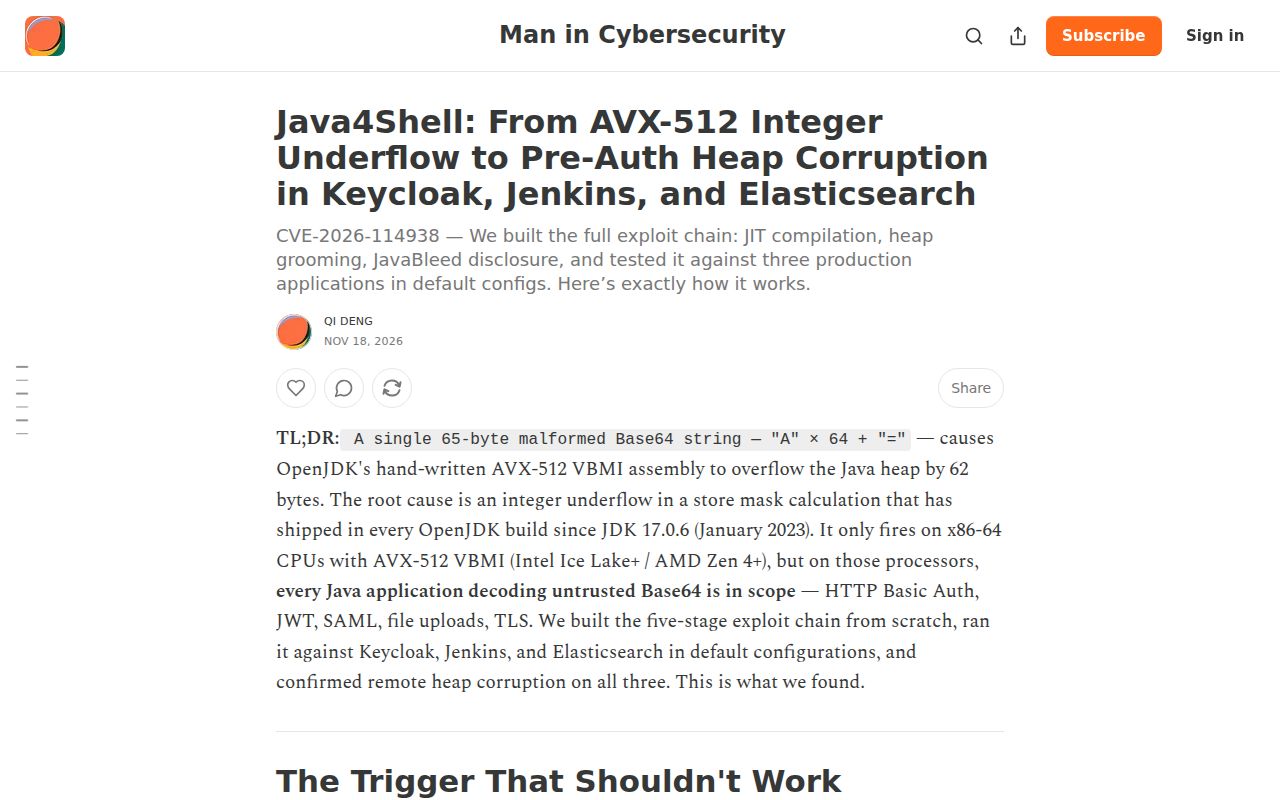
Qi Deng reports a bounded write of 62 bytes beyond the expected output, and zejunyang describes using that trigger as the starting point for a separate exploitation project. Those are the concrete uses documented by ikow's pinned README and zejunyang's development account.
- Qi Deng, ikow's author, reports 62 changed bytes beyond the expected output on Temurin 21.0.13+9-LTS, on a GCE c3-standard-4 instance. The demonstration uses a large destination array to contain the write. You can inspect the reported output in the README's reproduction section.
- zejunyang reports reproducing the bounded write on the first attempt, then developing a separate local command-execution chain. That later project describes additional mechanisms and a particular tested configuration; its result belongs to java4shell-rce, rather than validating ikow's downstream modules.
For a newcomer, Base64 is a way to represent bytes as ordinary text. The vulnerable operation is decoding that text inside certain Java runtimes. The README bundles a local trigger, host and network scanners, detection rules and claimed exploitation stages. You can choose a component without accepting every claim made for the rest of the repository. The README itself recommends the bounded wrapper, rather than the exploit directory, for production-related checks.
What happened when we ran it
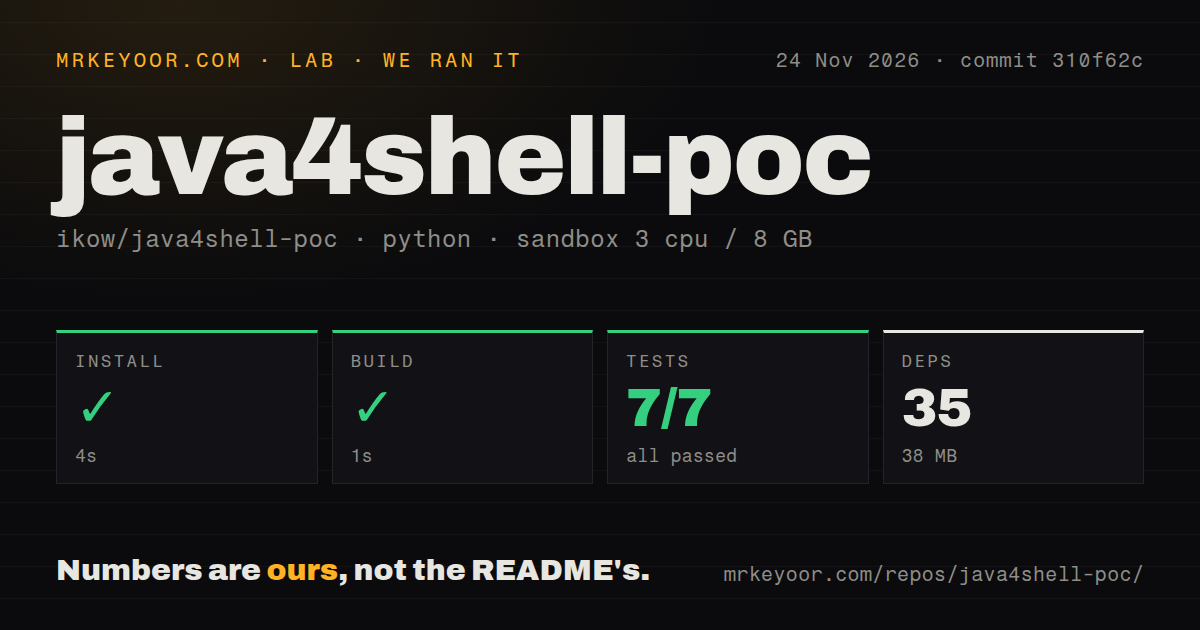
Our November 24, 2026 sandbox run at commit 310f62c installed successfully in 4 seconds, built in 1 second and passed 7 of 7 pytest tests in 2 seconds. These are our repository-check measurements, with zero failed tests.
| Repository check | Our measured result |
|---|---|
| Install | Succeeded in 4 seconds; 35 dependencies recorded |
| Installed footprint | 38 MB on disk |
| Build | Succeeded in 1 second |
| Tests | Succeeded in 2 seconds; pytest reported 7 passed, 0 failed of 7 |
| Checkout | 40 files, about 4,834 source lines, 2.1 MB |
| Repository signals | 0 CI workflow files detected, no Dockerfile detected, tests directory present |
Our harness configuration specified 3 CPUs and 8 GB RAM, using image label ghcr.io/astral-sh/uv:python3.12-bookworm. That label identifies the requested image. Actual runtime and operating-system versions require the raw toolchain logs. The Python ecosystem classification describes these repository checks, while the vulnerability reproduction concerns a Java runtime.
The recorded sequence is straightforward: installation passed, then the build passed, then pytest passed. The checks clear an initial hurdle for someone inspecting the project. They don't turn a scanner result into proof of corruption. The README describes its offline checks as using synthetic versions, flags and JVM outcomes without contacting targets or executing the corruption trigger.
A separate hands-on attempt stopped at the safety check. Its step log reports a missing required Compose file: unsafe repo: none of compose.yaml, compose.yml, docker-compose.yaml, docker-compose.yml exists. This was a harness requirement, not a diagnosis of the Java decoder. The generic run summary says it deployed with Docker Compose, but the failed step supplies no completed deployment or task result. The attempt ended with a successful teardown report. We count that attempt as stopped, not as an independent reproduction of the overwrite.
Where people get stuck: success messages outrun the proof
Issue #3 describes a 128-byte destination containing the claimed write and challenges the disclosure and remote-simulation results. The issue is open with no comments, so there is no recorded maintainer resolution to cite.
| Reported problem | What you should require | Recorded status |
|---|---|---|
| WriterPrimitive.java allocates 128 bytes for a write ending at offset 111 | A demonstrated change outside the destination array | Issue #3 reports containment; open |
| JavaBleed.java is challenged on the same primitive | Recovered data from outside the intended object | Issue #3 raises the objection; open |
| RemoteExploitSim.java prints a corruption success message | Observable corruption, rather than the message alone | Issue #3 disputes the success signal; open |
| Python framework treats generic Java errors as possible disclosure evidence | Actual recovered heap data tied to the request | Issue #3 challenges the inference; open |
| ModSecurity rules use disputed severity labels | Rule loading with accepted syslog severity values | Issue #4 reports invalid values; open, no comments |
The severity problem is separate from exploitation. Issue #4 says ModSecurity expects syslog values from 0 to 7, with names such as CRITICAL or WARNING, rather than high or medium. Replacing those labels is the reporter's stated direction, not a shipped fix demonstrated by the thread. A rule advertised as ready for a web application firewall still needs to load in that firewall.
The third sampled thread, issue #2, titled "java", contains no diagnostic body and has no comments. It contributes no reproducible failure or solution. GitHub reports the last repository push on November 18, 2026. That recent activity and the unresolved substantive reports belong together: neither the push nor the issue count tells you that the disputed modules have been repaired.
The full-chain source allocates room for its stated overwrite
Java4ShellExploit.java allocates a 112-byte destination, adding DECODE_BUF_SIZE to OVERFLOW_LEN, and calls it a safe container. That allocation is visible in the full-chain source, alongside comments describing a tight buffer intended to let the write escape.
The constants are 50 and 62, making a 112-byte destination. A write ending at offset 111 fits inside that allocation. This supports the containment objection without requiring you to accept the issue author's broader criticism of the repository. The module's descriptive comments and allocation describe different things.
| Component | What its evidence supports |
|---|---|
| Base64Trigger.java | The author's reported bounded output-change signature, contained in a large destination array |
| WriterPrimitive.java | A disputed adjacent-object writer claim, challenged by the allocation described in issue #3 |
| JavaBleed.java | A disputed disclosure claim that depends on the challenged writer |
| HeapFengShui.java | The README describes heap-placement work; a file name or stage description isn't an observed corruption result |
| Java4ShellExploit.java | The source allocation contains the stated overwrite despite its full-chain description |
| RemoteExploitSim.java | A simulated HTTP attack path whose success message is challenged in issue #3 |
| Downstream Python modules | The README advertises product-specific chains; that description alone supplies no successful target-compromise transcript |
The README's stage list, source allocation and issue objections support different rows of this assessment. There is also a version mismatch worth catching before a lab session: the full-chain source hardcodes the shorter input, while the README describes a different variant for Java 17. The bounded wrapper's documented version handling shouldn't be assumed to apply to every exploitation module.
The README's claim that any application decoding untrusted Base64 is an attack surface is also too broad. The technical analysis by cyberheartmi9 distinguishes the basic and URL decoder routes from the MIME decoder, and requires runtime conditions as well as an input path. MIME is the decoder variant for mail-style encoded text. Map the actual decoder call instead of flagging every use of the Base64 class.
Runtime inventory needs access to the JVM serving your application
The host scanner checks discoverable Java installations, while the network scanner returns CANDIDATE or INCONCLUSIVE hints. Those are the README's documented scopes, and they call for different follow-up work.
A JVM, the process running your Java application, can use a different executable from the java on your shell's PATH. Start with the service process and the container namespace it runs in. Ikow's host scanner includes visible process executables and allows additional Java paths, but needs suitable permissions and matching tooling to inspect effective flags. Missing tools, permissions or unknown versions produce UNKNOWN.
For fleet work, preserve those unknowns in the inventory. The README says the network JSON leaves vulnerable null and adds separate candidate and assessment fields. Converting null into false would manufacture a clean bill of health. A service banner can't tell you the host CPU, vendor backport status or the flags on the live JVM. Hardware exclusions also apply to current placement, a useful distinction if a workload moves between nodes.
The bounded wrapper starts a separate process and checks an intrinsic-disabled control. An intrinsic is a runtime shortcut that replaces a Java operation with specialized machine code. The wrapper documentation explicitly says it doesn't inspect or change the running application's configuration. A result from that helper process belongs in the inventory beside the application process, not in place of it.
java4shell-poc vs techdevfun, fumioryoto and other alternatives
Choose techdevfun/java4shell for documented exposure inventory without exploit code, or fumioryoto/java4shell-poc for a narrower bounded local reproduction. Their README scopes and explicit exclusions make them useful alternatives to ikow's mixed toolkit.
| Project or service | Documented emphasis | When it fits your task |
|---|---|---|
| techdevfun/java4shell | Runtime exposure checks and CI decisions, without exploit code | You want inventory and an explanation of exposure conditions |
| fumioryoto/java4shell-poc | Bounded local reproduction with a negative control; excludes product-specific chains and mass scanning | You want a smaller proof scope |
| arkrwn/PoC-CVE-2026-114938-CrashLeak | Distinguishes a local corruption oracle from network observations | You need to distinguish an HTTP failure from proof of the bug |
| sam00/Java4Shell-CVE-2026-114938-PoC | Explicit proof contract for host prerequisites, local corruption and HTTP observations | You need evidence requirements for an assessment report |
| zejunyang/java4shell-rce | Reports a separate local command-execution chain and mitigation control | You're studying escalation in the author's particular lab configuration |
| Pentest-Tools.com Network Vulnerability Scanner | Paid network check based on exposed Java version information, without sending the trigger | You already use that service and need remote inventory hints |
These choices separate jobs rather than rank exploit power. Ikow puts reproduction, inventory, signatures and claimed downstream chains in one repository. Sam00's proof contract is particularly helpful when someone hands you an HTTP 502 or 503 as the result: it explains that proxies, firewalls and timeouts can produce those responses too. Its standard asks for an on-host corruption signature before claiming reproduction.
What the other reviews get wrong
White Hat's broad OpenJDK 17 description omits the update boundary, and Pentest-Tools.com's November 18 Red Hat patch status is dated. Their version summary and patch list need narrower readings before you use them for inventory decisions.
White Hat describes OpenJDK 17 and newer as affected. Ikow's version table starts the Java 17 range at 17.0.6 and names fixed builds. A release-line label alone cannot classify an installation. Pentest-Tools lists RHEL fixes as pending on November 18; Tenable's November 19 update reports fixed RHEL OpenJDK packages, while distinguishing products that bundle Java and were still listed as affected.
DigiCert's advisory says Oracle released updates on November 17, then says DigiCert will apply the patch when publicly available. Read that as inconsistent patch-availability wording, not evidence that DigiCert completed patch deployment. The page reports mitigation and promises a later deployment update.
Inside Digital Universe's explainer calls both severity scores critical. The transcript makes that claim; DigiCert distinguishes the researcher score of 9.2 Critical from Oracle's 8.1 High. Both ratings warrant attention without changing their labels.
The video titled "Java4Shell Explained: How One Equals Sign Breaks Java" says the repositories examined on disclosure night contained no working takeover. Keep its November 17 time qualification: zejunyang later reports local command execution, and other lab projects describe different outcomes. For example, alt3kx's remote result is a chosen-content file write; the author says remote command execution still needs an application sink or further escalation. Neither result repairs ikow's disputed modules.
Questions people ask
Ikow reports a bounded overwrite of 62 bytes; the allocation in its full-chain source supports the containment objection to its broader exploitation claims. That distinction follows from the reported trigger output and the source allocation.
Does ikow/java4shell-poc contain a functional exploit chain, or does it only demonstrate the overwrite?
The strongest supported result is the author's bounded report of 62 bytes written beyond the expected output. The README advertises further stages, but issue #3 challenges their primitives and success signals. The full-chain allocation gives you a concrete reason to demand a cross-object result before describing that module as a functional chain.
Are the ModSecurity severity values in these rules valid?
Issue #4 reports that high and medium are invalid severity values and lists ModSecurity's accepted syslog scale. The thread is open with no comments. Treat the rules as review material until their values and loading behavior have been checked in your firewall.
Which Java services actually meet all the exposure conditions?
A service needs an affected runtime, eligible x86-64 hardware, the accelerated decoder path and attacker-controlled data reaching it. Ikow documents the runtime and hardware checks; Calif describes the vulnerable decoder and application-dependent exploitation. Merely running an application named in a product list doesn't answer those questions for your deployment.
How can I check exposure when the CPU and Java version are hidden from a remote scanner?
Use host-side inventory tied to the application process, retaining UNKNOWN where access is missing. Ikow's network scanner explicitly excludes CPU eligibility, vendor backports and live mitigation settings from its conclusions. Its candidate result tells you where to investigate, rather than replacing access to the host.
What exploitation claims are supported by evidence, and which remain unproven?
Ikow's author reports a bounded trigger, Calif reports product-specific remote exploitation, and zejunyang reports a separate local chain. Calif says there is no universal exploit. On X, KevTheHermit likewise describes an application-specific exploit. Those attributed reports aren't transcripts of ikow compromising its advertised downstream targets.
How does a malformed equals sign cause corruption before Java rejects the input?
The optimized decoder writes 62 bytes beyond its expected destination after calculating a negative output length, before Java's later input rejection. Calif explains this ordering in its technical account. Catching the eventual exception therefore doesn't mean the preceding memory operation was harmless.
How serious is Java4Shell, and what should affected operators do now?
Calif reports remote code execution in affected application configurations, making runtime remediation a priority. DigiCert recommends upgrading to a patched runtime and restarting the relevant services. Its documented temporary option disables the Base64 intrinsic. Apply mitigation to the service's startup configuration, rather than assuming a helper JVM's result changed the service.
How can the Java4Shell Base64 vulnerability be reproduced?
Ikow documents a bounded local wrapper that runs the trigger and an intrinsic-disabled control in separate processes. It requires a matching Java compiler and suitable hardware. The wrapper documentation says a negative result can also reflect inherited options, unavailable intrinsics or JIT behavior, so keep the output and environment together when reporting a lab result.
Can I find every Java runtime, including copies bundled inside other products?
A single host scan cannot promise complete discovery. Ikow documents visible-filesystem and container-namespace boundaries, extra Java paths and attach-permission requirements. Its scanner instructions preserve UNKNOWN outcomes. Bundled runtimes and containers need their own place in your service inventory.
Which Java versions and distributions are affected?
Ikow lists Java 17.0.6 through 17.0.21 and affected builds in the 21, 25 and 27 lines, with fixed boundaries of 17.0.21.1, 21.0.13.1, 25.0.5.1 and 27.0.1.1. These are the README's version boundaries, not a substitute for vendor backport information. Tenable also distinguishes standard Java 8 from Oracle's affected Enterprise Performance Pack.
Has Java4Shell been successfully exploited in the wild?
Tenable's dated account says GreyNoise reported attempts as of November 18 without confirmed successful exploitation against its sensors. That is a bounded observation from November 18, not a claim about all attacks through November 24. A laboratory command-execution transcript answers a different question from confirmed compromise of a real organization.
Is a public proof of concept available, and what does it prove?
Yes: ikow publishes a bounded trigger whose reported result is a write of 62 bytes beyond the expected output. The pinned README shows its signature. A proof of this decoder behavior doesn't automatically demonstrate exploitability of an application using a different runtime, host or input route.
What we have not tested yet
Our passing repository checks cover 7 tests at commit 310f62c; we did not independently reproduce the Java overwrite or compromise a downstream application. The hands-on attempt stopped at its Compose safety requirement. There are no completed task observations or screenshots from that attempt to turn into an exploitation result.
The next useful measurements are the bounded trigger and its control on eligible hardware, a matrix of actual vendor builds, ModSecurity rule loading, scanner false-positive and false-negative rates, and results tied to the JVM serving each application. Detection signatures also need live validation rather than an assumption that synthetic regression checks measure coverage.
Multi-platform reproduction reliability, fleet-scale scan behavior and the advertised Keycloak, Jenkins, Spring Boot and Elasticsearch chains remain untested by this review team. The research contains no substantive Reddit discussion or autocomplete questions supporting extra adoption or demand claims. Our recommendation rests on the measured repository checks, the author's bounded reproduction report and the specific proof problems visible in the code and tracker.