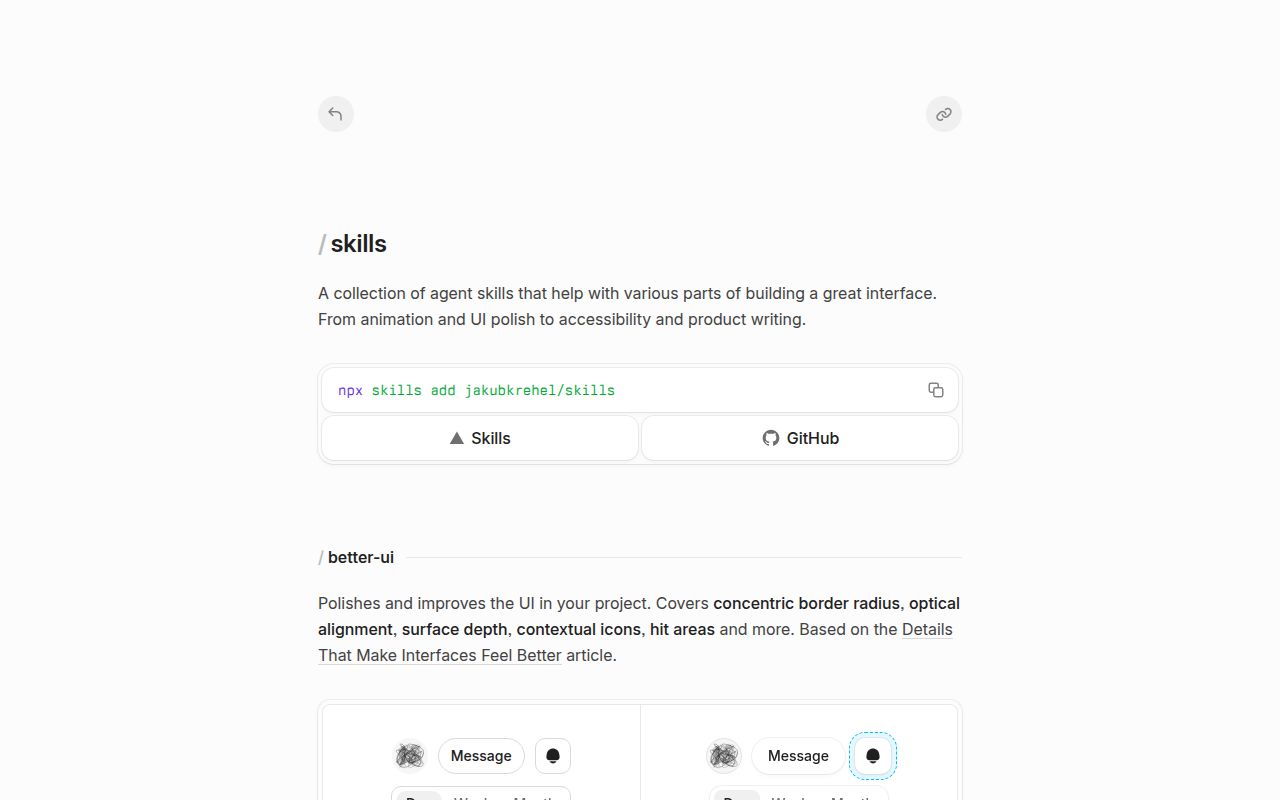
Eleven skills divide interface work by discipline
Jakub Krehel's repository contains 11 English-language agent skills. Six better-* entries cover accessibility, layout, writing, typography, color, and UI polish. better-interface coordinates those specialists into one report. Four user-invoked tools review a change, explain how an interface works, render a component in many states, or build variants for comparison. The result is closer to an editor's handbook than a package imported by an application.
The separation is useful because the instructions assign ownership instead of letting every review become a grab bag. better-accessibility handles keyboard paths and semantic controls, while better-colors owns contrast measurements. better-interface caps its consolidated report at 15 findings and requires a file and line for code claims. That structure can make an agent less prone to listing personal taste as a defect, provided all 6 domain skills are available when the combined review starts.
The review method demands code and browser evidence
The combined skill says a visual finding needs rendered evidence, while a code finding needs the current implementation. It asks the agent to identify the framework, styling system, design tokens, viewports, and project guidance before judging a screen. It also names 320px reflow and 200% zoom among its accessibility checks. Those are concrete review conditions, although the Markdown cannot force the host agent to obtain a browser or finish every check.
The rules are more prescriptive than a general design checklist. A focus indicator needs a 2px perimeter or equivalent visible area. Touch targets aim for 44 by 44 pixels, with 24 by 24 pixels presented as the WCAG 2.5.8 baseline. Motion should respect prefers-reduced-motion. These values make findings easier to verify, but teams should still reconcile suggested fixes with the rendered component and the accessibility standards they support.
What happened when we ran it
Our sandbox did not run commit 267330e on 2026-09-10. The harness classified the repository's language as Markdown, found no supported ecosystem, and found no Dockerfile. The allocation was 3 CPUs and 8 GB of RAM in an unprivileged container with no secrets. There is no install result, build result, test result, dependency count, or vulnerability result for us to claim.
That outcome matches the product's form: 11 folders contain instructions and references, not a conventional application entry point. It does not show whether Claude Code selects the right skill, whether a generated component compiles, or whether a visual diagnosis is correct. Evaluate those questions in a disposable front-end project, then run that project's own checks and inspect the page at the viewports the skill names.
One install command hides several runtime assumptions
The README gives npx skills add jakubkrehel/skills as its general installation route. Claude Code users instead get 2 commands, one to add the repository as a marketplace and one to install its interfaces plugin. The page does not state a Node version, Claude Code version, removal command, or post-install verification step. A user should confirm which 11 skills were placed and read their local files before invoking them.
explain-interface carries another dependency choice. Open issue 36 points out that its Chrome DevTools MCP setup command resolves chrome-devtools-mcp@latest, so two installations on different days can fetch different code. The issue asks for an exact reviewed version. Until that changes, pinning the package locally is the sensible choice, especially when the MCP server receives browser access as part of an interface investigation.
Open reports expose behavior that Markdown cannot test
Issue 22 measures trigger selection rather than build health. In its pinned experiment, a request framed around a visual problem invoked better-typography 20 of 20 times, while a request that named CSS custom properties invoked it 9 of 18 times. The reporter also says this is model behavior, not a universal rate. The practical lesson is narrow: installing a skill does not guarantee the agent will load it for every relevant prompt.
Two newer reports concern generated harnesses. Issue 37 says break currently asks a Next.js page to use a client directive even when only the child component needs client behavior. Issue 39 says the variant picker can remain under a transformed or clipped ancestor despite fixed positioning and a high stacking value. Both are useful reasons to review temporary test pages before trusting the scenarios they display.
The project is active but has no tagged release
GitHub showed 6,076 stars and 22 combined open issues and pull requests. The default branch was last pushed on August 29, 2026, while issue activity continued on September 7. GitHub's latest-release endpoint returned no release. This is active maintenance, but consumers cannot pin a named release or scan release notes to understand what changed between installations. A commit hash is the clearest reproducible choice.
The alternatives solve different problems. Anthropic Skills is a wider official example set. HumanLayer Skills concentrates on coding-agent procedures, and Vercel's Skills CLI concentrates on distribution. Krehel's collection is the sharper pick when interface judgment is the job. Start with one specialist, compare its report with a human browser pass, and add the 6-skill coordinator only after the narrower result earns trust.