Five-language cloning comes with unusually direct controls
IndexTTS 2.5 clones a speaker from one reference clip and synthesizes Chinese, English, Japanese, Spanish, or Arabic. Its attraction is control. A second audio clip can provide emotion, an 8-value vector can set emotion intensities, and text can drive an emotion model. Pinyin, CMU phonemes, and Japanese Kana give developers ways to correct pronunciation. A duration factor changes speaking speed from 0.5x to 2.0x.
Those inputs make IndexTTS more suitable for directed character speech than a simple text box connected to a generic voice. They also multiply the cases a production team must test. Random sampling can reduce cloning fidelity, according to the README. Text-driven emotion in version 2.5 requires use_qwen_emo=True, while emotion strength has its own setting. A valid WAV file is not proof that the voice, words, or feeling are right.
The 8,413 MB environment arrives before the model checkpoints
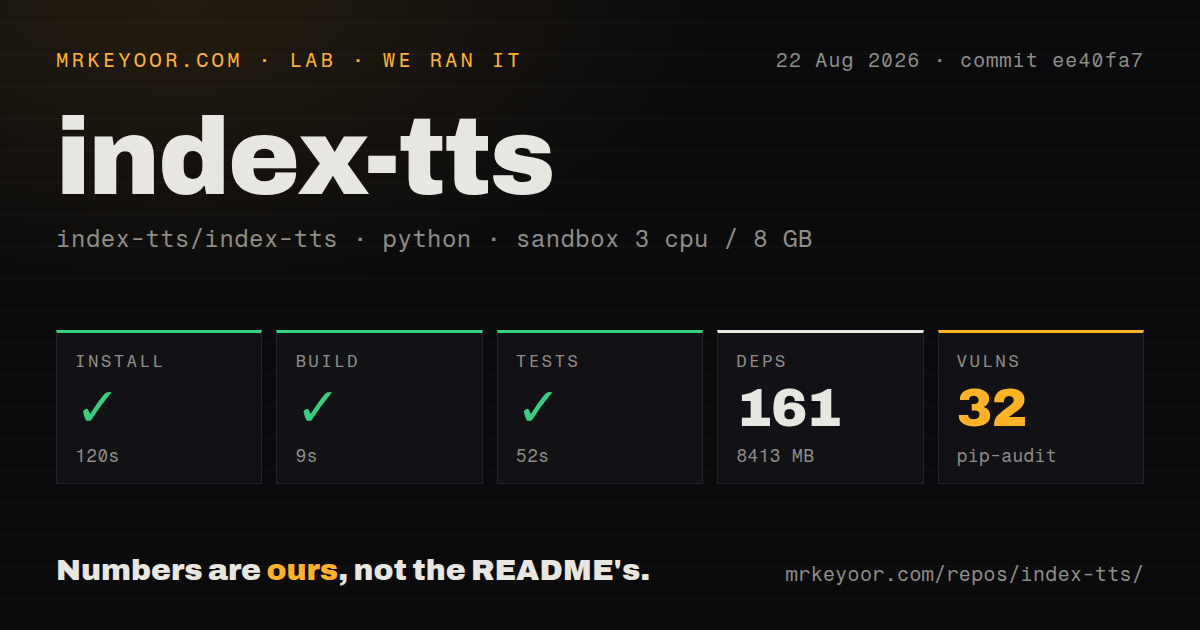
Our commit ee40fa7 checkout contained 337 files, about 77,236 source lines, and occupied 40.3 MB. Installing all Python extras succeeded in 120 seconds, pulled 161 packages, and used 8,413 MB on disk. The model checkpoints are obtained separately from Hugging Face or ModelScope, so that dependency figure is a floor for a working deployment rather than its final storage bill.
The project uses uv and asks users not to manually activate another environment around its commands. Example audio downloads on first Web UI use, while smaller model assets may also arrive at runtime. A reproducible image should fetch and pin every required checkpoint and example during deployment instead of discovering missing network access when the first request arrives.
What happened when we ran it
Our sandbox installed 161 packages in 120 seconds on 3 CPUs with 8 GB of RAM. The build completed in 9 seconds, and the available tests passed in 52 seconds. The repository included 2 CI workflow files and a tests directory, but no Dockerfile at the measured commit.
Pip-audit reported 32 known vulnerabilities in the installed Python environment. The supplied measurement does not list affected packages or severities, so this review cannot tell you which advisories are reachable in inference. It does establish a concrete review task before deployment. Export the resolved dependency set, map every advisory to its package and execution path, then patch, constrain, or accept it through your normal security process.
CUDA 12.8 is the documented troubleshooting baseline
The Web UI starts on 127.0.0.1:7860 after checkpoints are present. Linux and Windows users who encounter CUDA installation errors are told to ensure CUDA Toolkit 12.8 or newer is installed. The included GPU check reports detected accelerators. BF16 for IndexTTS 2.5 and FP16 for IndexTTS 2 can lower memory use and improve speed with a small quality tradeoff stated by the project.
DeepSpeed may help or hurt depending on the GPU, driver, operating system, and workload. Compiled CUDA kernels add another compatibility choice. The README's honest advice is to try both. That means a production evaluation needs your actual reference clips and script lengths on the exact GPU image you will ship. Our 52-second test result did not download weights or measure synthesis speed.
The Python surface exposes more than the Web UI
Python callers construct an IndexTTS object with a config path and model directory, then provide speaker audio, text, language, and an output path. Emotion can come from reference audio, a numeric vector, or processed text. IndexTTS 2.5 also separates the language selection from the text, which is helpful when punctuation or short phrases make automatic language detection uncertain.
The repository documents a vLLM recipe for production serving rather than pretending the demonstration UI is a service architecture. That is the right separation, though operators still need authentication, request limits, GPU scheduling, file retention, and consent controls around cloned voices. The code can synthesize a person's timbre from one clip. Your application must decide who may upload that clip and how generated speech is labeled and stored.
Version 2.5 is active while setup reports keep arriving
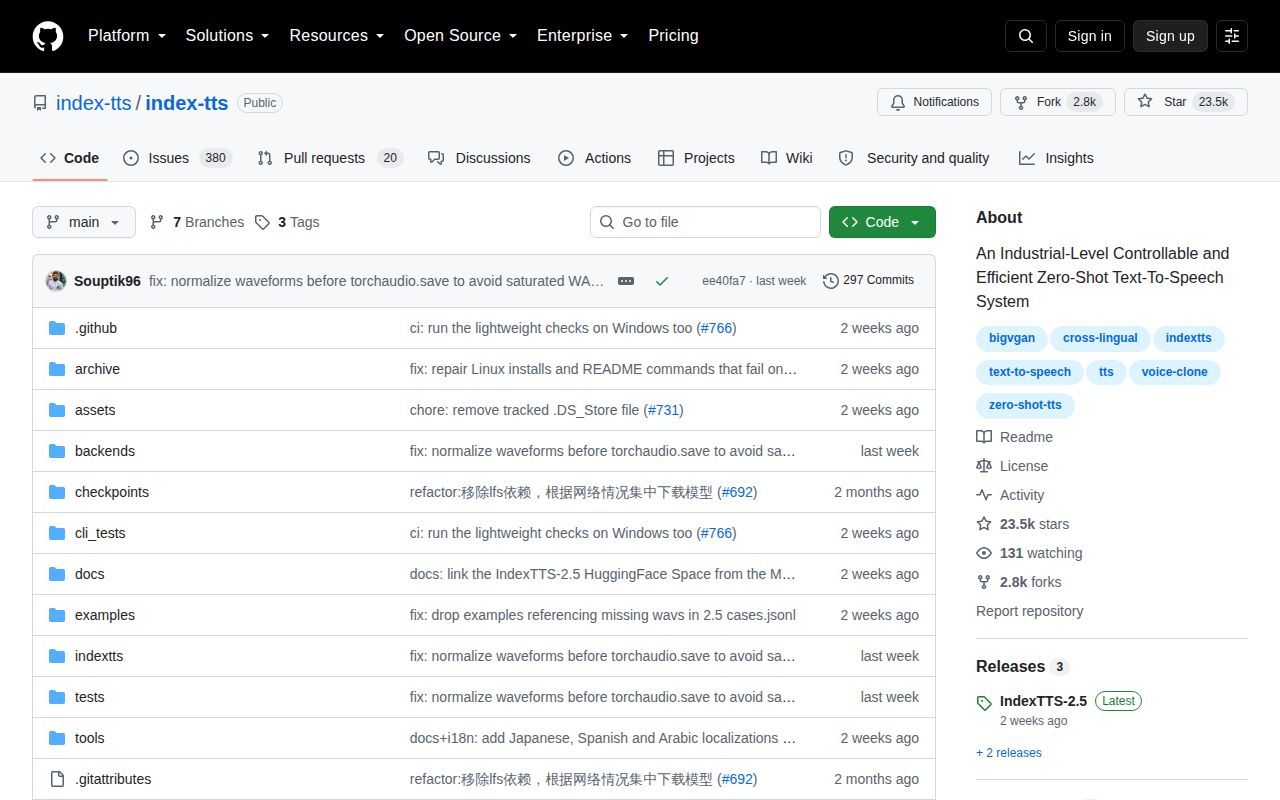
GitHub listed 23,511 stars and 400 combined open issues and pull requests when fetched. Version 2.5.0 was released August 13, 2026, and the repository was pushed August 18. Pull requests active through August 26 covered FP16 fallback, separate devices for reference encoders, container workflows, and synthesis-duration control. Issue 782 reports a missing cuDNN runtime DLL on Windows, while issue 447 reports a missing Gradio module.
That activity shows ongoing work around a fresh release, not settled deployment behavior. The repository's license field was not identified by GitHub, so organizations should read the actual license and model terms instead of assuming a standard SPDX license from the project description. Model weights, reference audio, generated voices, and source code can carry different obligations.
Passing tests do not settle speech quality
IndexTTS cleared its 52-second test run, which is better evidence than a README demo alone. It did not give us a measured word-error rate, speaker-similarity score, latency result, or listening panel, and we will not invent any of them. Build a test set from your languages, names, numbers, abbreviations, punctuation, emotional directions, and reference-recording conditions. Have fluent listeners review the output.
The recommendation follows the costs we can prove. A 161-package, 8,413 MB environment with 32 audit findings needs an owner, while the 5 supported languages and several emotion paths can repay that work for a serious speech product. IndexTTS is a credible engine to evaluate, not a drop-in audio feature that becomes production-ready after the Web UI opens.