The 42-second install left speech quality unmeasured
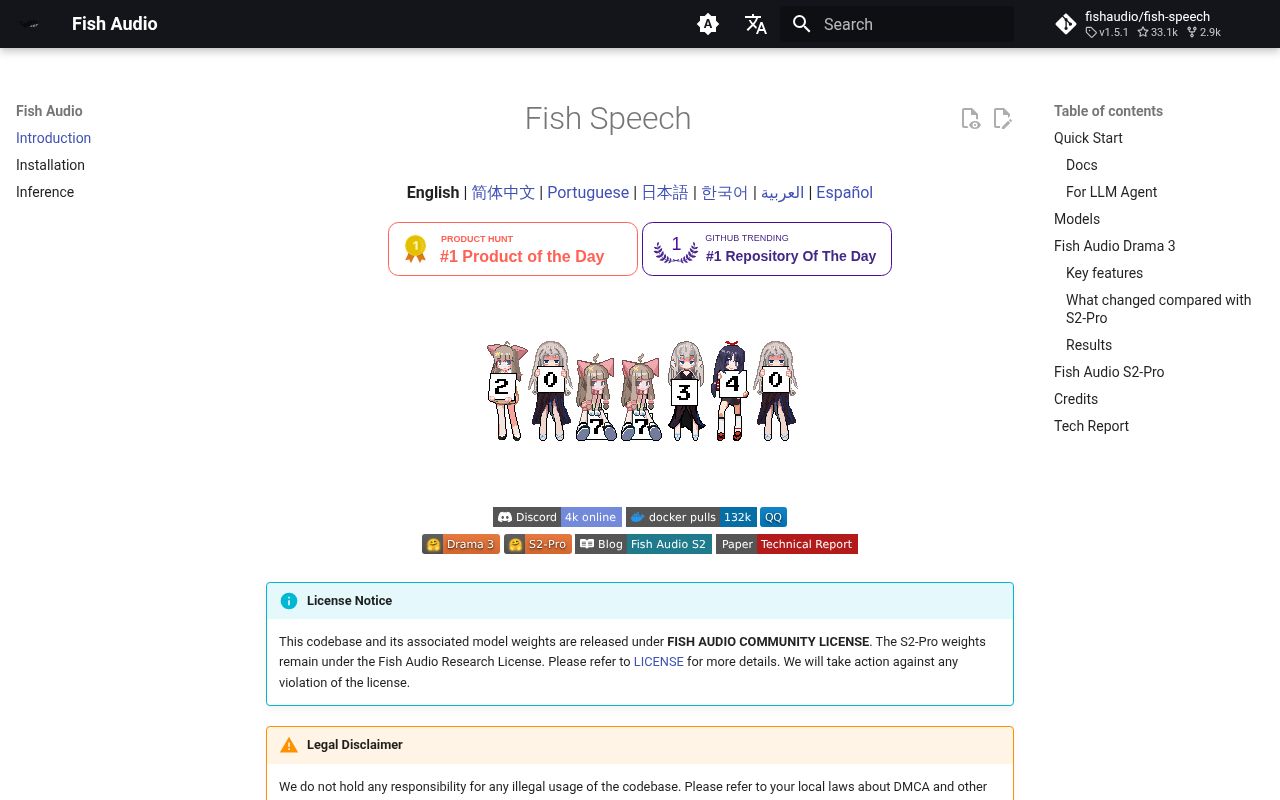
Fish Speech installed in 42 seconds in our sandbox, but that result cannot tell you whether it will deliver a convincing scene. The current Fish Speech README describes Drama 3 as a model for multiple characters, spoken performances you can revise, and edits within existing audio. Those controls give it a specific reason to exist: changing a character's delivery without rebuilding your entire recording workflow.
The checkout contained 137 files, roughly 13,908 source lines, and occupied 9.6 MB. You get Python model code with command-line and server interfaces, rather than a finished recording application that hides the machinery. I would consider it for a studio experimenting with synthetic dialogue or a developer building speech into a controlled product. For ordinary spoken notifications, much of that machinery would go unused.
What happened when we ran it
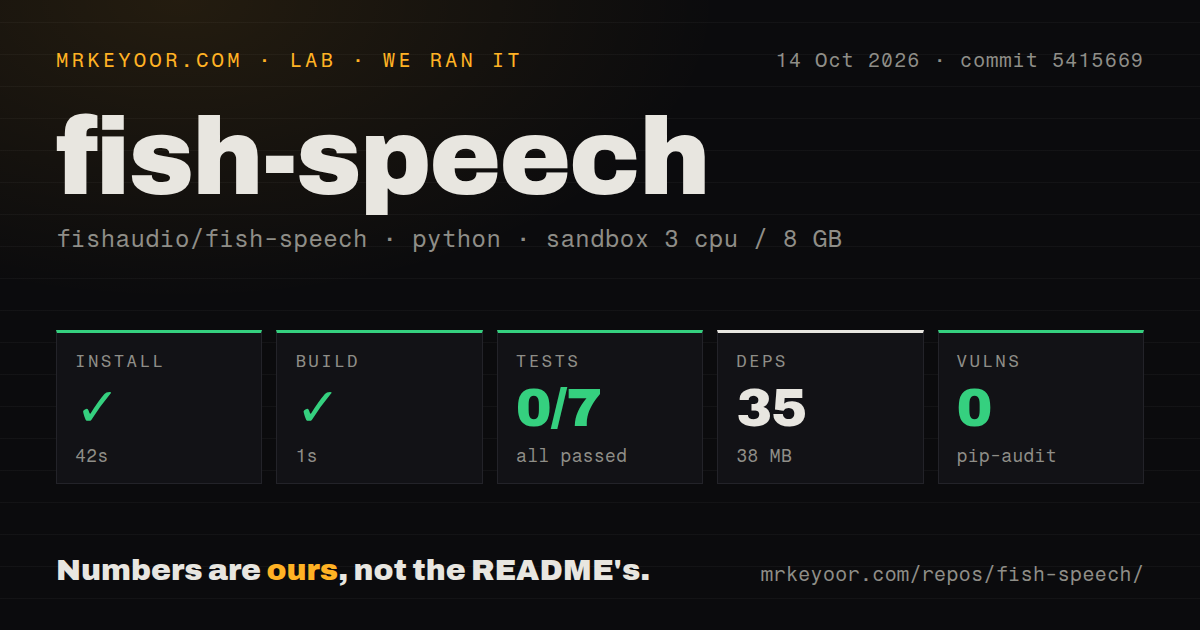
Our run installed commit 5415669 in 42 seconds, adding 35 packages and using 38 MB on disk. The build succeeded in 1 second. We ran it on October 14, 2026, in a fresh, unprivileged Debian container using ghcr.io/astral-sh/uv:python3.12-bookworm, with 3 CPUs, 8 GB of RAM, and no secrets. These are repository setup results. They establish neither working speech generation nor a model's voice quality.
The test step failed with exit 1 after 2 seconds. Pytest reported 0 passed, 0 failed, and 7 collection/setup errors. The log tail shows ModuleNotFoundError: No module named 'ormsgpack' and names attention, chunking, backbone, generation, server, and visualization test files, plus tools/drama3_ref_test.py. No test assertion passed or failed. The supplied tail does not show that every error has the same cause, or explain why that module was unavailable.
Pip-audit reported 0 known vulnerabilities in the environment we installed. Our scan also found 3 CI workflow files, a Compose file, and a tests directory, while reporting no Dockerfile. That last result sits beside documentation that references Docker builds and published images. Treat the scan as a finding about this sandbox checkout. It cannot certify the documented container path, and the audit result cannot certify the safety of generated audio.
Drama 3 needs NVIDIA hardware our sandbox did not measure
The 3 CPUs and 8 GB of RAM in our sandbox do not validate Drama 3's deployment requirements. The installation requirements specify NVIDIA GPUs and at least 48 GB of GPU memory for its FP8 path. CPU, Apple MPS, and AMD ROCm are excluded for Drama 3. S2-Pro has a separate CPU route. Choose the model before choosing the machine, since support for S2-Pro does not establish support for Drama 3.
The docs name Linux and WSL, list portaudio19-dev, libsox-dev, and ffmpeg, and explain CUDA-specific environment choices. Model weights need a separate download and a configured checkpoint path. Reference recordings and their transcripts supply the voices. Those requirements are documented, so blaming our collection errors on unmentioned system packages would overreach. The log names a missing Python module, and that's where the explanation has to stop.
The server loads a checkpoint before accepting speech requests
The measured 38 MB installed footprint says little about operating a server with downloaded weights. The inference guide says the loaded checkpoint determines the model, with no model selector per request. Its speech endpoint expects msgpack. Bearer authentication is optional through --api-key, so configure your own server credential before exposing it. Local inference does not require a hosted speech API subscription.
Saved reference voices and streaming responses make the server useful behind a speech application. Still, a successful health response only confirms that the server is up. It doesn't establish that a character sounds right or that a revision preserved the words you wanted. Our 1-second build supplies no listening evidence either. Evaluate a representative script and its revisions before making the output part of an unattended production process.
The community license excludes some commercial speech services
The community license, updated October 13, 2026, permits limited commercial use below an aggregate annual revenue threshold of $500,000. Hosted services, as the agreement defines them, require a separate written license. That definition covers services where customers supply material and generate speech themselves. A small company cannot assume its revenue alone makes a customer-facing voice-generation service eligible.
The agreement lists exclusions, including operator-directed work delivered as finished audio and speech for content your own product controls. Free noncommercial research demos have an exclusion too. The README separately leaves S2-Pro weights under the Fish Audio Research License. None of those permissions follows from the 42-second install. If you require permissive licensing for both the code and weights, this is a reason to choose another project before investing in deployment.
An October 14 push shows activity beyond the old release
The last repository push was October 14, 2026. GitHub listed 33,097 stars and 16 open issues and PRs, and recent activity included the Drama 3 update and a technical-report link correction. The latest tagged release remains v1.5.1, published May 31, 2025. The tag is old, but the push and merged changes show continuing maintenance. Stars alone would not establish that.
Our 7 collection/setup errors apply to commit 5415669, so active maintenance doesn't erase the reproducibility concern. Choose Pocket TTS for CPU speech and cloning, or Kokoro when a smaller model with Apache-licensed weights fits your application. F5-TTS is another reference-audio research route. Fish Speech earns an evaluation when editable character performances justify its hardware and license requirements. Start that evaluation with a scene you actually need to revise.