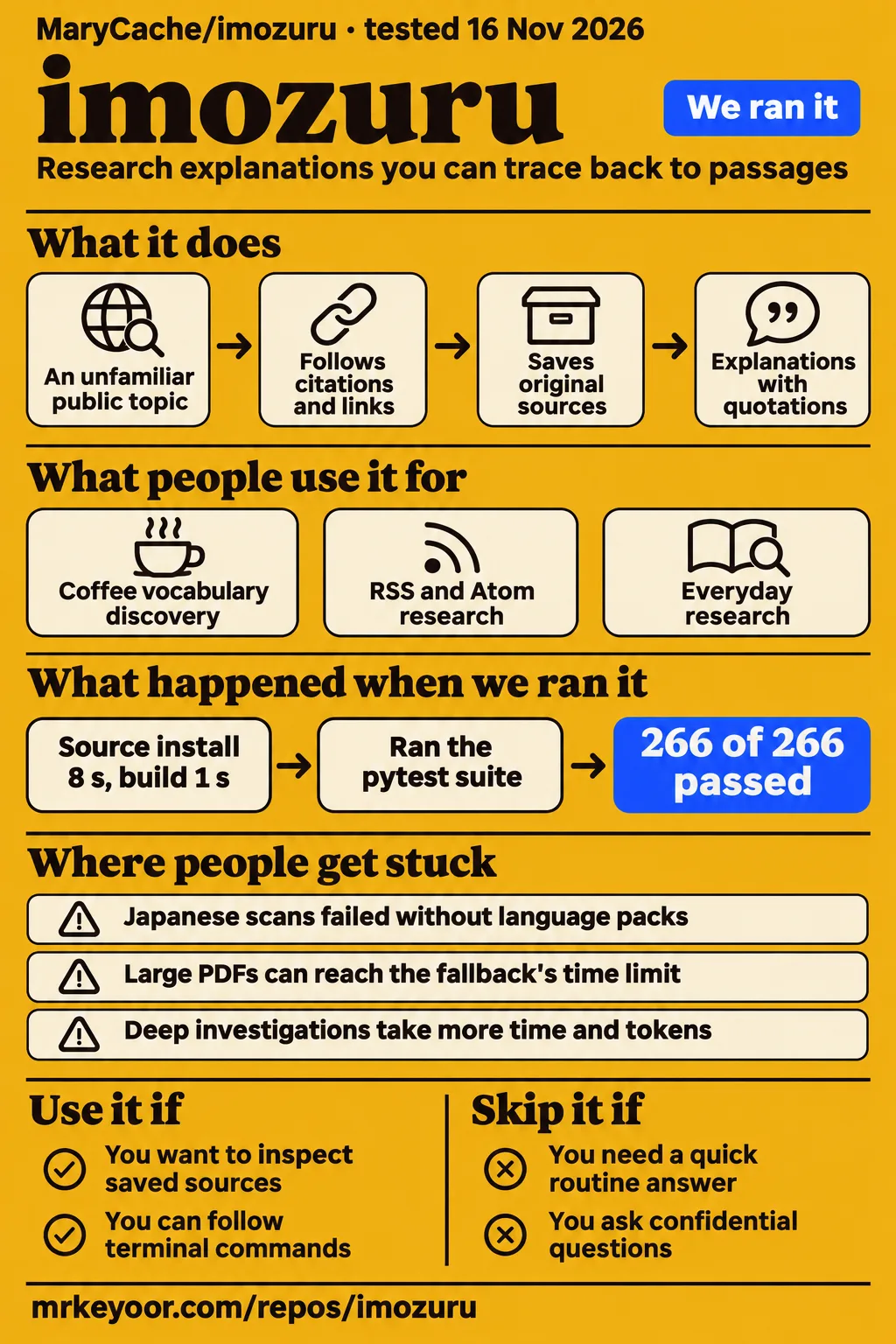
Use imozuru if you need to learn an unfamiliar public topic and want to inspect the passages behind an AI's explanation. Skip it for confidential investigations or a quick answer you won't revisit. Our sandbox installed the project in 8 seconds and passed all 266 tests; the decision to adopt it rests on the value of its saved evidence, not those setup results alone.
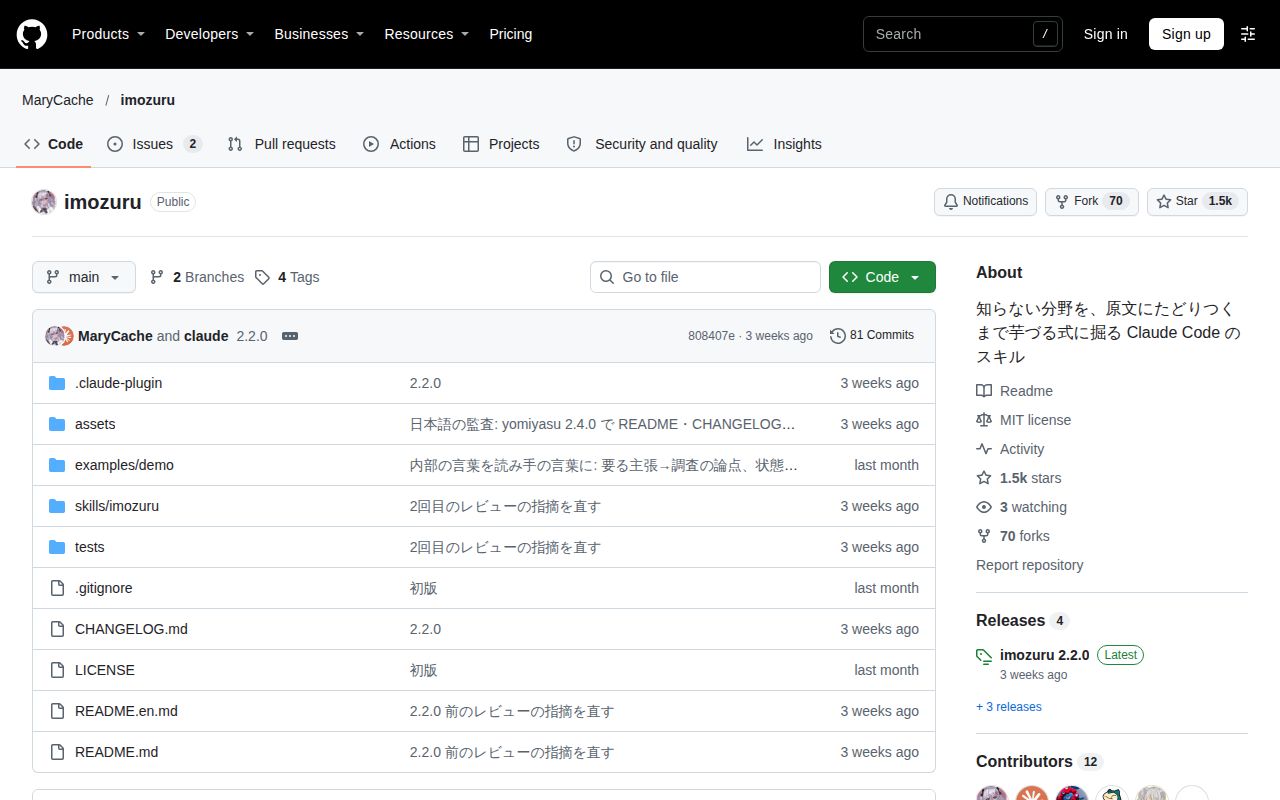
This review concerns MaryCache/imozuru, the Japanese-first research skill with an English README. Search results also include a ChainAnalyzer investigation product, an unrelated website trust report and a historical magazine. Those namesakes supply no evidence about this repository. The official description identifies a Claude Code skill, with Codex CLI instructions now included. Official README
What people use imozuru for
Published reports show vocabulary discovery, specification research and everyday use, with different levels of independence behind each account.
| Who used it | Task and reported outcome | Evidence |
|---|---|---|
| Qiita author inoyu-qiita, affiliated with イーディーエー | Compared ordinary AI search with imozuru on sour versus fruity coffee; imozuru surfaced professional evaluation criteria and sensory vocabulary. | Coffee investigation |
| The hide10 article, disclosed as written by Gemini Web | Investigated how RSS and Atom distinguish an existing article from an update; described a browser-readable extract page with original passages, Japanese translations and source line numbers. | RSS and Atom report |
| DovahkiinYuzuko, reporting in issue #23 | Said they use imozuru for everyday research and value its exploration design, while proposing smaller instructions to reduce context consumption. | Everyday-use report |
| MaryCache, the maintainer, in issue #16 | Used a collection of 46 investigations to assess citation links; reported links for 509 of 765 cited source files. | Citation-link work |
The coffee comparison is especially useful because the difference is concrete. An ordinary answer explained the taste distinction. The imozuru investigation reached how professionals evaluate and record it. That is a reason to choose this workflow when entering a field: its vocabulary becomes useful for your next question. It is one author's comparison on one topic, rather than a general ranking of research agents.
The X evidence includes adaptation as well as direct use. User matsuikentaro1 reported updating an existing literature-search skill after studying imozuru and noted that their environment requires Codex. Count that as influence on another tool, rather than a successful run of stock imozuru. The supplied Bilibili search returned unrelated entertainment results, so those records add nothing to the usage case. X reports
What you can do with imozuru
imozuru saves original sources and produces explanations for three reader levels after exploration stops. Its workflow starts by finding a field's vocabulary, central people and useful publications, then follows citations, authors and links. That order is its strongest reason to exist: a newcomer often needs better search terms before they need a better answer. Official workflow
The files make that process inspectable. map.md holds research points and leads, sources/ holds acquired text, and log.md records decisions. report.html presents extracts, while digest.html adds explanations backed by quotations. Query and fetch logs let you distinguish a search that found nothing from a page that was found but could not be acquired. Watch mode is a separate RSS workflow for following publications discovered during research.
The useful output is therefore a folder you can question. When an explanation makes an unexpected claim, open its passage and surrounding lines. When it overlooks a school of thought, inspect the map and search terms. This is a good match for someone who intends to read evidence, rather than someone who wants the agent to take responsibility for the conclusion.
What happened when we ran it
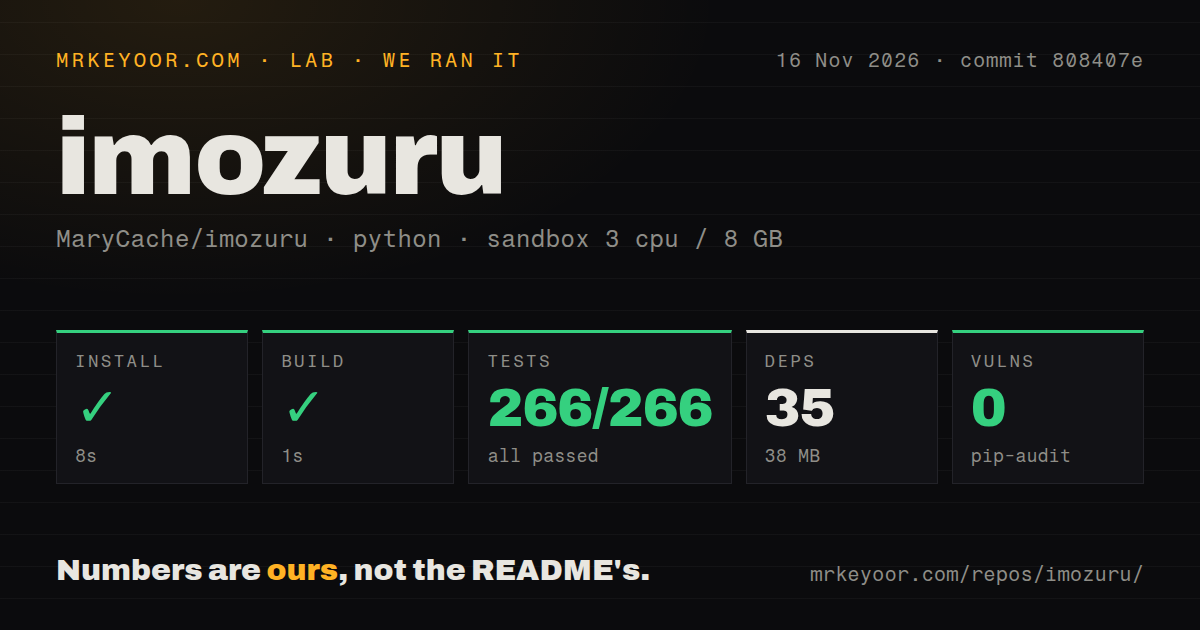
Our sandbox run at commit 808407e on November 16, 2026 installed imozuru in 8 seconds, built it in 1 second and passed all 266 tests in 13 seconds.
| Check | Our recorded result |
|---|---|
| Installation | Succeeded in 8 seconds; 35 dependencies recorded, 38 MB on disk |
| Build | Succeeded in 1 second |
| Tests | Succeeded in 13 seconds; pytest reported 266 passed, 0 failed of 266 |
| Dependency audit | pip-audit reported 0 known vulnerabilities |
| Checkout | 61 files, approximately 9,418 source lines, 1.6 MB |
| Repository signals | Tests directory present; 0 CI workflow files; no Dockerfile |
The recorded sandbox configuration was 3 CPUs, 8 GB RAM and image ghcr.io/astral-sh/uv:python3.12-bookworm. That image label describes configuration; actual runtime and operating-system versions require the raw toolchain logs. The 38 MB footprint describes this recorded installation, not every agent, browser or OCR helper you might add around it.
A separate hands-on attempt stopped at the safety check because none of the accepted Compose filenames existed. Its error was unsafe repo: none of compose.yaml, compose.yml, docker-compose.yaml, docker-compose.yml exists (rule: a compose file is required). A generic run record says the project was deployed with its own Compose configuration, but the step record shows the attempt was blocked. We treat that attempt as blocked, not as a completed deployment or research task. Teardown reported ok.
The missing Compose file is a mismatch with that harness's entry requirement. Upstream distributes a skill and scripts, so the blocked step is not evidence of a broken product. Our positive result is narrower and still useful: this checkout cleared its recorded installation, build and test steps. There is no completed known-answer investigation in our hands-on records to score alongside them.
Where people get stuck: extraction and old reports
Issue reports document fixes for lost source files, incomplete OCR and quotations whose meaning changed during normalization. The repair details matter because each defect affects the evidence you later read.
| Report | What the reporter found | Recorded resolution or action |
|---|---|---|
| Issue #1 | A failed re-fetch could overwrite and delete an existing saved source. | MaryCache changed acquisition to a working folder, moving files into sources only after validation. |
| Issue #11 | English-only OCR could accept meaningless text from Japanese scans. | Automatic Japanese language selection and confidence checks were added; the reporter confirmed readable horizontal and vertical Japanese with the language packs. |
| Issue #14 | A nonzero PDF conversion exit could leave partial OCR marked successful. | MaryCache says version 2.0.0 rejects the whole OCR operation when conversion exits nonzero. |
| Issue #15 | A user unable to install Poppler used a local pdfminer.six wrapper for a text-layer PDF. | The maintainer implemented a fallback and identified 2.2.0 as its release target; the current README documents it. |
| Issue #16 | Citations had file-and-line references without original-page links. | MaryCache added URL lookup from map.md and fetch-log.jsonl; regenerate existing HTML to add links. |
| Issue #19 | Removing a numerical minus sign could still pass the quotation check. | The maintainer changed normalization to preserve numerical signs and reject matches starting immediately after a minus. |
Version v2.2.0 fixed quotation matching that could accept an extract after a leading numerical minus sign was dropped. The release notes say text/plain sources were saved as .md, and version 2.1.0 removed the sign along with list markers. The fix preserves a leading minus before a number and rejects extracts beginning immediately after a minus. Numeric Markdown list items therefore need their marker copied too. Numerical-sign fix in v2.2.0
For an upgrade, check the installed release before copying a workaround. The latest public release is v2.2.0, published October 28, 2026, and its notes include the PDF fallback, APM scanner compatibility and numerical-sign fix. An issue response saying a change reached dev is an intermediate step; the release notes supply the shipping evidence. For older investigations, rerun report.py and digest.py to add citation links, retain the URL logs, and correct numeric extracts rejected by the tighter matcher. v2.2.0 release
Context consumption hurts alongside other skills
Issue #23 remains open with a proposal to split the large Japanese instruction file into references loaded only when needed. The reporter's prototype reduced instruction text from 19,083 to 6,305 characters and the resident description display from 580 to 227 tokens in their Antigravity environment. Those are measurements of a proposed instruction layout, not our runtime results. Context proposal
The tradeoff is practical. Moving output formats, watch instructions and tool details out of the main file reduces what sits in context. It also gives an agent another opportunity to skip a separate file containing an exception or safeguard. The reporter raises that risk directly and says full research-task testing of the split had not been performed. Don't treat the proposed reduction as a released optimization.
MoreLime relays one builder's comparison of 360k tokens and 22 minutes for imozuru against 178k tokens and 6 minutes for a plain request, with nine spot-checked citations holding up. That is a secondary account of one investigation, not a monetary estimate or a repeatable speed benchmark. It supports using this workflow selectively: spend the extra search effort where understanding the field changes a decision. MoreLime's attributed comparison
Security depends on the browser path too
The README says the fetch script blocks non-HTTP(S) URLs and local or private destinations, while issue #22 raises a separate concern about browser fallback configuration. The issue author reports that Playwright's default launch used an unsandboxed renderer in their Windows and Chrome check. They propose explicitly enabling Chromium sandboxing with local Chrome. The issue is open, with no recorded maintainer resolution. Browser-sandbox report
These controls cover different actions. A URL check constrains where the fetch script connects; browser sandboxing constrains the process opening an untrusted page. The README also documents a private-address override for proxy or VPN environments and cautions about DNS rebinding through proxies. Keep that distinction when assessing an agent that can write its own browser fallback. A successful dependency audit answers neither question. Official cautions
Research questions leave the machine as web-search terms, and the README tells users to avoid confidential or personal-data investigations. Saved originals are copies for local reading and should not be redistributed; inaccessible paid papers are reported rather than obtained through bypasses. These restrictions rule out several otherwise tempting uses, including asking the skill to investigate a private customer incident with identifying details.
English documentation does not prove English research quality
The official English README says the instructions, script messages and extract-page labels are Japanese, and that only Japanese requests have been tried. MoreLime reports acceptance of other-language requests. Those statements can both be true: accepting a prompt and delivering equally useful research are separate outcomes. Official language note, MoreLime language account
For an English-speaking team, the cost is reading the operational material as well as the final report. The coffee investigation and Japanese OCR threads are useful evidence from their stated settings. They should not become an English-quality endorsement through translation. Start with a public question whose answer someone on your team can assess, then inspect the search vocabulary and source passages before relying on the explanation.
imozuru vs ordinary AI search and research agents
The coffee reviewer found ordinary search sufficient for a quick explanation and imozuru more useful for professional vocabulary and evidence. The supplied comparisons support choosing by task, rather than declaring a universal winner.
| Choice | Why choose it | Basis for the distinction |
|---|---|---|
| Ordinary AI web search | A quick explanation where you don't need a reusable source folder. | inoyu-qiita's coffee comparison, one topic. |
| imozuru | Entering an unfamiliar field and following the passages behind the explanation. | The same coffee comparison and the documented saved-source workflow. |
| hyperresearch | Investigate it when a searchable source library is the main job. | Viral Agent's description, not a measured contest. |
| Deep-Research-skills | Investigate it when explicit user approval at each research stage matters. | Viral Agent's description, not a measured contest. |
Coffee comparison, Viral Agent's alternative descriptions
Two other projects offer concrete alternatives for developers building a research service. LangChain's Open Deep Research describes a configurable agent across model providers, search tools and MCP servers. GPT Researcher describes web and local research with cited reports. Choose the former to evaluate a configurable research agent, or the latter when both web and local materials belong in your application. Those are documented capabilities, not comparative quality results from our lab. Open Deep Research README, GPT Researcher README
What the other reviews get wrong
The current README documents numbered releases, explanatory reports and an HTML fallback, contradicting several older descriptions.
| Description | Correction supported by the records |
|---|---|
| ClaudeMap and explainx say there is no version number and each main commit becomes a version. | The official README says releases raise the version number, main matches the latest release, and development lives on dev. |
| explainx describes a tool that declines to summarize. | Version 2.0 added explanations for three reader levels after exploration stops; originals remain saved separately. |
| explainx groups missing ax with tools whose absence causes failure. | The README says HTML extraction falls back to standard-library text extraction; ax retains formatting better. |
| Viral Agent lists yt-dlp among PDF-reading helpers. | The official requirements assign yt-dlp to YouTube captions. |
ClaudeMap, explainx, Viral Agent, official requirements and release policy
The supplied overview-video transcript explains the source-acquisition flow and separates PDF extraction from YouTube transcripts. Its broader promise that skipping summaries guarantees no primary-data loss exceeds the evidence. The coffee report encountered inaccessible sources, and issue #14 documented incomplete acquisition being accepted before its fix. Saving acquired text helps you inspect it; it cannot recover a page that never arrived. Overview video, coffee retrieval failures, partial OCR report
Questions people ask
imozuru differs from a plain AI research request by mapping a field's vocabulary and following citations before producing a saved, line-referenced evidence set. The README documents that workflow; the coffee report gives one concrete comparison. Official workflow, coffee comparison
How does imozuru differ from simply asking an AI to research a topic?
imozuru explicitly maps terms, people and publications, then follows leads and saves source text with file-and-line references. Version 2.0 also produces explanations after research stops. Choose it when you intend to inspect those materials. README
What do I need to install and run imozuru?
The scripts require Python 3.10 or newer, plus an agent environment with web search and network access for source fetching. Claude Code has plugin commands; Codex uses the skill directory. PDF, OCR and caption helpers depend on the material being retrieved. Requirements
Is imozuru free, and what additional usage costs should I expect?
imozuru is MIT licensed; agent and model usage remain separate costs. MoreLime's reported token comparison shows why a free skill can still consume substantial usage. Its account supplies no monetary price to apply to your provider. Project and usage account
Can I use imozuru without knowing how to code?
Viral Agent says you need not write code, but you must follow terminal commands. The README confirms command-based plugin, skill and dashboard workflows. Someone comfortable using a terminal can evaluate it without building a research application. Setup assessment, commands
Does imozuru work with English research requests?
Other-language requests are accepted according to MoreLime, but the official language note reports trials only with Japanese requests. English documentation exists; equivalent English research quality needs its own evaluation. Language note, other-language account
What tools and agent environments does imozuru work with?
The README documents Claude Code and Codex CLI, OpenAlex citation lookup without an API key, and optional extraction helpers. For Codex, copy or link the skill into the documented skills directory and invoke $imozuru; enable web search and fetching access. Supported paths
Can imozuru's output be trusted to be correct?
Quotation matching checks whether text appears in saved source lines. It does not judge whether the source is true, whether the interpretation follows, or whether the investigation covered everything relevant. The hide10 article explicitly distinguishes source-text matching from truth. Quotation-check explanation
What are imozuru's privacy and source-reuse limits?
The README says questions become external search terms, excludes confidential and personal-data investigations, and asks users not to redistribute saved originals. Keep those constraints when choosing a research topic and deciding who receives the source folder. Official cautions
Can imozuru extract text-layer PDFs when pdftotext cannot be installed?
Yes: the current README documents a pdfminer.six fallback when installed in the Python used by the scripts. Scanned PDFs still need pdftoppm and tesseract. Large PDFs can reach the fallback's time limit. PDF fallback, requirements
How can imozuru read Japanese scanned PDFs without saving meaningless OCR text?
Install tesseract's jpn and jpn_vert language data for automatic Japanese selection. Issue #11 records confidence checks and a reporter's confirmation that Japanese scans read correctly with the packs and failed without them. OCR response and confirmation
How can report citations link directly to their original articles?
Regenerate report.html and digest.html with the updated scripts. Issue #16 says links are resolved using map.md and fetch-log.jsonl; existing generated HTML does not gain them automatically. URL records determine which citations can receive links. Citation-link fix
Why does APM 0.35.0 block installation of imozuru?
Issue #20 reports that literal bidirectional control characters in v2.1.0's filename-validation regex triggered APM's scanner. The maintainer changed them to visible Unicode escapes, and v2.2.0 lists the fix. The report describes packaging compatibility, not malicious code. APM report, release notes
What we have not tested yet
Our measurements cover installation, build, tests and a dependency audit at 808407e, not a completed research investigation. The Compose safety failure leaves no hands-on answers, screenshots, indexing measurements or research-memory readings to report. A passing suite and zero known dependency vulnerabilities do not establish research accuracy or security against hostile sources.
We have not compared English and Japanese investigations on the same questions, checked a representative citation sample ourselves, reproduced the context-splitting proposal, or exercised the browser fallback. The supplied coffee comparison is one topic; the hide10 report discloses AI authorship; the token comparison is relayed by another publication. These are useful leads with different evidential weight, not a broad benchmark.
GitHub's public API showed 1,486 stars and a last push on October 28, 2026, while the sampled tracker includes open context and browser-sandbox reports. Those facts show attention and continuing questions, not installed usage or a support commitment. We have no production-volume, repeatability or cost-per-correct-answer result. For a first decision, use a public question you can already check and read the source passage behind the conclusion that would change your mind.