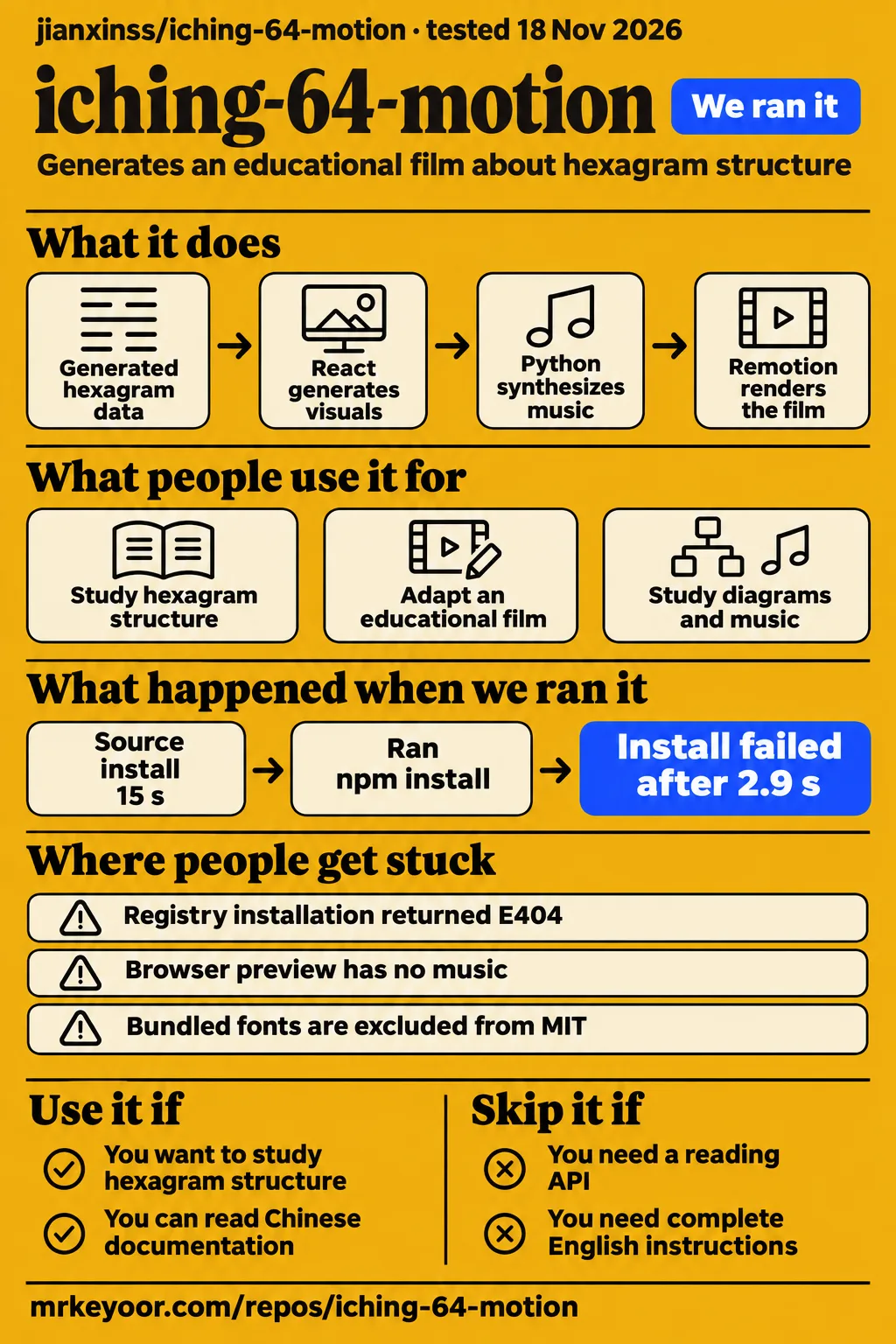
Our run installed iching-64-motion's dependencies in 15 seconds, recording 289 dependencies and 405 MB on disk. Use this project if you want to study or adapt a code-generated film explaining hexagram structure. Choose something else if you need a reading API, complete English teaching instructions, or a repository whose bundled assets all share the MIT code license.
The project gives viewers and developers different starting points. Viewers can follow the author's Releases link to the finished film. Developers can work with a Remotion timeline, generated hexagram data and a Python soundtrack program. The useful adoption question is which of those production components you need to change, and whether the documented language and asset conditions suit your intended film.
What you can do with iching-64-motion
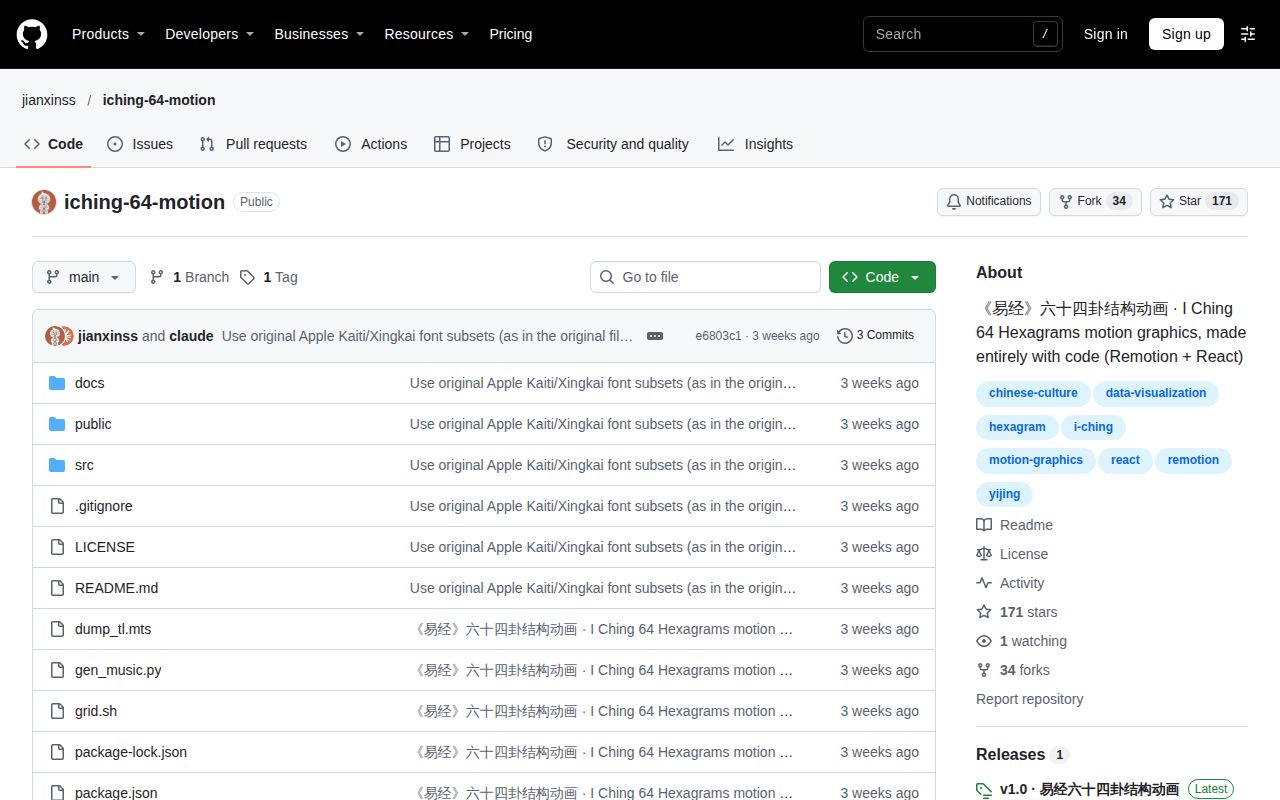
iching-64-motion generates an educational film about the I Ching's 64 hexagrams using React, SVG and three.js. The project README describes seven chapters covering generation, circular and square arrangements, complementary and inverted figures, mutual and changing hexagrams, sequence, monthly patterns and the eight-palace scheme. Remotion renders the visuals, while Python synthesizes music against a schedule of visual events.
The changing-line chapter supplies a particularly concrete example for a developer. The README describes the 64 hexagrams as vertices of a six-dimensional cube, with a single changed line corresponding to movement along one edge. An adopter interested in explaining relationships can use that chapter as a starting point: identify the transformation to teach, locate its scene and data, then follow how the timeline presents it.
The author describes the film as an explanation of symbolic structure and intellectual history and explicitly excludes its use as a basis for divination. That stated purpose helps determine which changes belong in an adaptation. A lesson about how figures are generated fits the documented project; an application that produces readings calls for a different interface and a different source of interpretive content.
What people use iching-64-motion for
The documented completed use case is the author's educational motion-graphics film about hexagram structure. The v1.0 release description lists a 1920×1080 film at 30 fps lasting 2 minutes 56 seconds. It names the same seven chapters as the README. For an educator, watching that release is the most direct way to decide which part of the subject an adaptation should emphasize.
For a developer, the README's directory map gives a useful inspection order. Start with src/g/data.ts for generated hexagram data, then ev.ts for the event table and Main.tsx for the main timeline. Chapter scenes also live under src/g/. This makes it possible to approach the source through the relationship being explained, rather than beginning with an arbitrary visual effect and trying to discover its purpose afterward.
The author also offers custom knowledge-visualization work for courses, books, brands and exhibitions. That service offer identifies possible adaptation contexts. Within this repository, the concrete production example remains the hexagram film. A motion designer can study how its schedule connects diagrams and music, while an educator can select a chapter whose structural explanation matches a lesson objective. Both uses begin with the same documented source files.
What happened when we ran it
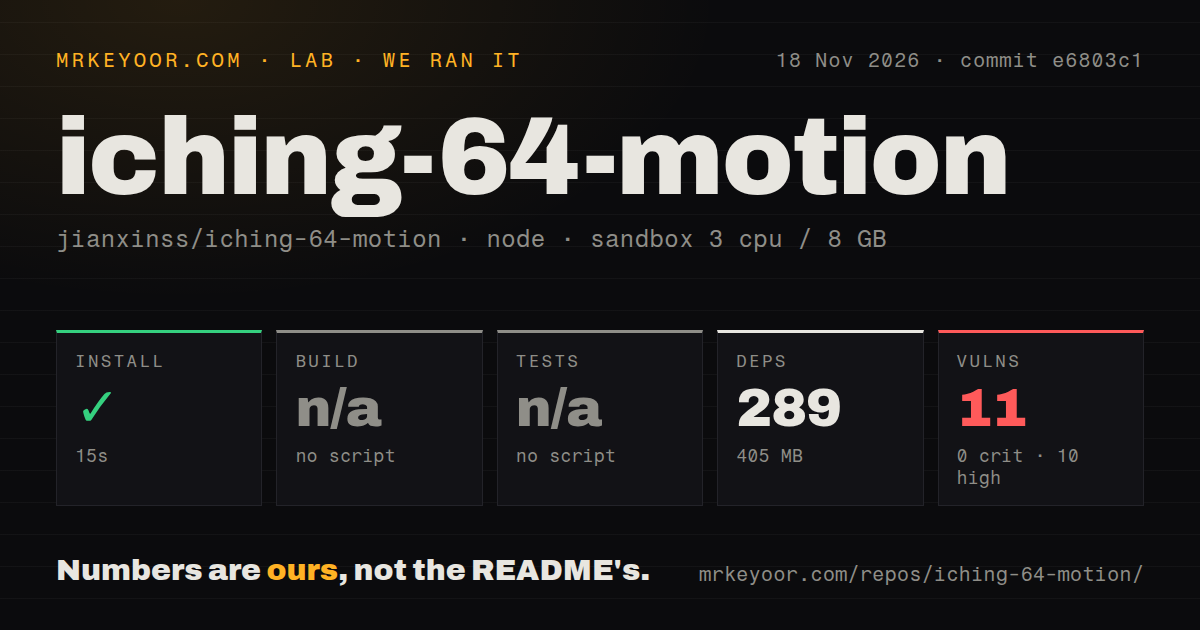
Our run installed dependencies at commit e6803c1 on 2026-11-18 in 15 seconds, using a configured sandbox with 3 CPUs and 8 GB RAM. The image label was lab-node:22. We measured a dependency footprint of 289 dependencies and 405 MB on disk. The repository scan recorded 35 files, approximately 2,377 source lines and a 2.9 MB checkout.
| Question or check | Recorded answer | Verdict | Why |
|---|---|---|---|
| Could the clone's dependencies be installed? | Installation succeeded in 15 seconds | Installation passed | The harness recorded exit 0 |
| How large was the installed dependency footprint? | 289 dependencies and 405 MB on disk | Footprint recorded | These are the harness measurements |
| Did the build check run? | No build script or target; skipped | Skipped | The harness found no conventional build target |
| Did the test check run? | No tests script or target; skipped | Skipped | The harness found no conventional test target |
| What did npm audit report? | 11 known vulnerabilities: 0 critical, 10 high, 1 moderate, 0 low | Dependency findings recorded | The audit summary supplies severity counts |
| What did the repository scan find? | 35 files, approximately 2,377 source lines, 2.9 MB checked out | Source footprint recorded | These figures describe the checkout |
| What automation did the scan find? | 0 CI workflow files, no Dockerfile, no tests directory | Automation scan completed | These were the recorded scan results |
| What happened in the separate clone step? | The quickstart-lib clone step took 1 second | Step recorded | The research pack records this separately from the harness |
| Could the separate recipe install the project from npm? | Installation failed in 2.9 seconds with exit 1 and E404 | Failed | GET https://registry.npmjs.org/iching-64-motion returned Not Found |
| Where did that recipe stop? | At installation, with an npm debug-log path | Stopped at install | The finding identifies the failed stage |
| What did teardown report? | teardown: ok | Teardown completed | The teardown record states this outcome |
The separate registry command was npm install iching-64-motion@latest. Its log includes npm error code E404 and Not Found - GET https://registry.npmjs.org/iching-64-motion. The research pack records that failed installation as taking 2.9 seconds with exit 1. This operation requested a registry package by name; the successful harness operation installed dependencies inside the repository clone.
The separate run record identifies commit e6803c1aeb44 and a fresh unprivileged lab-node:22 container with 2 CPUs, 4 GB RAM, no published ports and no secrets. Its description says the project was installed, but the detailed step records installation failure. The detailed step therefore determines the reported outcome. The clone step records 1 second, the failure finding points to /work/home/.npm/_logs/2026-11-18T12_22_54_473Z-debug-0.log, and the teardown record says teardown: ok.
Where people get stuck: registry installation and silent previews
The recorded registry installation returned E404, while the README documents commands run inside the source project. Start with that distinction when following the setup instructions. The other concrete workflow detail is sound: browser preview works without generating music, and the README explicitly says that such a preview is silent. A silent preview therefore has a documented explanation before any diagnosis of an audio fault.
| Symptom or decision | Supplied evidence | Documented route |
|---|---|---|
| E404 when installing the project name | The registry GET returned Not Found | Work from the repository and install its dependencies |
| Browser preview has no music | The README permits preview without generated music | Generate public/music.wav with npm run music |
| Soundtrack generation needs Python packages | The README names Python 3, numpy and scipy | Prepare the separate music environment |
| An MP4 export is required | The README gives a render command and output path | Use npm run render for out/iching-64-motion.mp4 |
The documented commands are npm run studio for browser preview, npm run music for public/music.wav, and npm run render for out/iching-64-motion.mp4. These are upstream instructions. The README also identifies dump_tl.mts as the script that exports the visual event schedule for music. When adapting timing, follow the schedule through both the visual timeline and soundtrack generation so the intended explanation remains connected to its musical cues.
Chinese documentation shapes an English adaptation
The supplied README is primarily Chinese and includes an English project subtitle. Its explanations cover the hexagram systems, production commands, directory structure and font conditions. An English adaptation therefore includes explanatory writing as well as code changes. The distinction matters for a film built around named transformations: translating the labels should preserve what each scene says happens to the underlying six-line figure.
The README distinguishes complementing every line from turning a whole figure upside down, and it treats mutual hexagrams as another operation. Those descriptions provide concrete material for an adaptation brief. Write down which operation a scene teaches, which labels appear, and how its before-and-after figures relate. Then use those decisions to guide the English script and annotations. This keeps translation work tied to the film's documented structure.
MIT covers the code, with separate font conditions
The README excludes public/kaiti.ttf and public/xingkai.ttf from the code's MIT grant. It identifies them as subsets of macOS Kaiti SC and Xingkai SC fonts, with copyright belonging to the original font makers, and says they are supplied only to reproduce this film. These conditions make font selection part of an adaptation's asset planning, alongside changes to scenes and soundtrack.
For a new branded or educational film, choose fonts whose permissions fit the intended distribution or obtain suitable permission for the existing fonts. That recommendation follows the author's explicit exclusion. Keep a record of which font files the adapted project uses and the terms attached to them. The repository's code license and its font statement answer different parts of the reuse decision, so both belong in the production brief.
Security and maintenance begin with the dependency findings
Our npm audit recorded 10 high-severity vulnerabilities and one moderate vulnerability in the installed dependency tree. The total was 11, with 0 critical and 0 low. These figures give an adopter a concrete dependency-maintenance task. Together with the 405 MB installed footprint, they also show why the size of the 2.9 MB checkout alone is a poor guide to the environment required for working on the film.
The scan recorded 0 CI workflow files, no Dockerfile and no tests directory. GitHub metadata supplied with the review shows a last push on 2026-10-27 and zero open issues and PRs when observed on 2026-11-18. For someone adapting the source, the practical ownership question is who will maintain that working copy and its dependencies. The documented project combines a Node.js visual toolchain with a Python music workflow.
iching-64-motion vs strobus/i-ching and Salt Iching
iching-64-motion documents a film workflow, while strobus/i-ching and Salt Iching document interfaces for hexagram data. Choose according to the output your project needs. A developer creating an application can begin with a lookup or reading interface; a developer changing an explanatory film can begin with scenes, generated data and a timeline. The supplied documentation supports that functional distinction.
| Project | Documented job | Pick it when |
|---|---|---|
| iching-64-motion | Educational motion graphics generated with code | You want to inspect or adapt a film about hexagram structure |
| strobus/i-ching | Node.js library and API, including graph representations | Your JavaScript application needs hexagrams, line changes or readings |
| Salt Iching | Python interface returning hexagram information as a dictionary | You want Python lookups by number or binary line array |
strobus/i-ching documents hexagram and trigram objects, line changes, a graph representation and an ask interface that returns a reading. Its README also specifies that line arrays run from the bottom of the hexagram to the top. That ordering is useful when planning data interchange: record the representation explicitly before connecting a library's output to your own diagrams. strobus/i-ching API documentation.
Salt Iching documents returning hexagram information as a dictionary. Its examples cover all hexagrams, all trigrams, random selection, number lookup and binary line arrays. The README identifies the first element of its illustrated array as the bottom line. For a Python notebook built around lookups, those documented operations provide a more direct starting point than extracting an interface from a film timeline. Salt Iching README.
What repository summaries do not establish
The supplied repository summaries provide no independent render or classroom-use evidence. HotRepo says its text was written by AI from the README, and GitNova identifies a model-generated README summary. Their useful contribution is orientation: they describe the film's subject, technology and possible applications. The primary README and release description supply the author's production instructions and finished-film description. HotRepo summary, GitNova summary.
The listings point readers toward different entry points in the same project. A viewer can start with Releases, a developer can study the Remotion example, and an educator can consider the chapter structure against a lesson. Those are useful navigation choices for this review's adaptation question. The source files then make the work more concrete: data definitions, chapter scenes, event schedule, main timeline and soundtrack program each identify a component an adopter may need to change.
FAQ
The README starts with solid and broken lines, then trigrams and six-line hexagrams, giving beginners a concrete route into the film's subject. Three questions below come from the supplied beginner discussion; their answers stay focused on understanding or adapting this project. The remaining questions resolve the documented production steps and font conditions. Beginner questions and discussion.
Where should a complete beginner start learning the I Ching?
Start with solid yang lines and broken yin lines, then how three lines form a trigram and six form a hexagram. The project README introduces those building blocks before describing the seven chapters. For someone preparing to use the film, this provides a sensible viewing order: learn to recognize the figures, then follow the chapter that generates them before moving into arrangements and transformations.
Which books, resources, or concepts should an I Ching beginner study first?
For this film, begin with the README's explanations of lines, trigrams and hexagrams, followed by its chapter outline. The supplied Reddit discussion also contains a recommendation to study hexagrams, trigrams, yin and yang. Those concepts connect directly to the film's diagrams. An educator preparing an adaptation can use the outline to select the structural relationship a lesson should explain before deciding which scene or labels to change.
If 11 represents Old Yang, should 00 represent Old Yin?
In the convention described in the supplied Reddit exchange, 00 means young yin and 01 means old yin about to change to yang. The same passage gives 10 as young yang and 11 as old yang. The film README separately uses 0 for a broken line and 1 for a solid line. Keep those representations distinct when writing explanatory labels or moving data into an adapted scene. Binary encoding exchange.
Can I preview the film before generating its soundtrack?
Yes. The README says browser preview works without generated music and will have no sound in that state. It documents npm run studio for preview and npm run music for generating public/music.wav. This separation lets an adopter organize visual inspection and soundtrack work as different tasks. The music step requires Python 3 with numpy and scipy alongside the documented Node.js 18+ visual environment.
How do I export the film?
The README documents npm run render with output at out/iching-64-motion.mp4. It lists that command separately from browser preview and music generation. Follow those upstream instructions inside the source project, with the soundtrack generated when sound is required. The v1.0 release page also describes the author's finished film as 1920×1080 at 30 fps, lasting 2 minutes 56 seconds.
Can I reuse the bundled fonts under MIT?
The README explicitly excludes the two bundled font subsets from its MIT code grant. It names public/kaiti.ttf and public/xingkai.ttf, identifies their macOS font origins and limits their supplied purpose to reproducing the film. For an adaptation, make a separate font choice with permissions suited to the intended use. The Chinese font statement is part of the documentation an English adaptation needs to account for.
What we have not tested yet
Our recorded checks contain no viewed Studio session, synthesized soundtrack or completed video render. Export duration, audio synchronization, output quality, browser compatibility, target-machine memory use and an English adaptation remain unassessed. The separate registry recipe stopped at installation. The image labels describe configured environments; actual Node.js, Python and operating-system versions require raw toolchain logs. The supplied release description is the author's account of the finished output.
The audit summary supplies severity counts without advisory identifiers, dependency paths or exploitability analysis. It therefore cannot identify an exact remediation or demonstrate that a particular update resolves the findings. The supplied evidence also contains no head-to-head execution of the two alternative libraries, no assessment of substitute font layouts and no legal assessment of a particular distribution arrangement. The comparison rests on documented interfaces and the README's stated asset conditions.
Independent classroom adoption, commissioned customer outcomes and measured learning gains are absent from the supplied records. The Reddit discussion and video concern general I Ching questions, the X search returned an empty results array, and there are no supplied project issue threads for assessing support response. Rendered page layout, images, related links, recommendation modules and template behavior also sit outside this text-and-evidence review.
The supplied star-history sources report different daily figures. AwesomeRepos shows a highest daily gain of 96, while Trendshift assigns October 27 a gain of 70; their counting difference is unexplained. Neither figure measures classroom adoption. For a developer deciding whether to adapt this film, the next useful evidence is a completed export from the pinned source using fonts suitable for the intended distribution, followed by inspection of its labels and soundtrack. AwesomeRepos history, Trendshift history.