The first line tells you which file to edit
The README's authentication example starts the revised reply with a file path and an edit. You can act before reading the explanation. That's the useful promise of i-have-adhd: give your coding assistant a repeatable way to present work when its conversational padding keeps hiding the instruction. Numbered actions and visible progress suit someone switching between a terminal and chat. The project has English documentation and welcomes users without an ADHD diagnosis.
Our checkout contained 73 files, roughly 3,608 source lines, and occupied 0.6 MB. The central instruction file, skills/i-have-adhd/SKILL.md, is readable enough to inspect before accepting its defaults. Those defaults extend beyond brevity: they ask the assistant to keep the current task visible and postpone unrelated suggestions. I would try this when I keep rereading a response to find the command, especially during interrupted debugging sessions.
What happened when we ran it
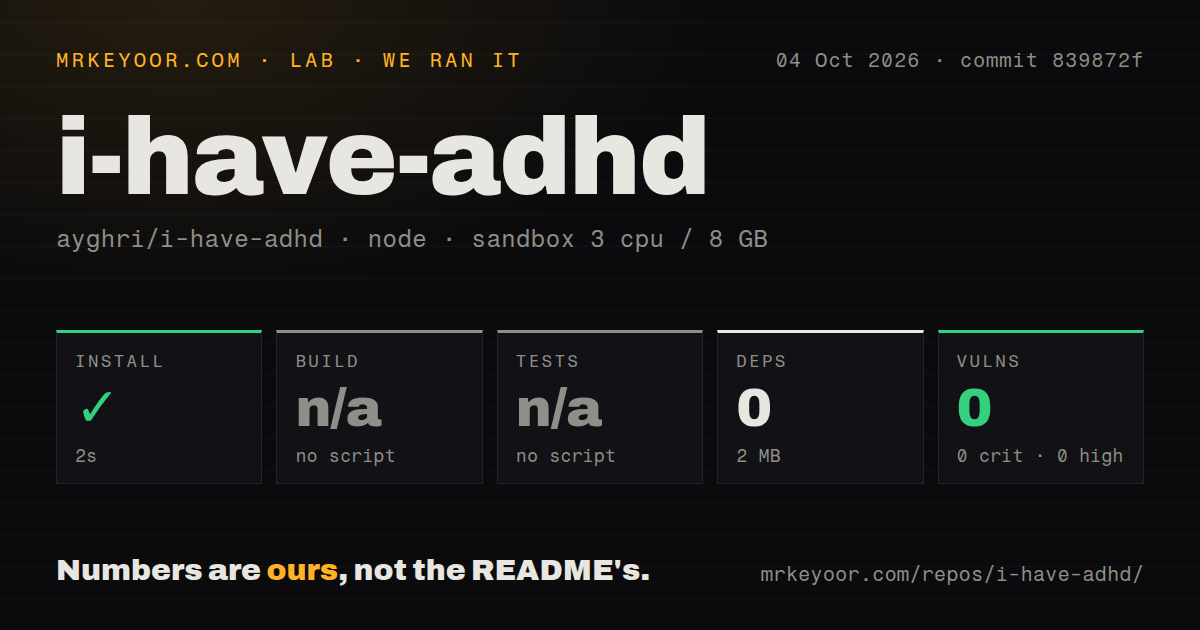
Our run installed commit 839872f in 2 seconds, added 0 npm packages, and occupied 2 MB on disk. We cloned and ran it on 2026-10-04 in a fresh Debian sandbox with 3 CPUs and 8 GB of RAM, using image lab-node:22. The container was unprivileged and had no secrets. Installation succeeded. These figures describe the repository setup that our harness exercised.
The harness skipped build and tests because it found no build or test script or target. Its scan found 4 CI workflow files and a tests directory, but no Dockerfile. Npm audit reported 0 known vulnerabilities, with 0 critical, high, moderate, or low findings. Skipping those steps means there is no build or test result to judge. The supplied measurements contain no assistant-response assessment or evidence of improved task completion.
Claude Code needs explicit activation by default
The Claude Code installation instructions register the repository with claude plugin marketplace add ayghri/i-have-adhd, then install i-have-adhd@i-have-adhd. You invoke /i-have-adhd to apply the style. For automatic session activation, the guide documents a .i-have-adhd-always flag in your Claude configuration directory. Decide which behavior you want before copying commands. Simply seeing the plugin listed doesn't demonstrate that its rules shaped a reply.
The 2 MB footprint from our sandbox makes this an inexpensive repository to inspect, but your coding assistant remains a separate requirement. Its existing account or provider configuration supplies the model. The project describes no separate hosted service or API key for the formatting rules. Other supported assistants have their own installation and activation routes, so use the relevant section of INSTALL.md rather than translating Claude commands by guesswork.
A custom Claude configuration directory can break always-on mode
Open issue 255, filed on 2026-10-12, describes a specific silent failure. The reporter stores Claude configuration outside the default directory and enables CLAUDE_CODE_SUBPROCESS_ENV_SCRUB. According to the report, the hook loses CLAUDE_CONFIG_DIR, looks for the flag in the default location, then exits successfully without emitting the rules. This concerns the current always-on hook, rather than an unrelated editor plugin.
Installing 0 npm packages in our run tells you little about that integration boundary. The issue describes an environment-variable problem inside the host assistant, which our repository install did not exercise. If you depend on automatic activation with a custom configuration directory, verify the first reply in a fresh session before relying on it. The reporter documents a symlink workaround. I'd prefer explicit invocation until the automatic path works in my configuration.
Complete explanations can override the short-output defaults
The canonical skill rules allow full explanations when requested and say that presentation limits must preserve relevant information. A long list should be grouped, with important items first. That makes the skill more usable for code review than a rigid truncation rule would be. Still, people who want a tutorial with background by default may dislike a style that starts with the immediate action and suppresses side discussions.
Our 0-known-vulnerability npm audit gives no evidence about whether a model obeys those exceptions. Neither does the skipped test step. Issue 178 asks for a clearer response-length target because the README examples vary. Treat the format as instructions the assistant must follow, with room for checking the result. It provides no reliable word ceiling, and concrete time estimates in generated replies still need your judgment.
October pushes and issue activity show ongoing maintenance
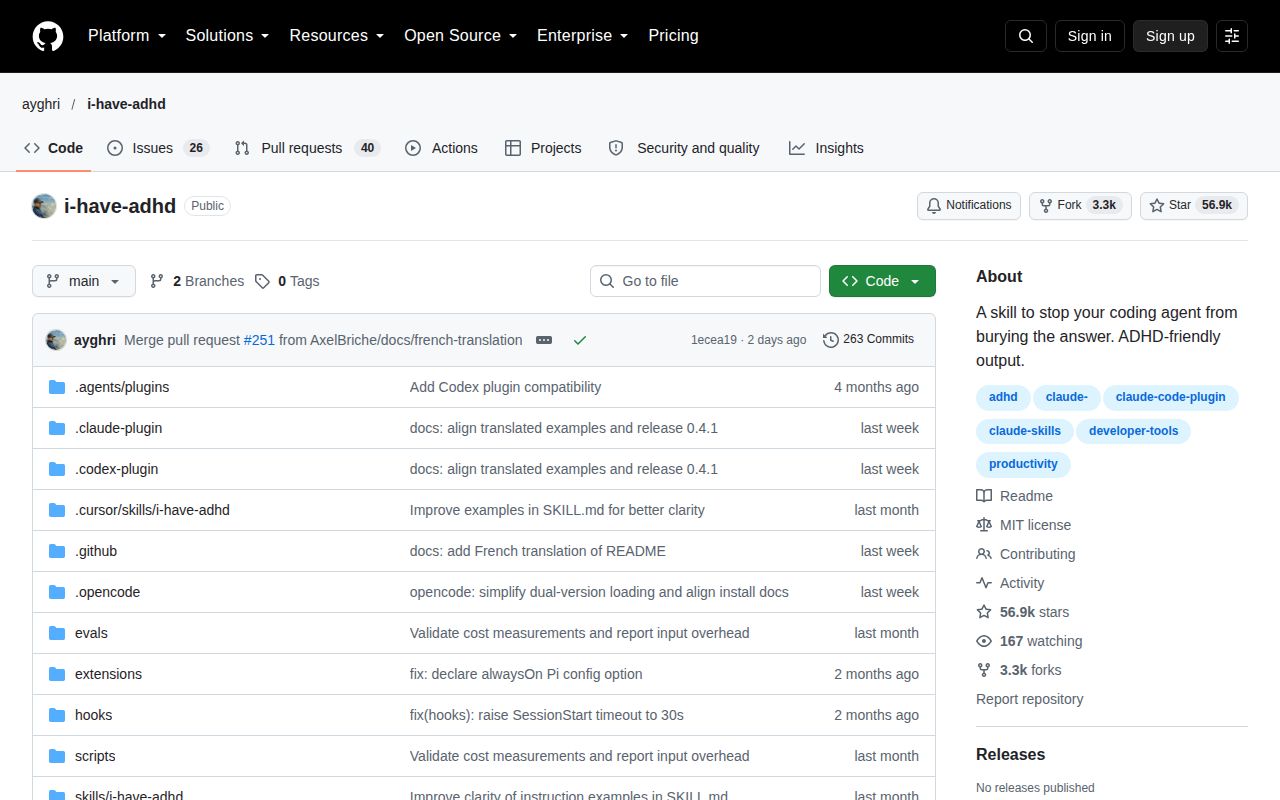
The last push was 2026-10-11. GitHub listed 56,906 stars and 66 open issues and PRs on 2026-10-13, while the hook report arrived on October 12. Together, recent repository activity and specific integration feedback show ongoing work. The latest-release endpoint returned no published release. That missing release listing is a distribution detail, not a reason to call an actively updated repository abandoned.
The 4 CI workflow files and tests directory found in our scan are useful maintenance signals, even though our harness skipped the test step. Keep that distinction when deciding how much confidence to place in the project. The README also describes replacing the upstream plugin with your own fork after editing the rules. Customization is practical here, but you'll need to track your changes when upstream installation details move.
Caveman compresses agent output; Humanizer edits prose
Caveman is the closer alternative if aggressive shortening of agent replies and compression of material the agent reads are your priorities. Humanizer fits a different job: rewriting generated prose so it sounds natural while preserving its meaning. Choose by the output you're fixing. A terse debugging instruction and a readable published paragraph need different editing decisions.
The 2-second install makes i-have-adhd easy to investigate. Activation and useful replies remain the adoption checks. Start on demand with a task whose answer you can verify. Ask for a repair, interrupt with a question, then request a full explanation. Check that the response keeps the current task visible without dropping necessary detail. Finally say normal mode and check the next reply. Keep it if those transitions work for you.