Installing the skill leaves the service dependency in place
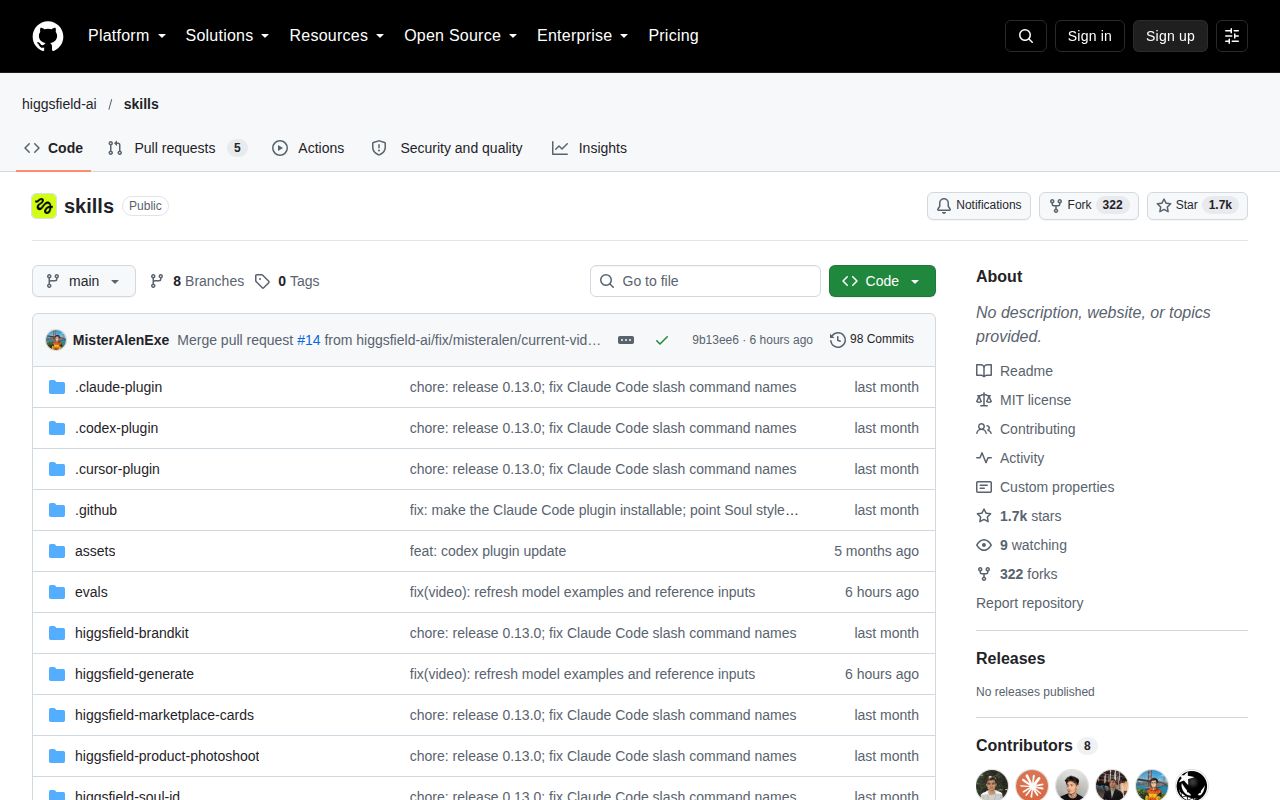
Higgsfield AI Skills requires an authenticated Higgsfield CLI workflow. Adding its Markdown instructions to Claude Code or Codex gets an agent directions for submitting jobs, checking their progress and returning assets. It does not put a local generation engine on your machine. That distinction should decide whether this repository belongs in your workflow before its catalog of creative tasks does.
The README groups generation, identity training and product visuals into separate skills, alongside brandkit, marketplace cards, websites, explainers and thumbnails. For someone already working in Higgsfield, those task boundaries could reduce repeated briefing. The value depends on the agent choosing the right workflow and the live service accepting its commands. We haven't verified either behavior.
What happened when we ran it
The October 26, 2026 lab record at commit f83af0b says NOT RUN: the harness had no supported ecosystem route for this Python repository, and no Dockerfile was present. There are no install or build timings, passing-test counts, dependency measurements or vulnerability results to report. A repository that the harness cannot execute has not failed a product test.
The configuration recorded 3 CPUs and 8 GB RAM, with image listed as n/a. It doesn't establish an actual runtime or operating-system version. We also have no generated image, finished video or exported brandbook from this run. The recommendation therefore rests on documented workflow boundaries and primary-source reports, with output quality and end-to-end operation still unassessed.
Authentication and export tools are separate setup jobs
The installation guide lists the Higgsfield CLI and authentication as prerequisites. It documents agent installation through a skills command, a Claude Code marketplace route and a setup script. Installing the instructions and having an authenticated account able to use the selected model are separate requirements. Neither was exercised by the unsupported lab attempt.
Local work varies by task. Website workflows additionally use git and Bun. The guide says full brandkit exports may need Playwright Chromium, ImageMagick, librsvg, LibreOffice, Poppler and Fontconfig. Those are concrete reasons to choose a deliverable before preparing the machine. Someone asking for a single image should not infer that every brandbook export dependency is necessary for that image job.
Cost approval needs to be explicit in the brief
The generation skill tells agents not to pre-estimate cost or optimize for cheaper models unless the user asks. It favors its chosen quality defaults. For a person making an occasional image, that may be acceptable. For an unattended agent producing campaign variants, it is a workflow policy you should change explicitly in your instructions before the first job.
The same skill tells the agent to inspect live model contracts and pass supported media inputs. It says local file paths supplied as media inputs are automatically uploaded. A local reference image therefore becomes part of a service request. Decide which assets the account may submit, and ask for a cost estimate and spending approval when your workflow requires them. This review establishes no price, included allowance or retention guarantee.
An open compatibility proposal is a reason to check commands
PR 13, titled "fix: align skills with Higgsfield CLI 1.2.2", proposes corrections to command examples and changed model contracts. It remained open when inspected. Its author reports that some examples are rejected by that CLI and that an explainer assembly operation was unavailable on the author's account. Those are upstream contributor observations, without reproduction by our lab.
The PR says it could not determine whether the unavailable assembler was account-plan dependent. That uncertainty rules out a blanket claim that the explainer workflow is broken for everyone. It also rules out treating a proposed guard as already shipped. Before generating component clips, check that your account exposes the operation needed to assemble the final deliverable. A folder of clips is an expensive stopping point if your brief requires a finished video.
Local graphs and code-based video offer different paths
ComfyUI documents reusable node-graph workflows and local execution, with optional service nodes. It is a relevant alternative when model control and local processing are central requirements. You'll still need to choose supported models and hardware. We have no comparative setup, speed or output-quality measurements for it here.
Remotion Agent Skills supplies guidance for Remotion projects, including creating compositions, previewing them and invoking renders. Choose that direction when the video should be a composition you maintain as code. It addresses a different production method from submitting a prompt and references to a Higgsfield model, so the choice begins with how you want to revise the finished work.
Only documentation receives a numerical rating
Our documentation scale uses 1 for instructions missing the basic entry path, 3 for a usable task-specific guide with unresolved discrepancies and 5 for instructions corroborated across the evaluated workflows. Intermediate scores reflect partial evidence between those points. Documentation receives 3 because authentication and export prerequisites are explained, while the compatibility proposal identifies commands needing verification. Setup, community and maturity remain unassessed: neither Markdown breadth nor a public contribution proves successful operation or support capacity.
For the first trial, choose one deliverable, require a cost estimate and verify the final export or assembly operation before starting upstream generation. Accept the resulting file only after opening it in the application where you intend to use it.