Short answer: keep this on testnet
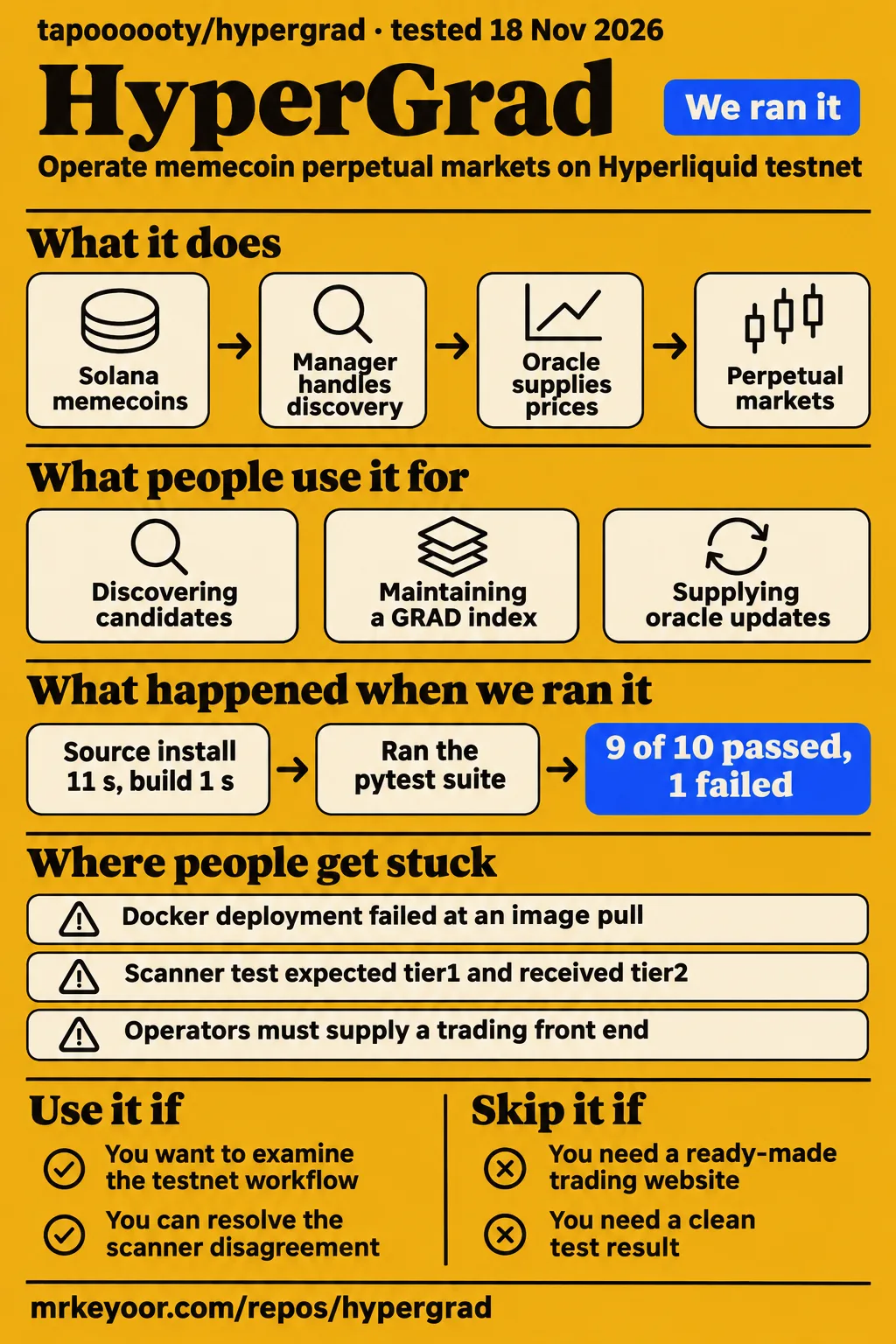
Our HyperGrad deployment stopped at an image pull, and the separate source checks finished with one failing scanner test. Use it if you're a Python developer investigating how to operate memecoin perpetual markets on Hyperliquid testnet. Skip it if you want a trading website you can launch and hand to users: the README explicitly leaves a trading front end, capital and several operating responsibilities to you.
The interesting part is the combination of a coin scanner, an index, an oracle and a market maker. Those components address different jobs involved in running a market. The decision is whether you want to own those jobs. HyperGrad's README labels the project testnet and even captions its dashboard picture as demo data. That's the right starting point for reading its feature list.
What you can do with HyperGrad
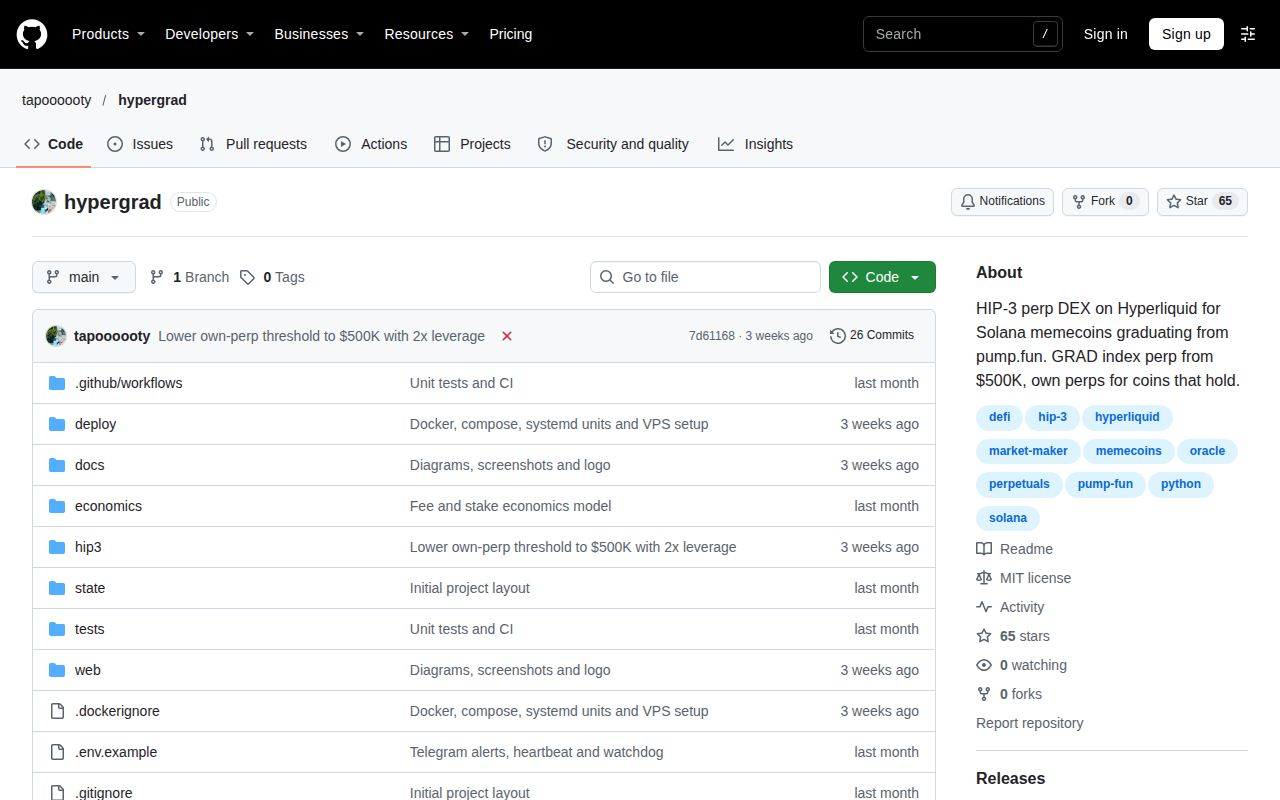
The README describes a Python system that discovers Solana memecoins graduating from pump.fun and manages perpetual markets for them on Hyperliquid. A perpetual is a futures contract without an expiry date. HyperGrad proposes both an index of qualifying coins, called GRAD, and individual markets for coins that meet additional conditions. These are upstream descriptions of the intended workflow.
The manager handles discovery, tier assignment and market retirement. Its documented cycle runs every ten minutes, while the index is rebalanced daily. The oracle supplies market prices, the market maker quotes bids and asks, and the dashboard displays their state. That division is useful for an operator: a dashboard showing a candidate coin and an oracle updating a live market represent different stages of the process.
The project also documents a doctor command that checks configuration and connectivity without sending a transaction. Its market maker has a dry-run mode, and its backtest command replays historical coin prices through the mark-price rule. I'd start an evaluation with those inspection paths. The commands that create a DEX or list a market belong later, after you understand which account signs each action and which configuration it reads.
What people use HyperGrad for
The attributable use in our evidence is MrKeyoor's attempted Docker deployment at commit 7d6116874504 on November 18, 2026. We used the project's own Compose configuration with every port bound to localhost. The run record identifies that attempt, and the deployment result below determines what it actually accomplished. There is no named operator success story in the supplied community records.
That makes the README's proposed uses worth distinguishing from user outcomes. Discovering candidates, maintaining a GRAD index and supplying oracle updates are documented jobs for the software. They aren't examples of someone in the research pack running a successful exchange. If you're considering a fork, those jobs give you a concrete evaluation scope without borrowing credibility from a similarly named machine-learning project.
What happened when we ran it
Our Docker deployment failed after 25 seconds while trying to pull hypergrad:latest, before we obtained a running service. The deployment log says pull access was denied and that the repository does not exist or may require login. It also prints WARNING: Some service image(s) must be built from source and suggests docker compose build oracle. The recorded outcome is a failed deployment, despite the run-setup record's shorthand description of the Compose method.
| Hands-on step | Recorded result | What it tells a reader |
|---|---|---|
| Compose deployment | Failed in 25 seconds | The image pull blocked this attempt |
| Image requested | hypergrad:latest | This is the image named in the error |
| Suggested action in the log | docker compose build oracle | A suggested next step, without a successful follow-up in the record |
| Teardown | OK | The lab recorded cleanup after the attempt |
The teardown record says cleanup was OK. The pull failure is a useful day-one warning for anyone following the server instructions: don't assume the referenced image is already available to your host. The message offers alternative explanations, so blaming an account, a registry outage or the application itself would go beyond what the log shows.
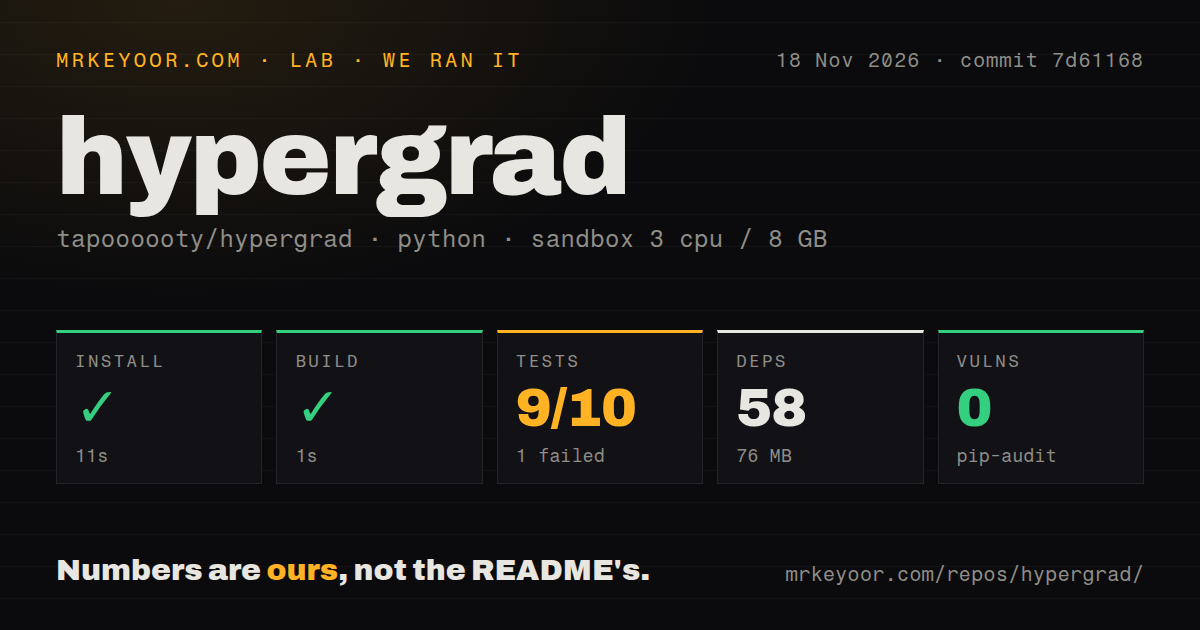
The separate source sandbox produced a more encouraging setup result and a specific correctness concern. We ran commit 7d61168 on November 18, 2026 with a recorded configuration of 3 CPUs and 8 GB RAM. Its image label was ghcr.io/astral-sh/uv:python3.12-bookworm. That identifies the configured image, while actual runtime and operating-system versions require the raw toolchain logs.
| Source sandbox check | Our recorded result |
|---|---|
| Dependency installation | Succeeded in 11 seconds |
| Dependencies and installed footprint | 58 dependencies, 76 MB on disk |
| Build | Succeeded in 1 second |
| Test command | Failed, exit 1, in 2 seconds |
| Pytest result | 9 passed, 1 failed, 10 total |
| Dependency audit | pip-audit reported 0 known vulnerabilities |
These sandbox measurements cover source setup and checks. The failing case was tests/test_scanner.py::test_tier1_coin: its assertion expected tier1, while the result was tier2. That matters because tier assignment is part of the documented listing workflow. The output gives us an exact disagreement to investigate, rather than an unexplained red test command.
The repository scan found 89 files, approximately 2,459 source lines and a 4.2 MB checkout, plus a Dockerfile, Compose file, tests directory and one CI workflow. That is a manageable amount of code for a focused inspection. A small checkout also leaves the larger operational obligations unchanged: someone still has to manage the keys, price sources and processes described in the README.
Where people get stuck: the image and the tier expectation
The two concrete blockers in our records are an unavailable image pull and a scanner assertion that disagrees with its expected tier. They need separate investigations. A source installation that completes doesn't supply a missing container image, and a locally built image wouldn't by itself explain why the test returned tier2.
| Symptom | Supported next step | Evidence boundary |
|---|---|---|
| Pull access denied for hypergrad:latest | Inspect the local build route named by Compose's warning | The log suggests building the oracle image; it records no completed recovery |
| test_tier1_coin expects tier1 and receives tier2 | Compare the test input, tier policy and scanner logic at the measured commit | The assertion identifies the mismatch, not which side should change |
| Uncertainty before signed actions | Read and run the documented doctor checks in a testnet evaluation | The README says doctor sends no transaction |
For the scanner failure, changing the expected string just to make the test green would settle nothing. The useful question is which tier the fixture should receive under the intended policy. The README connects tiers to eligibility for individual markets, so a contributor should trace that policy before changing either code or expectation. Our log supports this investigation, without supplying its answer.
The Docker result deserves the same discipline. Treat the printed build command as a lead to check against the Compose file, then record the next outcome. Calling it a proven fix would hide the exact step a new operator still needs to complete. There are no target-project issue threads in the pack that supply a maintainer's resolution for either finding.
Security defaults keep testnet and signing keys separate
The README says testnet is the default and mainnet additionally requires HL_ALLOW_MAINNET=yes. It also calls for separate deployer, oracle and market-maker keys. These documented boundaries matter because the processes perform different actions: supplying a price, creating a market and placing an order should not become interchangeable responsibilities through a shared key.
The market-making instructions explicitly say to fund a separate account and keep the deployer key out of trading. The dashboard is documented as a localhost service reached through an SSH tunnel. The standby oracle should contact the primary dashboard over a tunnel or private network. An evaluator can therefore start with a private control surface instead of exposing that dashboard just to make it accessible from a laptop.
Oracle configuration needs particular attention. The README lists DexScreener and Jupiter as enabled by default, with a minimum source count of one. Its risk guidance recommends at least two sources on mainnet, and an on-chain source requires a private Solana RPC. Read the default and the recommendation together: configuring several providers and requiring agreement from several providers are separate choices. The dependency audit in our table concerns known package advisories; it is no assurance about these signing or pricing decisions.
The missing front end and operating capital are your responsibility
The README explicitly lists a trading front end and market-making capital among the things the code cannot provide. This is an important reason to walk away if your goal is simply to offer a trading interface. The supplied dashboard is described as read-only, and its published screenshot uses demo data. Neither is evidence of an application ready for customers.
The documented server workflow keeps an oracle running while markets are live. It adds a manager, a dashboard and an optional market-maker service, with a standby oracle on another server. Telegram alerts cover events such as a frozen price or a stalled oracle. For an operator, these descriptions define an on-call job: deciding who reacts to an alert and who has authority to halt a market.
The README also describes financial and legal prerequisites, including stake, funds and advice about operating jurisdictions. Those are the project's warnings, not costs calculated by our lab or permission to operate anywhere. I would assess the software first as an operating system for a testnet experiment. Paying for a server and completing a Python installation answer only a small part of the question its own operations checklist raises.
HyperGrad vs the Hyperliquid Python and TypeScript SDKs
The Hyperliquid Python and TypeScript SDKs are narrower options when you need API access rather than HyperGrad's proposed market-operation workflow. Their primary READMEs describe API clients, while HyperGrad describes an application built around listing policy, discovery and pricing. This comparison is about which job you want to own, without a performance ranking.
| Project | Documented role | Choose it when |
|---|---|---|
| HyperGrad | Scanner, manager, oracle, market maker and read-only dashboard for its memecoin-market design | You want to examine that complete testnet workflow |
| hyperliquid-dex/hyperliquid-python-sdk | SDK for Hyperliquid API trading with Python | You need Python API access for your own application |
| nktkas/hyperliquid | Community-supported Hyperliquid API SDK written in TypeScript | You need a JavaScript or TypeScript client for your own interface |
The Python SDK README includes a testnet account-state example and explains API-wallet configuration. The TypeScript SDK README provides examples for reading data, trading and subscriptions. HyperGrad itself points to both SDKs, including the TypeScript project in its checklist for a trading front end. They are useful alternatives to adopting its whole application when your requirement stops at integration.
Neither SDK is a ready-made substitute for HyperGrad's listing rules. Choosing a client means your application owns the rest of that behavior. Conversely, adopting HyperGrad makes sense only if its particular scanner, index and oracle design is relevant to what you intend to investigate. Start by deciding between building an API integration and operating a market design.
Search results for hypergrad mix unrelated projects
The supplied research includes machine-learning repositories, an Unreal Engine plug-in, a homework website and a compressor discussion. Their shared spelling supplies no evidence about tapoooooty/hypergrad. The PMLR paper record points explicitly to moskomule/hypergrad; an older X result identifies HIPS/hypergrad. Neither repository is this Hyperliquid project.
The community results need the same filtering. Historical_Candle511's r/GoRVing question compares Hyper-Grade compressors. In the video titled HyperGrade: Automated Code Grading for Teachers and Students, the presenter describes managing programming homework. The Unreal Engine video describes a plug-in for changing and previewing scene looks. Counting these as user experiences with the exchange software would manufacture a community the records don't contain.
One X post by lianyi520 reports a decline in stars for a project called hypergrad and explicitly says the cause is unchecked. It omits the owner, so we exclude the reported trend from this review. The target repository's public metadata records 65 stars. Its last push was October 29, 2026. Its issues endpoint returned an empty list on November 18. Those observations describe attention and visible tracker activity, without establishing support quality or abandonment.
Questions people ask
HyperGrad's README calls for Python 3.10 or newer and a Hyperliquid wallet, and says everything defaults to testnet. The following are first-time operator questions drawn from that documentation; the supplied search intents contain no attributable questions about this repository.
What do I need to start HyperGrad?
Python 3.10 or newer and a Hyperliquid wallet are the README's starting requirements. Configuration separates the deployer, oracle and market-maker credentials, and the documented source providers include Solana RPC. Telegram credentials configure alerts. Follow the README's quick start and configuration sections for the role of each value rather than putting one signing key into every field.
Is HyperGrad MIT licensed?
Yes. The README's licence section labels HyperGrad MIT licensed and says it is independent of Hyperliquid, pump.fun and trade.xyz. The software licence answers a code-use question. The same README separately tells operators to obtain legal advice about where they and their users may operate, so its licence is no substitute for that assessment.
Does HyperGrad include a trading front end?
No. The README lists a trading front end among the work an operator must supply and describes the included dashboard as read-only. If you're building an interface, its links to the Python and TypeScript SDKs are more relevant than the dashboard picture. Budget interface development as separate work before treating this as a user-facing product.
What we have not tested yet
Our Compose attempt stopped before a running service, so we have not tested market creation, scanner output against live coins, oracle updates, failover, order placement, cancellations, halts or the dashboard. We did not execute the suggested image build and a successful redeployment. The scanner log does not establish whether the fixture, expectation or implementation needs changing, and we have no subsequent regression result.
The source measurements cover one commit and one recorded sandbox configuration. Actual runtime and operating-system versions need the raw toolchain logs. There is no load test, live price-quality measurement, profitability result, independent signing review or assessment of losses under a feed failure. The SDK alternatives were read for scope, not run side by side. The README's safety mechanisms remain untested here, including the difference between configured source counts and actual failover behavior.
The supplied community evidence contains no attributable production deployment for this repository, and the empty issue list gives no support-response history to assess. We have not inspected the full linked operations manuals or established legal suitability for any country. The next useful evidence is a successful testnet deployment at a pinned commit, followed by an explained tier result and recorded oracle and halt behavior.