Hy4 is a 770B model whose repository mostly ships recipes
Hy4 preview is Tencent's open-weight mixture-of-experts language model. The specification lists 770B total parameters, 49B activated per token, 78 layers, and a 1M-token context window. Tencent provides full and FP8 weights, then points operators to vLLM or SGLang for an OpenAI-compatible server. English and Chinese guides cover three fine-tuning systems.
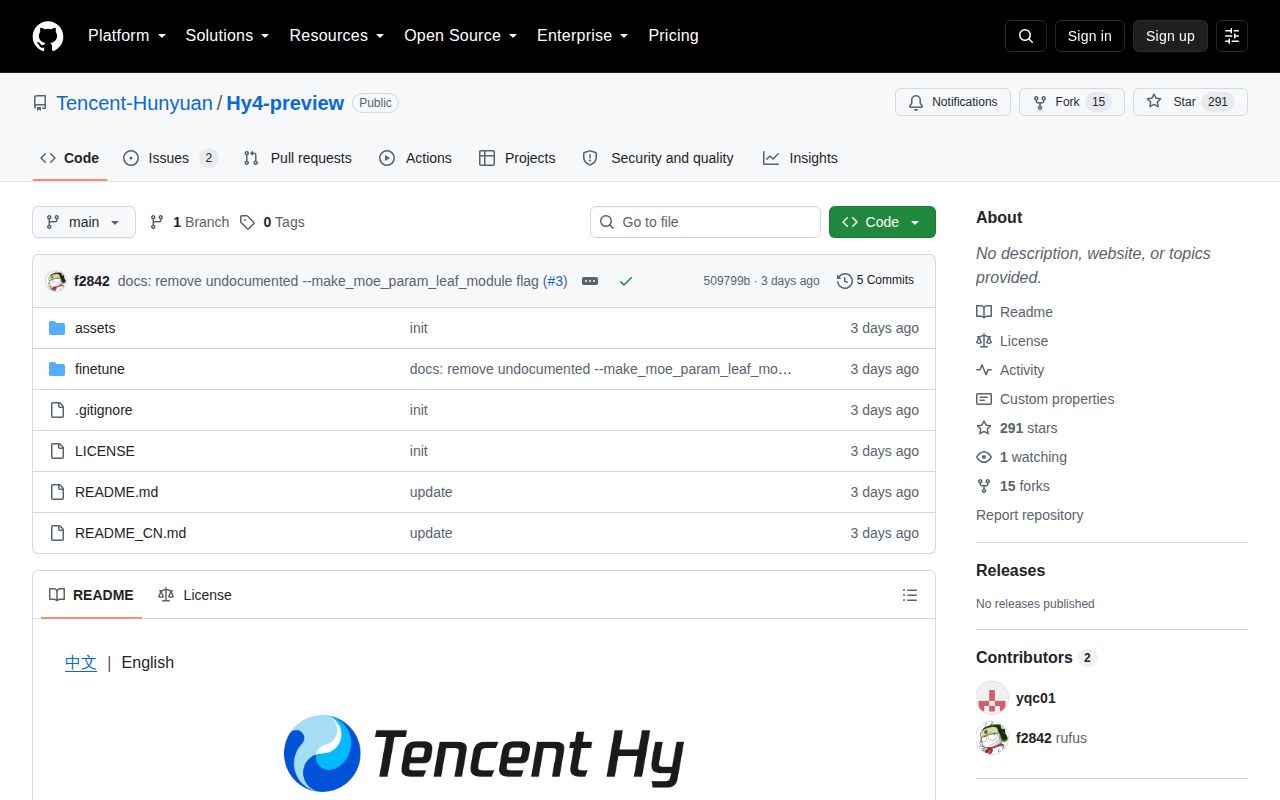
The checkout is much smaller than the model. Our sandbox saw 32 files, about 2,483 lines of source, and 24.9 MB on disk at commit 509799b. Most of that size came from benchmark images. The Python project lives under finetune, so a successful local install says little about whether your hardware can load Hy4.
The documented serving path uses eight-way tensor parallelism
Tencent's vLLM example runs the FP8 model with tensor parallel size 8, speculative decoding, sparse attention, and Hy4-specific parsers. The SGLang command also sets tensor parallel size 8. Both expose hy4-preview on port 8000, which makes application integration familiar once the GPU server exists.
Our 3-CPU, 8 GB sandbox did not start either image or download weights. It installed only the fine-tuning dependencies. The quick Python client in the README is the final step after a separate model server has been provisioned. Supplying enough accelerators and storage is the purchase decision.
What happened when we ran it
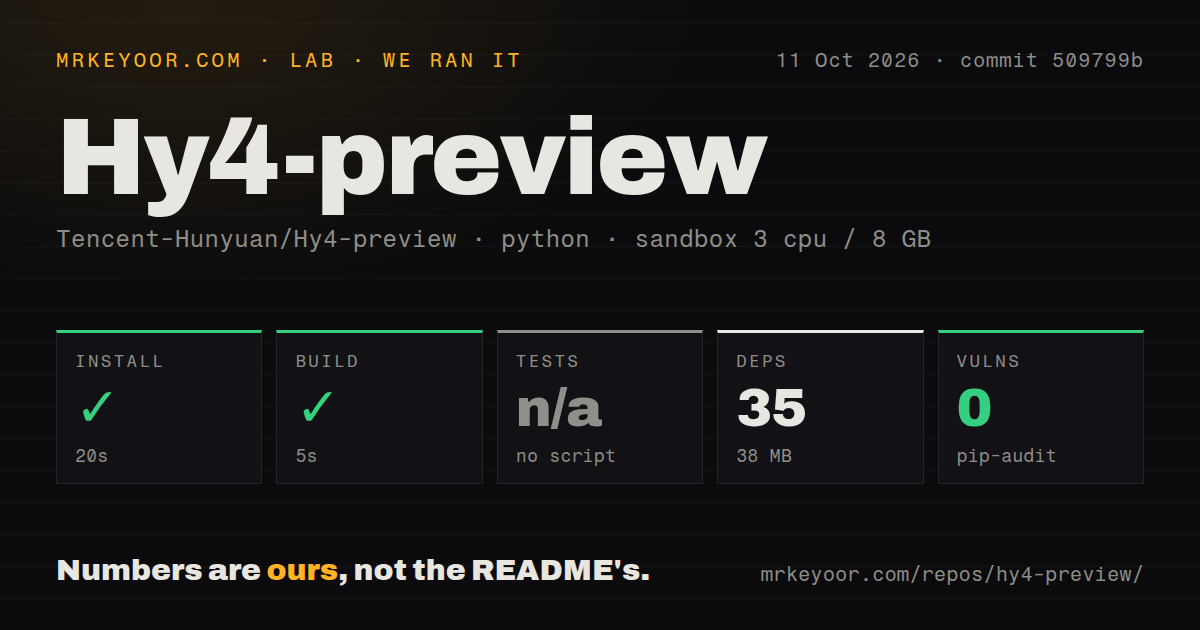
Our sandbox installed the finetune project in 30 seconds. The process added 35 packages and left 37 MB on disk, then the build completed successfully in 9 seconds. Pip-audit reported 0 known vulnerabilities in that environment. These are support-code results for commit 509799b, with no inference, quality, latency, or training measurement implied.
There was no test script or target, so we skipped tests. The checkout had 0 CI workflow files, no Dockerfile, and no tests directory. Tencent supplies external prebuilt images, but the repository does not show how those images are assembled. A team changing the training patches must design its own regression checks and choose which upstream image build to trust.
Fine tuning starts at 64 high-memory GPUs
Tencent lists at least 8 machines and 64 GPUs for LoRA fine tuning, with each GPU carrying at least 96 GB and each machine at least 2 TB of CPU memory. Full tuning starts at 16 machines and 128 GPUs with the same per-device memory floor. Longer sequences and larger batches can raise those requirements.
Our 30-second dependency install does not exercise that path. Multi-machine users must configure passwordless SSH between containers, keep code and data identical on every node, and open an SSH port. This is cluster work with root access inside training containers, not a one-command developer-box experiment.
The native DeepSpeed code supports full and LoRA training with several ZeRO configurations. Separate integrations cover LLaMA-Factory and ms-swift. Each path requires model and tokenizer locations, dataset registration, output storage, and distributed settings. The LLaMA-Factory configuration explicitly enables remote model code.
The 35-package environment we measured is only the common Python layer. LLaMA-Factory comes from its own project, while ms-swift can come from pip or source. There is no lockfile, so operators should freeze a tested environment before launching a 64-GPU job.
The preview label comes with specific behavior limits
Tencent calls Hy4 an early version and names two problems: it can reason longer than necessary on complex tasks and over-verify its own output. The API defaults to high reasoning effort, while callers can request no_think for direct answers. Product teams still need evaluations based on their prompts, tools, languages, and failure costs.
The repository was created on August 27, 2026 and last pushed on August 28. GitHub showed 291 stars and 2 open issues on August 31. One documentation issue about an unsupported training flag was closed the day it was filed. A newer community benchmark issue had no maintainer reply yet. Four days cannot establish a maintenance record.
No release tag and no test target make change control your job
GitHub returned no latest release for Hy4-preview. Users consume a moving main branch, model-host artifacts, and external serving images rather than a fixed repository release. Pin the commit, model revision, image, framework versions, and chat template together so a later investigation can reconstruct the exact combination.
Our build finished in 9 seconds, yet no test target checked the Hy4-specific patches. The closed flag issue shows that documentation and code can briefly disagree. Before a costly run, test tokenization, checkpoint loading, one optimizer step, resume behavior, and artifact saving on a smaller allocation.
Hy4 makes sense only after the infrastructure decision is made
Hy4-preview gives an experienced infrastructure team a direct route to serve and adapt Tencent's model. The bilingual material is detailed, and the 64-GPU minimum is stated plainly. Its audience remains narrow: teams already comfortable with distributed GPU training, remote model code, external images, and their own validation.
A 30-second install and 37 MB dependency footprint should not decide the model choice. Use Hy4 when it wins an evaluation that represents your work and the eight-way layout fits hardware you can operate. If finding 64 suitable GPUs is still an open question, try a smaller model family or hosted access first.