A 1,228.7 MB clone contains a playable Springfield
Hit & Run Web is a new Three.js runtime for The Simpsons: Hit & Run, built around data converted from a PAL PlayStation 2 disc. The original executable is neither emulated nor recompiled. Instead, the project reads converted geometry, textures, animations, audio, and mission scripts, then supplies its own renderer, controls, physics, and campaign runtime. You can open the hosted build or clone the repository and run it locally.
The included assets explain the unusual repository size. Our checkout contained 12,568 files and occupied 1,228.7 MB before npm dependencies, despite having about 6,086 lines of source. The README says those converted browser assets are about 1.09 GB. This choice makes the clone immediately playable and lets the tests inspect real data. It also makes every fork, CI checkout, and clean workspace much heavier than the TypeScript code suggests.
What happened when we ran it
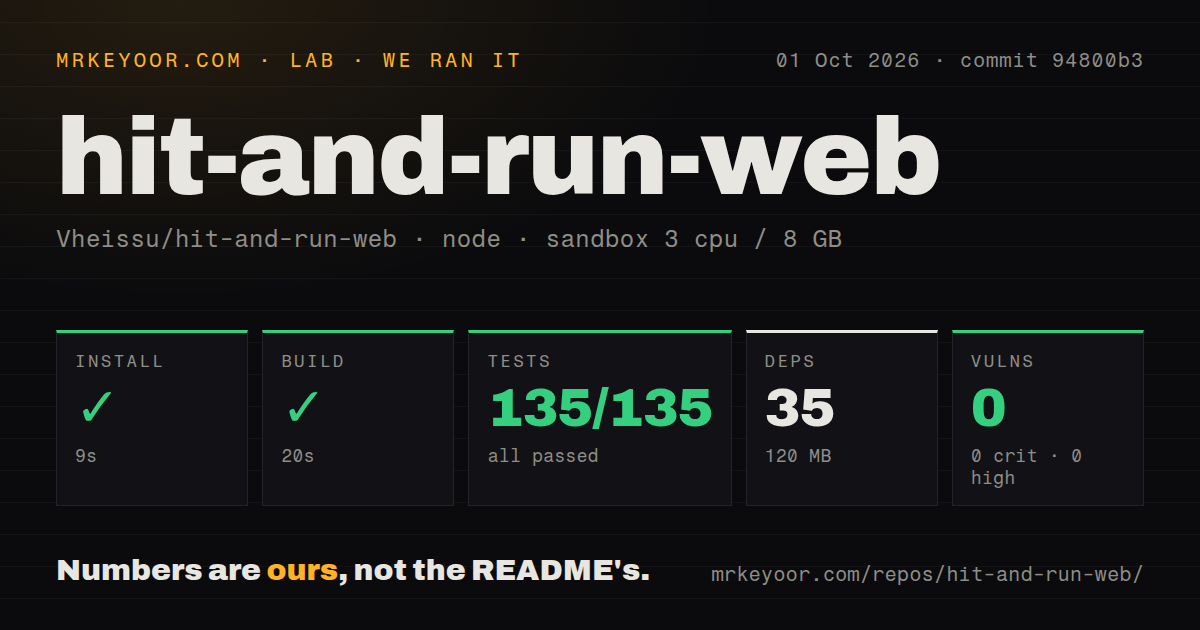
Our harness installed commit 94800b3 in 9 seconds, adding 35 packages and using 120 MB on disk. The TypeScript and Vite build completed in 20 seconds. Tests finished in 12 seconds with 135 node:test cases passed and 0 failed. Npm audit reported 0 known vulnerabilities. The container used Node 22, 3 CPUs, 8 GB of RAM, no secrets, and no elevated privileges.
Those results cover the repository mechanics and included test command. They do not establish that every mission can be completed in a browser, and the README says full playthrough testing is ongoing. Our run also did not compare handling, AI, collision response, or mission timing against the PS2 game. The project has 2 CI workflow files, a tests directory, a Dockerfile, and a compose file, so its checks are visible rather than described only in prose.
Node.js 24+ is the documented local requirement even though our supplied lab image was Node 22 and the measured steps passed there. Docker Compose avoids installing Node on the host and exposes Vite on port 5173. The container is a development setup with a bind mount and live file polling, not a production image. A public deployment should use the production build and account for the asset payload separately.
The campaign has 89 missions, while parity remains unfinished
The scope is far beyond a map viewer. The README counts 89 scripted missions across 7 chapters and 610 stages, including story missions, bonus missions, street races, and wager races. It also lists 67 character models, 71 vehicle models, and 549 dialogue clips. Saves retain coins, purchases, outfits, and completed missions. Touch controls and gamepad steering are present alongside keyboard controls.
The project is candid about the missing pieces. Full gamepad menu navigation is unfinished. Traffic lights, parked traffic, ordinary traffic-car boarding, gags, free prop motion, debris, collectible cards, and menu parity still need work. Vehicle handling, collision response, driver control, mission AI, and the UFO sequence contain reconstructed behavior whose timing or difficulty may differ from the original. Open issue 5 also reports odd car movement and places where the player can pass through the map.
That honesty makes the project easier to judge. If you want to drive around Springfield, try missions, or study how a browser engine consumes console-era assets, the current build has real substance. If your standard is a faithful replacement for the PS2 release, the README itself says the work has not reached that point. One green 135-test run cannot substitute for the missing complete playthrough.
Rebuilding assets needs five tools and the PAL disc
Playing from the repository is simple once the 1,228.7 MB checkout is present. Reproducing the asset pipeline is a different job. The README calls for Python 3.11+, 7-Zip, FFmpeg with AAC and IPU support, Blender 5.1+, and a local PAL PS2 disc image. The scripts extract archives, convert levels and interiors, process campaign material, and run several Blender passes. Other disc releases have not been verified.
This split is sensible for contributors. Most people can work on the browser runtime without repeatedly extracting a disc, while preservation work can still trace converted output back through public tooling. It also means a normal npm ci and build do not reproduce every checked-in asset. Teams that require a source-to-artifact rebuild must prepare the larger toolchain and the correct disc rather than assuming the 35 npm packages cover it.
The MIT license stops where the original assets begin
The repository's license says the original project code is MIT-licensed. It then excludes The Simpsons: Hit & Run, its artwork, characters, audio, scripts, and other game data. GitHub consequently reports the license as nonstandard rather than a plain MIT identifier. The README repeats that the project is unofficial and has no affiliation with the original developers or rights holders.
That boundary should shape any use beyond a personal experiment. The code license does not grant rights to host, package, or redistribute the converted game material. We cannot settle those rights from the repository, and this review is not legal advice. A company, public mirror, or packaged service should complete its own review before treating the included assets as redistributable.
September activity is real, but the project has no release
The repository was created on September 7, 2026, and its last code push was September 10. GitHub showed 139 stars, 20 forks, 1 open issue, and 1 open pull request on October 1. The open pull request adds mission direction to the radar. No release has been published, so there is no tagged stable artifact or changelog milestone for players to pin.
Hit & Run Web earns attention because the reconstruction is already playable and our 135-test run was clean. Its limits are just as important: 1,228.7 MB of checked-in material, incomplete parity, young community history, and original assets outside the code license. Treat it as an impressive work in progress and a rich technical reference, not a finished drop-in edition of the game.