Original notes have instruction-based protection
Obsidian Second Brain's README says the First-Brain layout protects original notes through instructions, not a filesystem sandbox. That boundary matters when deciding whether to let an agent revise your knowledge base.
The project documents commands for saving conversations, finding notes and revising linked pages. Consider it if you want an agent to maintain Markdown knowledge and can review its changes. The supplied measurements establish installation, build and test outcomes, not reliable note maintenance.
What happened when we ran it
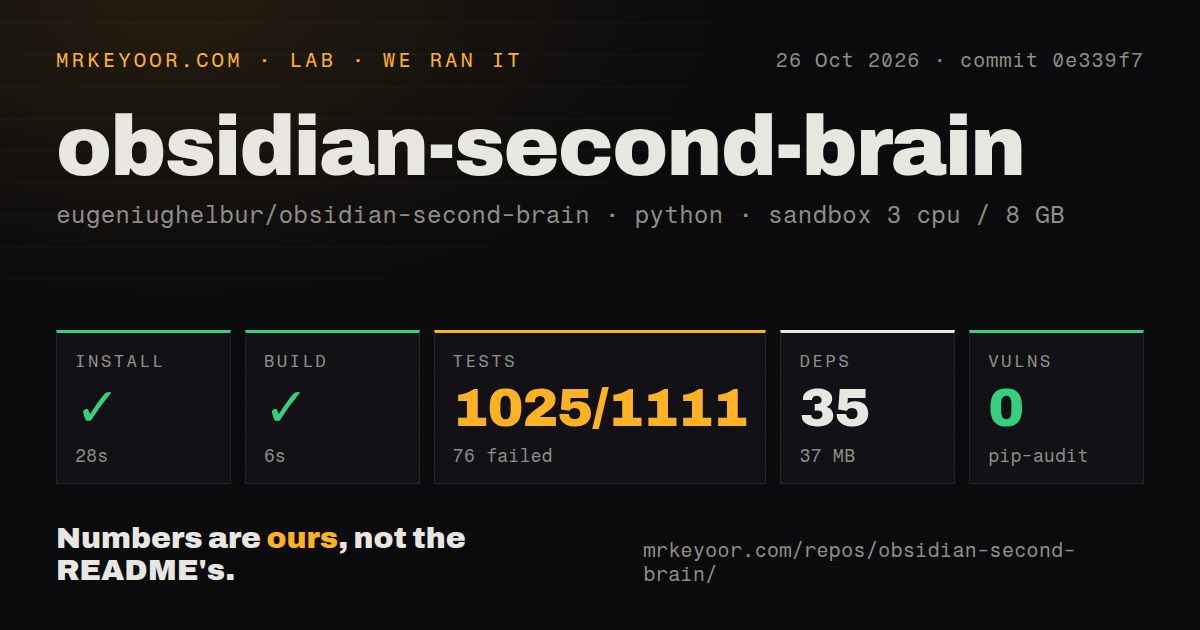
Our sandbox installed Obsidian Second Brain in 28 seconds and built it in 6 seconds. Tests failed with exit 1 after 381 seconds. The October 26, 2026 run used commit 0e339f7 and recorded 35 dependencies occupying 37 MB. The checkout held 393 files, approximately 42,445 source lines and 6.8 MB.
The supplied pytest summary records 1,025 passed, 76 failed, 2 skipped and 10 collection/setup errors, with a recorded total of 1,111. The raw tail also lists one expected failure. These categories should not be combined into a new denominator. Pytest reports 375.86 seconds internally; the outer test step records 381 seconds. They measure different scopes.
The tail shows wikilink-validation assertions expecting markers such as U+2014 and U+00A0 in empty output. Several Windows-compatibility checks fail while decoding JSON, including CRLF and byte-order-mark cases. An environment-file override check also fails. The excerpt identifies failure locations but does not establish their causes. Windows-named checks failing in this sandbox do not prove that Windows deployment fails.
Pip-audit reported 0 known vulnerabilities. The repository scan found 2 CI workflow files and a tests directory, with no Dockerfile. The configured sandbox had 3 CPUs, 8 GB RAM and image ghcr.io/astral-sh/uv:python3.12-bookworm; the image label does not establish actual runtime versions. Retrieval quality, successful vault maintenance and cross-platform behavior remain unassessed.
Review ownership before allowing writes
The README describes human notes in First-Brain/, ingestion captures in raw/ and AI-maintained knowledge in wiki/. Initialization prepares ownership and routing; it does not move or ingest existing notes.
Start with a copied vault containing material you can inspect. Ingest one source, review the resulting notes and compare the files with their earlier state. This is a proposed acceptance procedure, not a workflow completed in our run. Check that the original remains intact and that rewritten claims point to sources that support them. A generated link alone does not establish that support.
The README says the headless background agent uses --dangerously-skip-permissions and ships inert until enabled. It describes a tool set limited to Read, Write, Edit, Glob and Grep, excluding shell commands and network access. These are documented boundaries, not protections independently verified in our run. Leave background work disabled during the first evaluation and review the file changes before considering unattended writes.
Research commands need a separate data-flow decision
The supplied README documents /obsidian-init for setup, /obsidian-save for capture and /obsidian-find for retrieval. The available extracts do not establish complete plugin installation prerequisites, so this review cannot provide a verified installation checklist.
The research section says /research and /research-deep can fall back to free sources when no Perplexity key is configured. Other research commands have their own credential requirements. Check the documented command you intend to use rather than treating all research features as having the same setup.
Local Markdown storage does not establish that every workflow keeps note content local. The README's /notebooklm example uploads selected vault notes to Gemini File Search. Review the command and model route before using private material. The dependency audit and build did not evaluate confidentiality or data flows.
Folder ingestion has a reported document-format gap
Issue 370 reports that folder ingestion excludes DOCX and ODT files although single-source ingestion supports LibreOffice-to-PDF conversion. Opened October 26, 2026, the report names v0.20.0 on Windows. This is a reported limitation, not a result reproduced in our sandbox.
The supplied latest-release endpoint identifies v0.20.0, published October 25, 2026. Repository metadata records a last push on October 26. Those observations are separate from the measured checkout at commit 0e339f7 and do not establish that its failed checks have been resolved.
Choose alternatives by the interface you need
Copilot for Obsidian documents an Agent chat window inside Obsidian. Consider it when an interface inside the editor is the deciding requirement.
Basic Memory documents Markdown knowledge files that humans and AI can read, write and search through MCP. Consider it when connecting an existing MCP client to persistent knowledge files is the main requirement. These are documented differences; this review does not compare the alternatives' reliability or retrieval quality.
The supplied Obsidian Mind overview covers another vault template for persistent agent context. This review's narrower question is whether the measured checks and documented write boundaries justify a trial of Obsidian Second Brain.
Make that trial end with a reviewed file diff and source checks. The supplied run does not establish that the system can maintain your vault reliably.