Choose an integration for the Hermes you already run
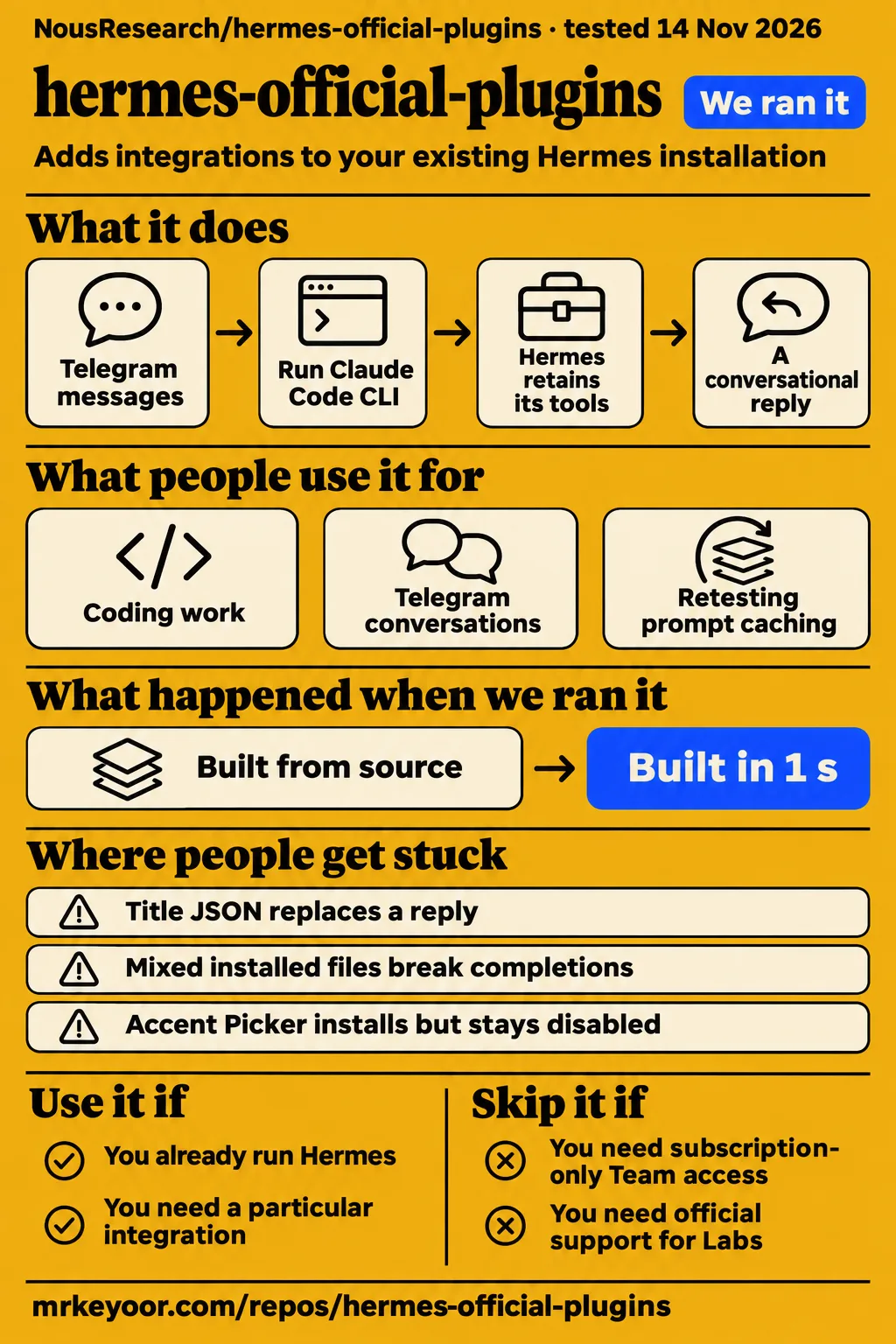
Nous Research maintains hermes-official-plugins as its first-party collection for Hermes Agent, including a Claude subscription provider, home automation and Desktop extensions. Use it if you already run Hermes and need a particular integration. Skip it if your main requirement is guaranteed subscription-only access for Claude Team or Enterprise seats: the account reports below leave that decision open. Official plugin descriptions, account reports.
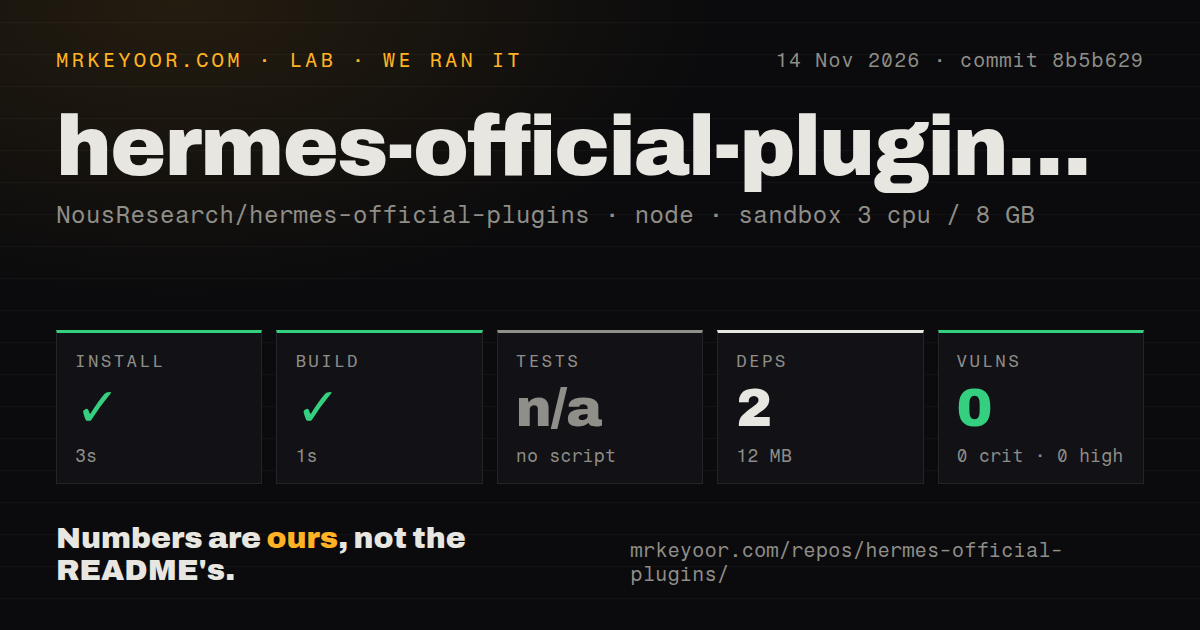
Our sandbox installed the Accent Picker subproject in 3 seconds and built it in 1 second. That is a useful result for a small Desktop component. Choosing DirectSDK as your everyday model provider is a different decision, involving account acceptance, conversation handling and the version actually loaded by your gateway. The most useful way to read this collection is plugin by plugin, with a working outcome in mind.
The README describes Home Assistant device control, Spotify playback, Blender scene tools and REA reverse engineering. DirectSDK is marked experimental and uses the official Claude Code CLI while Hermes retains its own agent loop, tools, approvals and compaction. You are choosing an integration into that existing agent. The repository itself is not a replacement for installing and configuring Hermes. README.
What people use hermes-official-plugins for
GitHub users report DirectSDK doing ordinary coding work and Telegram conversations, with outcomes tied to named versions and changes.
| Who and workflow | What happened | What to take from it |
|---|---|---|
| rganz and their team's seats, coding through three Kanban profiles over an SSH terminal backend | They reported that the earlier excessive-thinking gap was gone on plugin 6dacaad, Hermes v0.22.2 and Claude Code 2.1.299. Issue #40 | Core, plugin and timeout changes arrived together. The report supports the combined setup. |
| Sergiove07, Telegram conversations, session management, skills and tool calls | Several dozen exchanges completed without title JSON leaking after the terminal-title environment workaround and restart. Issue #78 | A normal conversation was a better outcome check than a successful provider selection. |
| jonathanoliveira-a11y, retesting subscription caching | After moving from DirectSDK v0.3.2 to v0.3.3, they reported cache reads following conversation growth over eight calls, from 93% toward 100%. Issue #38 | This was a live check of the frozen-anchor fix. |
| teknium1, migrating individual plugin repositories into the monorepo | The collaborator's real-clone probe preserved user files and installation directory names, and freshly installed Accent Picker. Migration PR | Blender used a PATH stub in this probe, so read it as migration evidence. |
Sergiove07's report gives the clearest picture of why a small transport bug matters. Telegram messages sometimes received an internal title object instead of a conversational response. Turning off Hermes's own title generator had not solved it. The diagnosis concerned Claude Code's separate title request competing for the plugin's single admitted request. A fix that merely hid the JSON would have left the actual answer missing. Report and maintainer explanation.
Discovery material tells a different story. On r/hermesagent, u/Hermes_helper published a weekly catalog roundup covering integrations across categories. That is useful for finding a plugin, but a catalog announcement offers less help when choosing a model provider for daily work. In the video titled Exploring Hermes Plugins: REA and Meshy, the creator starts asking REA to inspect their Garage Studio application. The supplied extract ends during that example. The results we can assess here come chiefly from the issue reporters who returned after changing their setup. Reddit roundup, video extract.
What happened when we ran it
Our November 15 hands-on attempt stopped at the Compose safety check because none of the required Compose filenames existed. The November 14 Accent Picker install and build had succeeded.
The hands-on safety record says the repository lacked compose.yaml, compose.yml, docker-compose.yaml and docker-compose.yml. That blocked this runner's deployment route. Teardown reported success. A separate run header describes a Compose deployment with ports bound to 127.0.0.1, but the failed step supplies no successful deployment outcome to support that header. We give the failed check precedence.
| Recorded check | Result | Meaning for your decision |
|---|---|---|
| Hands-on Compose safety check, November 15 | Failed: none of the required Compose files existed | This deployment route stopped before a working application outcome. |
| Teardown | OK | The run recorded cleanup. |
| npm install in ./accent-picker/, November 14 | Succeeded in 3 seconds | The selected Node subproject completed dependency installation. |
| Dependencies | 2 recorded, 12 MB on disk | This footprint belongs to the selected subproject. |
| Build | Succeeded in 1 second | The recorded build step completed. |
| Tests | No tests script or target; skipped | There is no passing test result from this run. |
| npm audit | 0 known vulnerabilities: 0 critical, high, moderate or low | A dated npm audit result for this dependency set. |
| Repository scan | 1 CI workflow file, no Dockerfile, no tests directory detected | Scan observations, with scope distinct from the individual plugins' documentation. |
The source run used commit 8b5b629 on November 14, 2026, with 3 CPUs, 8 GB RAM and configured image lab-node:22. It recorded 720 files, approximately 103,167 source lines and a 14.8 MB checkout. The selected project lived in ./accent-picker/. Those details explain why a small dependency footprint and a much larger repository can both be true. The image label alone says nothing conclusive about the actual runtime or operating-system version.
Accent Picker is described as a Desktop status-bar colour wheel that retints the theme without persisting the selected colour. A successful build checks only part of that path. Its own catalog history contains a report where installation completed yet the card and activation state were wrong. For a theme author, dragging the wheel and seeing the active theme change is the useful acceptance check. Plugin description, Desktop report.
Where people get stuck: a newer checkout can still mean an older running plugin
DirectSDK reports show that an update can require a process restart, and mixed installed files can break completions.
The repository README defines the catalog pin as the release. A merge to main and the version installed through the catalog can therefore be different states. Use hermes plugins info <name> to inspect the catalog entry, then compare the installed revision before following a fix thread. A gateway already running the old code needs its own restart when the fix instructions call for one. Release and catalog instructions.
The most costly mistake is treating every failure as the same problem. A title object is a request-selection problem. An AttributeError can come from files that belong to different revisions. A valid upstream response can still lose its tool call locally. Start with the visible symptom and the installed plugin revision, then follow the corresponding record.
| Symptom and source | What the record supports | Practical response |
|---|---|---|
| Title JSON replaces a reply, #39 and #78 | Maintainers merged 3c5c30f to suppress native terminal-title requests and confirmed catalog publication. | Update the affected DirectSDK entry and restart the gateway or session loading it. |
| Admission.unrestored AttributeError, #86 | Maintainers reproduced the error with mismatched files; the reporter confirmed reinstalling restored the correct files. | Reinstall a matching plugin copy before adding a local initializer patch. |
| error_max_turns despite upstream tool_use, #221 | Reporters describe invalid streamed tool-call JSON being discarded locally. | Inspect the tool-call parsing path; the report includes a successful comparison with eager input streaming off. |
| REA rejects unknown keys ['timeout'], hermes-agent #139202 | Maintainers removed the manifest key, repinned the catalog and confirmed installation on v0.22.2. | Update REA through the catalog. |
| Accent Picker installs but stays disabled or its card keeps '+' | The migration thread references a repair for origin tracking, activation and the reinstall dialog. | Check the installed card, enabled state and a visible colour change after installation. |
These are attributed findings: #39, #78, #86, #221, REA report, Accent Picker history.
Issue #86 is especially easy to misread. The opening report blamed a missing initializer in the released plugin. The maintainer found that initializer in the named commit and reproduced the crash by combining an older admission.py with a newer directsdk.py. The reporter then confirmed an upgrade had left the installation out of sync. Reinstalling fixed their service. That sequence is a good reason to read the last exchange before copying the first proposed patch.
DirectSDK's cache fixes address different failures
Version 0.3.3 fixed the frozen cache anchor reported in #38; later threads addressed new-turn cache rewrites separately.
The distinction affects what you should measure after updating. In #38, cache reads stayed near the initial request's mark while the conversation grew. The reporter's follow-up showed reads growing again. Issue #36 concerned a new user turn after a long thinking and tool loop: previously cached conversation content was written again. Maintainers landed a second message breakpoint as ad20043d4faf61081a905fc684d7c0ba3dfe9d6b and told users to update and restart the consuming process. Frozen anchor, long-loop rewrite.
Issue #99 is another useful warning against one blanket cache verdict. The reporter had byte-identical replay but still measured a new-turn miss after a thinking answer. Maintainers closed that issue after both the context-layout and stable-session-ID fixes reached main, citing live cache reads and the reporter's Windows rerun. A request that looks stable on a loopback peer and a request that earns a vendor cache hit answer different questions. For your own workload, record the new-turn cache reads as well as the tool rounds inside a turn. Issue #99.
Free plugin code still needs accounts and local software
The README requires paid services or local applications for several integrations, so the catalog command is only one part of setup.
| Plugin | Prerequisite described upstream | Cost or operating consequence |
|---|---|---|
| DirectSDK | Logged-in official Claude Code CLI and a Claude Pro or Max subscription | Subscription access is a prerequisite; Team and Enterprise reports need separate treatment. |
| Blender | Blender 5.1+ with its MCP add-on, Git and uv | You operate Blender and allow tools that run Python inside it. |
| REA | Node.js 22.19+; Ghidra, Hopper or IDA for native decompilation | Static JavaScript inspection and native decompilation have different prerequisites. |
| Meshy | Node.js 18+ and a Meshy API key on a Pro plan | Credit-spending calls require approval according to the README. |
| Camofox | A running camofox-browser server | Browser operation remains your responsibility. |
| Snyk | Node.js/npm and a free Snyk account | Account login is separate from installing the plugin. |
These are upstream requirements, not timings from our sandbox. Official descriptions.
For an existing Hermes installation, choose the integration before changing the environment. A Blender workflow needs an application capable of executing scene operations. A browser workflow needs a reachable browser service. That is why the migration probe's Blender stub was appropriate for checking installation paths yet says nothing about scene editing. Keep that distinction in your own rollout checklist: selected plugin, external prerequisite, activation, then one real task.
Security defaults affect Camofox deployment
Camofox's reported credential guard accepts HTTPS, or plain HTTP only on loopback, which blocks credential fills to an ordinary HTTP Docker hostname.
In #291, danielhunt ran the browser in a separate container sharing the Hermes container's network so it appeared local. They reported that this worked, but rebuilding or restarting Hermes could leave the browser needing a manual restart to reconnect. That is an operational dependency to account for if the assistant uses browser logins. Normal browser connectivity and permission to transport a stored credential are separate checks. Camofox report.
The general plugin guide also says user-installed backends and general plugins are disabled by default and require explicit enablement. That gives you a useful stopping point before tools or hooks load. Treat Blender's ability to run Python in the application as part of the access you are granting, and follow the README's advice to use trusted workflows. The npm audit's zero known advisories is a dependency finding for Accent Picker, not a security assessment of these integrations. Enablement documentation, Blender description.
hermes-official-plugins vs native Claude Code and hermes-labs-plugins
Native Claude Code is the direct provider comparison; hermes-labs-plugins is a different support tier, explicitly described as experimental and unsupported.
| Choice | Evidence that separates it | Pick it when |
|---|---|---|
| Official DirectSDK inside Hermes | The README says Hermes keeps its own agent loop, tools, approvals and compaction. | You need those Hermes workflows and can qualify your account and installed plugin together. |
| Native Claude Code | The Team-account reporter's native control accepted a request and generated a tool call; adding the plugin's caller settings reproduced rejection without the relay. | Your work already fits the native workflow and the extra Hermes integration has no clear benefit. |
| hermes-labs-plugins | Its README labels the collection unsupported and places it in the community catalog tier. | You specifically need a Labs workflow and accept responsibility for maintaining it. |
DirectSDK description, Team comparison, Labs support statement.
On X, former heavy Hermes user jungleskellam asked what concrete task would justify returning when their Codex and Claude apps already covered their work. They acknowledged the appeal of self-hosting and modifiable internals. That is a useful buying question without accepting every feature comparison in the post as independently checked: name the workflow that improves before taking on another agent stack. User's account.
What the other reviews get wrong
The plugin guide's quick overview omits an activation step, and the opening diagnosis in #86 was corrected by the maintainer and reporter.
The overview says tools become callable after adding files and starting Hermes. The same guide later says general plugins and user-installed backends are disabled by default. Read the enablement instructions as part of setup. Discovery in a plugin list is not enough to conclude the hooks and tools are loaded. Quick overview, opt-in section.
The claim that DirectSDK shipped without the unrestored initializer also needs the thread's correction: the maintainer found it in the reported commit, and the user recovered by reinstalling matching files. Finally, the October migration PR's description of Telegram Business as official is historical. The supplied Labs README now lists Telegram Business in its unsupported experimental collection and community tier. Shared Nous authorship does not give those two repositories the same support promise. Corrected diagnosis, migration PR, Labs README.
Questions people ask
Subscription-only DirectSDK failed for a reported Claude Team seat with extra usage disabled, while the native Claude Code control accepted the request.
Does subscription-only DirectSDK work for Claude Team seats with extra usage disabled?
The Team reporter received HTTP 400 requiring extra usage despite reporting subscription capacity. Their native control generated a tool call with extra usage disabled, but adding the plugin's caller settings reproduced rejection without the admission relay. The control deliberately prevented native execution, so its success means request acceptance and tool generation. Team report.
What supported DirectSDK configuration should Team and Enterprise accounts use?
The supplied Team and Enterprise comments contain no maintainer-approved configuration. Enterprise user alanzchen reported streaming, tool calls and continuation working with a local sdk-cli caller patch, but minimal requests also succeeded before it. They explicitly declined to call that patch a causal fix. Ask for supported account guidance rather than treating this patch as a general solution. Account reports.
Should DirectSDK's listing explain any plan-eligibility limits behind its successful Max-account testing?
Yes, the Team reporter specifically requested that clarification after comparing their rejection with documented Max-account testing. The comments leave plan tier, CLI version, organization settings and request shape as variables to separate. A successful Max-account report is an unsuitable eligibility guarantee for a Team seat. Eligibility question.
Can Camofox accept a Docker container hostname over HTTP for credential fills?
The reported default rejects plain HTTP to non-loopback hosts for credential transport. Sharing Hermes's container network worked for danielhunt but coupled browser recovery to Hermes restarts. A contributor described an explicit insecure-transport opt-in in a proposed branch. That proposal should not be read as a released configuration instruction. Issue #291.
Why does REA installation fail with unknown keys ['timeout'] on Hermes v0.22.2?
The catalog manifest used a server timeout key that v0.22.2 rejected. Maintainers removed that declaration, repinned REA and confirmed installation on v0.22.2. Existing users were told to run hermes plugins update rea. Restoring the longer call budget was tracked separately. REA compatibility report.
Why does DirectSDK return title JSON instead of a real chat reply?
Claude Code's internal title request could take the single admitted upstream request before the conversational request. The merged fix sets CLAUDE_CODE_DISABLE_TERMINAL_TITLE=1 for native children. Update the affected plugin and restart its gateway or session. Turning off Hermes's own title generator addresses a different component. Maintainer diagnosis and resolution.
When will the fix for DirectSDK's frozen prompt cache be available?
The frozen-anchor fix is in v0.3.3 according to the reporter and closing comments in #38. The reporter confirmed growing cache reads after updating from v0.3.2. Later new-turn rewrite reports concern separate behavior, so identify which symptom your logs show before applying this version as the answer. Issue #38.
Why does a new turn rewrite the conversation cache after a long thinking and tool loop?
Issue #36 describes the opening-frame prefix falling out of reach after a long loop. Maintainers landed a second cache breakpoint and requested an update plus restart. Issue #99 separately closed after context-layout and stable-session-ID changes reached main. The two threads explain why fixing a frozen anchor alone did not settle every new-turn miss. #36, #99.
Why does DirectSDK repeat its reasoning and use more thinking tokens than native Claude Code?
Issue #40 reported earlier tool-round thinking failing to reach the next model step usefully, causing repeated analysis. The original reporter later said the gap was gone on their seats after plugin, Hermes core and timeout changes. Their follow-up supports that combined setup without assigning the entire improvement to one commit. Issue #40.
Why do DirectSDK tool calls fail with error_max_turns even when the API returns tool_use?
Issue #221 reports invalid streamed tool-call JSON being discarded locally, leaving no usable call despite upstream tool_use. The original comparison succeeded with eager input streaming disabled; another reporter recovered through a fallback model. The issue is marked closed, but the supplied extract contains no definitive merged fix to recommend. Issue #221.
How do I fix the Admission.unrestored error on every completion?
Reinstalling matching DirectSDK files fixed the original reporter's installation. Maintainers reproduced the crash with an older admission.py beside a newer directsdk.py and found the initializer already present in the named commit. Start with a clean matching copy, using the thread's force-reinstall guidance, before editing the initializer yourself. Issue #86.
Do Home Assistant-managed speakers need an extra Hermes bridge for Spotify?
No extra Hermes bridge is needed for speakers supporting Spotify Connect, according to #16. They appear as Spotify devices through native Spotify routing. The maintainer confirmed the documentation and explained that Spotify moved into the plugin catalog; after installation, its toolset remains opt-in in hermes tools. Issue #16.
What we have not tested yet
Our executed source checks cover Accent Picker at 8b5b629, and the later Compose-based hands-on route stopped at its safety check.
We have not tested a live DirectSDK conversation, account billing, browser credential fill, Home Assistant device action, Blender scene operation or Desktop colour interaction ourselves. The Node install and build are not a runtime evaluation of the Python plugins. No tests target ran in the selected subproject. The recorded image label cannot establish exact runtime versions, and the repository scan's missing tests directory should not override documentation of suites inside individual plugins. There are no hands-on question results or screenshots in this pack.
The community records also leave specific follow-ups. Team and Enterprise eligibility lacks a supported matrix. Alanzchen's Enterprise patch is not established as the cause of recovery. The second-breakpoint thread still requests real-workload confirmation for steer and review forks, and no subscription-savings claim follows from those cache repairs. The Camofox opt-in and Accent Picker repair extracts do not establish shipped fixes. Issue #221's closed label supplies no definitive merged resolution. The REA/Meshy video excerpt stops before a result for the demonstrated application analysis.
All four card ratings are unassessed: this evidence spans several different plugins, and an aggregate number would conceal which one you intend to run. The dated source checks and attributed issue outcomes are the decision aids here. Before adopting one integration, record its installed revision and host version, then complete the task you actually need: a conversational reply, a browser login or a visible Desktop change. Keep that outcome alongside the install result.